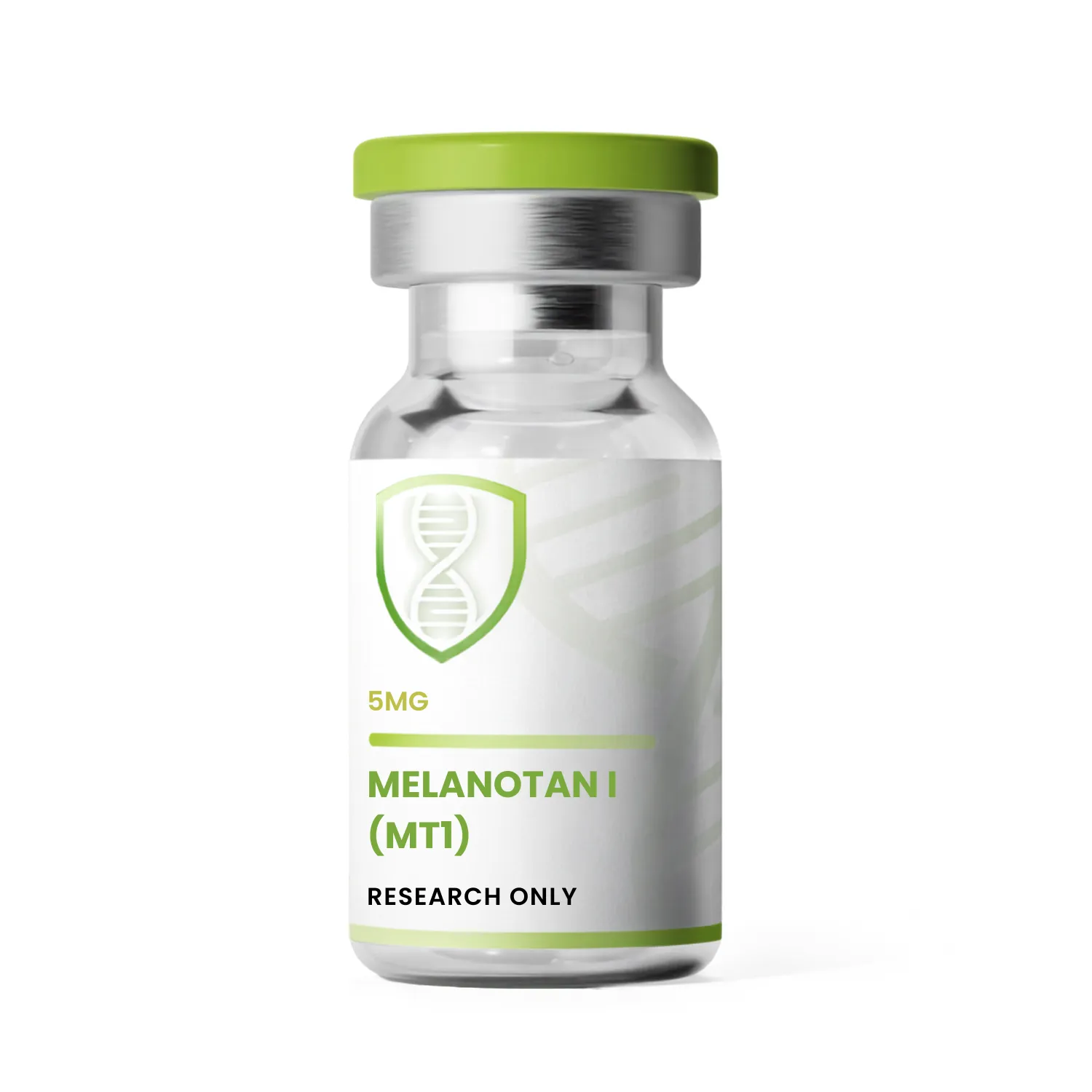
MT-1 Peptide 5mg for Sale | Melanotan I Research Peptide
The MT-1 peptide (Melanotan I) is a synthetic, linear peptide studied for its interaction with melanocortin receptors, particularly the melanocortin-1 receptor (MC1R). It is an analog of the naturally occurring hormone alpha-melanocyte-stimulating hormone (α-MSH). MT-1 contains 13 amino acid residues and has been investigated for its role in melanin production, melanocyte signaling, and pigmentation-related biological pathways. Researchers studying melanocortin biology use MT-1 to examine how receptor activation influences cellular responses and the production of eumelanin, the brown-black pigment found in skin and hair. MT-1 5mg is intended strictly for laboratory research. It is not for human consumption, self-administration, tanning, cosmetic applications, or therapeutic use.
What Is MT-1 (Melanotan I) Peptide?
MT-1, also called Melanotan I or afamelanotide, is a modified version of α-MSH. This naturally occurring peptide hormone helps regulate pigmentation by interacting with melanocortin receptors. The MT-1 peptide contains two important modifications compared with naturally occurring α-MSH:
-
Norleucine (Nle) replaces methionine at position 4.
-
D-phenylalanine (D-Phe) replaces L-phenylalanine at position 7.
These structural changes improve resistance to enzymatic breakdown and increase melanocortin receptor activity compared with the parent hormone. MT-1 is particularly relevant to research involving MC1R activation, melanogenesis, and pigmentation-associated signaling. Unlike Melanotan II, which is a cyclic heptapeptide, MT-1 has a linear structure containing 13 amino acid residues.
MT-1 Peptide 5mg: Chemical Properties
The following specifications describe the afamelanotide peptide structure, rather than any particular salt form or finished formulation.
| Property | Verified information |
| Peptide name | Melanotan I (MT-1) |
| Scientific name | Afamelanotide |
| Alternative names | MT-I, NDP-MSH, NDP-α-MSH |
| Peptide class | Synthetic α-MSH analog |
| Molecular formula | C₇₈H₁₁₁N₂₁O₁₉ |
| Molecular weight | Approximately 1,646.85 g/mol |
| CAS number | 75921-69-6 |
| PubChem CID | 16197727 |
| Amino acid residues | 13 |
| Peptide structure | Linear |
| Primary receptor of interest | MC1R |
| Listed vial quantity | 5 mg |
| Intended application | Laboratory research only |
Amino acid sequence:
Ac-Ser-Tyr-Ser-Nle-Glu-His-D-Phe-Arg-Trp-Gly-Lys-Pro-Val-NH₂ The molecular formula, sequence, and molecular weight are supported by PubChem. The CAS number is also listed by the IUPHAR/BPS Guide to Pharmacology.
How Does MT-1 Peptide Work?
MT-1 acts as a melanocortin receptor agonist. One of its main research targets is the melanocortin-1 receptor (MC1R), which is expressed on melanocytes. When MC1R is activated, it stimulates intracellular signaling pathways associated with melanin synthesis. Melanin is a natural pigment responsible for variations in skin, hair, and eye color. One form, eumelanin, is especially important in pigmentation research because of its light-absorbing properties. Researchers study MT-1 to understand how melanocortin signaling influences these processes. Although afamelanotide has an established pharmaceutical application, findings about the approved formulation should not be taken as evidence that independently supplied MT-1 research vials have the same safety, quality, or clinical effects.
MT-1 Peptide Research Applications
MT-1 has been investigated in several areas of melanocortin research, including receptor signaling, melanogenesis, and pigmentation biology. MC1R signaling research: MT-1 is used to investigate receptor activation and downstream cellular signaling mechanisms. Melanogenesis studies: Researchers examine how melanocortin signaling influences the synthesis and regulation of melanin in experimental models. Pigmentation research: MT-1 provides a useful model for studying the relationship between melanocortin receptor activity and pigment-producing cells. Photobiology research: Laboratory studies involving melanocortin signaling can help researchers examine biological pathways associated with pigmentation and responses to light exposure. These are areas of scientific investigation, not claims of performance or effectiveness for a research-grade 5mg compound.
MT-1 vs. MT-2: What Is the Difference?
Although both compounds are associated with melanocortin research, they have distinct molecular structures.
| Feature | MT-1 (Melanotan I) | MT-2 (Melanotan II) |
| Structure | Linear | Cyclic |
| Amino acid residues | 13 | 7 |
| Molecular formula | C₇₈H₁₁₁N₂₁O₁₉ | C₅₀H₆₉N₁₅O₉ |
| Molecular weight | ~1,646.85 Da | ~1,024.18 Da |
| Receptor activity | MC1R-focused, with broader melanocortin activity | Activity at multiple melanocortin receptors |
| Research focus | Pigmentation and melanocortin signaling | Melanocortin receptor pharmacology and signaling |
The different structures and receptor activity profiles make these compounds distinct research subjects. One should not be substituted for the other based on their similar names.
Frequently Asked Questions About MT-1 Peptide
What is MT-1 peptide?
MT-1 peptide, also known as Melanotan I or afamelanotide, is a synthetic analog of alpha-melanocyte-stimulating hormone. It contains 13 amino acid residues and is studied for its effects on melanocortin receptor signaling and melanin production.
Is MT-1 the same as Melanotan I?
Yes. MT-1, Melanotan I, and afamelanotide refer to the same defined peptide structure. However, compounds sold under these names may differ in formulation, purity, and manufacturing quality.
What is the molecular weight of MT-1?
The molecular weight of afamelanotide is approximately 1,646.85 g/mol in its anhydrous free-base form. Salt forms, including acetate, have different formulation-specific molecular weights.
Where to buy Melanotan I for laboratory research?
Research can buy Melanotan I Peptide for research purposes at
Orion Peptides. Is MT-1 FDA-approved?
Afamelanotide is FDA-approved in the United States as SCENESSE, a prescription implant used to increase pain-free light exposure in adults with erythropoietic protoporphyria (EPP). This approval does not apply to independently marketed MT-1 research vials.
What is the difference between MT-1 and MT-2?
MT-1 is a linear peptide containing 13 amino acid residues, while MT-2 is a cyclic peptide containing seven residues. Their structures and receptor activity profiles differ, and they should not be treated as interchangeable compounds.
Important Research Disclaimer
MT-1 5mg is intended exclusively for legitimate laboratory research by qualified personnel. It is not intended for human or veterinary administration, self-injection, tanning, cosmetic applications, or treatment or prevention of any condition. The FDA’s approval of the afamelanotide implant SCENESSE does not constitute approval of this research-grade compound. Research findings involving pharmaceutical afamelanotide should not be assumed to apply to unapproved MT-1 preparations.
Scientific References
1.
Effect of MELANOTAN on Melanin Synthesis in Humans with MC1R Variant Alleles (2006) 2.
Skin Pigmentation and Pharmacokinetics of Melanotan-I in Humans (1997) 3.
Afamelanotide for Erythropoietic Protoporphyria (2015