Popular
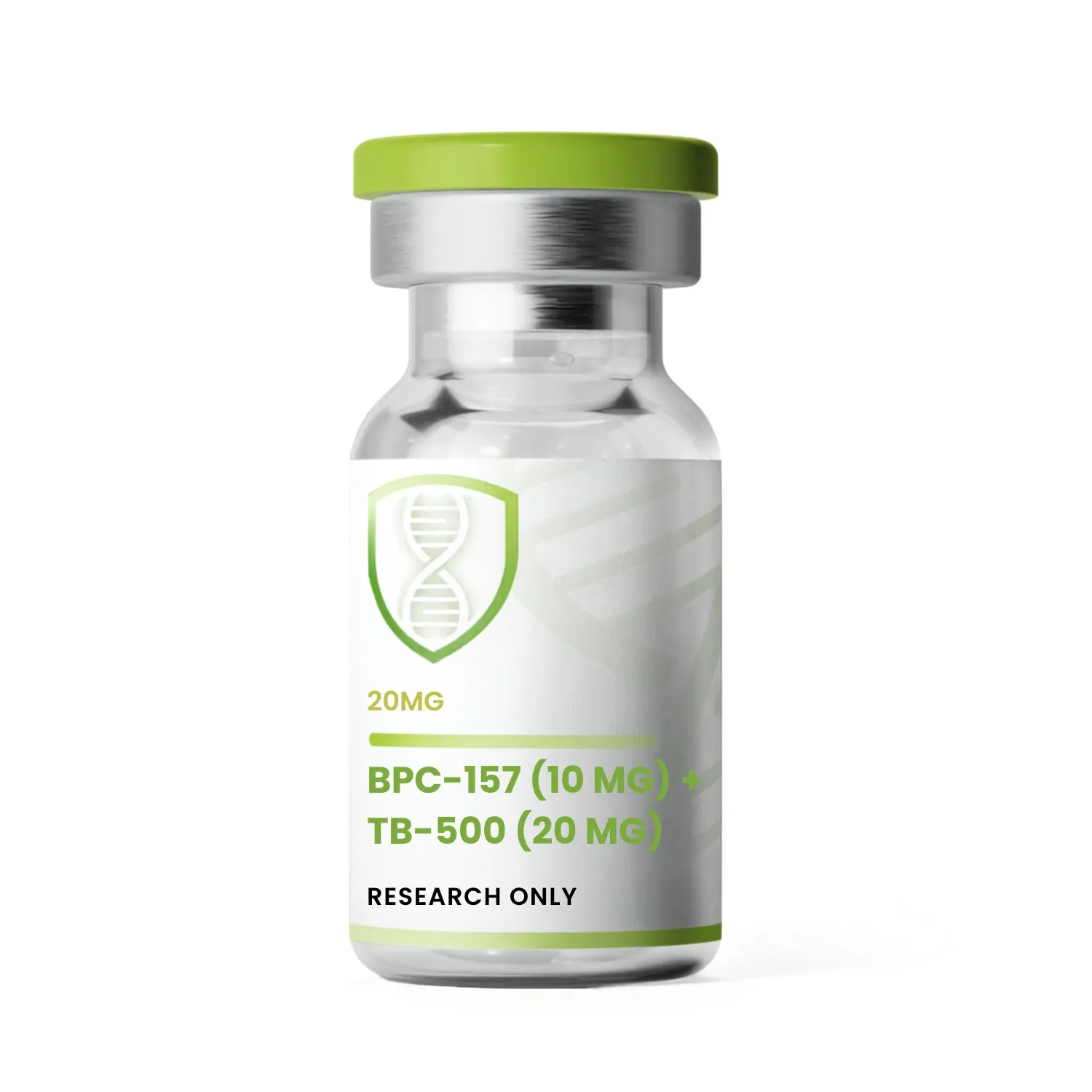
Buy BPC-157 (10 mg) + TB-500 (20 mg) Blend

BPC 157 (10mg) + TB 500 (10mg) Blend

| Third-Party Tested | 99% Purity | COA Available | Research Use Only

The BPC-157 + TB-500 Blend adds two widely researched synthetic peptides in an equal ratio, i.e., 1:1  (10mg BPC-157 + 10mg TB-500 per vial).

$147.00

0 out of 5 · 0 ratings
Be the first to rate this compound:

Out of stock

Out of stock

Email when stock available

Buy BPC-157 10mg + TB-500 10mg (Blend)

The BPC-157 + TB-500 Blend adds two widely researched synthetic peptides in an equal ratio, i.e., 1:1  (10mg BPC-157 + 10mg TB-500 per vial).  BPC-157 is a stable 15-amino-acid fragment obtained from the protein of human gastric juice, while TB-500 is a synthetic variant of the active domain of Thymosin Beta-4.   The synergistic effects of this combination on tissue repair, angiogenesis, cell migration, inflammation modulation, and regenerative biology are being researched in preclinical models. Each vial is delivered as a clean and lyophilized powder made in the USA that is ≥99% pure (HPLC-verified). The pre-mixed format makes reconstitution simple and supports efficient dosing in in vitro assays, cell culture, or animal injury models. This blend is used exclusively for in vitro and in vivo laboratory research, and it is not for human consumption, therapeutic use, veterinary application, or any non-research purpose. For research use only. Strictly not for human consumption.

Biochemical Characteristics

BPC-157

  • Sequence: Gly-Glu-Pro-Pro-Pro-Gly-Lys-Pro-Ala-Asp-Asp-Ala-Gly-Leu-Val  

  • Molecular formula: C₆₂H₉₈N₁₆O₂₂  

  • Molecular weight: 1419.55 Da  

  • Stable in gastric juice; high resistance to enzymatic degradation  

TB-500 (Thymosin Beta-4 fragment)  

  • Active domain: Ac-LKKTETQ  

  • Molecular formula: C₃₈H₆₈N₁₀O₁₄  

  • Molecular weight: ≈889 Da  

  • Regulates actin polymerization and cytoskeletal dynamics  
The blend is provided as a single lyophilized acetate salt powder. The 10mg/10mg ratio helps the researchers to find out an additive or synergistic relation between gastric-derived cytoprotection and actin-binding repair pathways.

Research Application

In preclinical studies, the BPC-157 + TB-500 combination is used to:
  • Accelerate the healing of soft musculoskeletal tissues, for example, ligaments, muscles, and tendons.
  • To study the activity of fibroblasts, deposition of collagen, and angiogenesis.
  • Model reduction of edema and inflammation in ischemia-reperfusion or injury settings
  • To see the formation of granulation tissue, closure of the wound, and biomechanical healing.
  • To study the comparison of systemic and localized effects in models of severe lesions or tendon-to-bone integration.
  • Function as a helpful tool for peptide-mediated cytoprotection, sports medicine models, and regenerative biology.
Comparative research and continuous dosing are supported by the pre-blended vial without the need for customized reconstitutions.

Mechanism Overview

BPC-157 increases growth factors (VEGF, FGF), FAK-paxillin signaling, and also changes the pathways of nitric oxide. While promoting angiogenesis, collagen organization, and the balance of anti-inflammatory cytokines, it keeps endothelial integrity. Actin monomers are attached by TB-500, which also sequesters G-actin and promotes F-actin assembly. While promoting angiogenesis and decreasing inflammation through a number of mechanisms, it supports cell migration, differentiation, and cytoskeletal remodeling.  Together, these two ( TB-500  and BPC-157) improve motility, structural reorganization, growth factors, and cytoprotection. Preclinical evidence suggests that fibroblast recruitment, vascularization, and tissue remodeling work together to improve functional recovery in injury models.

Preclinical Research Summary

Preclinical research demonstrates that BPC-157 enhances tendon, ligament, and muscle healing, specifically in rodent models. In Achilles transection and ligament injury models, it counteracts corticosteroid impairment, elevates collagen deposition, and increases biomechanical strength. TB-500 supports migration of cells, angiogenesis, and actin dynamics in wound and soft-tissue restoration. In animal research, combined use shows improved results:
  • Quicker formation of granulation tissue and wound closure
  • Decreased edema and inflammation
  • Better tendon-to-bone integration and ligament tensile load
  • Systemic effects on the protection of distant organs, such as the liver and kidney in ischemia-reperfusion.
Systematic reviews show that more than 35 preclinical studies regularly produced positive histological and functional results, with no toxicity found in safety evaluations. The mixture is being studied for musculoskeletal regeneration, but the human data is still not enough.

Form and Analytical Testing

  • Form: Sterile, lyophilized powder blend (10mg BPC-157 + 10mg TB-500)  
  • Purity: ≥99% (HPLC for each peptide)  
  • Identity: Confirmed by mass spectrometry  
  • Endotoxin: <0.1 EU/μg  
  • Solubility: Excellent in bacteriostatic water  
  • Appearance: White to off-white cake  
  • Storage (unopened): 2–8°C, protected from light and moisture  
  • Reconstitution: Use sterile bacteriostatic water under aseptic conditions  
  • Stability: Stable 24–36 months refrigerated when sealed; reconstituted stable 4–6 weeks at 2–8°C (avoid repeated freeze-thaw)  
All batches undergo third-party analytical testing for purity, identity, and contaminants.

Referenced Citations

  • Sikiric P, et al. (2018). Stable gastric pentadecapeptide BPC 157 may recover brain-gut axis and gut-brain axis function. Pharmaceuticals.  
  • Chang CH, et al. (2014). Pentadecapeptide BPC 157 enhances the growth hormone receptor expression in tendon fibroblasts. Molecules. 
doi:10.3390/molecules191119066.  
  • Vasireddi N, et al. (2025). Emerging Use of BPC-157 in Orthopaedic Sports Medicine: A Systematic Review. HSS Journal. PMC12313605.  
  •  Krivic A, et al. (2006). Achilles detachment in rat and stable gastric pentadecapeptide BPC 157: Promoted tendon-to-bone healing. Journal of Orthopaedic Research. doi:10.1002/jor.20109.  
  • Malinda KM, et al. (1999). Thymosin β4 accelerates wound healing. Journal of Investigative Dermatology.  

RUO Disclaimer

The BPC-157 + TB-500 Blend (10mg/10mg) is an investigational research compound intended solely for in vitro laboratory research and in vivo animal studies.  It is not approved by the FDA, EMA, or any regulatory authority for human therapeutic use, diagnosis, treatment, or supplementation.   It is classified as a research chemical (WADA S0 non-approved substances category), and preclinical findings do not predict human outcomes; no claims are made regarding safety or efficacy in humans.   Compounds may carry risks, including immunogenicity or impurities. If mishandled, it should be handled only in qualified research facilities with institutional biosafety oversight.   All sales are for laboratory research use only; not for human or veterinary consumption.

Research Use Only

This compound is intended for laboratory research use only. It is not intended for human or animal consumption, or for use in diagnostic or therapeutic procedures.

Chemical Properties

Property BPC-157 TB-500
Molecular Formula C62H98N16O22 C212H350N56O78S
Molecular Mass 1419.5 g/mol 4963 g/mol
Monoisotopic Mass 1418.70415882 Da 4960.4863169 Da
Polar Surface Area 573 Ų 2250 Ų
Molecular Complexity 3040 12,200
XLogP −9 −43.5
Heavy Atom Count 100 347
Hydrogen Bond Donors 16 72
Hydrogen Bond Acceptors 24 88
Rotatable Bonds 39 180
PubChem CID 9941957 16132341
InChIKey HEEWEZGQMLZMFE-RKGINYAYSA-N UGPMCIBIHRSCBV-XNBOLLIBSA-N
SMILES C[C@@H](C(=O)N[C@@H](CC(=O)O)C(=O)… CC[C@H](C)[C@@H](C(=O)N[C@@H](CCC(=O)O)C(=O)…

Certificate of Analysis

Quality

Every batch of BPC 157 (10mg) + TB 500 (10mg) Blend is tested for purity and identity using industry-standard methods.

HPLC Analysis

High-Performance Liquid Chromatography confirms purity ≥99%. Each batch is analyzed to ensure consistent quality.

Mass Spectrometry (MS)

Identity verification via mass spectrometry confirms correct molecular weight of 4113.58 g/mol.

Third-Party Testing

All compounds undergo independent third-party laboratory testing for quality assurance.

Request COA

Certificate of Analysis documents are available for all compounds. Contact us with your order number to request batch-specific documentation.

COA Lab Tests

Each compound batch is tested by independent laboratories to verify purity, identity, and quality. The Certificate of Analysis (COA) provides transparent lab results, ensuring the compound meets strict research-grade standards.

Storage & Handling

Be‍fore Reconstitu⁠tion (P‌owder Form)

Long-T‍erm Storag‍e

  • Store at -2‌0°C or -4°F o‌r below
  • Ca⁠n remain stable for extended periods when fr‌ozen

Short-Term Sto⁠rage

  • R‌efrigerate at 2-‌8°C or 36-46°F for up to 4 weeks
  • Stable at room temper‌a‍tu‍re‌ for 3 weeks maximum
  • Cold storage‍ recommended for‌ best results
  • Avoid st‍oring i‍n refrigerato‌r door

After Reconstitution (Liquid Form)

  • Refrigerate im‌mediately at 2-8°C o‌r 36-46°F
  • St‌ore in main refrigerator c⁠ompartment
  • Do not‍ store in refrig‌erator door
  • Never leave at room temperature
  • Use with‌in 2-4 weeks of‍ reconstitution
  • For extended storage, fr‌eez‌e below -18⁠°C with carri‍er protein

Important St‍orage Precautions

  • Avoid repeated f⁠reeze-thaw cycles co⁠mpletely
  • Avoid any te‌mperature fluctuations⁠
  • Keep away from dire‌ct sunlight always‍
  • Add 0.1% HSA or⁠ BSA carrier⁠ protein‍ f‍or long-term storage

After Reconstitution (Liquid Form)

  • Refrigerate im‌mediately at 2-8°C o‌r 36-46°F
  • St‌ore in main refrigerator c⁠ompartment
  • Do not‍ store in refrig‌erator door
  • Never leave at room temperature
  • Use with‌in 2-4 weeks of‍ reconstitution
  • For extended storage, fr‌eez‌e below -18⁠°C with carri‍er protein

×
On Sale
Out of Stock

Storage

Store at -20°C.
Protect from light and moisture.

Added to cart successfully!

Certificate of Analysis

ORP#00034

Client:
Orion Peptides
Sample:
BPC-157 10mg + TB-500 10mg Blend
Batch:
202609BPCTB1010

Tests Requested:
Standard + Endotoxins + Sterility
Appearance:
White Lyophilized Powder in 3mL Vial

Analysis Conducted on:
09/01/2026
Report Issued on:
09/02/2026
Test Method Result Specification  
Identity HPLC-DAD BPC-157 / TB-500 BPC-157 / TB-500 Pass
Purity HPLC-DAD 99.24 >99% by HPLC Pass
Quantity HPLC Analyte Concentration Curve Assay 10.15 / 10.44 10mg / 10mg Pass
Endotoxins LAL ELISA 0.152 EU/mL ≤ 0.5 EU/mL Pass
Sterility Pour Plate No Growth No Growth Pass