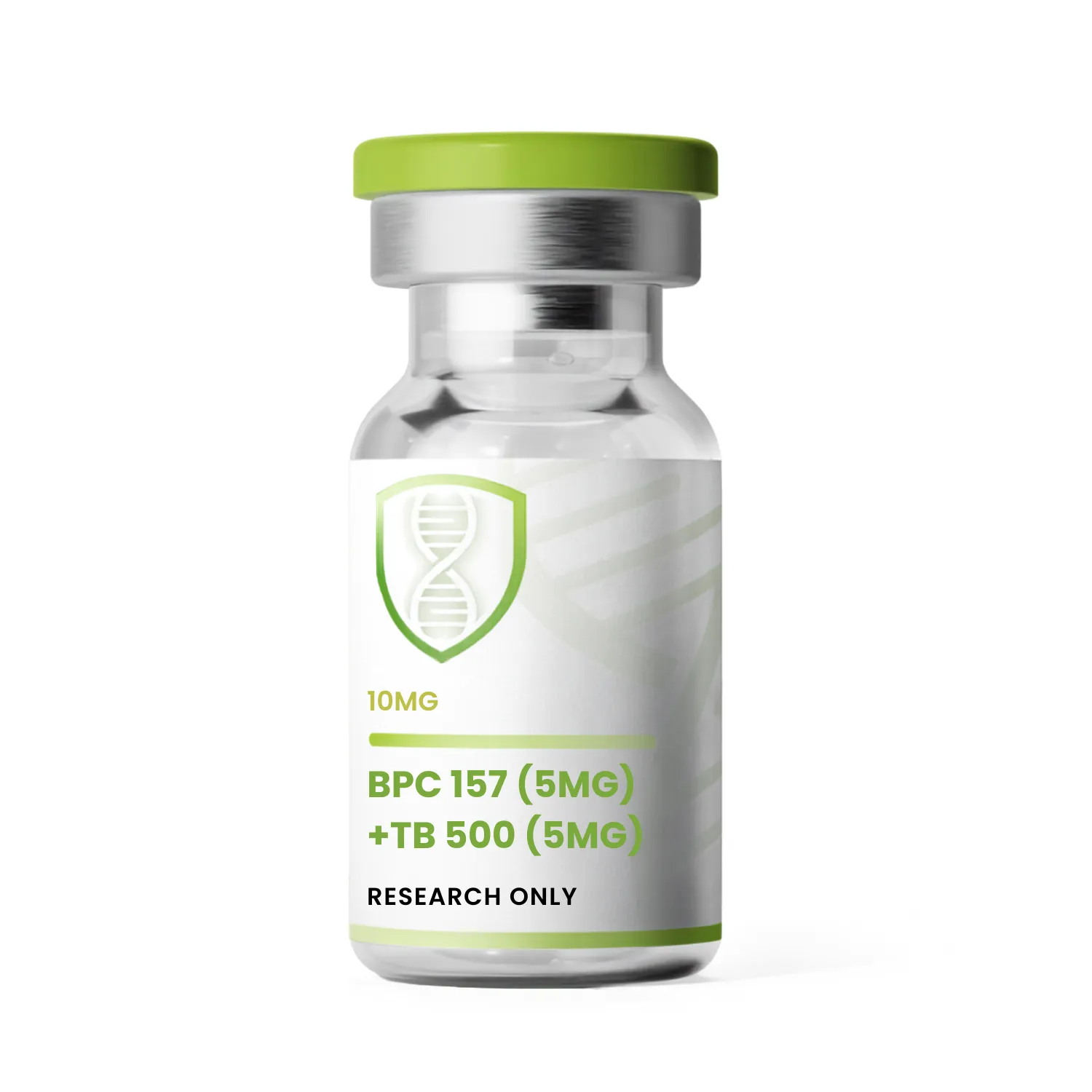
Wolverine Blend For Sale (BPC-157 5mg + TB-500 5mg)
The
BPC-157 5mg + TB-500 5mg Blend (Wolverine Blend) combines two synthetic research peptides in a single lyophilized vial, providing
5 mg of BPC-157 and 5 mg of TB-500 for a total peptide content of 10 mg. BPC-157 is a synthetic 15-amino-acid peptide with the sequence
GEPPPGKPADDAGLV. It is derived from a sequence associated with a gastric protein and has been investigated primarily in laboratory and animal models involving cellular migration, tissue response, angiogenic signaling, and musculoskeletal injury. Its molecular formula is
C₆₂H₉₈N₁₆O₂₂, with a molecular weight of approximately
1419.5 g/mol. TB-500 is chemically distinct from full-length thymosin beta-4 (Tβ4). TB-500 is generally identified as the
N-terminally acetylated thymosin beta-4 17–23 fragment, Ac-LKKTETQ-OH. The corresponding free-base molecular formula is
C₃₈H₆₈N₁₀O₁₄, with a molecular weight of approximately
889.01 g/mol. FDA documentation distinguishes the free-base form from TB-500 acetate, which has a higher formula weight. The BPC-157 + TB-500 blend is intended to provide researchers with both peptides in a consistent
1:1 mass ratio for controlled laboratory investigation. At
Orion Peptide, it is supplied
strictly for research use only and is not intended for human or veterinary use.
BPC-157 + TB-500 Blend Specifications
| Specification | Details |
| Compound | BPC-157 + TB-500 Blend |
| BPC-157 Content | 5 mg |
| TB-500 Content | 5 mg |
| Total Peptide Content | 10 mg |
| Ratio | 1:1 by labeled mass |
| BPC-157 Sequence | GEPPPGKPADDAGLV |
| BPC-157 Molecular Formula | C₆₂H₉₈N₁₆O₂₂ |
| BPC-157 Molecular Weight | Approx. 1419.5 g/mol |
| TB-500 Sequence | Ac-LKKTETQ-OH |
| TB-500 Molecular Formula | C₃₈H₆₈N₁₀O₁₄, free base |
| TB-500 Molecular Weight | Approx. 889.01 g/mol, free base |
| Form | Lyophilized peptide blend |
| Research Category | Peptide and regenerative-biology research |
| Intended Use | Laboratory research only |
| Human Use | Not intended for human consumption or therapeutic use |
What Is the BPC-157 + TB-500 Blend?
The
BPC-157 and TB-500 5mg/5mg blend combines two structurally different peptides that have been studied in areas related to cellular migration, wound biology, angiogenic pathways, extracellular-matrix responses, and tissue-remodeling models. The scientific evidence for the two compounds should, however, be considered separately. BPC-157 has a relatively large preclinical literature. A 2025 systematic review identified
36 eligible studies, including 35 preclinical studies and one human study, and reported research involving muscle, tendon, ligament, and bone models. The authors emphasized that human clinical evidence and clinical safety information remained very limited. Additional human research has since appeared, including a very small 2025 intravenous pilot study involving only two participants. More recent reviews continue to characterize the human evidence as preliminary and insufficient to establish clinical efficacy or a reliable clinical safety profile. TB-500 has an even more important evidence distinction. It should
not be treated as interchangeable with full-length thymosin beta-4. Many commonly cited wound-healing and actin-regulation findings originate from studies of full-length Tβ4 or related sequences rather than clinical studies of TB-500 itself.
BPC-157 Research
BPC-157 has been investigated predominantly in cell-based and animal research models. Research areas have included:
- Tendon fibroblast migration and survival
- Focal adhesion signaling
- Tendon and ligament injury models
- Skeletal muscle injury
- Bone and tendon-to-bone models
- Angiogenic signaling
- Gastrointestinal tissue models
- Cellular responses to oxidative stress
- Inflammatory signaling
- Vascular and endothelial pathways
In cultured rat tendon fibroblasts, BPC-157 increased cell migration and spreading and increased phosphorylation of
focal adhesion kinase (FAK) and paxillin. These proteins participate in focal-adhesion signaling and cellular movement. The same experiment did not demonstrate increased fibroblast proliferation under the tested conditions. This distinction is important for accurate compound content. Rather than saying BPC-157 universally “accelerates healing,” it is more scientifically appropriate to state that researchers have observed changes in pathways and experimental outcomes associated with tissue repair in preclinical models.
TB-500 Research
TB-500 is the acetylated peptide
Ac-LKKTETQ, corresponding to residues associated with the central functional region of thymosin beta-4. Full-length thymosin beta-4 is a 43-amino-acid peptide with established interactions involving actin regulation. Research has also identified biological activity within shorter regions of the molecule, including the LKKTETQ sequence. Experimental research with this sequence has examined cellular migration, angiogenesis, and wound-repair processes. However, researchers should distinguish
LKKTETQ, acetylated TB-500, and full-length thymosin beta-4 when interpreting published findings. A 2024 study specifically investigated TB-500,
Ac-LKKTETQ, and its metabolites. The authors noted that although biological activities had previously been associated with the related unacetylated sequence, the biological effects of TB-500 itself had not been well documented. In their fibroblast assay, one TB-500 metabolite,
Ac-LKKTE, produced significant wound-healing activity compared with the control, leading the authors to suggest that some biological effects attributed to TB-500 could involve its metabolites. Therefore, claims that TB-500 itself has all of the actin-binding, angiogenic, or wound-repair properties established for full-length thymosin beta-4 should be avoided.
Research Applications of BPC-157 + TB-500
The BPC-157 5mg + TB-500 5mg blend may be incorporated into appropriately designed laboratory studies examining areas such as:
Cellular Migration
Both BPC-157-related signaling and thymosin beta-4-derived sequences have been investigated in experimental systems involving cell movement. BPC-157 has been associated with increased tendon-fibroblast migration in vitro through pathways involving FAK and paxillin.
Cytoskeletal and Cell-Motility Research
Thymosin beta-4 is strongly associated with actin biology, and the region containing LKKTETQ forms part of its central actin-related domain. Because TB-500 is an acetylated short fragment rather than full-length Tβ4, researchers should investigate its activity independently rather than assuming identical pharmacology.
Angiogenesis Research
BPC-157 and thymosin beta-4-related peptides have separately been investigated in experimental angiogenesis models. These findings provide a basis for studying pathways associated with vascular development and endothelial responses, but they do not establish therapeutic angiogenic effects in humans.
Tendon and Ligament Models
BPC-157 has been studied in multiple preclinical musculoskeletal models. For example, animal studies have examined experimental Achilles tendon injury and tendon-to-bone healing, while laboratory investigations have examined tendon fibroblast survival, migration, and signaling. A 2025 systematic review concluded that positive musculoskeletal findings were concentrated overwhelmingly in preclinical research and that robust human clinical evidence was still lacking.
Wound and Tissue-Remodeling Research
Full-length thymosin beta-4 and its active peptide regions have a substantial experimental history in wound biology. A study in aged and diabetic animal models found that thymosin beta-4 affected several wound-repair measures. A seven-amino-acid synthetic LKKTETQ peptide also demonstrated activity in the aged-animal model. These findings are relevant to research involving thymosin beta-4-derived sequences, but they should not be presented as proof that commercial TB-500 produces the same effects.
Comparative Peptide Research
A pre-mixed BPC-157 and TB-500 vial can also be used for studies comparing:
- Individual versus combined peptide exposure
- Cellular migration pathways
- Cytoskeletal responses
- Fibroblast behavior
- Extracellular-matrix remodeling
- Angiogenesis-associated signaling
- Injury-response models
- Peptide metabolism and degradation
Does BPC-157 + TB-500 Have a Synergistic Effect?
A synergistic effect should
not currently be presented as an established scientific fact. BPC-157 and thymosin beta-4-derived peptides affect different experimental pathways, which creates a scientific rationale for investigating their combined activity. However, evidence demonstrating that a
BPC-157 + TB-500 5mg/5mg combination produces superior or synergistic effects compared with either peptide individually is insufficient. For this reason, this blend is best described as a tool for
combined-peptide and comparative laboratory research, rather than as a scientifically proven synergistic formulation.
BPC-157 Mechanism Research
No single clinically validated mechanism of action has been established for BPC-157. Experimental studies have associated the peptide with several signaling systems, including:
- FAK-paxillin signaling
- Cellular migration pathways
- ERK-related signaling
- AKT-related signaling
- Growth hormone receptor expression
- Angiogenesis-associated pathways
- Nitric-oxide-related signaling
- Inflammatory signaling
In tendon fibroblasts, phosphorylation of FAK and paxillin increased following experimental BPC-157 exposure, providing one of the more directly demonstrated cellular mechanisms associated with BPC-157-mediated migration. The broader 2025 systematic review also identified proposed effects involving ERK, AKT, growth hormone receptor expression, and pathways involved in cell growth and angiogenesis. These remain primarily
preclinical mechanistic findings and should not be interpreted as evidence of therapeutic effectiveness in humans.
TB-500 Mechanism Research
TB-500 requires particularly careful terminology. Full-length
thymosin beta-4 is a major actin-sequestering protein and interacts extensively with the cellular cytoskeleton. Its central region contains the LKKTETQ sequence associated with several experimentally observed biological activities. TB-500 itself is
Ac-LKKTETQ, an acetylated derivative of this region. The mechanism and biological activity of the commercial research compound therefore should not simply be described as identical to full-length thymosin beta-4. Research published in 2024 examining TB-500 metabolism found several metabolites and suggested that biological effects observed after exposure may partly depend on metabolite formation.
Current State of the Evidence
BPC-157
The majority of published BPC-157 evidence remains preclinical. A 2025 systematic review identified 35 preclinical studies and only one human study within its inclusion period. More human pilot research has since been published, but sample sizes remain extremely small. A 2026 pharmaceutical-development review concluded that BPC-157 still has
no approved formulation, no validated clinical dosing regimen, and no completed Phase II evidence establishing efficacy. A randomized Phase II hamstring-injury study was registered as recruiting in 2026, but registration of a clinical trial does not constitute evidence that the compound is effective.
TB-500
Evidence directly examining TB-500 is substantially more limited than the literature on full-length thymosin beta-4. Researchers should therefore avoid using full-length Tβ4 clinical or preclinical findings as direct proof of TB-500 activity.
Analytical Testing
Each batch should be evaluated according to the analytical documentation supplied with that specific lot. Depending on the testing performed, a Certificate of Analysis may provide information such as:
- Peptide identity
- Chromatographic analysis
- Mass-spectrometry results
- Lot or batch identification
- Testing date
- Additional analytical parameters
Researchers should review the
batch-specific Certificate of Analysis (COA) rather than relying on generalized specifications that may not apply to every production lot. No fixed purity percentage is stated on this page.
Storage and Handling
BPC-157 + TB-500 should be handled as a laboratory research material. Store the unopened compound according to the conditions shown on the
compound label and batch-specific documentation, protected from inappropriate heat, moisture, and light where specified. Researchers should use validated laboratory procedures for preparation, handling, storage, and disposal. Specific claims regarding long-term shelf life or post-reconstitution stability should only be made when supported by validated stability data for the exact formulation and batch.
BPC-157 + TB-500 Research Blend FAQ
What is in the BPC-157 + TB-500 blend?
Each vial contains a labeled total of
10 mg peptide material, consisting of
5 mg BPC-157 and 5 mg TB-500 in a 1:1 mass ratio.
Is TB-500 the same as thymosin beta-4?
No. Full-length thymosin beta-4 consists of 43 amino acids. TB-500 is generally identified as the acetylated short sequence
Ac-LKKTETQ, corresponding to a region derived from thymosin beta-4. The two should not be treated as chemically or pharmacologically identical.
What is the amino-acid sequence of BPC-157?
BPC-157 is a 15-amino-acid peptide with the sequence:
Gly-Glu-Pro-Pro-Pro-Gly-Lys-Pro-Ala-Asp-Asp-Ala-Gly-Leu-Val or
GEPPPGKPADDAGLV.
What is the sequence of TB-500?
TB-500 is identified as:
Ac-Leu-Lys-Lys-Thr-Glu-Thr-Gln-OH or
Ac-LKKTETQ-OH.
What is the molecular weight of BPC-157?
The molecular weight of BPC-157 is approximately
1419.5 g/mol.
What is the molecular weight of TB-500?
The TB-500 free base has a molecular weight of approximately
889.01 g/mol. FDA documentation lists TB-500 acetate separately at approximately
949.1 g/mol.
Are BPC-157 and TB-500 FDA-approved drugs?
These compounds should not be marketed as FDA-approved therapies. FDA specifically states that compounded drugs containing BPC-157 may present safety concerns related to immunogenicity, peptide-related impurities, API characterization, and limited safety information.
Is the BPC-157 + TB-500 combination proven to be synergistic?
No established body of controlled research currently demonstrates that the 5mg/5mg combination has a clinically meaningful synergistic effect. The combination is better characterized as a formulation for researchers interested in studying the two compounds together.
Is BPC-157 + TB-500 intended for human use?
No. This compound is supplied
strictly for laboratory research. It is not intended for human or veterinary consumption, diagnosis, treatment, prevention, supplementation, or therapeutic use.
Research Use Only Disclaimer
BPC-157 5mg + TB-500 5mg Blend is sold strictly for laboratory research use only. It is not intended for human consumption, veterinary use, diagnostic procedures, therapeutic use, supplementation, or the treatment, prevention, or cure of any disease or medical condition. BPC-157 and TB-500 should not be represented as FDA-approved therapeutic compounds. Experimental findings described on this page primarily originate from
in vitro, animal, mechanistic, and other early-stage research. Such findings do not establish safety or efficacy in humans. For competitive-sport research context,
TB-500 is identified by the World Anti-Doping Agency under its prohibited growth factor/growth factor modulator framework, and WADA laboratory documentation for 2026 specifically includes TB-500 under S2.3. This compound should be handled only by qualified personnel using appropriate laboratory procedures and institutional safety protocols.
Research References
- Vasireddi N, Hahamyan H, Salata MJ, et al. Emerging Use of BPC-157 in Orthopaedic Sports Medicine: A Systematic Review. HSS Journal. 2025;21(4):485–495. doi:10.1177/15563316251355551.
- Chang CH, et al. The promoting effect of pentadecapeptide BPC 157 on tendon healing involves tendon outgrowth, cell survival, and cell migration. Journal of Applied Physiology. 2011.
- Sosne G, et al. Biological activities of thymosin beta4 defined by active sites in short peptide sequences. FASEB Journal. 2010. doi:10.1096/fj.09-142307.
- Malinda KM, et al. Research examining thymosin beta-4 and its actin-binding-domain-derived peptide in dermal wound repair models.
- Rahaman KA, et al. Simultaneous quantification of TB-500 and its metabolites in in-vitro experiments and rats by UHPLC-Q-Exactive orbitrap MS/MS and their screening by wound healing activities in-vitro. Journal of Chromatography B. 2024.
- Lee E, Burgess K. Safety of Intravenous Infusion of BPC157 in Humans: A Pilot Study. Alternative Therapies in Health and Medicine. 2025;31(5):20–24.