

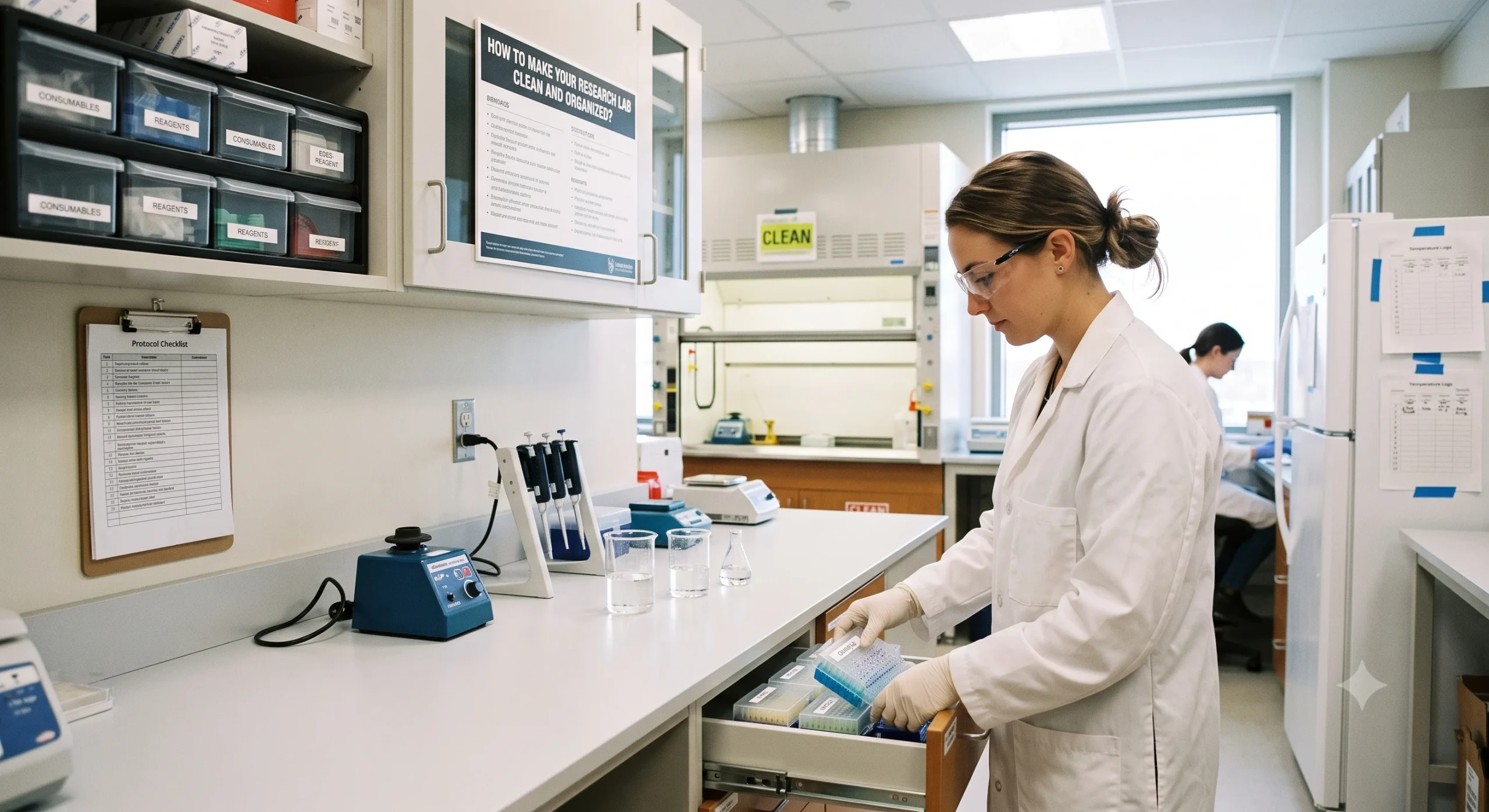
A clean and organized research laboratory is the basis of safe, accurate, and reproducible scientific work. The laboratory setup can directly affect the quality of experimental results, equipment performance, and overall efficiency of research in academic institutions and biotech companies. Even minor issues like misplaced samples, poor labeling, or cluttered workspaces can increase the risk of contamination, compromise data integrity, and delay research progress.
According to the World Health Organization (WHO) Laboratory Biosafety Manual, Fourth Edition, effective laboratory housekeeping is a fundamental component of biosafety. Good housekeeping practices – including maintaining clean work surfaces, appropriately organizing materials, and following standard procedures – all contribute to reducing hazards in the lab and ensuring that scientific results are reproducible. Good Laboratory Practice (GLP) principles also stress organized working environments, proper documentation, and consistent operating procedures to improve data quality and reproducibility.
An organized laboratory will also save valuable time. Scientists who keep their lab space organized, label their samples clearly, and keep their inventories efficiently spend less time looking for things and more time conducting productive experiments. Proper storage also prevents degradation of sensitive research materials such as peptides, antibodies, enzymes, and other biological reagents that can occur through mishandling or environmental exposure.
At Orion Peptide, we understand that high-quality research depends on more than premium research peptides. Discipline in lab practices, in storage conditions, and organization is needed too. Whether you’re running a university research lab, a biotech startup, or an independent research facility, maintaining a clean and organized lab is critical for experimental consistency, better laboratory safety, and more reliable scientific results.
In this article, you’ll learn practical and effective strategies to organize your research laboratory, minimize contamination risks, improve workflow efficiency, and create an environment that supports high-quality scientific research.
Why a Clean Laboratory Matters
A disorganized laboratory environment can be dangerous to both the results of experiments and the safety of its workers. By enforcing strict standards of cleanliness, you can ensure the integrity of your work in five different ways:
- Accuracy: By removing outside factors such as other particles and broken compounds, scientists can be more certain that their results are accurate to the best of their ability.
- Reproducibility: By keeping the same standard of organization and cleanliness in your workspace, you can guarantee that running the same experiment yields the same results every time it is performed.
- Integrity: Working in a clean and organized workspace ensures that the work published under your name is free of outside interference.
- Safety: By organizing chemicals, you reduce the risk of harmful exposure to toxic compounds, spills, and other dangers unique to a laboratory environment.
- Legal Compliance: By enforcing a standard of cleanliness, you follow legal guidelines that may be necessary to uphold if an official inspection is made.
5S Framework for Laboratory Organization
The 5S approach—which stands for Sort, Set in Order, Shine, Standardize, and Sustain—is the base of lab management. First invented for manufacturing processes, this approach is easily adaptable to the needs of research laboratories.
Sort
Start by reviewing everything in your laboratory. Differentiate what you need from what is not useful anymore. It is time to get rid of expired reagents, damaged equipment, and everything you cannot assign an owner to.
Set in Order
Each item must have a proper place. To achieve this goal, it is important to:
- Clearly label shelves and drawers
- Make shadow boards for tools
- Draw up a floor plan of the place and show how to store everything
- Use point-of-use storage so reagents and consumables can be stored where they are used
Shine
Formulate a cleaning routine that will cover all work surfaces, equipment, and common areas. Cleaning procedures will involve such actions as:
- Wiping down work surfaces both before and after procedures
- Cleaning high-contact surfaces like doorknobs, light switches, and shared equipment
- Maintaining equipment properly as prescribed by the manufacturer
Standardize
Standardize your processes to guarantee consistency, such as:
- Having lists for laboratory open and close operations
- Setting standards regarding cleaning duties
- Having standard operating procedures
Sustain
This is the toughest part as it involves sustaining your system over time. Implementing a rota system is an ideal way. An example is Oxford lab, where newer members are matched up with older members for cleaning once a month.
Create Designated Workspaces
Separation of spaces is the first step to preventing any crossover events. Create distinct and single-function spaces that keep materials separate from one another.
- Preparation Space: Ensure that there is no paperwork, computer work, or personal belongings in this space. Counters should be used only for pipetting, reconstitution, and vortexing purposes.
- Storage Room: Make sure that your ultra-low freezers, refrigerators, and desiccators are kept in places far away from doorways where there will be less fluctuation in temperature.
- Analytical Equipment: Use low vibration and environmentally controlled spaces for your mass spectrometers, HPLC equipment, and spectrophotometers.
- Documentation Space: Create a dry area that would be used only for your notebooks, computers, and administrative record keeping.
- Waste Disposal: Separate your waste streams through use of designated biohazard bins, sharps, and chemical carboys.
Label Everything Clearly
Inadequate labeling is the biggest contributor to lab mistakes and a buildup of unorganized inventory. Each sample container should have an identifiable label that offers information at first glance:
- Sample Labels: Utilize chemical-safe ink that will remain legible through ethanol or solvent spills as well as liquid nitrogen storage.
- Storage Containers: It is necessary to differentiate between master stocks and individual aliquots to avoid unnecessary freeze-thaws.
- Reagents: No shorthand labels; write out the full names of chemicals along with the precise concentration.
- Dates: Include dates of arrival, dates opened, and expiration dates on the outer jacket.
- Concentration: Write the concentrations in mg/mL or mM to ensure accurate dosing calculations when diluting the samples.
- Batch Codes: Record lot codes from the manufacturer for quick access to purity matrices in the case of a control group malfunction.
Organize Chemicals and Research Peptides Properly
Biochemical molecules have specific requirements for storage, which allow maintaining their conformation and avoiding fast denaturation.
Temperature Requirements
It is important to store materials with attention to structural needs. Although usual buffers may be stored at 4°C, enzymes and active proteins should be stored at -20°C or -80°C.
Light Sensitive Material
Use amber vials, wrap containers with aluminum foil, or place them into opaque secondary containment.
Lyophilized Peptides
Freeze-dried peptide powders must be stored in desiccators at negative temperatures. Hydration results in fast hydrolysis at increased temperature.
Prevent Contamination
Never place raw powder chemicals above areas where samples can be prepared, since this leads to cross-contamination by gravitational dust particles.
Inventory Management
Implement the FIFO principle in your laboratory. Place older materials on front shelves so that they are used before newer materials.
Formulate Daily and Weekly Cleaning Protocols
There should be no procrastination regarding cleanliness, and it needs to be incorporated into daily and weekly routines by means of maintenance sheets.
- Bench Cleaning: Clean all active surfaces with 70% isopropyl alcohol or any decontaminating material before and after assays.
- Equipment Cleaning: Decontaminate shared equipment casings like microcentrifuges, vortex mixers, and analytical balances to get rid of chemical residues.
- Cold Storage Inspection: Conduct a cold storage audit weekly to eliminate any unmarked vials or frosting on the structure, or any expired chemical media.
- Freezer Maintenance: Get rid of any ice accumulated near the freezer gaskets to make sure that there are airtight seals and check the temperature logs of the freezer automatically.
- Waste Disposal: Get rid of any biohazard bags, clinical waste, or chemical trash carboys at the end of every afternoon shift.
Reduce Cross-Contamination
Contamination often comes from the researchers’ hands and their tools. The best way to prevent foreign agents from entering the experimentation area is by imposing barrier techniques.
- PPE: It is mandatory to wear lab coats, safety glasses, and appropriate gloves (nitrile or latex). Change gloves if they come into contact with any foreign substances such as a computer keyboard or a doorknob.
- Disposable consumables: Use disposable sterile pipette tips and microcentrifuge tubes certified to be free of DNase and RNase to prevent the destruction of DNA or RNA molecules.
- Sterile techniques: Work inside a certified laminar flow hood or a biosafety cabinet when handling live cells or highly purified peptide solutions.
- Separate clean and dirty zones: Set a line in the middle of the laboratory at which all boxes and bags are opened, removing cardboard packaging.
Use Digital Inventory Management
Clipboards and paper trails can lead to errors and lost information. Modern laboratories use digital tracking to ensure total visibility of their inventory.
- Sample Tracking: You can use database software to record the shelf, box, and grid where every vial is stored in your lab.
- Expiration Dates: Use software that will notify you when a chemical or research material is due to expire after 30 days of procurement.
- COAs: Store electronic PDF scans of certificates of analysis and independent laboratory testing with your material records for easy access and verification.
- Barcoding: Program 2D barcodes on every vial you receive. Every scan should provide information about the contents, safety, and quantity.
- Laboratory Information Management Systems: Use a Laboratory Information Management System (LIMS) to track everything about your physical inventory. A LIMS connects every detail of your physical materials to the relevant procedures and data records.
Train Each Team Member
The effectiveness of an organizational system is only as good as the team members implementing it. Uniform habits prevent systemic operational drift.
- Standard Operating Procedures (SOPs): Maintain a centralized, digital master folder containing step-by-step instructions for every cleaning and disposal process.
- Laboratory Housekeeping: Include practical clean-up training as an explicit milestone in your onboarding curriculum for new postdocs, students, and technicians.
- Emergency Procedures: Routine drills for chemical spills, power outages, and cold storage unit emergencies, and emergency eyewash activation.
- Documentation Procedures: Weekly audit of laboratory notebooks and digital records will be conducted to confirm tracking information matches physical inventory modifications.
Common Laboratory Organization Mistakes
Recognize and prevent the following pitfalls to ensure that your laboratory organization supports rather than hinders a successful assay window.
- Stockpiling on Benches: Storing extra boxes and equipment on a laminar hood not only creates clutter but also impairs the vital laminar flow needed for protection and containment.
- Labeling Chaos: Avoid ambiguous and non-uniform abbreviations that can lead to catastrophic mix-ups in the middle of a multi-step procedure.
- Outdated Chemicals: Getting rid of expired or ineffective reagents saves both space and the hazard of mistakenly using them in assays.
- Random Reagent Storage: Avoiding having shared reagents in different drawers that have to be opened every time a worker needs to find a specific compound.
- Lost Documentation: Having failed to file a validation sheet or vendor-specific analytical reports means risking an audit by a regulatory agency or a third party.
Best Practices for Research Peptide Storage
Peptides are highly sensitive structures prone to physical and chemical degradation if handled incorrectly. Preserving their integrity requires strict adherence to stabilization criteria:
- Store According to Manufacturer Recommendations: Always check the specific compound datasheet. While some specialized sequences require -80°C storage, standard lyophilized peptides should be kept at -20°C for long-term stability.
- Protect from Heat, Moisture, and Light: Avoid auto-defrost freezers. Their cyclical temperature fluctuations introduce humidity and heat spikes that can degrade sensitive peptide bonds.
- Use Sterile Handling Techniques: Reconstitute your powders inside a sterile laminar flow hood using high-purity, degassed buffers to prevent enzymatic or bacterial contamination.
- Maintain Accurate Inventory Records: Log the exact dates of reconstitution and the specific solvent used (e.g., sterile water, PBS, or DMSO) directly into your digital management system.
Conclusion
A clean, meticulously organized laboratory produces reliable data, maximizes workflow efficiency, and protects personnel from preventable biohazards. By dividing your workspace into functional zones, digitizing your chemical tracking, and adhering to strict sample storage procedures, you cultivate an environment optimized for scientific discovery.
Consistent housekeeping practices directly underpin reproducible research. Elevate your project’s precision by pairing these systemic protocols with premium chemical inputs from Orion Peptides, where independent testing and absolute compound purity support your commitment to scientific excellence.
Frequently Asked Questions
1. Why is laboratory cleanliness important?
Cleanliness eliminates environmental contaminants, dust, and microbial vectors that introduce unwanted variables into your assays, thereby protecting the accuracy and validity of your experimental findings.
2. How often should research laboratories be cleaned?
Workbenches must be sanitized before and after every single procedure. Deep cleaning tasks, including instrument calibration checks, cold storage defrosted audits, and shelf wipe-downs, should be executed on a fixed weekly schedule.
3. How should research peptides be stored?
Long-term storage requires lyophilized peptide powders to be sealed in airtight containers with desiccant packs at -20°C or -80°C, shielded from direct light exposure. Reconstituted peptides should be divided into single-use working aliquots to prevent structural damage caused by repeated freeze-thaw cycles.
4. What is the best way to organize laboratory samples?
Implement a standardized 2D barcoding system tied directly to a digital Laboratory Information Management System (LIMS). Physically arrange items using grid-coordinate storage boxes inside designated, temperature-controlled zones.
5. How can laboratories reduce contamination?
Enforce strict personal protective equipment (PPE) mandates, utilize certified laminar flow hoods for delicate liquid handling, opt for pre-sterilized disposable consumables, and maintain a sharp spatial boundary between administrative work and sample preparation zones.
6. What is a laboratory inventory management system?
A laboratory inventory management system is a software-based platform that automates the tracking of chemical stocks, reagent expiration timelines, sample locations, safety datasheets, and certificates of analysis (COAs) across your entire institution.
Disclaimer
Peptides and related research compounds are supplied exclusively for in-vitro laboratory research and analytical testing purposes. They are not intended, approved, or cleared for human or animal consumption, diagnostic use, or therapeutic applications.
