

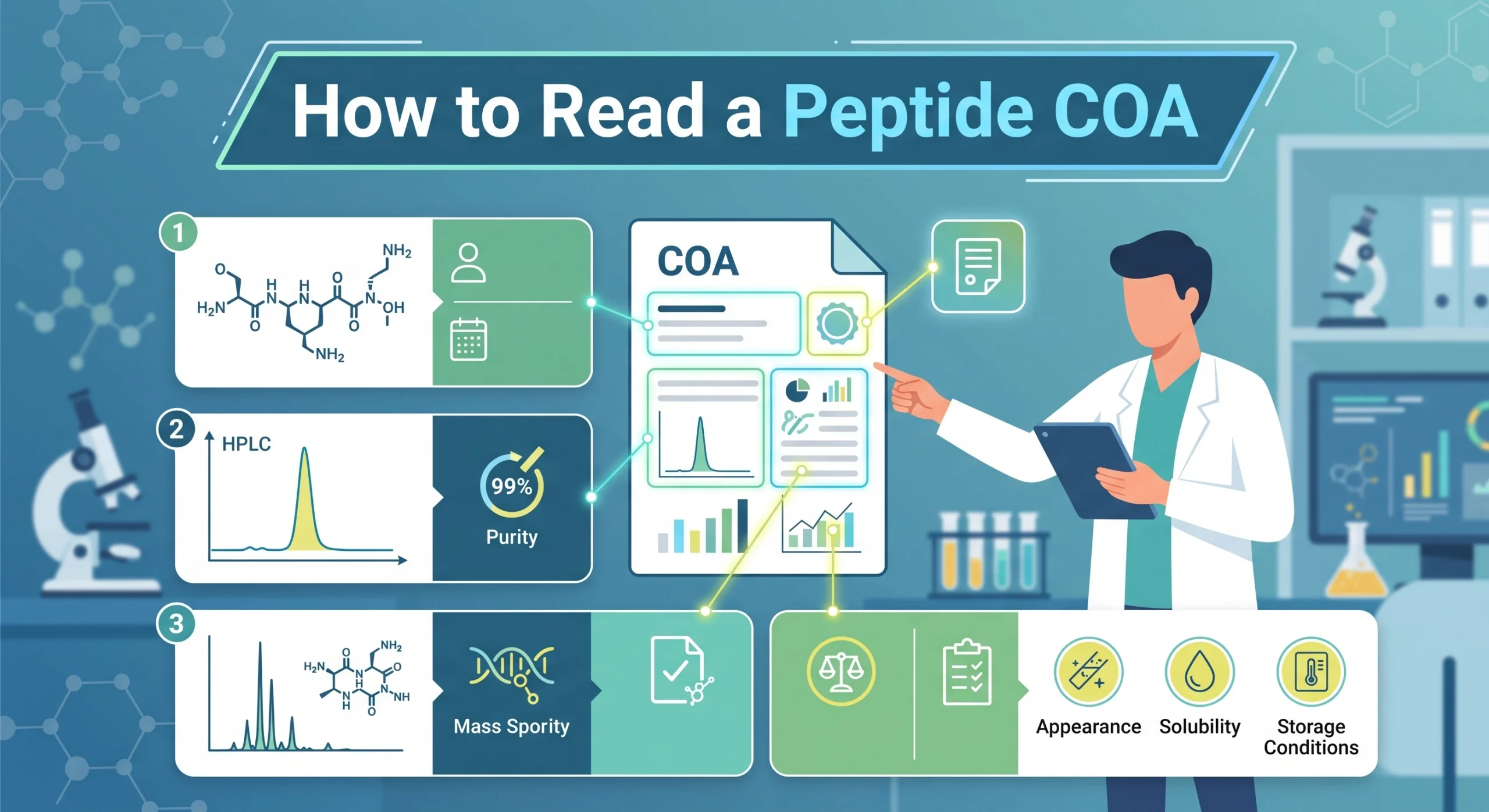
An Overview
The Certificate of Analysis, or COA, provides researchers with a technical assessment of a peptide batch’s performance during laboratory testing. It can offer valuable data about peptide identity, purity, molecular weight, batch traceability, and other characteristics.
But a COA can only be helpful if a researcher knows how to properly analyze its findings.
A document that displays “99% purity” is certainly an impressive document on the surface. But HPLC purity does not solve all the quality problems. The analytical method, mass spectroscopy data, batch number, lab information, and test date must also be checked.
This guide is designed to help researchers understand how to analyze a peptide COA.
Research Note: A COA represents an analysis of a specific sample or batch of peptides. It does not indicate clinical efficacy or suitability of the compound for human application.
What Is a Peptide COA?
A Certificate of Analysis (COA) is a laboratory document that reports analytical results for a defined material.
Analytical characterization of synthetic peptides can involve several techniques.
These include:
- High-performance liquid chromatography (HPLC)
- Mass spectrometry (MS)
- Chromatography
- Nuclear Magnetic Resonance spectroscopy (NMR)
- Other analytical methods.
Research on peptide reference standards shows that multiple analytical approaches can help establish identity, purity, content, and consistency.
A useful COA should connect the following information:
| Element of COA | What it tells you |
| Compound name | Which peptide the report concerns |
| Batch/lot number | Which production batch was tested/analyzed |
| Test date | On which specific date the laboratory performed the analysis |
| HPLC result | Chromatographic purity under the stated method |
| Mass spectrometry(MS) | It is proof that the measured molecular mass fits the expected peptide |
| Analytical method | Through which method the laboratory performed the test |
| Laboratory information | Who performed or reported the analysis |
| Additional tests | Additional measured quality attributes |
The key point is simple:
It is important not to judge a COA from one large number. Read the complete analytical record.
Why COA Matters for Peptide Research?
Synthetic peptide preparation can produce related substances and impurities. These materials can include truncated sequences, modified forms, or other structurally related species.
Analytical methods help researchers identify and characterize these components.
A PubMed-indexed study on synthetic peptide reference materials describes the use of chromatography and mass spectrometry for peptide identity, content, and impurity assessment.
Another study used liquid chromatography with high-resolution mass spectrometry to identify and quantify numerous structurally related impurities in synthetic human C-peptide. The study identified more than 65 impurities in its test material.
This illustrates why purity, identity, and content are separate analytical questions.
For a strong COA, it is mandatory to answer each question with appropriate evidence.
How to Read a Peptide COA
1. Start With the Compound Name
Ask yourself: does this certificate of analysis apply to the peptide I need?
Check the following details:
- Peptide name
- Peptide sequence, if available
- Molecular formula, if available
- Molecular weight
- Compound or catalog number
- Batch or lot number
The name alone provides limited analytical assurance. For example, different sequences may exhibit similar analytical properties. In such cases, mass spectrometry can provide additional evidence that the material under investigation matches the expected molecular weight. Peer-reviewed research identifies mass spectrometry as an analytical technique for evaluating synthetic peptide identity and purity.
2. Check the Batch or Lot Number
A COA should relate to an exact batch of material.
This is one reason why a certificate of analysis should include a batch or lot number.
Check that the following numbers match:
- The COA
- The vial of peptide
- The supplier’s database or records
If these numbers do not match, the document does not provide clear batch-specific evidence for that material.
This distinction matters because peptide quality can vary between production batches.
3. Look at the HPLC Purity Result
High-performance liquid chromatography (HPLC) is one of the most common analytical techniques used for peptide purity assessment.
HPLC separates components based on their interaction with the chromatographic system. A detector then produces a chromatogram with peaks that represent detected components.
The COA may report a result such as:
HPLC purity: 99.2%
That number needs context.
In many peptide COAs, HPLC purity represents the relative area of the principal chromatographic peak compared with the detected chromatographic signal under the stated method.
It does not automatically mean that 99.2% of the entire vial mass consists of peptide.
This distinction is important.
Research on synthetic peptide reference standards uses HPLC and other analytical methods to assess peptide content and impurities.
What to check besides the HPLC number
Look for:
- Chromatogram
- Detection wavelength
- Column information
- Retention time
- Peak integration
- Mobile phase information
- Gradient conditions
- Flow rate
- Sample identification
- Analytical method reference
A percentage without analytical context tells you less than a complete chromatographic report.
4. Understand That HPLC Purity Is Not the Same as Peptide Content
This is one of the most important points when reading a peptide COA. HPLC purity and peptide content measure different things.
- HPLC can indicate the relative chromatographic purity of the target peak under a defined method.
- Peptide content refers to the actual amount or mass fraction of peptide material in the sample.
A lyophilized peptide preparation can contain components such as:
- Peptide material
- Counterions
- Residual water
- Residual solvents
- Other process-related substances
Therefore, a high HPLC purity result does not automatically establish the total peptide mass in a vial.
The USP-affiliated research literature on synthetic peptide reference standards discusses multiple approaches for value assignment and peptide content, including mass balance and other analytical techniques.
Simple example
Imagine a report states:
HPLC purity: 99%
That tells you something about chromatographic purity under that analytical method.
It does not automatically mean:
99% of the vial’s total mass is pure peptide.
Researchers should look for a separate content, assay, mass balance, or related measurement when that information matters for the research protocol.
5. Check the Mass Spectrometry Result
HPLC primarily addresses chromatographic purity.
Mass spectrometry provides important evidence about molecular identity.
Mass spectrometry measures the mass-to-charge ratio of ionized molecules. For synthetic peptides, researchers can compare the observed molecular mass with the expected mass from the intended peptide structure.
PubMed-indexed research describes MS as a useful method for confirming the identity and purity of synthetic peptides.
A useful COA may show:
| MS field | Example |
| Theoretical mass | 2,000 Da |
| Observed mass | 2,001 Da |
| Method | LC-MS |
| Result | Consistent with expected mass |
The exact interpretation depends on the analytical method, ionization mode, charge state, adducts, and instrument characteristics.
For that reason, researchers should not apply one universal tolerance to every peptide and every instrument.
The key question
Ask:
Does the reported mass support the expected molecular identity under the stated analytical method?
6. Look at the Chromatogram, Not Only the Percentage
In case a COA contains an HPLC chromatogram, examine it closely.
The chromatogram should enable the determination of the main peak and all other peaks according to the described methodology.
Be aware of:
- Retention time
- Peak shape
- Other peaks
- Integration results
- Detection wavelength
- Chromatographic conditions
- Identification of the sample
The chromatogram tells much more than the headline percentage of purity only.
For instance, a certificate containing 99.5% HPLC purity becomes much clearer if the chromatogram and conditions of analysis are also provided.
The percentage itself does not provide any information about the way of obtaining it.
7. Consider the Date of Test
The COA should be able to tell you when the test was conducted for this analysis.
This will help to establish the link between the report and the material being currently examined.
It is not always true that a very old COA indicates a bad-quality material. But the researcher must make sure that this report is relevant to this particular batch.
It is especially significant when the supplier keeps changing manufacturing batches.
8. Recognizing the Testing Laboratory
Search for the name of the laboratory and related contact/report information.
An ideal analysis history should enable the recognition of the following:
- Name of the laboratory
- Report number
- Date of test
- Analysis method
- Identification of the sample
- Reviewer/analyst when necessary
Laboratory competence is also important.
ISO/IEC 17025 is an international standard relating to the competence of testing and calibration laboratories. Nevertheless, the existence or non-existence of accreditation cannot take the place of the analysis data itself.
Scientists need to assess the entire testing history and not rely on accreditation symbol as evidence of all results.
9. Seek Additional Analytical Tests
All peptide COAs do not contain all tests.
Additional information that might be included in a COA, depending on the requirement of the research, is:
1. Water content
Water affects the mass measurement of lyophilized samples.
2. Residual solvents
The production of synthetic peptides might use solvents, and hence residual solvent test will yield additional information.
3. Counterion analysis
Peptides can have counterions like acetate or trifluoroacetate. The counterion can affect the relationship between the nominal vial mass and peptide content.
4. Endotoxins testing
Endotoxins testing is required for some laboratory uses, especially those involving biological systems.
However, an ordinary COA does not necessarily qualify as an endotoxin, sterility or biological safety certificate.
Each test provides an answer to a particular question.
What a COA Does Not Tell You
This point often gets overlooked.
A COA can provide analytical information about a particular sample. It does not automatically establish:
- Human safety
- Therapeutic efficacy
- Clinical effectiveness
- FDA approval
- Suitability for human administration
- Biological activity in a specific model
- Long-term stability beyond the tested conditions
- Suitability for every laboratory application
A chemical analysis and a biological experiment answer different questions.
For research peptides, that distinction is especially important.
COA vs. Third-Party Testing: What Is the Difference?
- A Certificate of Analysis (COA) is simply the laboratory report that shows the test results for a specific peptide batch, including details such as HPLC purity, mass spectrometry confirmation, lot number, and test date.
- Third-party testing, on the other hand, refers to who performed those tests — specifically, an independent laboratory that is not the manufacturer or seller of the peptide.
In short, a COA is the document itself, while third-party testing means the analysis was done by an outside lab, which generally provides greater credibility than results generated only in-house.
Frequently Asked Questions
1. What does a peptide COA show?
It shows information of analytical results of an identity, chromatographic purity, molecular weight, batch, and other quality control tests.
2. What does 99% HPLC purity mean for a peptide?
It means that in general, the result of the peptide is high, pure, and based on a given analytical method. However, it does not necessarily imply that 99% of the stuff in the vial is the desired peptide.
3. How can you verify a peptide COA?
By looking at the peptide’s name, batch number, test date, lab information, analytical method, HPLC result, the chromatogram, and mass spec result.
4. Does HPLC confirm the identity of a peptide?
It confirms only chromatographic purity. In addition, researchers may use different analytical procedures to establish the identity of a substance. Information from an HPLC analysis is not enough to identify a peptide. Instead, Mass spectrometry can provide molecular-mass evidence for identity, while tandem MS/MS and other analytical methods can provide sequence-related information.
5. What is the difference between HPLC and mass spectroscopy?
They differ in the type of analysis. While HPLC is a chromatographic method used to separate and identify components of a mixture, mass spectroscopy is an analytical technique used to measure the mass of ions.
6. What should a good peptide COA contain?
It should contain information about the analyzed peptide batch and analytical results needed for the identification, purity, and other characteristics. Also, a good peptide certificate should indicate the date of the test and enough information about the lab that performed the analysis to check the results.
7. Is a COA a guarantee that the peptide is safe and suitable for humans?
No, it is not. A certificate of analysis is only documentation of some analytical procedures of a tested material. Therefore, it cannot confirm the safety, effectiveness, or other desired properties for humans or animals.
Final Thoughts
A peptide COA should be able to demonstrate analytical support for the purity claim.
HPLC can confirm chromatographic purity. Mass spectrometry can confirm the identity of the peptide. Other analytical procedures can be used to support the content, peptide-related impurities, water, and residual solvent claims, as well as other pertinent quality aspects.
Thus, a combined presentation of the analytical results is the most optimal one.
Researchers would most likely ask these types of questions:
- Is this the peptide that I actually ordered?
- Does this batch correspond to the specifications stated in the certificate?
- How was the purity determined?
- Does the analytical data confirm the peptide’s identity?
- Are there any additional relevant details about the peptide’s quality?
A comprehensive COA may not answer all potential questions concerning a particular research material. However, it should serve as an accurate analytical basis for considering a material for use in studies, preparing documentation, and conducting reliable laboratory work.
For research-use-only materials, make sure to evaluate the analytical package according to your lab’s standards, institutional requirements, and regulatory considerations.
