
Popular
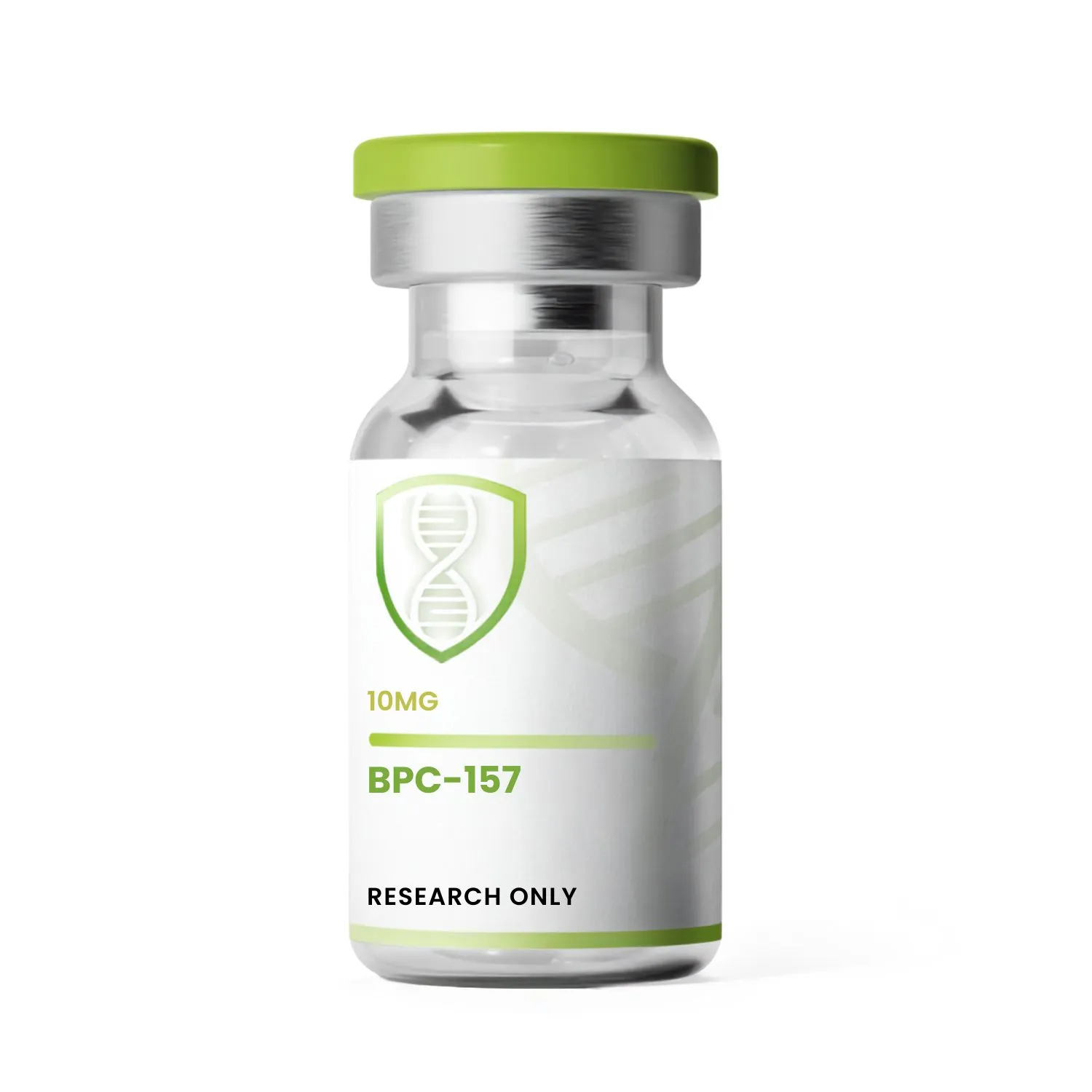
Buy BPC-157 10mg

Buy BPC-157 10mg

| Third-Party Tested | 99% Purity | COA Available | Research Use Only

BPC-157, also known as Body Protection Compound-157, is a man-made pentadecapeptide with a 15-amino-acid chain.

$68.00

0 out of 5 · 0 ratings
Be the first to rate this compound:

10 in stock

10 in stock

Bulk Pricing – Save More

3
Buy 3 units 5% OFF
$64.60 each Total: $193.80 (Save $10.20)
5
Buy 5 units 10% OFF
$61.20 each Total: $306.00 (Save $34.00)
10
Buy 10 units 15% OFF
$57.80 each Total: $578.00 (Save $102.00)

BPC-157 10mg For Sale

BPC-157 (Body Protection Compound-157) is a synthetic peptide composed of 15 amino acids. Its sequence is derived from a protein found in gastric juice. This research peptide has gained attention for its potential role in cellular repair, tissue regeneration, and inflammatory signaling. Preclinical studies have investigated BPC-157 in laboratory and animal models, particularly in relation to wound healing, gastrointestinal protection, angiogenesis, and cellular recovery. Researchers continue to explore its biological mechanisms and interactions with various signaling pathways. At Orion Peptides, we offer BPC-157 10mg for laboratory research. Our research-grade peptide is third-party tested for purity and quality, with a Certificate of Analysis (COA) available for verification. Research Use Only: BPC-157 is intended strictly for laboratory research purposes. It is not FDA-approved for human consumption, therapeutic use, or veterinary application.

BPC-157 Peptide Chemical Properties

BPC-157 (Body Protection Compound-157) is a synthetic pentadecapeptide composed of 15 amino acids. It is studied in laboratory research for its molecular structure, biological signaling pathways, and interactions with cellular processes.

BPC-157 Chemical Properties Table

Property Correct Information
Compound Name BPC-157
Alternative Name Bepecin, Body Protection Compound-157
Molecular Formula C₆₂H₉₈N₁₆O₂₂
Molecular Weight 1419.5 g/mol
CAS Number 137525-51-0
PubChem CID 9941957
Amino Acid Length 15 amino acids
Peptide Classification Synthetic pentadecapeptide
One-Letter Sequence GEPPPGKPADDAGLV
Three-Letter Sequence Gly-Glu-Pro-Pro-Pro-Gly-Lys-Pro-Ala-Asp-Asp-Ala-Gly-Leu-Val
Peptide Structure Linear peptide
Disulfide Bonds None
C-Terminal Group Free carboxyl group (–COOH)
Monoisotopic Mass 1418.7042 Da
DrugBank ID DB11882
Research Status Investigational, not FDA-approved
These chemical properties are verified against the PubChem compound record.

Reference

PubChem – BPC-157 (CID 9941957)

How BPC-157 Works in Preclinical Models

In experimental research, BPC-157 demonstrates pleiotropic activity by influencing several important signaling pathways. Studies indicate activation of VEGFR2 and downstream Akt-eNOS pathways, supporting nitric oxide production and angiogenesis in both cellular and animal models. The peptide also increases FAK-paxillin signaling involved in cell migration and survival, upregulates growth hormone receptor expression, and interacts with JAK-2 signaling pathways. Additionally, BPC-157 may modulate inflammatory responses by reducing pro-inflammatory mediators such as Nos2 and Nfkb while supporting anti-inflammatory processes. These mechanisms are observed under controlled in vitro and in vivo laboratory conditions.

BPC-157 and Recovery Support in Research Models

Preclinical animal studies involving induced injuries have explored the role of BPC-157 in tissue recovery. Research models demonstrate improved healing responses in musculoskeletal injuries including tendon transection, ligament damage, and muscle injury. Studies report improved collagen organization, enhanced fibroblast activity, and increased biomechanical strength, suggesting interaction with natural repair pathways in experimental systems.

BPC-157 and Digestive Balance in Research Models

Extensive preclinical research using rodent gut injury models, including NSAID-induced damage and ulcer formation, has examined BPC-157 as a cytoprotective compound. Laboratory findings suggest support for mucosal integrity, reduced lesion severity, and improved epithelial healing through angiogenesis and inflammation modulation.

BPC-157 and Tissue Support in Research Models

BPC-157 has also been studied in connective tissue research involving muscles, ligaments, and bone systems. Experimental findings indicate stimulation of fibroblast proliferation, collagen production, and tissue remodeling responses following injury or stress.

Choosing the Right BPC-157 Strength for Laboratory Use

BPC-157 is commonly supplied in 5MG and 10MG research vials to accommodate different experimental requirements. The 5MG option is suitable for lower-dose studies or titration experiments, while 10MG vials are preferred for larger-scale or extended research protocols.

How to Store and Handle BPC-157 Safely in the Laboratory

BPC-157 should be stored in a dry, frozen environment protected from light and temperature fluctuations. During reconstitution and handling, aseptic laboratory procedures and proper personal protective equipment (PPE) should always be used.

Intended Use & Disclaimer

BPC-157 is a research-grade peptide intended solely for in vitro and in vivo laboratory research. It is not approved by the FDA for therapeutic or human use. The World Anti-Doping Agency (WADA) classifies this compound under prohibited substances without authorized application. Results obtained from preclinical models cannot be directly applied to humans. Human research data remain limited, and potential risks such as immunogenicity may exist when sourced from unregulated materials. All information provided is for research and educational purposes only.

Frequently Asked Questions (FAQs)

1. Is BPC-157 10mg third-party tested?

Yes. All BPC-157 10mg vials available at Orion Peptides are third-party tested for purity and quality to ensure they meet our research-grade standards.

2. Is a Certificate of Analysis (COA) available for BPC-157 10mg?

Yes. A Certificate of Analysis (COA) is available for BPC-157 10mg. Researchers can review the testing documentation to verify compound purity and quality.

3. How long does BPC-157 10mg take to ship?

Orion Peptides offers same-day dispatch for eligible orders. Standard delivery typically takes 3–5 business days, depending on your location and shipping conditions.

4. What is the difference between BPC-157 5mg and 10mg?

Both contain the same synthetic 15-amino-acid peptide. The primary difference is the quantity of BPC-157 per vial. A 10mg vial contains twice the peptide quantity of a 5mg vial.

5. What is BPC-157 studied for in laboratory research?

BPC-157 is primarily investigated in preclinical models involving tissue regeneration, gastrointestinal protection, angiogenesis, collagen formation, and inflammatory signaling. Most published findings come from animal and cell-based studies.

6. How should BPC-157 10mg be stored?

BPC-157 should be stored according to the manufacturer’s specifications, preferably in a dry, temperature-controlled environment protected from direct light and moisture. Long-term storage of lyophilized research peptides commonly involves freezing.

7. Is BPC-157 10mg approved for human consumption?

No. BPC-157 is not FDA-approved for human consumption, therapeutic use, or veterinary applications. All BPC-157 compounds sold by Orion Peptides are intended strictly for laboratory research purposes.

Referenced Citations

  • Krivic A, et al. (2006). Achilles detachment in rat and stable gastric pentadecapeptide BPC 157. Journal of Orthopaedic Research.
  • Cerovecki T, et al. (2010). Pentadecapeptide BPC 157 improves ligament healing. Journal of Orthopaedic Research.
  • Vasireddi N, et al. (2025). Emerging Use of BPC-157 in Orthopaedic Sports Medicine: A Systematic Review. HSS Journal.
  • Xu C, et al. (2020). Preclinical safety evaluation of body protective compound‑157. Regulatory Toxicology and Pharmacology.
  • Sikiric P, et al. (2013). Toxicity by NSAIDs counteracted by stable gastric pentadecapeptide BPC 157. Current Pharmaceutical Design.

Research Use Only

This compound is intended for laboratory research use only. It is not intended for human or animal consumption, or for use in diagnostic or therapeutic procedures.

Chemical Properties

Molecular Formula C62H98N16O22
Molecular Mass 1419.5 g/mol
Monoisotopic Mass 1418.70415882 Da
Polar Area 573 Ų
Complexity 3040
XLogP -9
Heavy Atom Count 100
Hydrogen Bond Donor Count 16
Hydrogen Bond Acceptor Count 24
Rotatable Bond Count 39
CID 9941957
InChI InChI=1S/C62H98N16O22/c1-31(2)25-37(55(92)74-50(32(3)4)62(99)100)71-46(81)29-65-51(88)33(5)67-53(90)38(26-48(84)85)73-54(91)39(27-49(86)87)72-52(89)34(6)68-57(94)41-15-10-21-75(41)58(95)35(13-7-8-20-63)70-45(80)30-66-56(93)40-14-9-22-76(40)60(97)43-17-12-24-78(43)61(98)42-16-11-23-77(42)59(96)36(18-19-47(82)83)69-44(79)28-64/h31-43,50H,7-30,63-64H2,1-6H3,(H,65,88)(H,66,93)(H,67,90)(H,68,94)(H,69,79)(H,70,80)(H,71,81)(H,72,89)(H,73,91)(H,74,92)(H,82,83)(H,84,85)(H,86,87)(H,99,100)/t33-,34-,35-,36-,37-,38-,39-,40-,41-,42-,43-,50-/m0/s1
InChIKey HEEWEZGQMLZMFE-RKGINYAYSA-N
IUPAC Name (4S)-4-[(2-aminoacetyl)amino]-5-[(2S)-2-[(2S)-2-[(2S)-2-[[2-[[(2S)-6-amino-1-[(2S)-2-[[(2S)-1-[[(2S)-3-carboxy-1-[[(2S)-3-carboxy-1-[[(2S)-1-[[2-[[(2S)-1-[[(1S)-1-carboxy-2-methylpropyl]amino]-4-methyl-1-oxopentan-2-yl]amino]-2-oxoethyl]amino]-1-oxopropan-2-yl]amino]-1-oxopropan-2-yl]amino]-1-oxopropan-2-yl]amino]-1-oxopropan-2-yl]carbamoyl]pyrrolidin-1-yl]-1-oxohexan-2-yl]amino]-2-oxoethyl]carbamoyl]pyrrolidine-1-carbonyl]pyrrolidine-1-carbonyl]pyrrolidin-1-yl]-5-oxopentanoic acid
Smiles C[C@@H](C(=O)N[C@@H](CC(=O)O)C(=O)N[C@@H](CC(=O)O)C(=O)N[C@@H](C)C(=O)NCC(=O)N[C@@H](CC(C)C)C(=O)N[C@@H](C(C)C)C(=O)O)NC(=O)[C@@H]1CCCN1C(=O)[C@H](CCCCN)NC(=O)CNC(=O)[C@@H]2CCCN2C(=O)[C@@H]3CCCN3C(=O)[C@@H]4CCCN4C(=O)[C@H](CCC(=O)O)NC(=O)CN

Certificate of Analysis

Quality

Every batch of Buy BPC-157 10mg is tested for purity and identity using industry-standard methods.

HPLC Analysis

High-Performance Liquid Chromatography confirms purity ≥99%. Each batch is analyzed to ensure consistent quality.

Mass Spectrometry (MS)

Identity verification via mass spectrometry confirms correct molecular weight of 4113.58 g/mol.

Third-Party Testing

All compounds undergo independent third-party laboratory testing for quality assurance.

Request COA

Certificate of Analysis documents are available for all compounds. Contact us with your order number to request batch-specific documentation.

COA Lab Tests

Each compound batch is tested by independent laboratories to verify purity, identity, and quality. The Certificate of Analysis (COA) provides transparent lab results, ensuring the compound meets strict research-grade standards.

Storage & Handling

Before Reconstitu‍tion (Powde‌r Form)

  • Store in des‍iccated conditio‍ns below -80°C for long‌-term storage
  • Keep i‍n original sealed conta‍iner
  • Protect f‌rom moisture and humidity

After Reconstitution (⁠Liquid Form)‍

  • Store at 4°C for 2-7‍ days only
  • F‍or extended use, stor‌e below -80°C
  • Use 0.1% HSA‌ or B‍SA as carrie‍r protein

Important Storage Pr‍ecautions

  • Always preven‌t freeze-thaw cycles
  • D⁠o not repeated‌ly fr‍e⁠eze‌ and thaw
  • Ke⁠ep away from direct light expos‍ure
  • Store in sterile conditions a‍t all times
  • L⁠a‍bel with‍ reco⁠ns⁠ti⁠tution⁠ date
  • Do not shake vigorously

After Reconstitution (⁠Liquid Form)‍

  • Store at 4°C for 2-7‍ days only
  • F‍or extended use, stor‌e below -80°C
  • Use 0.1% HSA‌ or B‍SA as carrie‍r protein

×
On Sale
Out of Stock

Storage

Store at -20°C.
Protect from light and moisture.

Added to cart successfully!

Certificate of Analysis

ORP#00024

Client:
Orion Peptides
Sample:
BPC-157 10mg
Batch:
202601BPC10

Tests Requested:
Standard + Endotoxins + Sterility
Appearance:
White Lyophilized Powder in 3mL Vial

Analysis Conducted on:
01/06/2026
Report Issued on:
08/01/2026
Test Method Result Specification  
Identity HPLC-DAD BPC-157 BPC-157 Pass
Purity HPLC-DAD 99.32 >99% by HPLC Pass
Quantity HPLC Analyte Concentration Curve Assay 10.32 10mg Pass
Endotoxins LAL ELISA 0.145 EU/mL ≤ 0.5 EU/mL Pass
Sterility Pour Plate No Growth No Growth Pass