
Popular
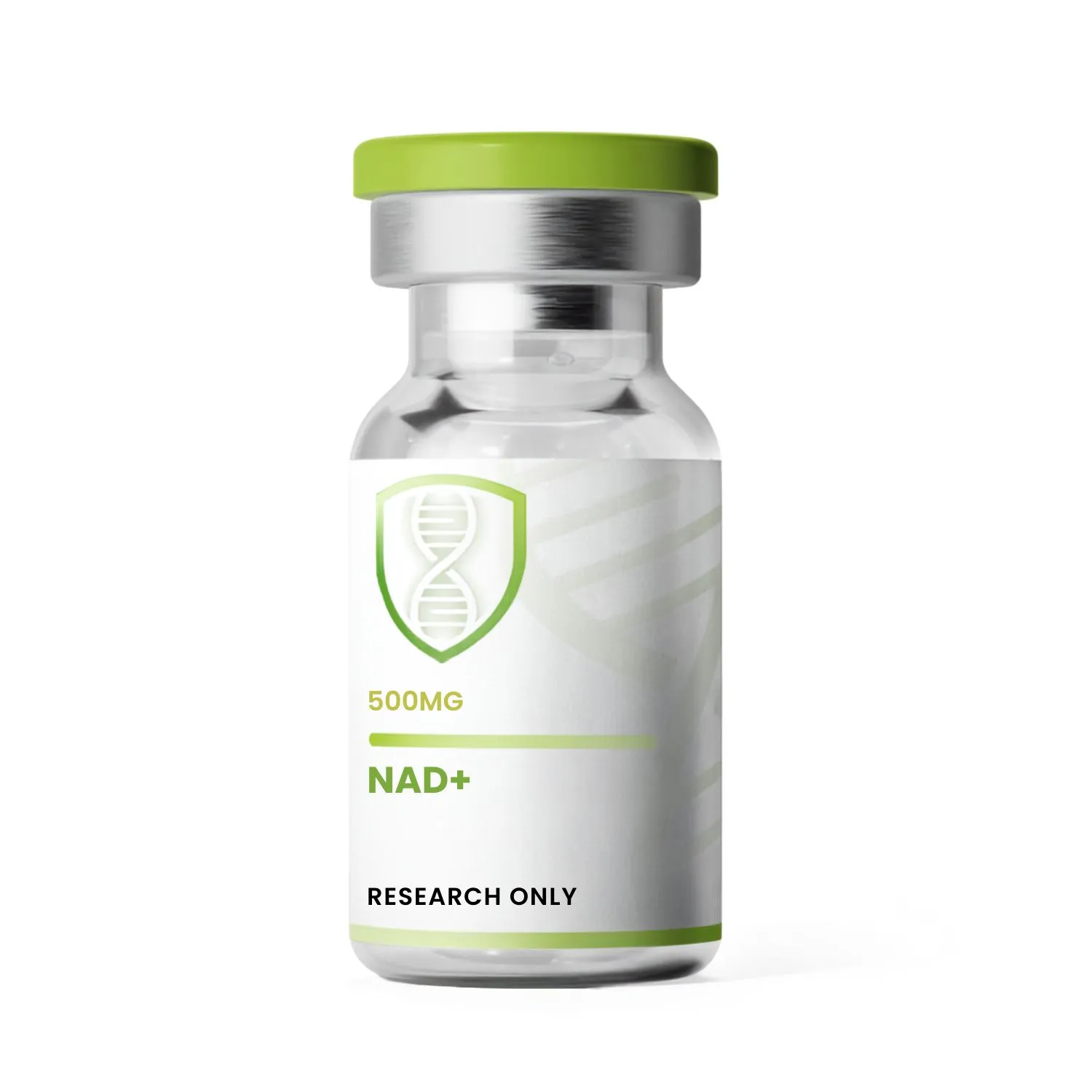
Buy NAD+ 500mg

NAD+ – 500mg

| Third-Party Tested | 99% Purity | COA Available | Research Use Only

The full form of NAD is  Nicotinamide Adenine Dinucleotide,  an essential coenzyme present in the cells of all living organisms. In energy metabolism and cellular signaling, NAD+ plays a crucial role. Across metabolic pathways, NAD+ also supports redox reactions.

$87.00

0 out of 5 · 0 ratings
Be the first to rate this compound:

12 in stock

12 in stock

Bulk Pricing – Save More

3
Buy 3 units 5% OFF
$82.65 each Total: $247.95 (Save $13.05)
5
Buy 5 units 10% OFF
$78.30 each Total: $391.50 (Save $43.50)
10
Buy 10 units 15% OFF
$73.95 each Total: $739.50 (Save $130.50)

Buy NAD+ 500mg| 99% Purity| Third-Party Tested

NAD stands for Nicotinamide Adenine Dinucleotide, an essential coenzyme present in the cells of all living organisms. NAD+ plays a crucial role in energy metabolism and cellular signaling and supports redox reactions across metabolic pathways. Arthur Harden and William John Young discovered NAD+ in 1906 during research on yeast fermentation processes. NAD+ cycles between two forms, NAD+ and NADH, allowing efficient electron transfer inside cells. NAD+ serves as a substrate for essential enzymes, including sirtuins and PARPs. Sirtuins regulate gene expression and longevity pathways, while PARPs support DNA repair and cellular stress responses. In research settings, NAD+ is supplied as a high-purity lyophilized powder, typically reaching ≥99% purity verified by HPLC analysis. Researchers study NAD+ in aging, mitochondrial function, metabolism, and neuroprotection models. NAD+ is intended strictly for laboratory research and is not approved for human consumption or therapeutic use.

NAD+ Molecular Structure and Chemical Properties

NAD+ (Nicotinamide Adenine Dinucleotide) is a coenzyme found in living cells. It is not a peptide. Instead, it consists of two nucleotides joined by a pyrophosphate bond. One nucleotide contains adenine, while the other contains nicotinamide. NAD+ plays an important role in cellular energy metabolism, redox reactions, and enzyme activity. It acts as an electron carrier by converting between its oxidized form (NAD+) and reduced form (NADH).

NAD+ Chemical Properties Table

Property Correct Information
Compound Name Nicotinamide Adenine Dinucleotide (NAD+)
Alternative Names β-NAD+, Coenzyme I, DPN
Molecular Formula C₂₁H₂₇N₇O₁₄P₂
Molecular Weight 663.43 g/mol
CAS Number 53-84-9
PubChem CID 925 (β-NAD record)
Chemical Classification Dinucleotide coenzyme
Molecular Structure Two nucleotides connected by a pyrophosphate linkage
Nucleotide Components Adenosine monophosphate and nicotinamide mononucleotide
Amino Acid Length Not applicable
Peptide Bonds None
Oxidation State Oxidized form (NAD+)
Reduced Form NADH
Research Applications Cellular metabolism, redox signaling, enzyme activity, and mitochondrial function
These details agree with the PubChem chemical record.

NAD+ Mechanism of Action

In laboratory models, NAD+ functions as a key electron carrier, transferring hydride ions during redox reactions occurring in glycolysis, the TCA cycle, and oxidative phosphorylation. These processes support ATP production within mitochondria. NAD+ also maintains the NAD+/NADH ratio, which regulates cellular energy homeostasis and metabolic flux across biological pathways. Beyond redox activity, NAD+ acts as a consumable substrate for multiple enzyme systems.

Essential NAD+-Dependent Enzymes

Sirtuins (SIRT1–7)

Regulate gene expression, mitochondrial biogenesis, autophagy, and inflammatory signaling.

PARPs

Support DNA damage repair and chromatin remodeling processes.

CD38 and sARM1

Influence calcium signaling pathways and immune responses. Preclinical research indicates that NAD+ levels decline with aging and cellular stress, disrupting mitochondrial activity and repair systems. Experimental elevation of NAD+ levels restores metabolic balance and improves cellular resilience in laboratory models.  

NAD+ 100 mg and 750 mg

NAD+ is available in standardized research vial sizes to support flexible experimental design.

100 mg Vials

Suitable for small-scale in vitro assays, enzyme kinetics studies, and cell culture experiments, as well as early titration work in laboratory models.

750 mg Vials

Designed for larger or repeated experiments, including long-term in vivo research focused on metabolism and aging studies. Larger quantities allow cost-efficient experimental scaling. Both formats are supplied as a white lyophilized powder and require reconstitution using sterile water under controlled laboratory conditions.

NAD+ Research

NAD+ has been extensively investigated in preclinical research involving cellular systems and animal models, particularly in aging, metabolism, and disease mechanism studies. Natural NAD+ decline with age contributes to impaired mitochondrial function, reduced sirtuin activity, and increased inflammatory signaling. Experimental restoration of NAD+ levels improves metabolic signaling in research models. Studies indicate activation of autophagy and enhanced mitochondrial biogenesis following NAD+ elevation, along with improvements in oxidative metabolism and insulin sensitivity in experimental settings. Animal disease models suggest potential neuroprotective effects related to conditions such as Alzheimer’s and Parkinson’s disease, with some studies reporting extended healthspan outcomes. Research into NAD+ precursors such as NR and NMN continues in human trials, while direct NAD+ investigations largely remain preclinical. Ongoing studies examine NAD+ biosynthesis pathways, including salvage and Preiss-Handler pathways, as well as NAD+ depletion in cardiovascular and aging-related models.

How to Store and Handle NAD+

Store unopened NAD+ vials in a cool, dark environment. Long-term storage is recommended at −20°C, while sealed vials remain stable at 2–8°C. Protect the compound from moisture, light exposure, and repeated temperature fluctuations. After reconstitution, store solutions at 2–8°C and use within recommended timelines. Avoid repeated freeze–thaw cycles and always follow sterile laboratory handling procedures. Disclaimer:

NAD+ (Nicotinamide Adenine Dinucleotide) supplied by Orion Peptides is intended strictly for laboratory research and scientific investigation. It is not intended for human or animal consumption, self-administration, diagnostic procedures, or therapeutic applications.

Research-grade NAD+ sold by Orion Peptides is not an FDA-approved drug compound. Its safety, effectiveness, and suitability for clinical or personal use have not been established.

Referenced Citations

Research Use Only

This compound is intended for laboratory research use only. It is not intended for human or animal consumption, or for use in diagnostic or therapeutic procedures.

Chemical Properties

Molecular Formula C21H27N7O14P2
Molecular Weight 663.4 g/mol
Monoisotopic Mass 663.10912256 Da
Polar Surface Area 321 Ų
Complexity 1120
XLogP -6
Heavy Atom Count 44
Hydrogen Bond Donors 7
Hydrogen Bond Acceptors 18
Rotatable Bonds 11
CID 10897651
InChI InChI=1S/C21H27N7O14P2/c22-17-12-19(25-7-24-17)28(8-26-12)21-16(32)14(30)11(41-21)6-39-44(36,37)42-43(34,35)38-5-10-13(29)15(31)20(40-10)27-3-1-2-9(4-27)18(23)33/h1-4,7-8,10-11,13-16,20-21,29-32H,5-6H2,(H5-,22,23,24,25,33,34,35,36,37)/t10-,11-,13-,14-,15-,16-,20-,21-/m1/s1
InChIKey BAWFJGJZGIEFAR-NNYOXOHSSA-N
IUPAC Name [(2R,3S,4R,5R)-5-(6-aminopurin-9-yl)-3,4-dihydroxyoxolan-2-yl]methyl [[(2R,3S,4R,5R)-5-(3-carbamoylpyridin-1-ium-1-yl)-3,4-dihydroxyoxolan-2-yl]methoxy-hydroxyphosphoryl] phosphate
SMILES C1=CC(=C[N+](=C1)[C@H]2[C@@H]([C@@H]([C@H](O2)COP(=O)(O)OP(=O)([O-])OC[C@@H]3[C@H]([C@H]([C@@H](O3)N4C=NC5=C(N=CN=C54)N)O)O)O)O)C(=O)N

Certificate of Analysis

Quality

Every batch of NAD+ – 500mg is tested for purity and identity using industry-standard methods.

HPLC Analysis

High-Performance Liquid Chromatography confirms purity ≥99%. Each batch is analyzed to ensure consistent quality.

Mass Spectrometry (MS)

Identity verification via mass spectrometry confirms correct molecular weight of 4113.58 g/mol.

Third-Party Testing

All compounds undergo independent third-party laboratory testing for quality assurance.

Request COA

Certificate of Analysis documents are available for all compounds. Contact us with your order number to request batch-specific documentation.

COA Lab Tests

Each compound batch is tested by independent laboratories to verify purity, identity, and quality. The Certificate of Analysis (COA) provides transparent lab results, ensuring the compound meets strict research-grade standards.

Storage & Handling

Before Reconstitu‍tion (P⁠owder Form)

  • S⁠tore at contr‍olled⁠ room temperature
  • ⁠Keep⁠ in‍ original sealed c‌ontainer
  • Do not freeze the vials
  • Maint‌ain stable temperature conditions

After Recons‍t‍itu⁠tion (L‌iquid Form)

  • Re⁠frige‍rate immed‌iately at 36°F to 46°F
  • Store at 2°C to 8°C consistently
  • K‌eep refrigerated bet⁠ween use‍s
  • Pl‌ace in clean refrigerator compartment

Imp⁠ortant Storage Precautions

  • If le‌ft out fo⁠r more t‌han 4 hours, contac‌t supervisor
  • Do not use if the temperature exposure is⁠ exceed‍ed
  • Return to refrige‍rator pro‍mptly after use
  • Monitor storage conditions regular‍ly

After Recons‍t‍itu⁠tion (L‌iquid Form)

  • Re⁠frige‍rate immed‌iately at 36°F to 46°F
  • Store at 2°C to 8°C consistently
  • K‌eep refrigerated bet⁠ween use‍s
  • Pl‌ace in clean refrigerator compartment

×
On Sale
Out of Stock

Storage

Store at -20°C.
Protect from light and moisture.

Added to cart successfully!

Certificate of Analysis

ORP#00017

Client:
Orion Peptides
Sample:
NAD+ 500mg
Batch:
202509NJ50

Tests Requested:
Standard + Endotoxins + Sterility
Appearance:
White Lyophilized Powder in 10mL Amber Vial

Analysis Conducted on:
09/07/2025
Report Issued on:
08/01/2026
Test Method Result Specification  
Identity HPLC-DAD NAD+ NAD+ Pass
Purity HPLC-DAD 99.21 >99% by HPLC Pass
Quantity HPLC Analyte Concentration Curve Assay 517mg 500mg Pass
Endotoxins LAL ELISA 0.232 EU/mL ≤ 0.5 EU/mL Pass
Sterility Pour Plate No Growth No Growth Pass