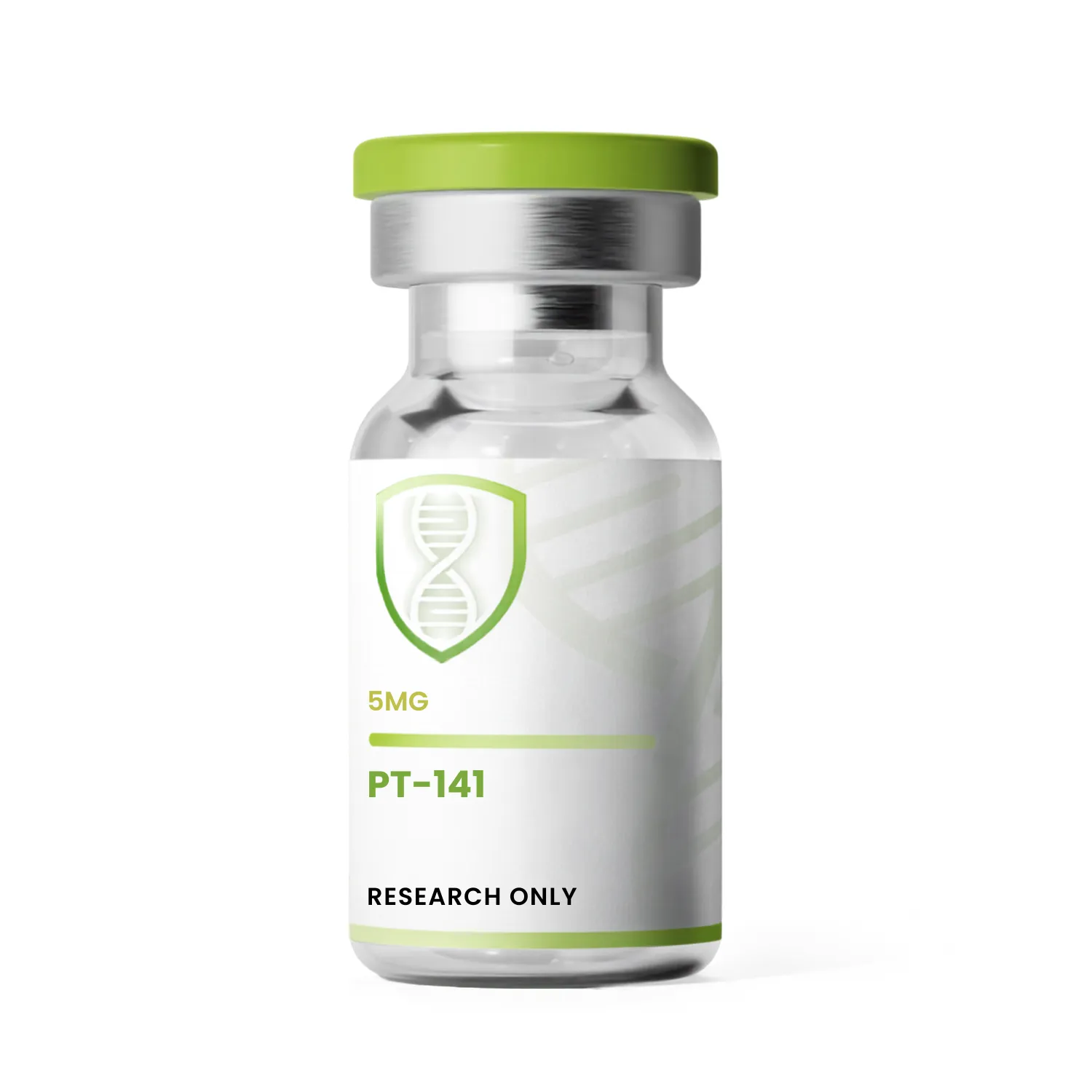
Buy PT-141 10mg | Bremelanotide Research Peptide
PT-141 10mg, also known as bremelanotide, is a synthetic cyclic peptide studied for its interaction with melanocortin receptors. It is derived from the peptide family associated with alpha-melanocyte-stimulating hormone (α-MSH), a naturally occurring signaling molecule. PT-141 contains seven amino acid residues arranged in a cyclic structure. Researchers study this compound to understand melanocortin receptor activity, central nervous system signaling, and the relationship between peptide structure and biological responses. At
Orion Peptides, PT-141 10mg is offered as a research peptide for controlled laboratory investigations. The 10mg designation describes the nominal quantity of peptide in the vial. PT-141 has been investigated in preclinical models and human clinical studies. However, the results of pharmaceutical research do not establish the quality, safety, or suitability of independently manufactured research-grade material.
For Research Use Only: Not intended for human or veterinary administration, diagnosis, treatment, or personal consumption.
What Is PT-141?
PT-141 is the research code name for bremelanotide, a synthetic melanocortin receptor agonist. Melanocortins are signaling peptides derived from the larger protein proopiomelanocortin (POMC). They interact with receptors involved in several physiological pathways. These pathways include pigmentation, energy balance, autonomic responses, and central nervous system signaling. PT-141 was developed from research involving Melanotan II, another synthetic melanocortin peptide. Although the compounds have closely related molecular structures, they are not chemically identical. An important difference is that PT-141 has a free C-terminal carboxylic acid group, while Melanotan II contains a C-terminal amide. This structural distinction makes the two peptides useful subjects for comparative research. PT-141 has been investigated for its effects on melanocortin receptor signaling, particularly in experimental models involving neural pathways. The pharmaceutical form of bremelanotide has also been studied in clinical trials. These studies helped establish its regulatory status for a specific medical indication. However, PT-141 supplied as a laboratory research peptide must not be confused with an approved pharmaceutical formulation.
PT-141 Molecular Formula and Chemical Properties
PT-141 is a cyclic heptapeptide consisting of seven amino acid residues. Its structure contains a lactam bridge formed between the side chains of aspartic acid and lysine.
| Property | Details |
| Compound name | PT-141 10mg |
| Chemical name | Bremelanotide |
| Alternative names | PT-141, PT 141 |
| Peptide class | Synthetic cyclic melanocortin analog |
| Amino acid length | 7 residues |
| Peptide sequence | Ac-Nle-cyclo(Asp-His-D-Phe-Arg-Trp-Lys)-OH |
| Molecular formula | C₅₀H₆₈N₁₄O₁₀ |
| Molecular weight | Approximately 1,025.2 g/mol |
| CAS number | 189691-06-3 |
| PubChem CID | 9941379 |
| Structural modification | Lactam cyclization |
| Research receptor family | Melanocortin receptors |
| Nominal vial content | 10mg |
| Intended use | Laboratory research only |
These values describe the bremelanotide parent molecule. Certain salt forms, including bremelanotide acetate, have different chemical composition and mass specifications. Researchers should confirm the exact chemical form supplied using batch-specific documentation.
Chemical reference: PubChem: Bremelanotide, CID 9941379.
PT-141 Peptide Sequence and Structure
PT-141 contains seven amino acid residues arranged in the following sequence:
Ac-Nle-cyclo(Asp-His-D-Phe-Arg-Trp-Lys)-OH The amino acids include:
| Residue | Full name |
| Nle | Norleucine |
| Asp | Aspartic acid |
| His | Histidine |
| D-Phe | D-Phenylalanine |
| Arg | Arginine |
| Trp | Tryptophan |
| Lys | Lysine |
The peptide contains an N-terminal acetyl group and a cyclic structure formed through a lactam bridge. This cyclization is relevant to the peptide’s structural behavior and interaction with melanocortin receptors. The presence of D-phenylalanine also distinguishes the synthetic structure from conventional peptide sequences containing only L-amino acids. Researchers can use analytical techniques such as mass spectrometry to confirm that a manufactured sample matches the expected molecular mass.
PT-141 Mechanism of Action
PT-141 acts as an agonist of melanocortin receptors. The melanocortin receptor family contains five receptor subtypes: MC1R, MC2R, MC3R, MC4R, and MC5R. These receptors are involved in different biological pathways. PT-141 is not strictly selective for one receptor subtype. It can activate several melanocortin receptors, although potency and biological responses differ between receptors. According to the FDA-approved bremelanotide labeling, the reported potency order is:
MC1R, MC4R, MC3R, MC5R, MC2R MC1R is closely associated with pigmentation signaling, while MC4R is expressed in several regions of the central nervous system.
Melanocortin Receptor Activation
Melanocortin receptors belong to the G-protein-coupled receptor family. Activation of certain receptor subtypes can stimulate intracellular signaling involving cyclic AMP (cAMP). The process generally involves:
- PT-141 interacting with a melanocortin receptor.
- Activation of receptor-associated G-protein signaling.
- Increased adenylyl cyclase activity in responsive systems.
- Changes in intracellular cAMP concentrations.
- Downstream cellular responses that depend on the receptor subtype and experimental model.
Researchers investigate these events to understand how melanocortin peptides influence cellular signaling. The precise relationship between receptor activation and all observed biological effects of bremelanotide remains incompletely understood.
Reference: FDA-approved Vyleesi prescribing information.
PT-141 Research Applications
PT-141 has been investigated in several areas of peptide pharmacology.
1. Melanocortin Receptor Research
One of the main research applications of PT-141 is the study of melanocortin receptors. Scientists examine how synthetic peptide agonists interact with receptor subtypes and influence intracellular signaling. These experiments can help researchers understand receptor activation, ligand interactions, and the differences between related melanocortin compounds.
2. Central Nervous System Signaling
Melanocortin receptors are expressed in several regions of the nervous system. Researchers have investigated PT-141 in experimental models involving neural signaling and centrally regulated physiological responses. MC4R has received particular attention because of its role in hypothalamic and other neural pathways. However, PT-141 also interacts with other melanocortin receptors, so observed responses cannot always be attributed to MC4R alone.
3. Sexual Response Research
PT-141 has been investigated in research involving neural pathways associated with sexual motivation and response. These investigations include preclinical studies and controlled clinical trials of pharmaceutical bremelanotide. Two randomized phase 3 trials, known collectively as RECONNECT, examined bremelanotide in premenopausal women with acquired, generalized hypoactive sexual desire disorder. The studies reported statistically significant improvements in measures of sexual desire and associated distress compared with placebo. However, the proportion of satisfying sexual events did not significantly improve. Common adverse reactions included nausea, flushing, and headache. These findings concern a regulated pharmaceutical formulation and a defined clinical population. They do not establish comparable outcomes for a research-grade PT-141 vial.
Research reference: Kingsberg SA, et al. (2019). Bremelanotide for the Treatment of Hypoactive Sexual Desire Disorder: Two Randomized Phase 3 Trials.
4. Peptide Structure-Activity Research
PT-141 and Melanotan II have closely related molecular structures. Researchers can compare these compounds to study how changes in peptide structure influence receptor activity. The difference between their C-terminal groups is particularly relevant to studies involving molecular recognition and receptor pharmacology.
5. Melanocortin Signaling and Autonomic Research
The melanocortin system is involved in several processes regulated by the nervous system. Bremelanotide research has also identified cardiovascular responses, including temporary increases in blood pressure and changes in heart rate. These observations illustrate why melanocortin signaling research must consider multiple receptor pathways and not only one desired biological response.
PT-141 vs Melanotan II
PT-141 and Melanotan II belong to the same synthetic melanocortin peptide family. They share a closely related cyclic peptide structure but differ in their C-terminal chemical groups.
| Property | PT-141 | Melanotan II |
| Alternative name | Bremelanotide | MT-II, Melanotan 2 |
| Peptide class | Cyclic melanocortin agonist | Cyclic melanocortin agonist |
| Amino acid length | 7 | 7 |
| C-terminal group | Carboxylic acid (-OH) | Amide (-NH₂) |
| Molecular formula | C₅₀H₆₈N₁₄O₁₀ | C₅₀H₆₉N₁₅O₉ |
| Main research areas | Melanocortin signaling and neural responses | Melanocortin signaling and pigmentation |
| FDA approval | Specific bremelanotide medicine approved | No FDA-approved medicine |
Although these peptides are structurally similar, researchers should not assume identical receptor potency or biological responses. The results of studies involving one compound should not automatically be applied to the other.
PT-141 5mg vs 10mg at Orion Peptides
Orion Peptides lists PT-141 research compounds in two strengths.
| Compound | Nominal quantity |
| PT-141 5mg | 5mg |
| PT-141 10mg | 10mg |
Both compounds are associated with the same peptide compound. The primary difference is the nominal amount of material supplied. Researchers should compare the available batch documentation, actual peptide content, and intended laboratory requirements when evaluating different quantities. The 10mg vial content is not a clinical dose and should not be interpreted as a recommended amount for administration.
PT-141 Purity and Certificate of Analysis
Analytical testing is important for research involving synthetic peptides. Incorrect molecular identity, degradation compounds, or differences in peptide content can affect experimental findings.
High-Performance Liquid Chromatography
High-performance liquid chromatography (HPLC) is commonly used to separate a peptide from detectable impurities. A reported purity result describes the chromatographic findings under specific test conditions. A purity claim of 99% should be supported by the actual batch report.
Mass Spectrometry
Mass spectrometry can help verify the molecular identity of the tested PT-141 compound. The theoretical molecular weight of bremelanotide is approximately 1,025.2 g/mol. The expected result may differ when testing a particular salt form or measuring a specific charged ion.
Certificate of Analysis
A useful batch-specific PT-141 COA should include:
- Compound and lot number
- Testing date
- Testing laboratory
- HPLC purity results
- Molecular identity testing
- Actual peptide content, where available
- Relevant analytical specifications
HPLC purity, peptide quantity, sterility, and endotoxin content are separate characteristics. Researchers should not assume that a high purity percentage establishes all aspects of compound quality.
PT-141 Storage and Handling
PT-141 research compounds may be supplied as lyophilized peptide material. The appropriate storage conditions depend on the formulation, packaging, and validated stability information. Laboratories should follow the supplier’s batch-specific recommendations. General precautions include protecting material from moisture, unnecessary light exposure, and temperature changes that could affect stability. After a peptide is dissolved, its stability can depend on solvent composition, concentration, temperature, and handling conditions. A universal post-reconstitution shelf life should not be assumed without appropriate stability data.
Frequently Asked Questions About PT-141
What is PT-141?
PT-141 is the research name for bremelanotide, a synthetic cyclic heptapeptide that activates melanocortin receptors.
Is PT-141 the same as bremelanotide?
Yes. PT-141 and bremelanotide refer to the same active peptide molecule. However, different commercial compounds may contain different salt forms, excipients, and manufacturing specifications.
How many amino acids are in PT-141?
PT-141 contains seven amino acid residues arranged in a cyclic peptide structure.
What is the molecular formula of PT-141?
The molecular formula of bremelanotide is C₅₀H₆₈N₁₄O₁₀.
What is the molecular weight of PT-141?
The molecular weight of the parent bremelanotide molecule is approximately 1,025.2 g/mol.
What is the CAS number of PT-141?
The CAS number of bremelanotide is 189691-06-3.
What receptors does PT-141 interact with?
PT-141 interacts with several melanocortin receptor subtypes, including MC1R, MC3R, MC4R, and MC5R.
Is PT-141 the same as Melanotan II?
No. PT-141 and Melanotan II are closely related synthetic peptides, but they have different C-terminal functional groups and are chemically distinct compounds.
What does a PT-141 COA show?
A Certificate of Analysis can provide information about batch identity, chromatographic purity, molecular characterization, and other tested specifications.
Is PT-141 FDA-approved?
The FDA has approved a specific prescription bremelanotide compound called Vyleesi for a defined medical indication. This approval does not apply to independently manufactured PT-141 research peptide vials.
Can PT-141 research vials be used as a substitute for Vyleesi?
No. A laboratory research vial is not an approved substitute for Vyleesi and should not be used for human administration.
Research Use Disclaimer
PT-141 supplied by Orion Peptides is intended exclusively for legitimate laboratory research. It is not an FDA-approved pharmaceutical compound and must not be used for human or veterinary administration, diagnosis, treatment, or personal consumption. Clinical findings involving prescription bremelanotide cannot establish the safety, sterility, effectiveness, or pharmaceutical equivalence of independently manufactured research materials. Published clinical research also identifies risks associated with bremelanotide, including nausea, temporary blood pressure increases, heart-rate changes, and pigmentation-related effects. All research must comply with applicable laws, institutional requirements, and established laboratory safety procedures.
Scientific References
- National Center for Biotechnology Information. PubChem Compound Summary: Bremelanotide, CID 9941379. PubChem.
- Kingsberg SA, Clayton AH, Portman D, et al. (2019). Bremelanotide for the Treatment of Hypoactive Sexual Desire Disorder: Two Randomized Phase 3 Trials. Obstetrics & Gynecology, 134(5), 899–908. PubMed. DOI.
- Long-Term Safety and Efficacy of Bremelanotide for Hypoactive Sexual Desire Disorder (2019). Obstetrics & Gynecology. PubMed.
- U.S. Food and Drug Administration. Vyleesi (Bremelanotide Injection), Prescribing Information. DailyMed.
- National Center for Biotechnology Information. PubChem Compound Summary: Bremelanotide Acetate, CID 71558915. PubChem.