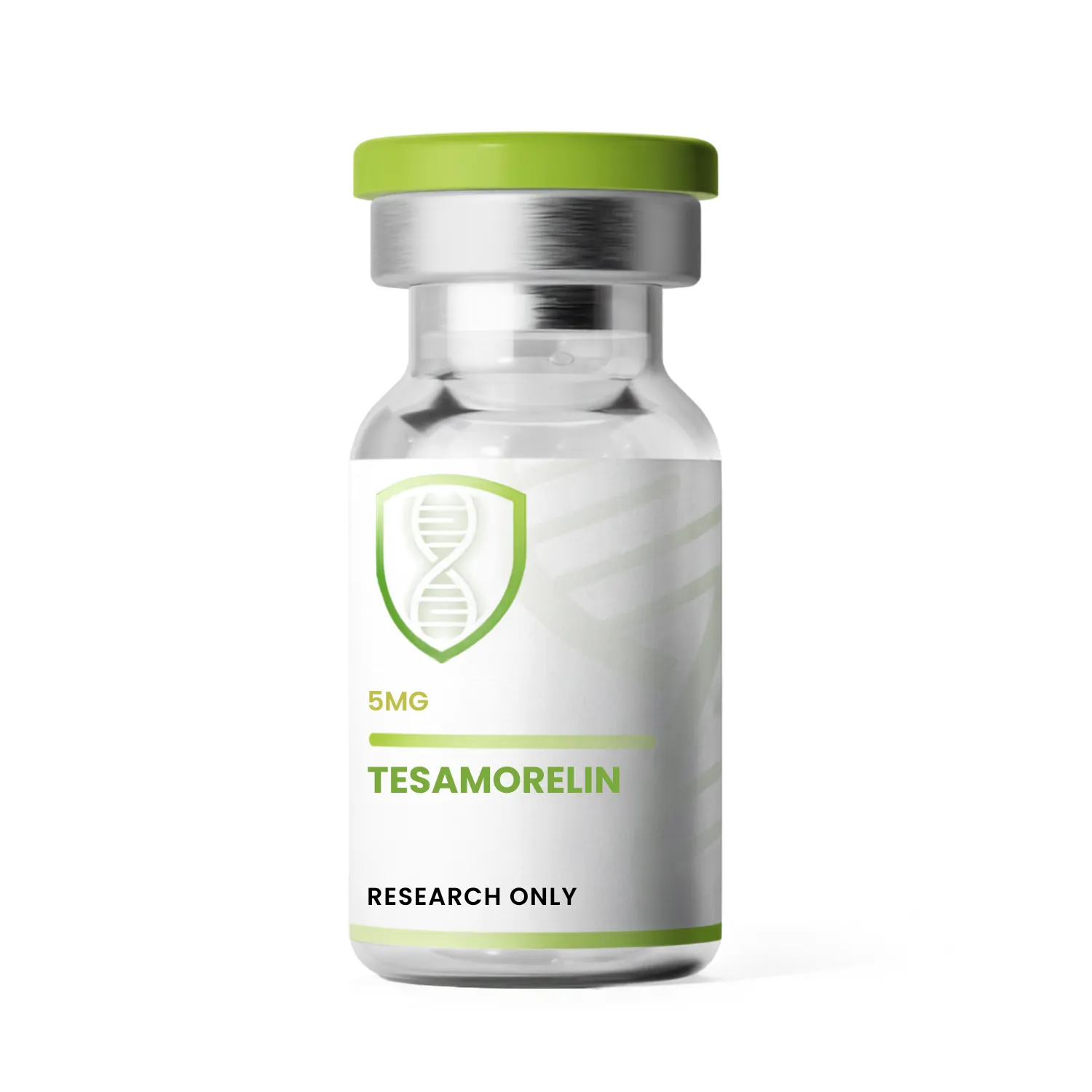
Buy Tesamorelin 5mg | Research Peptide | Orion Peptides
Tesamorelin 5mg is a synthetic peptide derived from growth hormone-releasing hormone (GHRH). It contains 44 amino acids and an N-terminal trans-3-hexenoyl modification that helps protect the peptide from rapid enzymatic degradation. Tesamorelin is studied for its interaction with growth hormone-releasing hormone receptors, pituitary signaling, and the growth hormone–IGF-1 axis. Published research has also examined the compound in metabolic studies involving visceral adipose tissue and liver fat. At
Orion Peptides, Tesamorelin 5mg is listed as a lyophilized research peptide for controlled laboratory investigations. The 5mg designation refers to the nominal quantity of peptide supplied in the vial. Tesamorelin has been evaluated in clinical trials, and specific prescription formulations have received FDA approval. However, those approvals do not extend to independently manufactured research peptides.
Research Use Only: Orion Peptides’ Tesamorelin 5mg is not intended for human or veterinary administration.
What Is Tesamorelin 5mg?
Tesamorelin is a stabilized analog of human growth hormone-releasing hormone, a peptide naturally produced in the hypothalamus. GHRH plays a role in regulating growth hormone secretion from the anterior pituitary gland. Natural GHRH contains 44 amino acids. Tesamorelin retains this sequence but includes a trans-3-hexenoyl group attached to the N-terminal tyrosine residue. This modification helps distinguish tesamorelin from unmodified GHRH. The compound binds to GHRH receptors on pituitary somatotroph cells and activates signaling pathways involved in growth hormone release. Researchers investigate tesamorelin to understand:
- GHRH receptor activation and signaling
- Growth hormone secretion
- The GH–IGF-1 endocrine axis
- Visceral adipose tissue metabolism
- Liver fat regulation
- Peptide structure and stability
Tesamorelin is distinct from other GHRH-related peptides, such as Sermorelin and CJC-1295 (No DAC). These compounds act within related endocrine pathways but differ in molecular structure, peptide length, and pharmacological characteristics.
Tesamorelin 5mg Molecular Specifications
Tesamorelin is a linear 44-amino-acid peptide with a modified N-terminus.
| Property | Details |
| Compound name | Tesamorelin 5mg |
| Compound name | Tesamorelin |
| Research identifier | TH9507 |
| Peptide class | Synthetic GHRH analog |
| Amino acid length | 44 |
| Molecular formula | C₂₂₁H₃₆₆N₇₂O₆₇S |
| Molecular weight | Approximately 5,135.9 Da |
| CAS number | 218949-48-5 |
| PubChem CID | 16137828 |
| N-terminal modification | Trans-3-hexenoyl group |
| C-terminal modification | Amidation |
| Primary research target | GHRH receptor |
| Nominal vial content | 5mg |
| Physical form | Lyophilized powder |
| Intended use | Laboratory research only |
The formula and molecular weight refer to tesamorelin itself. Tesamorelin acetate preparations include acetate counterions, which affect the composition of the supplied material.
Chemical reference: PubChem: Tesamorelin.
Tesamorelin Peptide Sequence and Structure
Tesamorelin contains the full 44-amino-acid sequence of human GHRH with an additional modification at its N-terminus.
Complete peptide sequence: trans-3-hexenoyl-Tyr-Ala-Asp-Ala-Ile-Phe-Thr-Asn-Ser-Tyr-Arg-Lys-Val-Leu-Gly-Gln-Leu-Ser-Ala-Arg-Lys-Leu-Leu-Gln-Asp-Ile-Met-Ser-Arg-Gln-Gln-Gly-Glu-Ser-Asn-Gln-Glu-Arg-Gly-Ala-Arg-Ala-Arg-Leu-NH₂
Why Is the N-Terminal Modification Important?
Natural GHRH is susceptible to degradation by enzymes, limiting its duration of activity. Tesamorelin was designed with a trans-3-hexenoyl group attached to the N-terminal tyrosine. This modification helps protect the peptide against certain forms of enzymatic breakdown while preserving its ability to interact with the GHRH receptor. The structural design makes tesamorelin relevant to studies investigating how chemical modifications influence peptide stability and receptor signaling. However, peptide stability depends on experimental conditions, and a specific shelf life or half-life cannot be established from the molecular structure alone.
Tesamorelin Mechanism of Action
Tesamorelin acts as an agonist of the growth hormone-releasing hormone receptor. This receptor is located primarily on somatotroph cells in the anterior pituitary gland. When tesamorelin binds to the receptor, it activates intracellular signaling involved in growth hormone secretion. The process includes several steps:
- Tesamorelin binds to the GHRH receptor.
- The receptor activates Gs-protein-mediated signaling.
- Adenylyl cyclase increases intracellular cyclic AMP (cAMP).
- cAMP-dependent signaling activates downstream pathways, including protein kinase A.
- These pathways contribute to growth hormone synthesis and secretion in responsive pituitary cells.
Growth hormone can stimulate the production of insulin-like growth factor 1 (IGF-1), particularly in the liver. The resulting GH–IGF-1 axis participates in several endocrine and metabolic processes.
Tesamorelin and Growth Hormone Secretion
GHRH receptor agonists have been investigated for their effects on growth hormone regulation. Unlike externally administered growth hormone, tesamorelin acts upstream by stimulating the body’s GHRH receptor pathway. This distinction is important when comparing growth hormone-releasing peptides and direct growth hormone exposure.
Tesamorelin and IGF-1 Research
IGF-1 is an important downstream marker of growth hormone signaling. Clinical trials have demonstrated increases in circulating IGF-1 during tesamorelin treatment. Researchers investigate these changes to understand endocrine feedback and metabolic responses. Elevated IGF-1 also represents a safety consideration in clinical use, rather than an automatically beneficial outcome.
Tesamorelin and Visceral Fat Research
Visceral adipose tissue is fat located within the abdominal cavity around internal organs. Growth hormone participates in the regulation of lipid metabolism, and studies have investigated whether GHRH receptor stimulation changes visceral adipose tissue. Clinical trials involving approved tesamorelin formulations have reported reductions in visceral fat in adults with HIV-associated lipodystrophy. These findings are population-specific and do not establish benefits for general weight loss, bodybuilding, or use of research-grade vials.
Tesamorelin Research: What Do Published Studies Show?
Tesamorelin has been investigated in human clinical trials and related endocrine research. The strongest evidence comes from controlled studies involving HIV-associated abdominal fat accumulation.
1. Visceral Adipose Tissue Research
A randomized controlled study published by Falutz and colleagues in 2010 evaluated tesamorelin in 404 adults with HIV-associated abdominal fat accumulation. After six months, visceral adipose tissue decreased by approximately 10.9% in the tesamorelin group, compared with 0.6% in the placebo group. The researchers also observed increases in IGF-1. Among participants who continued tesamorelin during the extension phase, the reduction in visceral adipose tissue reached approximately 18% at 12 months. However, the improvements were lost after treatment discontinuation in participants who switched to placebo. These findings demonstrate changes in visceral fat under controlled clinical conditions. They should not be interpreted as evidence of permanent fat reduction or general weight-loss benefits.
Research reference: Falutz J, et al. (2010). Effects of tesamorelin in HIV-infected patients with abdominal fat accumulation.
2. Liver Fat Research
A randomized study published in JAMA in 2014 examined the effects of tesamorelin on visceral and liver fat in adults with HIV-associated abdominal fat accumulation. The trial included 50 participants, with 48 receiving the study medication or placebo. After six months, the tesamorelin group showed a greater reduction in visceral adipose tissue than the placebo group. The researchers also reported a modest reduction in liver fat. The median change in liver lipid-to-water percentage was -2.0 percentage points in the tesamorelin group and +0.9 percentage points in the placebo group. These results were considered preliminary, and the authors called for further research into their clinical importance.
Research reference: Stanley TL, et al. (2014). Effect of tesamorelin on visceral fat and liver fat.
3. Metabolic Regulation Research
Tesamorelin has also been studied for its relationship with metabolic markers. Researchers have examined changes in glucose regulation, circulating lipids, visceral adipose tissue, and IGF-1 concentrations. The results vary by study population and measurement. For example, the 2014 JAMA study found an early increase in fasting glucose during tesamorelin exposure, although differences at six months were not statistically significant. This illustrates why metabolic research must consider both potential effects and safety-related outcomes.
4. GH–IGF-1 Axis Research
Tesamorelin provides a research model for studying stimulation of the GHRH receptor and downstream growth hormone signaling. Researchers can investigate receptor activation, intracellular cAMP signaling, and endocrine responses. These pathways are important for understanding the interaction between hypothalamic signals, pituitary hormone secretion, and peripheral metabolism.
5. Peptide Structure and Stability Research
The 44-amino-acid structure and N-terminal modification of tesamorelin make it relevant to peptide engineering. Laboratory studies can examine how modifications affect peptide stability, receptor interaction, and analytical behavior. These investigations are distinct from clinical studies and require suitable experimental methods.
Tesamorelin 5mg vs 10mg at Orion Peptides
Orion Peptides lists Tesamorelin in two research quantities.
| Compound | Nominal quantity | Research consideration |
| Tesamorelin 5mg | 5mg | Smaller nominal quantity for laboratory material planning |
| Tesamorelin 10mg | 10mg | Larger nominal quantity for experiments requiring more material |
Both presentations contain the same tesamorelin compound when their chemical forms and specifications match. The selection of a research vial depends on the experimental requirements, analytical methods, and availability of verified batch documentation. A compound labeled 5mg or 10mg describes nominal vial content. It is not a clinical dosing recommendation.
Tesamorelin vs Sermorelin: What’s the Difference?
Tesamorelin and Sermorelin both belong to the GHRH analog family. However, they differ in peptide length and molecular structure.
| Feature | Tesamorelin | Sermorelin |
| Amino acid length | 44 | 29 |
| Relationship to GHRH | Full GHRH(1-44) analog | GHRH(1-29) fragment |
| N-terminal modification | Trans-3-hexenoyl group | No equivalent modification |
| Research target | GHRH receptor | GHRH receptor |
| Main research focus | Endocrine signaling and metabolic responses | GHRH receptor pharmacology |
Both peptides are associated with GHRH receptor signaling, but they should not be treated as interchangeable. Differences in structure may influence pharmacokinetic behavior and experimental responses.
Tesamorelin 5mg Purity and Certificate of Analysis
Compound quality is important in experiments involving GHRH receptor activity and peptide characterization. Impurities, degradation compounds, and inconsistent peptide content may affect laboratory findings. Researchers should evaluate the analytical records for the specific Tesamorelin 5mg batch.
HPLC Purity Testing
High-performance liquid chromatography (HPLC) is used to separate peptide components and evaluate chromatographic purity. A claim of 99% purity should be supported by a batch-specific chromatogram and testing report.
Mass Spectrometry
Mass spectrometry helps verify molecular identity. The expected molecular weight of tesamorelin is approximately 5,135.9 Da. Measured values must be interpreted according to the analytical method, ion charge, and chemical form.
Certificate of Analysis
A useful tesamorelin COA should include:
- Compound name and batch number
- Testing laboratory and date
- HPLC purity result
- Molecular identity testing
- Actual peptide content, when measured
- Relevant analytical methods and specifications
A high HPLC purity result does not automatically establish sterility, endotoxin limits, or exact peptide quantity.
Tesamorelin 5mg Storage and Handling
Tesamorelin research material is commonly supplied as lyophilized powder. Its stability depends on its chemical form, formulation, packaging, and storage environment. Laboratories should follow validated storage specifications for the actual research compound. General handling precautions include protecting the peptide from moisture, unnecessary light exposure, and avoidable temperature changes. Reconstituted peptide stability may depend on solvent composition, concentration, container compatibility, and temperature. Storage and reconstitution instructions for FDA-approved EGRIFTA compounds are formulation-specific and should not automatically be applied to Orion’s research vials.
Frequently Asked Questions About Tesamorelin 5mg
What is Tesamorelin 5mg?
Tesamorelin 5mg is a research presentation containing a nominal 5mg quantity of tesamorelin, a synthetic 44-amino-acid GHRH analog.
What is the tesamorelin peptide sequence?
Tesamorelin contains the complete 44-amino-acid human GHRH sequence with an N-terminal trans-3-hexenoyl modification and C-terminal amidation.
What is the molecular formula of tesamorelin?
The molecular formula of the tesamorelin parent molecule is C₂₂₁H₃₆₆N₇₂O₆₇S.
What is the molecular weight of tesamorelin?
Tesamorelin has a molecular weight of approximately 5,135.9 Da.
What is the CAS number of tesamorelin?
The CAS number is 218949-48-5.
What is the difference between Tesamorelin 5mg and 10mg?
Both refer to the same peptide, but they contain different nominal quantities of material. Researchers should confirm the chemical form and batch specifications before comparing the compounds.
Is tesamorelin the same as Sermorelin?
No. Tesamorelin contains 44 amino acids and an N-terminal modification. Sermorelin contains the first 29 amino acids of natural GHRH.
Does tesamorelin interact with the GHRH receptor?
Yes. Tesamorelin is a GHRH receptor agonist. Research has investigated its effects on pituitary signaling, growth hormone secretion, and the GH–IGF-1 axis.
What does a tesamorelin COA show?
A Certificate of Analysis can document peptide identity, HPLC purity, assay results, and other verified characteristics of a specific manufacturing batch.
Is Tesamorelin 5mg FDA-approved?
Orion Peptides’ 5mg research vial is not an FDA-approved medication. Specific prescription tesamorelin formulations are FDA-approved for reducing excess abdominal fat in adults with HIV-associated lipodystrophy.
Can tesamorelin research vials replace EGRIFTA?
No. Research-grade tesamorelin is not an approved or verified equivalent to prescription EGRIFTA compounds.
Important Research Disclaimer
Tesamorelin 5mg offered by Orion Peptides is intended exclusively for legitimate scientific and laboratory research. It is not an FDA-approved pharmaceutical compound and is not intended for human or veterinary administration, self-treatment, bodybuilding, general weight loss, or dietary supplementation. Although approved tesamorelin formulations have been studied in controlled clinical trials, those findings do not establish the safety, sterility, pharmaceutical equivalence, or clinical effectiveness of independently manufactured research vials. Clinical use of prescription tesamorelin is associated with important safety considerations, including elevated IGF-1, glucose intolerance, fluid retention, and hypersensitivity reactions. All laboratory activities must comply with applicable laws, institutional requirements, and established safety standards.
Scientific References
- Falutz J, et al. (2010). Effects of tesamorelin, a growth hormone-releasing factor, in HIV-infected patients with abdominal fat accumulation: A randomized placebo-controlled trial with a safety extension. Journal of Acquired Immune Deficiency Syndromes, 53(3), 311–322. PubMed. DOI.
- Stanley TL, et al. (2014). Effect of tesamorelin on visceral fat and liver fat in HIV-infected patients with abdominal fat accumulation: A randomized clinical trial. JAMA, 312(4), 380–389. PubMed. DOI.
- Stanley TL, et al. (2012). Reduction in visceral adiposity is associated with an improved metabolic profile in HIV-infected patients receiving tesamorelin. Clinical Infectious Diseases, 54(11), 1642–1651. PubMed. DOI.
- Falutz J, et al. (2008). Long-term safety and effects of tesamorelin, a growth hormone-releasing factor analogue, in HIV patients with abdominal fat accumulation. AIDS, 22(14), 1719–1728. PubMed.
- National Center for Biotechnology Information. PubChem Compound Summary: Tesamorelin, CID 16137828. PubChem.
- U.S. Food and Drug Administration. EGRIFTA WR (Tesamorelin), Prescribing Information, 2025. FDA document.