

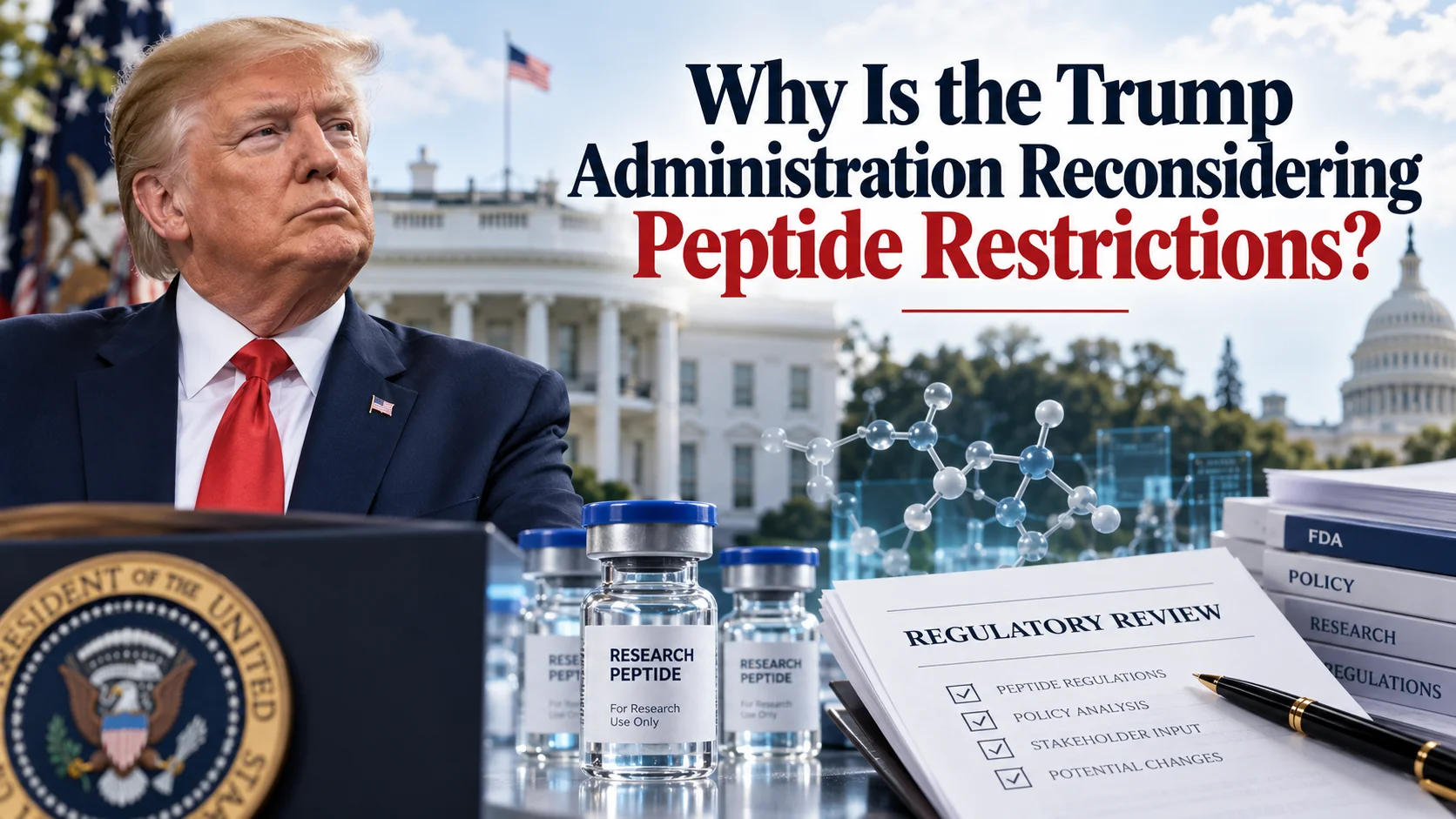
The Trump administration is considering a temporary policy change that could make certain unapproved peptides more accessible through licensed compounding pharmacies. The proposal follows months of debate over peptide restrictions, growing consumer demand, and concerns about compounds sold through unregulated channels. However, the proposal is not a final policy, and it does not mean that all research peptides will become legal for human use.
The issue gained attention in July 2026, when a federal advisory panel recommended easing restrictions on several peptides despite concerns from FDA scientists about limited safety and effectiveness data. In October, The Washington Post reported that federal officials were considering a temporary approach while they developed longer-term rules.
For the research peptide industry, this discussion could affect how certain compounds are regulated, how compounding pharmacies operate, and how officials respond to the expanding market for wellness compounds.
This article examines the reasons behind the administration’s reconsideration, the proposed regulatory approach, the scientific concerns, and what the reported changes could mean for peptide research.
What Is Happening With U.S. Peptide Restrictions?
The FDA has placed restrictions on the compounding of certain peptides. These restrictions were implemented because of concerns about their safety, effectiveness, and available quality information.
Compounding pharmacies, under legal conditions, prepare medications for individual patients. However, federal rules limit which substances pharmacies can use in compounded preparations. Some peptides have faced additional restrictions because regulators identified concerns about their use or insufficient evidence to establish their safety.
In July 2026, the FDA’s Pharmacy Compounding Advisory Committee reviewed several peptides that had attracted interest in wellness and medical markets. The committee recommended easing restrictions on some compounds, including BPC-157, KPV, TB-500, and MOTS-c. These recommendations were advisory, not binding decisions that automatically changed the law.
The debate continued in October. According to The Washington Post, the administration was considering temporary enforcement discretion that could allow certain state-licensed compounding pharmacies to prepare selected peptides for patients with prescriptions while regulators worked on longer-term rules. The proposal had not been formally announced, and its final scope remained uncertain.
The key distinction is between reconsidering restrictions and removing them. The reported proposal concerns a possible, limited pathway for certain compounded compounds. It does not establish general approval for unapproved peptides or authorize every compound sold online.
Why Is the Trump Administration Considering Relaxing Peptide Restrictions?
There are several factors that have brought the issue of peptide regulation back to the forefront of national discussion. The announced proposal reflects growing demands for wider availability in the marketplace, as well as questions about the control and proof of evidence to authorize their use.
Peptide Rising Demand
Peptides have drawn the interest of wellness centers, online marketers, and consumers seeking recovery, bodybuilding, anti-aging, and other indications.
This has led to an increase in the sale of substances not approved by the FDA for these indications, even though some are labeled for research purposes. Other compounds are marketed through wellness centers or clinics that offer compounded preparations.
The growing market has created a regulatory problem. Even with restrictions, consumer demand persists, and it may be challenging to distinguish between legitimate pharmacies and unreliable sellers. Washington Post reported on illicit sales channels, citing concerns about manufacturing practices and labeling.
Call For Regulation Of Unregulated Sales
Proponents of the proposed temporary policy change have argued that it would give pharmacies a safer alternative to illicit sellers while allowing the FDA to finalize its permanent policy.
The proposal, which advocates such as Scott Brunner, the chief executive of the Alliance for Pharmacy Compounding, have endorsed, would allow for the FDA’s interim enforcement discretion.
This would involve the FDA relaxing its immediate rules on compounding while developing more comprehensive regulations. It aims to accomplish this by introducing protocols such as patient notifications, serious adverse-event reporting, and data collection and analysis.
It is important to note that the FDA will not treat unapproved peptides as approved drugs.
Support From Robert F. Kennedy Jr. Of Health Secretary
Health and Human Services Secretary Robert F. Kennedy Jr. has expressed his support for the relaxation of restrictions on the use of peptides. This has helped keep the issue alive in the federal government’s policy agenda.
An FDA advisory committee voted last month to ease restrictions on several peptides. The vote came after days of discussions between peptide proponents, clinicians, and FDA researchers on the challenges, benefits, and risks of relaxing these restrictions.
It is important to note that the position of the health secretary does not change the rules governing the FDA. Policy changes will be determined by the appropriate federal agencies and will depend on the legal parameters governing each substance.
What Did the FDA Advisory Panel Recommend in July 2026?
The July meeting was an important step in the debate because the panel considered whether certain peptides should remain subject to existing restrictions on pharmacy compounding.
According to reporting from The Washington Post and The Guardian, the committee recommended easing restrictions on several compounds, including BPC-157, KPV, TB-500, and MOTS-c. The votes were divided, and FDA scientists had raised concerns about the lack of robust evidence for safety and effectiveness.
The review also drew scrutiny because some panel members had professional or financial connections to peptide-related businesses. Supporters argued for wider access and greater oversight, while critics questioned whether the evidence justified a change.
Three points matter when interpreting the committee’s recommendations:
- The vote was advisory. It did not automatically change federal regulations.
- The recommendations covered selected compounds. They did not apply to every peptide on the market.
- The FDA retained decision-making authority. The agency could consider the panel’s advice alongside scientific evidence and legal requirements.
The October report suggests that officials are considering an interim approach while they work on a longer-term policy. However, the exact compounds, conditions, and timing had not been finalized in the reporting available on October 13, 2026.
Why Is the Administration Considering Temporary Enforcement Discretion?
Temporary enforcement discretion would give regulators another option between maintaining the current enforcement approach and adopting permanent new rules immediately.
Under the approach proposed by pharmacy-compounding advocates, the FDA could choose not to prioritize certain enforcement actions against licensed pharmacies that prepare selected peptides under defined conditions. The reported proposal would not amount to FDA approval of the compounds themselves.
Supporters point to several possible advantages:
- Greater oversight: Licensed pharmacies operate within a regulated framework.
- Improved documentation: Defined requirements could support records and compound traceability.
- Adverse-event reporting: Reporting could help officials identify possible safety problems.
- Patient disclosures: Clear information could help distinguish investigational or unapproved compounds from approved medications.
- More data: Monitoring could give regulators additional information about use and reported outcomes.
These are proposed safeguards, not confirmed features of a finalized federal policy.
There are also limits. Compounding does not make a substance FDA-approved, and pharmacy oversight alone cannot establish that a peptide is safe or effective for a particular purpose. The FDA’s scientific concerns remain relevant to any decision about wider access.
Why Are FDA Scientists Concerned About Wider Peptide Access?
The debate is not only about consumer access. It also concerns the quality of the scientific evidence available for compounds that people may use for health purposes.
FDA scientists have raised concerns that several peptides under review lack sufficient evidence to establish their safety and effectiveness. The agency’s review materials prompted calls for caution before pharmacies receive broader permission to compound them.
Several issues explain these concerns.
Limited Human Safety Data
Some peptides have promising early research findings, but laboratory studies and animal experiments cannot establish safety in humans. Researchers need suitable human studies to evaluate adverse effects, dose-related risks, and other clinical outcomes.
Uncertain Effectiveness
Claims about recovery, longevity, body composition, or other health outcomes require evidence specific to each compound and intended use. Reports from individual users do not replace well-designed clinical trials.
Compound Quality and Contamination
Unreliable manufacturing, incorrect labeling, contamination, or inconsistent composition can create additional risks. A compound’s label alone does not establish its identity, purity, sterility, or suitability for a particular application.
Potential for Misleading Marketing
Some online promotions describe investigational peptides as established treatments. This can lead consumers to confuse preliminary research findings with proven clinical benefits.
These concerns help explain why the debate involves more than removing restrictions. Regulators must also consider how to protect patients and assess the evidence behind each compound.
Could the proposed change lead to broader availability of peptides?
Potentially, but it would depend on the final policy and the specific compounds.
If the FDA adopts a temporary enforcement-discretion approach, some licensed compounding pharmacies could get a pathway to make certain peptides under certain conditions, increasing availability through the prescription channel and subject to applicable federal and state requirements.
But it’s still unclear what peptides would be eligible; what conditions would apply to the compounding; whether additional reporting or documentation would be required; how long the temporary approach would last; or what evidence would be needed to make the change permanent.
As of October 13, 2026, the October report describes a proposal under consideration — not a finalized change in the policy.
Readers should not interpret what’s described in the report as an indication that any specific peptide is approved or legal for every intended use.
The distinction is also important to research suppliers, since a change in the rules about prescription compounding would not automatically allow the sale of every peptide for human use or alter the legal status of research-use-only compounds.
What Could This Mean for The Research Peptide Industry?
The policy discussion could have implications for researchers, suppliers, pharmacies, and regulators, but the impact will depend on final decisions and the rules that apply to each type of compound.
For the research peptide industry, there are several areas of interest:
- Analytical documentation: clear documentation of identity, purity, testing, and batch numbers will help researchers evaluate materials used in laboratory studies.
- Manufacturing quality: consistent production and appropriate quality controls are essential in supporting reliable research. The appropriate testing requirements will depend on the material and intended application.
- Regulatory clarity: suppliers and researchers will benefit from having research-use only compounds, prescription medicines, and compounded preparations clearly differentiated.
- Accurate compound claims: marketing should not suggest that investigational compounds are FDA-approved treatments or have proven clinical benefits without sufficient evidence.
The important point is that a possible change in compounding policy does not replace the need for reliable analytical records or establish the safety and effectiveness of a research compound.
What Happens Next With Peptide Restrictions?
What happens next, the FDA and other relevant federal authorities will determine. They would be obliged to specify the extent of any temporary approach, the substances affected, and the conditions under which they would apply.
Researchers and companies should keep an eye on the following:
- The official FDA announcements and related regulations.
- The guidance for pharmacies regarding compounding.
- The list of covered peptides.
- The requirements for patient disclosure and adverse-event reporting.
- Additional scientific assessments or studies.
- Proposed or approved regulatory changes.
Until then, any news reports about temporary enforcement discretion should be considered descriptions of a proposal.
The July advisory panel recommendations should be considered background, but they do not provide pharmacies with the basis to compound all the peptides they discussed.
Concluding Remarks: A Debate between Access and Evidence and Oversight
As consumer demand for peptides continues to rise, concerns about unregulated availability and a call for more regulated distribution of peptides through licensed compounding pharmacies have led the Trump administration to consider lifting peptide restrictions. Advocates say that temporary enforcement discretion may result in some “activity” coming under closer scrutiny.
Several peptides do not have sufficient evidence for FDA scientists and other medical experts to prove they are safe and effective. The report from the advisory panel in July 2026 took the conversation forward, and a potential temporary policy was still being considered in the October report. The two developments individually do not mean that all unapproved peptides can legally be used in humans.
The impact will be felt by the research peptide industry, which will be subject to the final regulatory measures, the types of compounds covered, and the protections mandated. Meanwhile, it is crucial to continue to distinguish research materials from approved medicines and to have accurate scientific information and analytical documentation that are transparent.
FAQs
1. Are peptides now legal for human use?
No, the Trump administration is only considering a temporary policy change. The government has not taken any final decision. Peptides are not allowed for general human use.
2. What exactly has the Trump administration proposed?
A temporary “enforcement discretion” approach has been proposed. It could let certain licensed compounding pharmacies prepare selected peptides such as BPC-157 for patients with prescriptions while regulators develop longer-term rules.
3. Which peptides are involved in that proposed policy?
In July 2026, an FDA advisory panel recommended easing restrictions on the following peptides:
- BPC-157
- KPV
- TB-500
- MOTS-c
4. Does this mean research peptides sold online are now legal?
No. A change in compounding rules wouldn’t automatically authorize online sales or change the legal status of research-use-only compounds.
5. Is there any possible date to make a decision?
As of October 13, 2026, the proposal was still under consideration. No timeline has been confirmed. Watch for official FDA announcements and formal guidance.
References
- https://www.washingtonpost.com/health/2026/10/07/trump-administration-paving-way-temporary-sale-some-unapproved-peptides/
- https://www.theguardian.com/us-news/2026/jul/23/peptides-advisory-panel-rfk-jr
- https://www.washingtonpost.com/health/2026/07/23/fda-advisory-panel-vote-recommending-7-peptides-broader-access/
Disclaimer: The information shared above (Orion Peptides) is based on the general information shared by Washington Post and The Guardian.
For Research Use Only — Not for human consumption
