

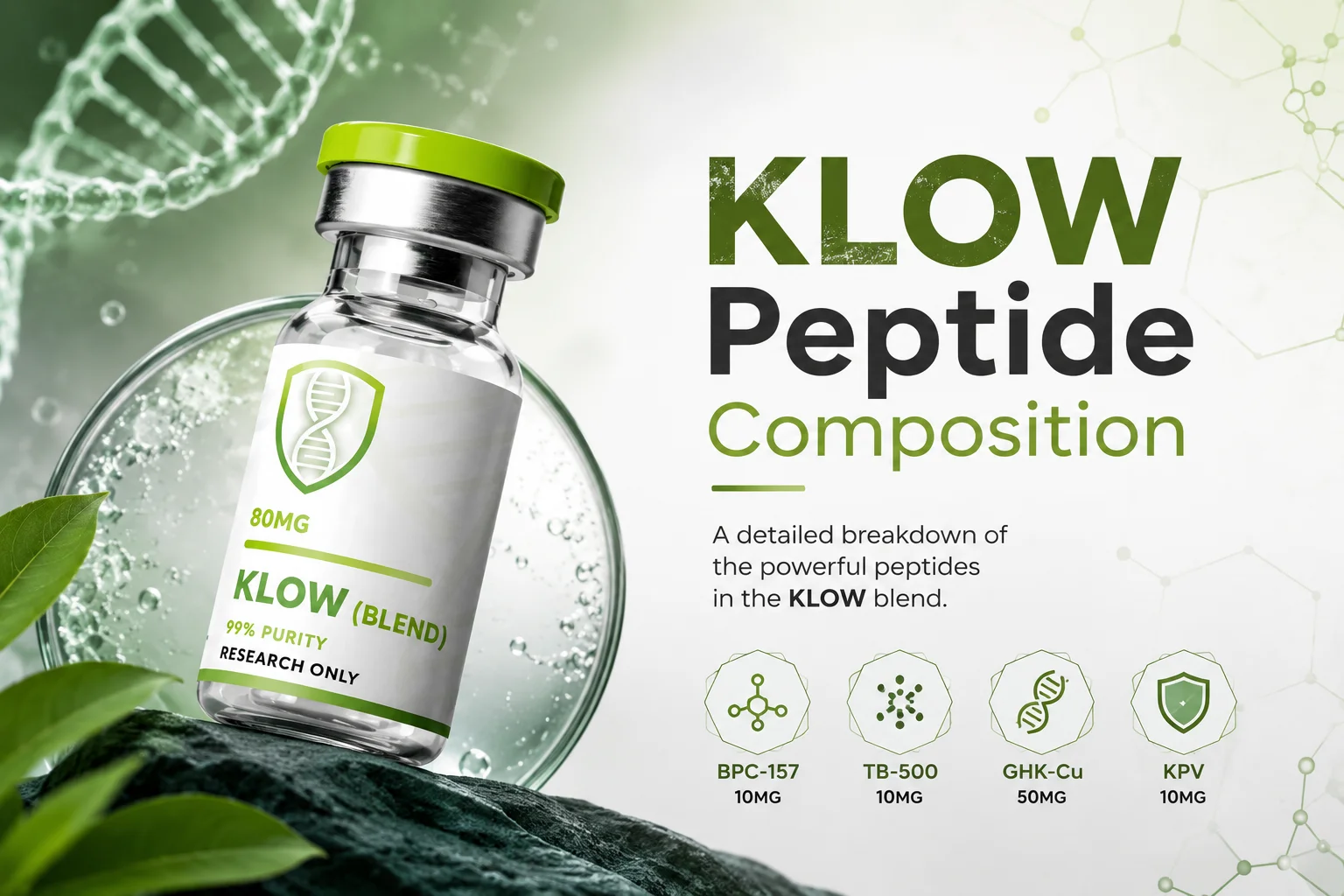
KLOW is a research compound of 4 peptides: BPC-157, TB-500, GHK-Cu, and KPV in one lyophilized mixture. Most commonly, it is supplied as an 80mg vial containing 50mg GHK-Cu, 10mg BPC-157, 10mg TB-500, and 10mg KPV. Sometimes the blend is called the GLOW stack (GHK-Cu, BPC-157, TB-500) with KPV added to make it unique.
The various components of the KLOW blend act differently on different parts of tissue repair, inflammation modulation, and cell signaling. The multi-component nature of it enables investigators to study peptide interactions in complex biological systems.
Researchers can buy Klow Blend at Orion Peptides for laboratory research purposes.
Peptide Composition in KLOW
The KLOW research blend is known as a mixture of four peptides, in which the concentration of the peptides is 80 mg. This formula includes GHK-Cu, BPC-157, TB-500, and KPV in the proportion 50/10/10/10 mg.
| Component | Amount | Share of blend | Primary research focus |
| GHK-Cu | 50 mg | 62.5% | Collagen biology and extracellular matrix |
| KPV | 10 mg | 12.5% | Inflammatory signaling |
| TB-500 | 10 mg | 12.5% | Tissue remodeling and cell migration |
| BPC-157 | 10 mg | 12.5% | Tissue research and cell migration |
The largest share of the blend belongs to GHK-Cu. In addition, the other three peptides contribute the same amount to the whole mixture, 12.5%.
Nevertheless, the concentration of a certain peptide cannot be regarded as an indication of its biological activity. All peptides have their specific structure, mechanisms, and effects on the human body, and therefore the mentioned ratio can be interpreted only as the composition of the mixture.
It is important since all peptides have their own literature of research. Thus, for instance, there are experiments on fibroblast migration connected with BPC-157, but those findings do not establish the effects of the complete KLOW blend
Why KLOW Contains Four Different Peptides
The reason why KLOW contains four different peptides is that each one has been studied for different indications, and it is thought that combining the individual research fields of each together in one formula allows a more diverse field of experimentation.
- BPC-157: Researched in relation to fibroblast activity and cell migration.
- TB-500: Thymosin beta-4, which is studied in connection to cell migration and tissue remodeling.
- GHK-Cu: Researched in relation to collagen formation and extracellular matrix.
- KPV: Researched for its inflammatory and intestinal signal activity.
Thus, there is a research path in several directions and not just a single target peptide.
However, it is crucial to distinguish between the research on the component peptides and the research on the mixture itself. Scientific publications about BPC-157, GHK-Cu, KPV, or thymosin beta-4 do not necessarily mean the same results for the KLOW.
At present, there is no controlled study establishing that the four components produce a synergistic effect when combined. Therefore, researchers should treat potential interactions as areas for investigation rather than established outcomes.
1. BPC-157: The Tissue Research Component
BPC-157 (Body Protection Compound-157) is a synthetic pentadecapeptide consisting of 15 amino acids. It is derived from a naturally occurring protein found in human gastric juice and was first introduced in 1993.
Mechanism of Action and Research Evidence
According to a study published in the Journal of Molecular Medicine (2017) by Hsieh and colleagues, BPC-157 promotes angiogenesis through upregulation of vascular endothelial growth factor receptor 2 (VEGFR2). The research demonstrated that BPC-157 could increase vessel density both in vivo and in vitro, as shown through the chick chorioallantoic membrane (CAM) assay and endothelial tube formation assays.
The study further revealed that BPC-157 accelerates blood flow recovery in ischemic muscle tissue and increases VEGFR2 expression at both the mRNA and protein levels in human vascular endothelial cells. Notably, BPC-157 promotes VEGFR2 internalization and activates the VEGFR2-Akt-eNOS signaling pathway, which is essential for its angiogenic effects.
Applications for Research
BPC-157 is studied in laboratories for:
- Tissue healing in muscle, tendon, and ligament models
- Studies of angiogenesis and wound healing
- Research on vascular regeneration
2. TB-500: The Cell-Migration Research Component
TB-500 is commonly described as a peptide related to thymosin beta-4 research. Research on thymosin beta-4 has examined cellular migration, angiogenesis, and tissue remodeling.
The study “Thymosin β4 stimulates directional migration of human umbilical vein endothelial cells” found that thymosin beta-4 promoted endothelial cell migration and influenced matrix metalloproteinase activity. These findings provide a research basis for studying cell movement and vascular processes.
Another study, “Thymosin beta4 accelerates wound healing,” examined thymosin beta-4 in experimental wound models and reported effects on re-epithelialization, collagen deposition, and angiogenesis.
Within the KLOW composition, TB-500 therefore represents the cell-migration and tissue-remodeling research component. Orion Peptide lists TB-500 at 10 mg in its 80 mg KLOW formulation.
One distinction is important: much of the published literature concerns full-length thymosin beta-4, not necessarily every commercial TB-500 preparation. Therefore, these findings provide biological context but should not be treated as direct evidence for the complete KLOW blend.
3. GHK-Cu: The Copper Peptide Component
GHK-Cu is a copper-binding tripeptide studied extensively in extracellular matrix and fibroblast research. Its research profile includes collagen synthesis, matrix remodeling, and cellular signaling.
The study “Stimulation of collagen synthesis in fibroblast cultures by the tripeptide-copper complex glycyl-L-histidyl-L-lysine-Cu²⁺” found that GHK-Cu stimulated collagen production in cultured fibroblasts.
Another study, “The tripeptide-copper complex glycyl-L-histidyl-L-lysine-Cu²⁺ stimulates matrix metalloproteinase-2 expression by fibroblast cultures,” found that GHK-Cu increased MMP-2 and tissue inhibitor levels. These findings suggest involvement in extracellular matrix remodeling, not only matrix production.
Within the KLOW formulation, GHK-Cu is the largest component at 50 mg. This represents 62.5% of the listed 80 mg blend. However, a higher mass does not automatically indicate greater biological activity because peptide potency depends on molecular targets, concentration, and other pharmacological factors.
These studies provide evidence for GHK-Cu’s individual research profile. They do not establish the effects of GHK-Cu within the complete KLOW blend.
4. KPV: The Inflammatory Signaling Component
KPV is a tripeptide composed of lysine, proline, and valine. It corresponds to the C-terminal sequence of α-MSH and has attracted research interest because of its effects on inflammatory signaling.
The study “PepT1-Mediated Tripeptide KPV Uptake Reduces Intestinal Inflammation” examined KPV in human intestinal and immune cell models, along with mouse models of colitis. Researchers found that KPV reduced NF-κB and MAP kinase signaling and lowered pro-inflammatory cytokine secretion. The animal models also showed reduced inflammatory markers after KPV treatment.
Another study, “Melanocortin-derived tripeptide KPV has anti-inflammatory potential in murine models of inflammatory bowel disease,” reported reduced inflammatory changes in two mouse models of intestinal inflammation. The researchers also found that some of KPV’s effects appeared independent of melanocortin-1 receptor signaling.
Within the KLOW composition, KPV represents the inflammatory signaling research component. However, these findings come from studies of KPV alone. They do not establish that the same effects occur when KPV is combined with BPC-157, TB-500, and GHK-Cu in the complete KLOW formulation.
Why GHK-Cu Makes Up Most of the KLOW Blend
One of the most noticeable features of KLOW is its 50/10/10/10 mg composition. GHK-Cu contributes 50 mg, making up 62.5% of the total 80 mg blend, while BPC-157, TB-500, and KPV each contribute 10 mg.
This ratio reflects the compound’s formulation, not the relative strength of the four peptides. In peptide research, biological activity depends on receptor targets, molecular structure, and concentration-response relationships rather than milligram weight alone.
GHK-Cu has one of the most extensive research histories among the four components. The study “Stimulation of Collagen Synthesis in Fibroblast Cultures by the Tripeptide-Copper Complex Glycyl-L-Histidyl-L-Lysine-Cu²⁺” demonstrated increased collagen production in cultured fibroblasts, supporting its role in extracellular matrix research.
Within KLOW, the larger GHK-Cu proportion should therefore be viewed as a formulation characteristic rather than evidence that it is the most biologically potent component.
Concluding Remarks
KLOW is an experimental four-peptide combination which includes BPC-157, TB-500, GHK-Cu, and KPV. It has an average of 80 mg per portion, where there is 50 mg of GHK-Cu and 10 mg of each of the other peptides.
Each peptide has its own research history, where BPC-157 is associated with cellular and tissue research, TB-500 with cell migration studies, GHK-Cu with extracellular matrix, and KPV with inflammation.
Still, the research on every single peptide does not provide information on the activity of the whole KLOW mixture, since research on this particular combination of four peptides is scarce. Thus, there is no basis for claims about synergy or biological effects of KLOW.
Thus, for researchers, information about the composition, research on every single peptide, and the lack of direct research on KLOW is important.
FAQs
1. What is the composition of KLOW peptide?
KLOW is commonly listed as an 80 mg four-peptide blend containing GHK-Cu, BPC-157, TB-500, and KPV. Orion Peptide lists the formulation as 50 mg GHK-Cu and 10 mg of each remaining peptide.
2. How much GHK-Cu is in KLOW?
The Orion Peptide formulation contains 50 mg of GHK-Cu, making it the largest component by weight.
3. How much BPC-157 is in KLOW?
The listed formulation contains 10 mg of BPC-157. Researchers have studied BPC-157 mainly in preclinical tissue and cellular models.
4. Does KLOW contain TB-500?
Yes. The Orion Peptide formulation contains 10 mg of TB-500. TB-500 is commonly associated with research related to thymosin beta-4 and cell migration.
5. What is KPV in the KLOW blend?
KPV is a three-amino-acid peptide composed of lysine, proline, and valine. Research has examined its role in inflammatory and intestinal signaling.
6. Why does KLOW contain four peptides?
The four components have different research profiles. This allows researchers to investigate multiple biological pathways within one experimental formulation.
7. Is KLOW a single peptide?
No. KLOW is a blend of four chemically distinct peptides supplied in one formulation.
8. Has the complete KLOW blend been clinically studied?
Direct evidence for the complete blend remains limited. Research on its individual components should not be treated as direct evidence for the combined formulation.
9. Is KLOW FDA-approved?
KLOW is a research formulation and is not an FDA-approved drug. Orion Peptide specifies its compound for controlled research applications rather than human use.
Research Disclaimer: The KLOW peptide blend is intended for laboratory and scientific research purposes only. It is not approved by the FDA for human therapeutic or diagnostic use. The information presented in this article summarizes findings from published scientific literature and should not be interpreted as medical advice. Researchers are advised to consult primary literature and regulatory guidelines before conducting any studies.
References
- https://orionpeptide.com/compound/klow-blend-80mg/
- https://pubmed.ncbi.nlm.nih.gov/27847966/
- https://pubmed.ncbi.nlm.nih.gov/9194528/
- https://pubmed.ncbi.nlm.nih.gov/10469335/
- https://pubmed.ncbi.nlm.nih.gov/3169264/
- https://pubmed.ncbi.nlm.nih.gov/11045606/
- https://pubmed.ncbi.nlm.nih.gov/18061177/
- https://pubmed.ncbi.nlm.nih.gov/18092346/