

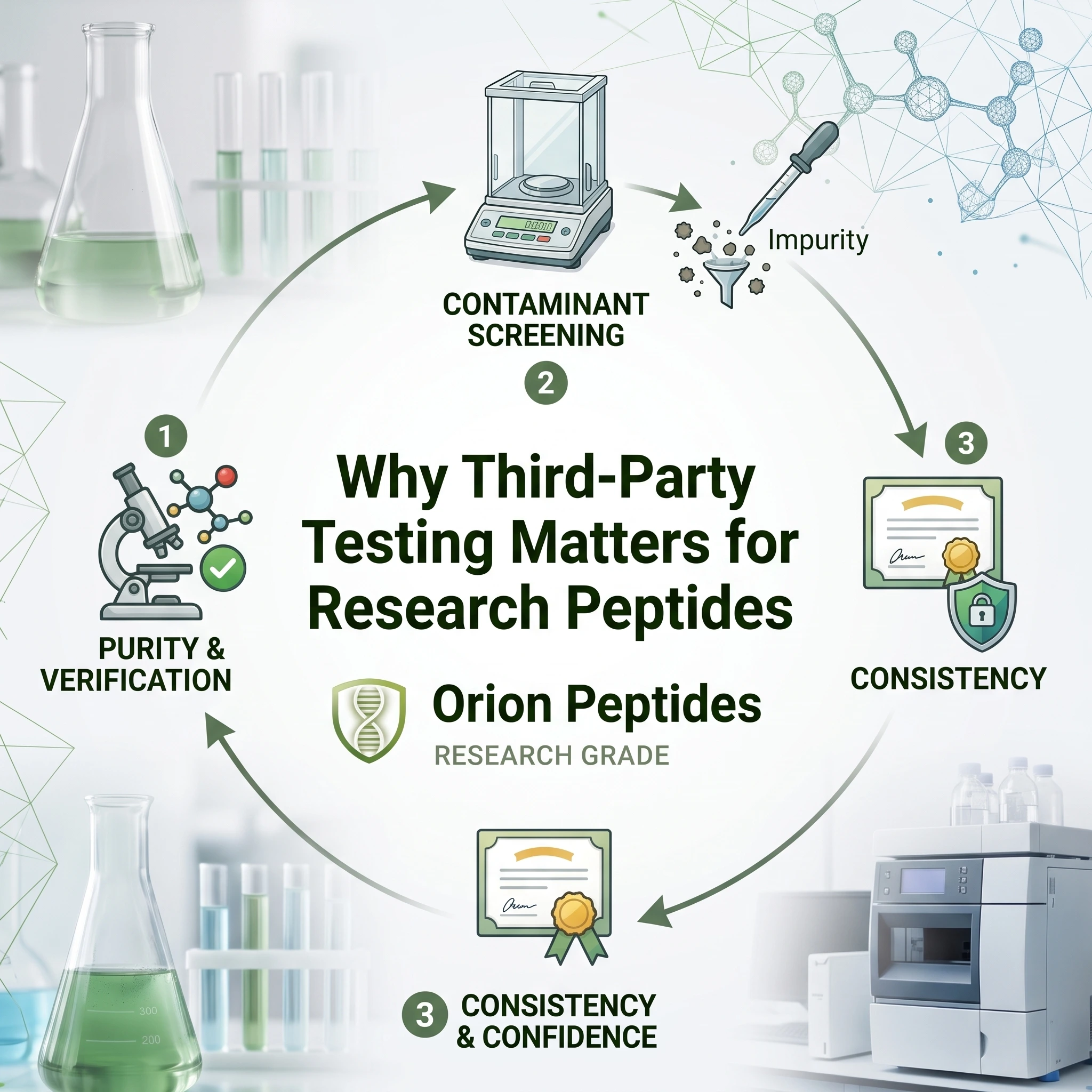
An Overview
Research peptides can play an important role in molecular biology, biochemistry, and preclinical research. Researchers often depend on these compounds to study biological pathways, protein interactions, cellular responses, and other experimental questions. However, the quality of the reagent itself can affect the reliability of the resulting data.
A peptide may appear identical to another vial based on its physical appearance. Yet, differences in purity, molecular identity, impurities, or batch consistency may produce different experimental outcomes.
This is why analytical verification matters.
Third-party testing gives researchers an additional source of evidence about the material they purchase. Independent laboratories can use analytical techniques such as high-performance liquid chromatography (HPLC) and mass spectrometry (MS) to assess peptide purity and identity. Scientific literature recognizes chromatography and mass spectrometry as important tools for characterizing synthetic peptides.
Research reagent quality also has a direct connection with reproducibility. A Nature Communications study found that inadequate quality control of protein reagents can contribute to unreliable experimental results and proposed practical quality-control measures for improving research reproducibility.
For researchers, the goal is not simply to find a peptide with a high stated purity. The more important questions are:
- What compound was tested?
- Which batch was tested?
- Which analytical methods were used?
- What results did the laboratory obtain?
- Can the documentation be connected to the supplied material?
A properly documented Certificate of Analysis (COA) can help answer these questions. Third-party analytical testing can provide additional evidence that supports batch traceability and informed reagent selection.
At Orion Peptide, transparent analytical documentation helps researchers evaluate research peptides before they enter a laboratory workflow. The following guide explains how third-party testing works, what HPLC and mass spectrometry can show, how to evaluate a peptide COA, and why batch-specific documentation matters for experimental reproducibility.
The Realities of Peptide Synthesis
Most synthetic research peptides are produced through solid-phase peptide synthesis (SPPS). This process builds the peptide chain step by step, with each amino acid added in a controlled sequence.
Each synthesis cycle generally involves:
- Deprotection: Removing the protecting group from the growing chain.
- Activation: Preparing the next amino acid for coupling.
- Coupling: Attaching the new amino acid to the peptide chain.
- Washing: Removing excess reagents before the next cycle.
Because these steps repeat across the peptide sequence, incomplete reactions or side reactions can create truncated sequences, modified peptides, or other related impurities. The final material therefore requires purification and analytical characterization before researchers can assess its quality. Peer-reviewed literature identifies chromatography and mass spectrometry among the analytical techniques used to evaluate peptide identity, purity, and related impurities.
This is where quality-control testing becomes important. HPLC can help assess chromatographic purity, while mass spectrometry can provide molecular-mass information that supports peptide identity. Using complementary analytical methods gives researchers more information than relying on a single purity value.
For this reason, researchers should evaluate not only the stated purity of a peptide but also the analytical data, testing methods, batch identification, and supporting COA documentation.
This approach avoids an important mistake: treating a high purity percentage as complete proof of peptide quality. A research peptide requires appropriate identity, purity, and batch-specific characterization for meaningful laboratory evaluation.
Why Third-Party Testing Matters for Research Peptides
Third-party testing adds independent analytical evidence to a supplier’s quality documentation. Instead of relying only on internal testing, an external laboratory evaluates the specific peptide batch.
For researchers, this can provide useful information about:
- HPLC purity
- Molecular identity
- Batch-specific results
- Analytical methods
- Testing laboratory
HPLC can assess chromatographic purity, while mass spectrometry can provide molecular-mass evidence for peptide identity. These methods answer different analytical questions, so using both provides a stronger assessment than relying on either test alone.
A third-party COA should also identify the specific batch or lot tested. This allows researchers to compare the document with the material they receive and maintain accurate laboratory records.
However, third-party testing is not a complete guarantee of compound quality. HPLC and mass spectrometry do not automatically assess every possible attribute, such as sterility, endotoxin levels, residual solvents, or long-term stability. Those properties require separate analytical tests when relevant to the research application.
For this reason, researchers should evaluate a COA based on its laboratory source, analytical methods, batch traceability, and actual test results, rather than simply looking for a “third-party tested” label.
HPLC Testing: What Does Peptide Purity Really Mean?
High-performance liquid chromatography (HPLC) is widely used to evaluate the chromatographic purity of research peptides. It separates components in a sample and produces a chromatogram with individual peaks. The main peak is then compared with other detected peaks to calculate the reported purity.
Researchers should understand one important limitation: HPLC purity does not automatically confirm peptide identity. A dominant peak can indicate high chromatographic purity, but another analytical method is needed to support the identity of that peak.
When reviewing an HPLC result, check:
- Reported purity percentage
- Chromatogram
- Retention time
- Analytical method
- Batch or lot number
HPLC purity also should not be confused with the total peptide content by mass. Water, counterions, salts, and other components can affect the overall material composition without appearing as the same type of chromatographic signal.
For this reason, researchers should view an HPLC percentage as one analytical measurement, rather than a complete statement about every aspect of peptide quality.
Mass Spectrometry: Aid in Establishing Peptide Identity
Mass spectrometry (MS) gives molecular mass information, which is complementary to HPLC purity determination. MS can be used to help establish whether the identified peptide has a molecular mass that corresponds to the expected compound.
While HPLC will give only information about chromatographic purity, MS provides evidence about molecular identity. The use of both techniques offers researchers a more complete profile compared to the use of any technique alone.
To confirm peptide sequence, tandem mass spectrometry (MS/MS) studies peptide fragments. Fragmentation data can be used to establish peptide sequences and identify some modifications or associated impurities.
However, intact mass match is not always evidence of the complete peptide sequence. There are several structural differences that may provide identical molecular mass and require the use of other analysis techniques.
This is why researchers should consider MS as supplementary evidence for peptide identification, but not as proof of peptide quality.
What Third-Party Testing Can Actually Verify
Third-party testing can provide independent analytical evidence about specific characteristics of a research peptide batch. The exact information depends on the analytical methods used by the testing laboratory.
Common results may include:
- Chromatographic purity through HPLC
- Molecular-mass evidence through mass spectrometry
- Batch-specific analytical results
- Analytical methods and acceptance criteria
- Peptide-related impurities, when suitable methods detect them
The FDA recognizes analytical procedures as important tools for evaluating attributes such as identity, strength, quality, and purity. FDA research also shows that LC-MS and LC-MS/MS can help characterize peptide-related impurities and complex peptide mixtures.
These results can help researchers compare the tested material with its stated specifications. However, third-party testing does not automatically verify every aspect of peptide quality. The value of a report depends on the specific tests performed, the analytical methods used, and the batch connected to the results.
For this reason, researchers should evaluate the actual analytical evidence, rather than rely only on a supplier’s “third-party tested” claim.
Why Batch-Specific Testing Matters
A third-party test becomes more useful when the results are linked to the specific peptide batch being evaluated. Batch information allows researchers to connect analytical findings with the material used in their research.
A batch-specific report should ideally include:
- Batch or lot number
- Compound identification
- Testing date
- Sample identification
- Specific analytical results
FDA guidance emphasizes the importance of defined specifications, analytical procedures, and acceptance criteria for evaluating the quality attributes of individual batches. It also notes that identification testing should use methods capable of distinguishing the intended substance from closely related compounds.
Batch traceability also helps researchers maintain accurate laboratory records. If different batches show different analytical results, researchers can identify those differences instead of treating all material from a supplier as identical.
For this reason, a batch-specific third-party COA provides more useful evidence than a generic certificate that does not identify the tested lot.
Third-Party Testing vs. Supplier-Provided Testing
Supplier testing can provide useful information about peptide quality and batch specifications. Third-party testing adds an independent analytical layer from an external laboratory.
Researchers should focus on the testing method, laboratory, batch number, and actual results, rather than the “third-party tested” label alone.
FDA guidance emphasizes that reliable quality assessment depends on appropriate analytical procedures, specifications, and acceptance criteria.
The key question is not simply “Was it third-party tested?” It is “What was tested, how was it tested, and do the results support the stated specifications?”
What Third-Party Testing Does Not Prove
Third-party testing can provide valuable analytical evidence, but no single test establishes every aspect of peptide quality.
For example, HPLC can assess chromatographic purity, while mass spectrometry can support molecular identity. Other characteristics require separate analytical methods.
These may include:
- Sterility
- Endotoxin levels
- Residual solvents
- Elemental impurities
- Stability and degradation
FDA guidance recognizes separate testing approaches for impurities, residual solvents, sterility, and endotoxins.
Therefore, researchers should evaluate a third-party COA based on the specific tests performed and the claims those tests can actually support. A “third-party tested” label should not be treated as a complete guarantee of peptide quality.
Interested in how to read a peptide COA? Read our blog How to Read a Peptide COA: A Detailed Researcher’s Guide
Red Flags in Third-Party Testing Documentation
Researchers should look beyond the “third-party tested” label when reviewing peptide documentation. Certain missing details can make a report less useful for batch verification.
Common red flags include:
- No testing laboratory identified
- Missing batch or lot number
- No testing date
- Purity results without supporting chromatograms
- No analytical method listed
- Generic COAs used for multiple batches
- Missing acceptance criteria or actual results
FDA guidance emphasizes that analytical records should identify the material and batch, testing methods, raw analytical data, and actual results.
A strong third-party report should therefore provide enough information to connect the laboratory, method, tested sample, batch, and reported result.
How Researchers Should Evaluate Third-Party Test Results
Researchers should evaluate a third-party report based on the method, sample, batch, and actual results. A useful review can follow five simple questions:
- Who performed the testing?
- What specific material and batch were tested?
- Which analytical method was used?
- What specification or acceptance criteria applied?
- Do the reported results meet those criteria?
FDA guidance states that analytical procedures should be suitable for their intended purpose and support assessments of identity, quality, and purity. FDA also emphasizes that specifications should include appropriate tests, analytical procedures, and acceptance criteria.
This approach helps researchers focus on actual analytical evidence instead of relying on a third-party testing claim alone.
Third-Party Testing Checklist
Before utilizing the information from a third-party test report, researchers must verify a few key pieces of information:
- Testing laboratory: Is the third-party laboratory mentioned explicitly?
- Batch number: Does the report correlate with the specific batch purchased?
- Testing methodology: Are the methods of testing clearly listed?
- HPLC: Does the purity information come with test results?
- Mass spectrometry: Is there molecular mass proof for identity testing?
- Test results: Are there actual results with specifications?
- Testing date: Does the report correspond to a certain testing period?
FDA guidelines state that specifications include “tests, analytical procedures, and acceptance criteria used to control a quality attribute.”
This type of checklist will enable researchers to verify the claims made about the test and not simply trust the label.
FAQs
1. What is third-party testing for research peptides?
Third-party testing means independent analysis of a peptide sample in a laboratory based on certain analytical techniques. The test results can be used as additional evidence of certain attributes such as purity and identity.
2. Can third-party testing confirm the peptide purity?
No. The answer depends on both the analytical technique and attribute in question. For example, HPLC can be used to get evidence of chromatographic purity, while other attributes need to be confirmed separately.
3. Can mass spectrometry prove peptide identity?
The use of mass spectrometry can give evidence of peptide identity via molecular-mass information. However, further characterization can require additional techniques, including MS/MS or other analytical techniques.
4. Why do we need the batch number on the peptide COA?
The batch number identifies the tested material in relation to the test results. Thus, it helps to ensure the traceability of the tested peptide and its records by the researcher.
5. Is third-party testing enough to prove peptide quality?
No. The use of third-party testing gives no guarantee of the quality attributes, because the researcher needs to analyze the lab, analytical methods, batch, specifications, and results.
Conclusion
Third-party testing gives researchers independent analytical evidence about a specific peptide batch. HPLC can assess chromatographic purity, while mass spectrometry can support molecular identity.
However, no single test can establish every aspect of peptide quality. Researchers should review the laboratory, analytical methods, batch information, specifications, and actual results before concluding.
Ultimately, a “third-party tested” label matters most when it is supported by clear, batch-specific, and scientifically appropriate analytical data.
References
- https://www.bachem.com/knowledge-center/solid-phase-peptide-synthesis-spps-explained/
- https://en.wikipedia.org/wiki/High-performance_liquid_chromatography
- https://www.fda.gov/regulatory-information/search-fda-guidance-documents/q6a-specifications-test-procedures-and-acceptance-criteria-new-drug-substances-and-new-drug-compounds
- https://orionpeptide.com/how-to-read-a-peptide-coa/
