

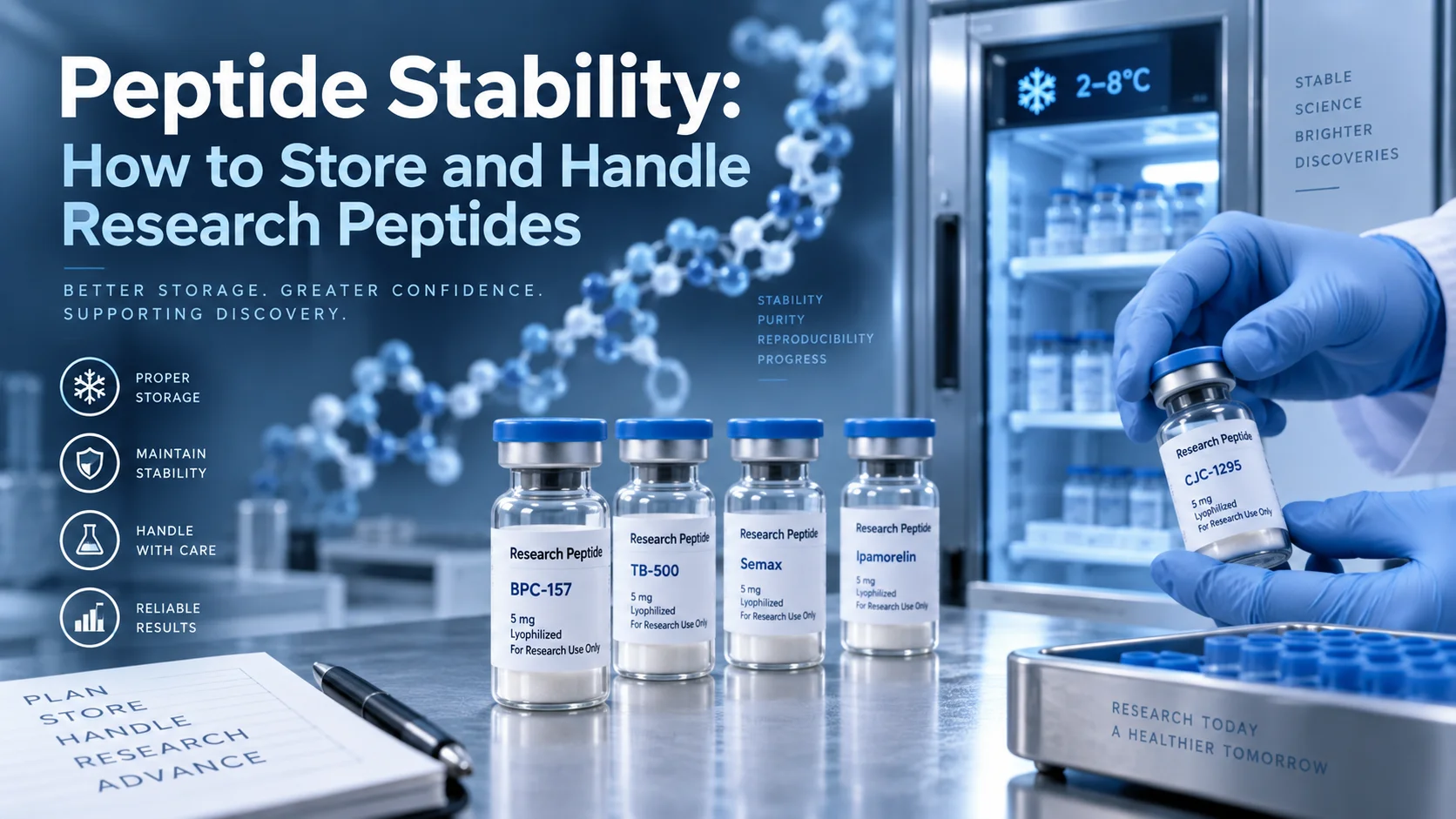
Peptide stability refers to a peptide’s ability to maintain its chemical and physical characteristics under defined storage and handling conditions.
Research peptides can change over time through several degradation pathways. These include oxidation, deamidation, hydrolysis, aggregation, and other sequence-dependent modifications. Temperature, moisture, pH, concentration, light, agitation, and formulation can also influence stability.
For laboratory researchers, peptide stability matters because degradation can alter the composition of a sample and introduce variables into an experiment.
There is no single storage condition that applies to every peptide. The appropriate conditions depend on the peptide sequence, formulation, physical state, packaging, and intended research application.
This guide explains the major factors that affect research peptide stability and provides practical considerations for storage, handling, reconstitution, and analytical monitoring.
What Is Peptide Stability?
Peptide stability describes how well a peptide maintains its intended chemical structure and physical characteristics over time.
When it comes to peptide stability, it can be divided into two broad categories:
- Chemical stability: it tells whether the peptide undergoes chemical modifications.
- Physical stability: it tells whether the peptide changes physically, such as through aggregation or precipitation.
There are some common chemical changes, including oxidation, deamidation, hydrolysis, and other modifications. Physical instability can involve aggregation, fibrillation, precipitation, or changes in the peptide’s higher-order structure.
These changes can occur during manufacturing, storage, transportation, reconstitution, or laboratory handling.
The rate of degradation is highly dependent on the individual peptide and its environment.
Peptide Degradation: What Are Some Common Causes?
Some of the most common causes related to chemical degradation of peptides are as follows:
1. Oxidation
Oxidation constitutes an important pathway of peptide degradation.
The amino acid residues present within a peptide sequence, including methionine, can undergo oxidation, which can lead to changes in the physicochemical properties of the molecule.
Exposure to light, oxygen, reactive impurities, and other environmental factors can result in oxidative transformations.
It is crucial for a researcher to avoid unnecessary exposure to environmental conditions that can promote oxidation.
2. Deamidation
Deamidation of asparagine and glutamine side chains constitutes another widespread mechanism of peptide degradation.
The pH, temperature, amino acid sequence, and formulation of the peptide can determine the extent of deamidation.
The most suitable pH for a specific peptide cannot be universally predicted, but the stability properties of the molecule must be examined considering its amino acid sequence and formulation.
Hydrolysis and Other Chemical Modifications
Peptides are subjected to various chemical transformations, including hydrolysis.
The literature reports degradation processes associated with hydrolysis, reduction, oxidation, deamidation, racemization, β-elimination, and other modifications that can take place in a sequence-dependent manner.
The choice of an analytical method mostly depends on the suspected peptide degradation mechanisms.
Physical Degradation: Aggregation and Fibrillation
Not all peptide instability involves a chemical change.
Peptides can also undergo aggregation, where individual molecules associate to form larger assemblies. Some peptides can form highly organized structures known as fibrils.
Several factors can affect peptide aggregation, including:
- Peptide sequence
- Concentration
- pH
- Temperature
- Surface interactions
- Impurities
- Agitation
- Freeze-drying conditions
- Freeze-thaw cycles
Research has shown that both intrinsic properties of the peptide and external conditions can influence physical stability.
This is one reason why a peptide that appears chemically stable may still require careful handling.
How Temperature Affects Peptide Stability
Temperature can significantly affect the rate of chemical and physical degradation.
In general, elevated temperatures can accelerate many degradation reactions. However, the relationship is peptide-specific and depends on factors such as formulation, concentration, solvent, and physical state.
For example, research on lyophilized and reconstituted peptide formulations has demonstrated that stability can change considerably after reconstitution and that temperature can influence aggregation and precipitation.
The key point for researchers
No universal rule exists, such as “all peptides must be stored at −20°C” or “all peptides remain stable for X months.”
Instead:
- Check the compound-specific storage recommendation.
- Keep the peptide within the specified temperature range.
- Minimize unnecessary temperature changes.
- Protect sensitive materials from moisture and light when appropriate.
- Avoid repeated freeze-thaw cycles for solutions whenever possible.
For Orion compounds, researchers should follow the storage information provided for the specific compound rather than applying one storage condition to the entire peptide catalog.
How pH and Solvent Conditions Affect Stability
Once a peptide is in solution, its stability can differ substantially from its stability in a dry, lyophilized state.
Factors that may affect stability include:
- pH
- Buffer composition
- Ionic strength
- Peptide concentration
- Solvent composition
- Temperature
- Exposure to air
- Container surfaces
Reviews of peptide formulation research identify pH and buffer selection as important considerations when developing stable aqueous peptide formulations.
However, researchers should not assume that one buffer or pH is suitable for every peptide.
The appropriate solvent and formulation depend on the individual peptide and experimental system.
For research applications, researchers should follow validated laboratory protocols and available compound-specific documentation.
Peptide Stability in Biological Samples
Peptide stability becomes a critical issue when studying peptides in biological matrices such as plasma, serum, and other biochemical samples.
Peptides can be easily degraded by proteases and peptidases that are naturally present in biological fluids. Sample collection and preparation, temperature, and storage conditions can therefore significantly affect the amount of analyte that is present at the time of analysis.
This is especially important for analytical studies in which distinguishing between the original peptide and its degradation compounds is required.
Sample preparation should therefore be tailored to the specific peptide, biological matrix, and analytical method that are being used.
Handling and Reconstitution Considerations
Lyophilized Peptide Storage
Many research peptides are supplied as lyophilized powders.
Lyophilization can reduce the amount of water available for certain degradation reactions and is widely used to improve the storage stability of sensitive biological materials.
However, freeze-drying does not make a peptide permanently stable.
Researchers should:
- Keep the container properly closed.
- Minimize moisture exposure.
- Follow the compound-specific storage recommendation.
- Protect the material from conditions known to affect its stability.
- Avoid unnecessary opening of the container.
Allowing a cold container to equilibrate before opening may also help reduce condensation when moisture-sensitive materials are involved.
Reconstitution Considerations
Reconstitution can introduce new stability challenges.
The appropriate solvent, concentration, mixing procedure, and storage conditions depend on the specific peptide.
Researchers should avoid assuming that purified water, saline, buffer, or an organic solvent will be appropriate for every peptide.
Instead, consult the relevant compound documentation and established laboratory protocols.
Published research has shown that the reconstitution process itself can influence the stability of lyophilized biological materials.
For some peptide formulations, changes after reconstitution may include aggregation, precipitation, or other physical changes.
The Importance of Freeze-Thaw Cycles
Peptide solutions are particularly sensitive to repeated cycles of freezing and thawing, which may expose them to different temperatures, concentrations, interfaces, and physical conditions.
Depending on the nature of the peptide and formulation, these changes can promote aggregation amongst other forms of instability.
When appropriate for the experimental design, it is possible to minimize unnecessary exposure by preparing solutions in appropriate aliquots.
The method used should be guided by a knowledge of the stability of the particular peptide in question and the demands of the intended application.
How Researchers Monitor Peptide Stability
Proper storage is only part of stability management. Analytical testing can help researchers determine whether a peptide has changed.
HPLC
Reversed-phase HPLC is widely used in peptide analysis.
It can separate the intended peptide from related substances and degradation compounds based on differences in chromatographic behavior.
Comparing chromatographic profiles over time can therefore help researchers investigate changes in peptide purity.
However, HPLC results should be interpreted according to the specific method and its limitations.
Mass Spectrometry
Mass spectrometry provides molecular-mass information that can help characterize the peptide and investigate certain degradation compounds.
For example, mass shifts may provide evidence of specific chemical modifications.
HPLC and MS can therefore provide complementary information when investigating peptide stability. Analytical methods should be appropriately selected and validated for the purpose of the study.
Visual Inspection
Visual inspection can also provide useful preliminary information.
Researchers may observe:
- Changes in powder appearance
- Changes in the lyophilized cake
- Discoloration
- Precipitation
- Cloudiness
- Visible particulates
Visual inspection cannot replace analytical testing, but unexpected physical changes can indicate that further investigation may be warranted.
How to Protect Research Peptides During Storage
A practical stability checklist includes:
Before storage
- Confirm the compound identity and batch information.
- Review the supplier’s storage instructions.
- Check the condition of the packaging.
- Minimize unnecessary exposure to environmental conditions.
During storage
- Maintain the recommended temperature.
- Keep containers properly sealed.
- Limit exposure to moisture and light where appropriate.
- Avoid unnecessary temperature fluctuations.
- Follow compound-specific handling instructions.
After reconstitution
- Use the recommended solvent and concentration.
- Follow an appropriate laboratory protocol.
- Minimize unnecessary freeze-thaw cycles.
- Monitor the solution for unexpected physical changes.
- Use analytical testing when stability is important to the experiment.
The most important principle is simple:
Research peptide stability is compound-specific. Follow documented conditions rather than applying a universal storage rule.
Frequently Asked Questions
1. What are the most common causes of peptide degradation?
Common degradation pathways include oxidation, deamidation, hydrolysis, and aggregation. The dominant pathway depends on the peptide and its environment.
2. How should lyophilized research peptides be stored?
Storage conditions depend on the specific peptide, formulation, and packaging. Researchers should follow the supplier’s compound-specific storage instructions and minimize exposure to moisture, heat, light, and unnecessary temperature changes.
3. Does temperature affect peptide stability?
Yes. Temperature can influence chemical degradation and physical instability, but the effect varies between peptides and formulations.
4. Why is pH important for peptide stability?
pH can influence chemical reactions such as deamidation and hydrolysis and can also affect aggregation. The optimal conditions are peptide-specific.
5. Do freeze-thaw cycles affect peptides?
They can. Repeated temperature changes may contribute to physical instability, including aggregation, depending on the peptide and formulation.
6. How can researchers monitor peptide stability?
Common approaches include HPLC, mass spectrometry, and visual inspection. HPLC can help track chromatographic changes, while MS can provide molecular-mass information about the peptide and potential degradation compounds.
7. Is a lyophilized peptide always more stable than a peptide in solution?
Not necessarily. Lyophilization can improve stability for many labile biomolecules, but the process and subsequent reconstitution can also introduce physical stresses. Stability must therefore be evaluated for the specific peptide and formulation.
Conclusion
Peptide stability is influenced by much more than storage temperature. Sequence, formulation, moisture, pH, concentration, temperature, light, handling, and physical state can all affect how a peptide changes over time.
Chemical degradation may involve oxidation, deamidation, hydrolysis, or other modifications. Physical instability can involve aggregation, fibrillation, or precipitation.
For researchers, the best approach is to treat storage and handling as part of experimental quality control. Follow compound-specific recommendations, minimize unnecessary environmental stress, and use appropriate analytical methods when peptide integrity is critical.
For additional quality information, researchers can also review a peptide’s batch-specific Certificate of Analysis, HPLC results, identity testing, and other available analytical documentation before beginning an experiment.