

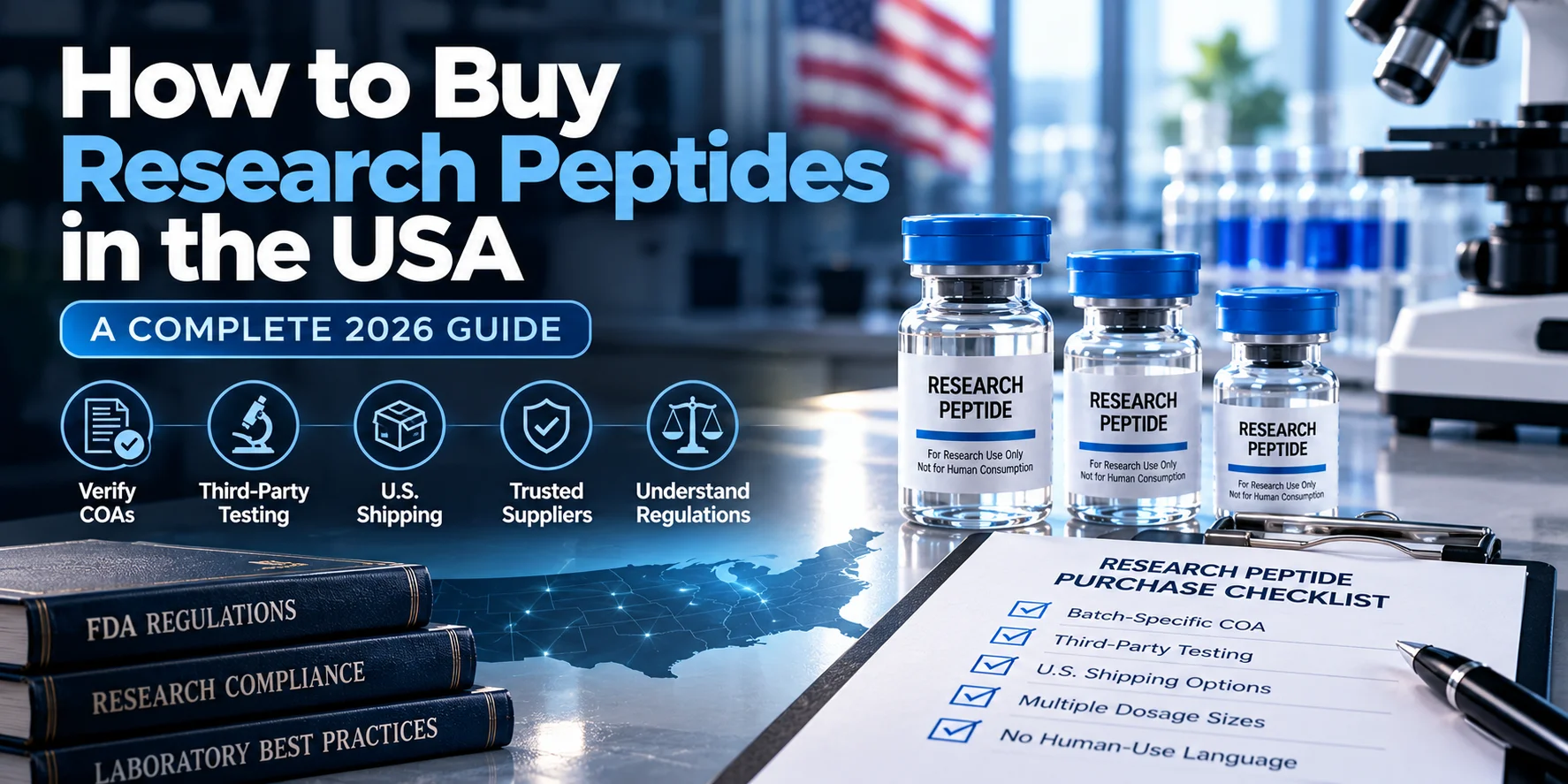
Buying research peptides in the USA requires more than finding a supplier with competitive prices. Researchers need to understand peptide quality, analytical testing, compound identity, shipping conditions, and the legal requirements that apply to their work.
Not every research peptide supplier provides the same level of documentation. Some publish detailed Certificates of Analysis (COAs), while others provide only a purity percentage without explaining how it was measured.
For researchers, these differences matter. A peptide with an incorrect identity, unknown impurities, or inadequate storage information can affect the reliability of laboratory results.
Before buying research peptides online, it is important to know what to check and which questions to ask.
This guide explains how to evaluate research peptide suppliers in the United States, understand COAs, compare prices, review shipping and storage requirements, and make informed purchasing decisions for legitimate laboratory research.
Key Takeaways
- Check the supplier: Choose suppliers that provide clear compound specifications, contact information, and research-use policies.
- Review the COA: Look for batch identification, testing methods, laboratory information, and actual analytical results.
- Understand purity claims: A 99% HPLC purity result does not automatically mean the vial contains 99% pure peptide by weight.
- Verify peptide identity: Mass spectrometry and other analytical techniques can provide evidence supporting molecular identity.
- Compare prices carefully: Cost per milligram is useful, but price alone cannot determine compound quality.
- Review shipping and storage: Different peptides may require different handling conditions.
- Understand the legal requirements: Research-use-only labeling does not establish FDA approval or automatically authorize every transaction.
What Are Research Peptides?
Research peptides are short chains of amino acids studied in laboratory and scientific settings.
Scientists use peptides to investigate cellular signaling, receptor interactions, protein function, and other biological processes.
Some synthetic peptides are designed to resemble naturally occurring molecules. Others contain structural modifications that affect their chemical or biological properties.
Research peptides may be studied through several experimental approaches, including:
- In vitro laboratory experiments
- Biochemical assays
- Molecular interaction studies
- Cell signaling investigations
- Analytical chemistry
- Appropriate nonclinical experimental models
Different peptides are studied for different scientific purposes.
For example, GHK-Cu is a copper-binding peptide studied in relation to cellular processes and extracellular matrix biology. MOTS-c is a mitochondrial-derived peptide investigated in metabolic and cellular signaling research.
Other compounds, including BPC-157 and TB-500, have been examined in preclinical research involving cellular signaling and tissue-related processes.
These research interests do not establish that a peptide is safe or effective for treating medical conditions.
Research-grade peptides should not be treated as approved medicines or used for personal administration.
Is It Legal to Buy Research Peptides in the USA?
The legality of buying research peptides in the United States depends on the compound, its intended use, and the circumstances of the transaction.
There is no single federal rule that makes every research peptide unlawful to purchase.
However, a compound described as a laboratory chemical may still be regulated as a drug if its intended use meets the legal definition of a drug under the Federal Food, Drug, and Cosmetic Act.
The FDA evaluates intended use by considering the available evidence, including compound descriptions, advertising, labeling, and other circumstances surrounding distribution.
A supplier cannot automatically avoid FDA requirements by placing a research-use-only statement on a compound that is otherwise marketed for human use.
What does “For Research Use Only” mean?
Research-use-only (RUO) labeling indicates that a compound is being represented for research rather than personal or clinical use.
A typical statement is:
For Research Use Only. Not for Human Consumption.
However, this statement is not a universal legal exemption.
The FDA can determine that a compound is an unapproved drug when the surrounding evidence establishes an intended drug use.
For example, promotional claims involving personal treatment results, injection instructions, or disease treatment may be relevant to the FDA’s evaluation.
In March 2026, the FDA issued a warning letter to Gram Peptides concerning the marketing of retatrutide, tirzepatide, and bacteriostatic water for injection.
The agency determined that the compounds reviewed were unapproved new drugs.
This demonstrates why researchers should not rely solely on the words “research use only” when evaluating a supplier.
External reference: FDA Warning Letter to Gram Peptides, March 31, 2026
For a more detailed explanation of U.S. peptide regulations, researchers should review official FDA publications and applicable state laws.
How to Choose a Research Peptide Supplier in the USA
A reliable research peptide supplier should provide enough information for researchers to evaluate the identity, quality, and suitability of the material for its intended laboratory application.
Here are the main factors to consider.
1. Check the supplier’s reputation and transparency
Begin by reviewing the supplier’s website.
A research-focused supplier should clearly explain what compounds it offers and provide relevant technical information.
Look for:
- Clear compound names and specifications
- Accessible customer support information
- Published research-use policies
- Analytical testing information
- Batch or lot identification
- Shipping and return policies
- Transparent descriptions of the compounds
Be cautious about suppliers that provide very little information about their compounds or testing procedures.
Customer reviews may be useful for evaluating service experiences, but they cannot independently verify peptide identity or purity.
For a more detailed checklist, see Orion Peptides’ article on how to choose a research peptide supplier.
2. Look for batch-specific Certificates of Analysis
A Certificate of Analysis is one of the most useful documents for evaluating a research peptide.
A COA reports analytical findings for a material or batch.
It can help researchers determine whether the tested sample meets specified identity and purity criteria.
A useful COA may include:
| COA information | What researchers should check |
|---|---|
| Compound name | Identifies the peptide tested |
| Batch or lot number | Connects the report to a particular batch |
| Testing date | Shows when the analysis was performed |
| Testing laboratory | Identifies the laboratory responsible |
| HPLC result | Provides chromatographic purity information |
| Mass spectrometry | Supports molecular identity assessment |
| Analytical methods | Explains how testing was performed |
| Specifications | States the relevant acceptance criteria |
| Actual results | Reports the analytical findings |
Not every COA includes every type of test.
The appropriate documentation depends on the peptide, its intended experimental application, and the research organization’s requirements.
Where batch-specific testing is claimed, researchers should check whether the document corresponds to the material being purchased.
3. Understand HPLC purity testing
High-performance liquid chromatography (HPLC) is commonly used to assess the chromatographic purity of peptides.
The method separates components in a sample and produces results that can indicate the presence of related substances or impurities.
A supplier may advertise a peptide as 99% pure based on HPLC testing.
However, researchers should understand what that percentage means.
A 99% chromatographic purity result does not automatically establish that 99% of the entire vial’s mass is the intended peptide.
It also does not prove sterility, complete peptide identity, or the absence of every possible impurity.
Different analytical methods evaluate different properties.
A meaningful purity report should identify the method used and provide enough supporting information for the result to be interpreted.
4. Verify peptide identity through analytical testing
Peptide identity is separate from chromatographic purity.
A sample can produce a strong HPLC purity result without providing sufficient evidence that it contains the expected molecular structure.
Mass spectrometry is commonly used to support peptide identity by measuring molecular mass.
More detailed analytical techniques may be needed when researchers must distinguish between closely related peptide sequences or structures.
Researchers should look for analytical findings that support the expected identity of the compound under the stated testing conditions.
For a complete explanation, read How to Read a Peptide COA: A Detailed Researcher’s Guide.
5. Look for third-party laboratory testing
Third-party testing means that an independent laboratory performs analytical work rather than relying entirely on the supplier’s internal testing.
Independent testing can provide additional evidence about a peptide’s reported characteristics.
However, the words “third-party tested” do not automatically establish complete compound quality.
Researchers should ask:
- Which laboratory performed the testing?
- Was the report issued for the relevant batch?
- Which analytical methods were used?
- What were the actual results?
- Can the laboratory’s identity be verified?
Third-party testing is most useful when it is supported by clear documentation.
For additional information, read Why Third-Party Testing Matters for Research Peptides.
How to Verify a Research Peptide COA
A COA should be evaluated carefully rather than accepted simply because it displays a high purity percentage.
Researchers can follow several practical checks.
Match the batch information
Compare the batch or lot number listed on the COA with the information supplied for the compound.
If the supplier provides a report from an earlier batch, that report does not automatically establish the quality characteristics of the current material.
Review the laboratory information
Check whether the report identifies the laboratory that performed the analysis.
Where independent testing is claimed, researchers may be able to confirm the report directly with the laboratory.
Some laboratories provide report identifiers, verification systems, or other methods of authenticating analytical records.
Review the actual test results
Look beyond a simple statement such as “99% purity.”
Useful supporting information may include chromatograms, molecular-mass results, analytical methods, and specification limits.
The absence of a particular data attachment does not automatically prove a certificate is fraudulent. However, researchers should request sufficient information to assess the reported findings.
Understand what the COA does not prove
A COA is not a guarantee of every compound characteristic.
For example, HPLC and mass spectrometry alone do not necessarily establish:
- Sterility
- Endotoxin levels
- Residual solvent content
- Long-term stability
- Biological activity in every experimental model
- Suitability for human administration
Additional analytical methods may be necessary depending on the research application.
How Much Do Research Peptides Cost in the USA?
Research peptide prices vary considerably.
There is no universal minimum price that guarantees peptide quality or identifies a fraudulent compound.
The cost of a peptide may depend on several factors.
1. Peptide structure and synthesis complexity
Some peptides are more difficult to synthesize or purify than others.
Factors such as peptide length, structural modifications, and manufacturing complexity may affect production costs.
2. Quantity purchased
Research peptides are often offered in different vial quantities.
Larger quantities may have a lower price per milligram, although this depends on the supplier and compound.
Researchers should consider how much material is required for the experiment rather than purchasing unnecessary quantities solely to obtain a lower unit price.
3. Analytical testing
Testing can contribute to the overall cost of supplying research materials.
Identity testing, chromatographic analysis, and other quality assessments may require specialized equipment and laboratory expertise.
However, a higher selling price does not automatically prove that more testing was performed.
4. Documentation and supplier services
Costs may also reflect packaging, shipping, technical documentation, batch tracking, and other supplier services.
How to compare research peptide prices
A useful starting point is to calculate the price per milligram.
Price per mg = Total compound price ÷ Total milligrams
For example:
| Compound price | Quantity | Price per mg |
|---|---|---|
| $40 | 5 mg | $8 |
| $65 | 10 mg | $6.50 |
| $110 | 20 mg | $5.50 |
These are hypothetical examples, not current market quotations.
The lowest price per milligram is not necessarily the best option.
Researchers should also compare analytical documentation, compound identity, quantity, and the specific requirements of their laboratory work.
What Should You Know About Shipping Research Peptides?
Shipping conditions are important because peptide stability can be influenced by temperature, moisture, light, and packaging.
The appropriate shipping method depends on the properties of the compound and the supplier’s stability information.
Domestic shipping
Some U.S. research peptide suppliers offer domestic shipping.
However, delivery times vary depending on the supplier, destination, carrier, and selected shipping service.
Researchers should confirm the estimated processing and delivery times before ordering.
For temperature-sensitive materials, the supplier should provide appropriate information about packaging and transport conditions.
How should research peptides be packaged?
Suitable packaging depends on the material.
Researchers may need to check:
- Container integrity
- Compound labeling
- Moisture protection
- Temperature requirements
- Protection from light, when necessary
- Lot identification
- Evidence of damage during transportation
Not every lyophilized peptide requires the same packaging.
Some materials may tolerate ordinary shipping conditions under validated circumstances, while others require controlled temperatures.
What should you do if a shipment is exposed to heat?
Temperature excursions can affect certain peptides.
However, exposure to a particular temperature does not automatically mean every peptide has degraded.
The effect depends on factors such as exposure duration, formulation, packaging, and chemical stability.
If a shipment arrives under questionable conditions, researchers should consult the supplier’s storage and stability documentation before using it in an experiment.
How Should Research Peptides Be Stored?
Peptide storage requirements depend on the compound’s chemical structure, physical form, formulation, and intended application.
It is not scientifically accurate to recommend one storage temperature for every research peptide.
Lyophilized peptides
Lyophilization removes water through a controlled drying process and can improve the stability of certain materials.
However, lyophilized peptides are not automatically stable under all conditions.
Researchers should follow compound-specific storage recommendations supported by appropriate stability information.
Depending on the material, relevant factors may include:
- Temperature
- Humidity
- Light exposure
- Container integrity
- Storage duration
- Sensitivity to oxidation or other degradation pathways
Peptides in solution
Peptides in solution can have different stability characteristics from their lyophilized forms.
Some may be susceptible to hydrolysis, oxidation, aggregation, or adsorption to container surfaces.
The appropriate storage conditions and usable period should be based on the specific formulation and supporting data.
A general recommendation such as “store every reconstituted peptide at 2–8°C” should not replace validated compound-specific guidance.
Why storage conditions matter
Improper storage can change the chemical or physical properties of a peptide.
This may affect analytical results, experimental reproducibility, and interpretation of laboratory findings.
Researchers should document relevant handling and storage conditions as part of their laboratory procedures.
Where Can Researchers Find Research Peptide Information in the USA?
Researchers evaluating peptide suppliers can begin with companies that provide detailed compound descriptions and analytical documentation.
For example, Orion Peptides maintains a research peptide catalog alongside educational resources covering peptide characteristics, research terminology, supplier evaluation, and analytical testing.
These resources can help researchers understand what information to request when assessing a compound for laboratory use.
However, supplier claims should always be evaluated against the available documentation for the specific compound and batch.
A company’s research focus, pricing, or general testing policy does not independently guarantee the suitability of every material it sells.
Researchers should verify that a compound meets the requirements of their intended experiment and applicable purchasing rules.
Pre-Purchase Checklist for Research Peptides in the USA
Before placing a research peptide order, review the following points:
- Confirm research purpose. Determine whether the compound is appropriate for the intended laboratory application and permitted under applicable requirements.
- Review supplier information. Check compound descriptions, contact information, research-use policies, and relevant technical documentation.
- Request a batch-specific COA. Confirm that analytical documentation corresponds to the material being purchased.
- Check peptide identity. Look for suitable analytical evidence supporting the expected molecular structure.
- Review purity data. Understand how the purity result was measured and what it does not establish.
- Evaluate third-party testing. Identify the laboratory, testing methods, and available verification procedures.
- Compare total costs. Consider quantity, price per milligram, shipping, and documentation rather than price alone.
- Confirm shipping and storage conditions. Check requirements specific to the compound and formulation.
- Follow institutional purchasing procedures. Obtain any approvals required by the research organization.
- Keep appropriate records. Maintain relevant invoices, lot numbers, analytical reports, and laboratory records.
These steps can improve purchasing decisions and support research reproducibility.
They do not replace applicable legal requirements or an institution’s internal procedures.
Frequently Asked Questions
Is it legal to buy research peptides online in the USA?
Certain peptides may be purchased for legitimate laboratory research, depending on the compound and circumstances. However, research-use-only labeling does not automatically make every sale lawful. FDA regulations, state laws, and other requirements may apply.
What is the best way to choose a research peptide supplier?
Evaluate the supplier’s transparency, compound information, batch-specific testing, COAs, research-use policies, and storage guidance. Avoid relying on prices or purity percentages alone.
Are third-party-tested research peptides better?
Independent testing can provide an additional source of analytical evidence. However, researchers should review the laboratory, analytical methods, batch information, and actual results rather than assuming third-party testing guarantees every quality attribute.
What does 99% HPLC purity mean?
It generally describes chromatographic purity under the specified analytical method. It does not automatically mean that 99% of the vial’s total mass is the intended peptide or establish complete compound quality.
Can I verify a research peptide COA?
Yes, when sufficient information is available. Review the compound name, lot number, testing date, laboratory information, analytical method, and reported results. Some laboratories also offer direct report verification.
Are cheap research peptides always low quality?
No. Price alone cannot establish quality. Low prices may justify closer scrutiny, but researchers should evaluate the actual analytical documentation rather than rely on arbitrary price thresholds.
Do all research peptides need refrigeration?
No universal temperature applies to all research peptides. Storage requirements depend on the compound, formulation, physical state, and stability information.
Is domestic shipping better for research peptides?
Domestic shipping may reduce transit time or simplify some logistics, but it does not independently guarantee quality. Appropriate packaging, shipping conditions, and material stability are more important than location alone.
Does a Certificate of Analysis prove a peptide is safe?
No. A COA reports specified analytical findings. It does not automatically establish sterility, safety for human use, clinical effectiveness, or FDA approval.
Can research peptides be used for human injections?
Research-use-only materials are not intended for human injection or self-medication. Researchers should not treat these compounds as substitutes for approved pharmaceutical compounds.
Conclusion
Buying research peptides in the USA involves more than selecting a compound and comparing prices.
Researchers should carefully evaluate supplier transparency, compound identity, batch-specific analytical testing, purity results, shipping conditions, and storage information.
A useful COA can provide important information about a peptide batch, but researchers should understand which properties were tested and which remain unverified.
Likewise, lower prices or faster shipping do not necessarily mean better value.
The most reliable purchasing decisions are based on appropriate scientific documentation, clear research requirements, and compliance with applicable regulations.
Researchers looking to learn more can explore the Orion Peptides official website for educational articles about peptide research, analytical testing, and laboratory quality considerations.
Research Disclaimer: This article is intended for educational and scientific purposes only. Research peptides are not automatically FDA-approved, and research-use-only materials are not intended for human or veterinary administration. This guide does not provide medical or legal advice. Researchers should follow applicable laws, institutional requirements, and compound-specific laboratory procedures.
