

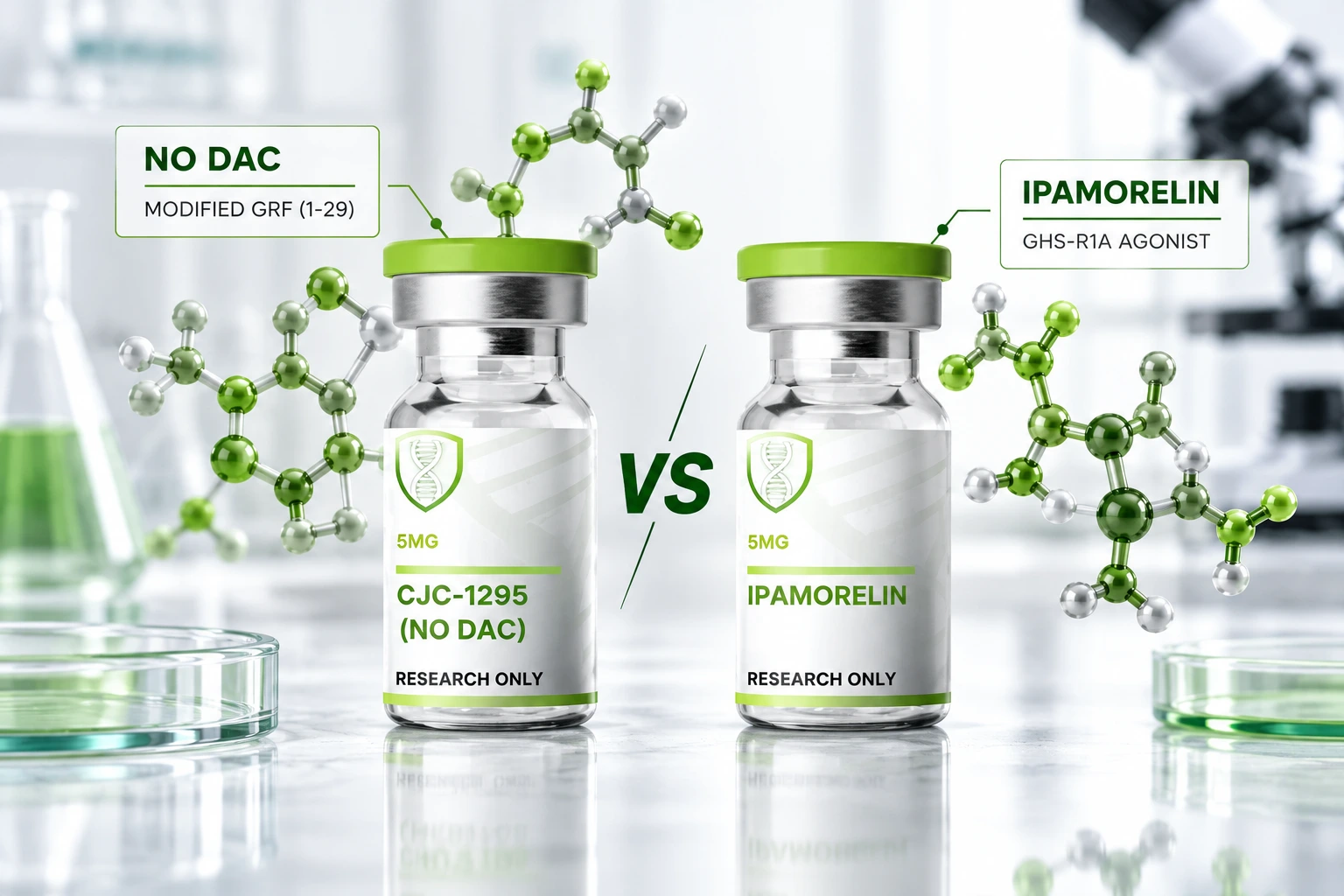
CJC-1295 is frequently mentioned alongside Ipamorelin in peptide research. However, one important detail is often overlooked: CJC-1295 with DAC and CJC-1295 without DAC are not the same compound.
The difference involves more than a naming convention. It affects the molecular structure, interaction with circulating proteins, and duration of exposure observed in experimental research.
CJC-1295 with DAC was developed as a long-acting analog of growth hormone-releasing hormone (GHRH). The version commonly marketed as CJC-1295 No DAC is generally associated with Modified GRF (1-29), a shorter-acting GHRH analog.
Both are relevant to studies involving growth hormone signaling, but their pharmacokinetic properties differ.
This distinction becomes particularly important when examining a CJC-1295 and Ipamorelin blend, where the exact identity of the CJC-1295 component influences how researchers interpret the formulation.
The Main Difference Between CJC-1295 With DAC and No DAC
The defining difference is the Drug Affinity Complex, commonly abbreviated as DAC.
DAC is a chemical modification designed to support binding to circulating albumin, an abundant protein in blood plasma.
Albumin binding can prolong a compound’s circulating exposure by changing how quickly it is distributed and eliminated.
CJC-1295 with DAC incorporates this modification. The peptide commonly described as CJC-1295 No DAC does not.
| Feature | CJC-1295 With DAC | CJC-1295 No DAC |
|---|---|---|
| Peptide classification | Modified GHRH analog | Modified GHRH (1-29) analog |
| Drug Affinity Complex | Present | Absent |
| Albumin-binding design | Yes | No |
| Expected circulating exposure | Prolonged | Shorter |
| Primary receptor | GHRH receptor | GHRH receptor |
| Clinical pharmacokinetic data | Available for the DAC form | Limited for compounds marketed as No DAC |
| Common research focus | Extended GHRH activity | Shorter-duration GHRH signaling |
Both forms are associated with GHRH receptor signaling. However, they should not be treated as interchangeable in research protocols or scientific interpretation.
What Does DAC Mean in CJC-1295?
DAC stands for Drug Affinity Complex.
It was developed to modify the pharmacokinetic behavior of peptide compounds.
Unmodified peptides may be cleared relatively quickly because of enzymatic degradation and other elimination processes.
The DAC modification provides a mechanism for reversible association with albumin, helping prolong exposure to the compound.
In CJC-1295, the albumin-binding design was intended to extend the biological activity of the GHRH analog.
How Albumin Binding Changes Peptide Behavior
Albumin is one of the most abundant proteins in circulating plasma.
It binds various endogenous molecules and pharmaceutical compounds.
When a compound associates with albumin, its distribution and elimination characteristics may change.
For CJC-1295 with DAC, this interaction contributes to its prolonged pharmacokinetic profile.
The original clinical investigations reported an elimination half-life of approximately 5.8 to 8.1 days for the long-acting compound.
These findings are specific to the investigated DAC-containing formulation.
They should not be applied to CJC-1295 No DAC.
What Is CJC-1295 Without DAC?
CJC-1295 No DAC is a commercial research term commonly used for Modified GRF (1-29).
Modified GRF (1-29) is a synthetic analog derived from the biologically active region of growth hormone-releasing hormone.
It contains structural modifications intended to influence peptide stability and biological activity.
Unlike DAC-containing CJC-1295, Modified GRF (1-29) lacks the albumin-binding modification responsible for prolonged circulating exposure.
As a result, its pharmacokinetic behavior is different.
Is CJC-1295 No DAC the Same as Modified GRF (1-29)?
In research peptide catalogs, the two names are frequently used interchangeably.
However, the terminology requires care.
The original compound identified as CJC-1295 in published clinical studies incorporated DAC.
The name CJC-1295 No DAC is widely used commercially, but it does not necessarily correspond to the exact compound investigated in those studies.
For accurate scientific documentation, researchers should verify the amino acid sequence, molecular identity, and analytical specifications of the material.
The commercial name alone is not sufficient to establish chemical identity.
CJC-1295 With DAC vs No DAC: Half-Life Differences
Half-life is one of the most frequently discussed differences between these two forms.
In pharmacokinetics, elimination half-life refers to the time required for the concentration of a compound to decrease by approximately half during its elimination phase.
This measurement helps describe how long a compound remains detectable or circulates within a biological system.
Half-Life of CJC-1295 With DAC
The long-acting CJC-1295 formulation has been investigated in clinical research.
A study published in the Journal of Clinical Endocrinology & Metabolism in 2006 evaluated its pharmacokinetic and pharmacodynamic properties.
Researchers reported an estimated elimination half-life of approximately 5.8 to 8.1 days.
The study also documented prolonged changes in circulating growth hormone and insulin-like growth factor I (IGF-I) concentrations.
These findings supported the investigation of CJC-1295 as a long-acting GHRH analog.
Reference: Teichman et al., 2006 — PubMed
Half-Life of CJC-1295 No DAC
CJC-1295 No DAC is generally characterized as shorter-acting because it lacks the albumin-binding DAC modification.
However, a precise elimination half-life should not be assigned to every compound marketed under this name.
The available clinical evidence is not equivalent to that of DAC-containing CJC-1295.
Differences in formulation, peptide identity, and experimental conditions can influence pharmacokinetic measurements.
For this reason, claims about an exact No DAC half-life should be supported by studies involving the specific compound being discussed.
Which CJC-1295 Form Is Used in Ipamorelin Blends?
Research peptide suppliers commonly list formulations containing CJC-1295 No DAC and Ipamorelin.
The naming usually indicates that the GHRH analog component does not include the Drug Affinity Complex.
However, this should be verified through the compound’s technical specifications.
A blend label should identify both peptide components and their respective quantities.
For example, a research preparation described as CJC-1295 No DAC + Ipamorelin 10 mg may contain a combined total of 10 mg of peptide material.
If formulated at an equal ratio, the preparation would contain 5 mg of each component.
Other ratios are possible, so the actual quantities must be established from the specific formulation.
Why Is the No DAC Form Commonly Listed in Blends?
One reason for the research interest is that Modified GRF (1-29) and Ipamorelin interact with different receptors involved in growth hormone regulation.
Modified GRF (1-29) is associated with the GHRH receptor.
Ipamorelin interacts with the growth hormone secretagogue receptor, GHS-R1a.
These distinct mechanisms provide a rationale for studying their signaling pathways together.
However, the fact that these compounds are combined in commercial formulations does not establish superior activity, effectiveness, or safety.
Direct experimental evidence is needed to characterize any interaction between them.
For a broader explanation of their molecular structures, receptor interactions, and research applications, see our guide to CJC-1295 and Ipamorelin Blend: Composition, Research Uses, and Key Differences.
How Does Ipamorelin Differ From Both CJC-1295 Forms?
Ipamorelin is a synthetic pentapeptide classified as a growth hormone secretagogue.
Its primary receptor target is GHS-R1a, which is associated with ghrelin signaling.
This is different from the GHRH receptor targeted by both CJC-1295 variants.
The distinction is important because growth hormone secretion is regulated by several interacting biological pathways.
GHRH Receptor Signaling
GHRH-type peptides interact with GHRH receptors on pituitary somatotroph cells.
This interaction activates intracellular signaling involving cyclic adenosine monophosphate (cAMP).
The resulting cellular responses contribute to growth hormone synthesis and release.
GHS-R1a Signaling
Ipamorelin interacts with GHS-R1a, a G-protein-coupled receptor.
Activation of this receptor is associated with intracellular signaling pathways involving phospholipase C and calcium mobilization.
These pathways differ from the principal cAMP-associated mechanism of GHRH receptor activation.
Why the Difference Matters
The two receptor systems offer separate experimental approaches to studying growth hormone regulation.
Researchers may investigate how each pathway responds individually and whether combined receptor activation changes measured biological responses.
However, mechanistic differences alone cannot establish additive or synergistic effects.
Such conclusions require direct experimental testing.
Does DAC Affect the Molecular Structure of CJC-1295?
Yes. DAC is a chemical modification that changes the structure and pharmacokinetic behavior of the peptide.
The DAC-containing compound incorporates an albumin-binding component that is absent from Modified GRF (1-29).
This affects the compound’s molecular identity.
As a result, researchers should not assume that CJC-1295 with DAC and CJC-1295 No DAC have identical molecular weights, chemical formulas, or analytical characteristics.
The specific structure must be considered when selecting reference standards or interpreting mass spectrometry results.
Why Chemical Identity Matters in Laboratory Research
Accurate chemical identification supports reproducibility.
If two materials are described using similar commercial names but have different structures, results obtained with one may not apply to the other.
Researchers should confirm the following information where available:
- Amino acid sequence
- Presence or absence of DAC
- Molecular mass and chemical form
- Component-specific purity
- Batch identity
- Analytical testing methods
These details help establish which compound was actually used in an experiment.
Laboratory Testing of CJC-1295 and Ipamorelin Blends
Blended peptide preparations require analytical methods capable of identifying their individual components.
A single overall purity figure may not fully characterize a two-component formulation.
High-Performance Liquid Chromatography
High-performance liquid chromatography (HPLC) is commonly used to separate peptide compounds and related impurities.
In a blended formulation, the analytical method should demonstrate adequate separation between CJC-1295, Ipamorelin, and relevant degradation compounds.
Method suitability is especially important when compounds have different structural characteristics.
Mass Spectrometry
Mass spectrometry provides molecular mass information that can support compound identification.
For CJC-1295 preparations, mass spectrometry may help distinguish DAC-containing compounds from structurally different GHRH analogs.
However, accurate identification depends on the method, reference materials, and chemical form being analyzed.
Certificate of Analysis
A Certificate of Analysis (COA) should provide batch-specific information about the tested material.
For a CJC-1295 No DAC and Ipamorelin blend, useful documentation includes identity testing for both components, purity information, and component-specific assay results.
A COA does not independently establish biological safety or suitability for clinical administration.
Research Limitations and Regulatory Considerations
The scientific literature involving CJC-1295 and Ipamorelin has important limitations.
Studies involving DAC-containing CJC-1295 do not automatically describe the behavior of Modified GRF (1-29).
Similarly, findings involving Ipamorelin alone cannot establish the properties of a combined formulation.
Published clinical data for the specific CJC-1295 No DAC and Ipamorelin combination remain limited.
Researchers should therefore avoid assuming that individual compound findings establish the combined formulation’s pharmacokinetics, safety, or effectiveness.
Neither CJC-1295 nor Ipamorelin is an FDA-approved drug.
The FDA has also identified safety concerns and limitations in the available information concerning certain peptide substances proposed for compounding.
Research-grade materials should not be presented as approved medications.
Frequently Asked Questions
Is CJC-1295 with DAC stronger than No DAC?
The available evidence does not establish a universal comparison of strength. The two compounds have different pharmacokinetic properties, and the DAC-containing version has been studied for prolonged circulating exposure. Longer exposure does not automatically mean greater effectiveness.
Does CJC-1295 No DAC contain a Drug Affinity Complex?
No. The designation No DAC indicates that the albumin-binding Drug Affinity Complex is absent.
Is CJC-1295 No DAC the same as Ipamorelin?
No. CJC-1295 No DAC is associated with GHRH receptor signaling, while Ipamorelin interacts with GHS-R1a. They are structurally and pharmacologically different peptides.
Can CJC-1295 with DAC and No DAC be used interchangeably in research?
They should not be assumed to be interchangeable. Their chemical structures and pharmacokinetic characteristics differ, and experimental findings must be interpreted according to the exact material studied.
Why is CJC-1295 No DAC combined with Ipamorelin?
The combination is of research interest because the compounds target different receptor pathways associated with growth hormone regulation. However, the scientific rationale for studying them together is not proof of an established combined effect.
What does CJC-1295 No DAC + Ipamorelin 10 mg mean?
It generally describes a formulation with a declared total peptide content of 10 mg. The amount of each component depends on the blend ratio and must be confirmed through compound specifications.
Does DAC change how CJC-1295 interacts with albumin?
Yes. The DAC modification was developed to facilitate albumin binding, which contributes to the prolonged circulating exposure observed in studies of long-acting CJC-1295.
Conclusion
The difference between CJC-1295 with DAC and CJC-1295 No DAC is fundamental to understanding their research applications.
CJC-1295 with DAC incorporates an albumin-binding modification associated with prolonged circulating exposure. CJC-1295 No DAC, commonly associated with Modified GRF (1-29), lacks that modification.
Both are related to GHRH receptor signaling, but they have different chemical and pharmacokinetic characteristics.
In CJC-1295 and Ipamorelin blends, identifying the exact CJC-1295 variant is essential for interpreting experimental results.
Researchers should rely on verified molecular specifications, appropriate analytical testing, and studies involving the specific compounds under investigation.
Scientific References
- Teichman SL, et al. (2006). Prolonged stimulation of growth hormone (GH) and insulin-like growth factor I secretion by CJC-1295, a long-acting analog of GH-releasing hormone, in healthy adults. Journal of Clinical Endocrinology & Metabolism. PubMed
- Ionescu M, Frohman LA. (2006). Pulsatile secretion of growth hormone persists during continuous stimulation by CJC-1295, a long-acting growth hormone-releasing hormone analog. Journal of Clinical Endocrinology & Metabolism. PubMed
- Raun K, et al. (1998). Ipamorelin, the first selective growth hormone secretagogue. European Journal of Endocrinology. PubMed search
- U.S. Food and Drug Administration. Safety Risks Associated with Certain Bulk Drug Substances Nominated for Use in Compounding. FDA
Research Use Disclaimer: This article on Orion Peptides is provided for scientific and educational purposes only. CJC-1295 and Ipamorelin are not FDA-approved drugs. Research-grade peptide preparations are not intended for human or veterinary administration, diagnosis, treatment, or disease prevention.
