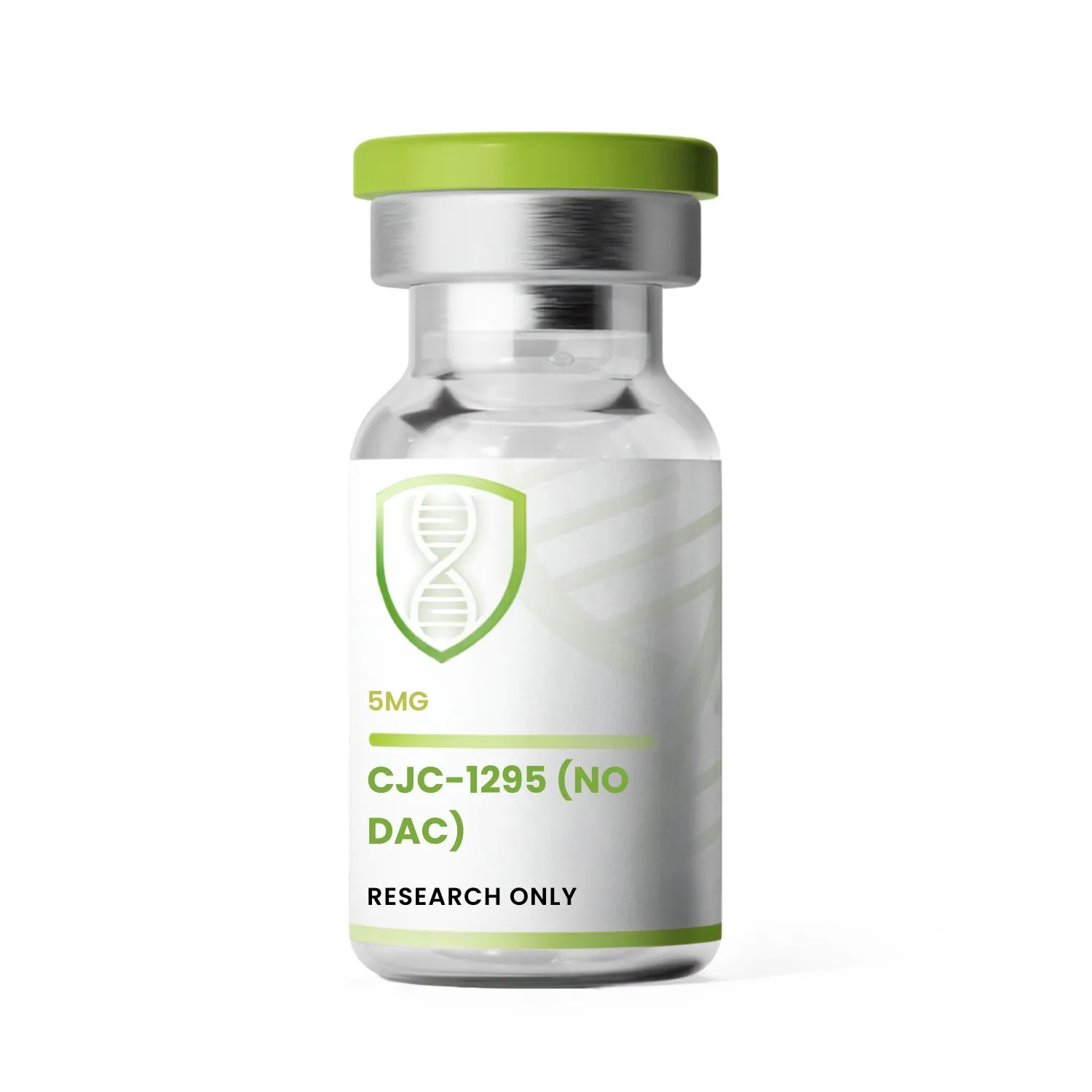
Buy CJC-1295 (No DAC)
CJC-1295 (No DAC), also called Modified GRF (1-29) or Mod GRF 1-29, is a synthetic peptide studied for its interaction with the growth hormone-releasing hormone (GHRH) receptor. It contains 29 amino acids and four structural modifications designed to improve stability compared with natural GHRH fragments. The peptide is used in laboratory investigations of GHRH receptor signaling, growth hormone (GH) regulation, and related endocrine pathways.
CJC-1295 without DAC is chemically different from the longer-acting CJC-1295 with DAC. The no-DAC peptide lacks the albumin-binding group responsible for the extended circulation time of the DAC form. Our CJC-1295 (No DAC) research peptide is supplied in lyophilized powder form for controlled laboratory work.
Research Use Only: Not approved for human or veterinary use, therapeutic treatment, or personal consumption.
What Is CJC-1295 (No DAC)?
CJC-1295 (No DAC) is a modified form of growth hormone-releasing factor, a peptide involved in communication between the hypothalamus and pituitary gland. Natural GHRH contains 44 amino acids. Its first 29 amino acids include the region responsible for activating the GHRH receptor. However, natural GHRH fragments are vulnerable to enzymatic breakdown. Researchers have developed modified analogs to investigate how specific amino acid changes affect peptide stability and receptor activity. Modified GRF (1-29) contains four substitutions compared with the natural human GHRH(1-29) sequence:
- D-Ala at position 2: Helps protect the peptide against cleavage by dipeptidyl peptidase IV (DPP-IV).
- Gln at position 8: Reduces chemical changes associated with the original asparagine residue.
- Ala at position 15: Is associated with improved receptor interaction in related GHRH analog research.
- Leu at position 27: Replaces methionine to reduce susceptibility to oxidation.
These changes are important for researchers studying the relationship between peptide structure, stability, and biological activity. Earlier peptide research by Campbell and colleagues examined how similar substitutions affected the stability and activity of modified GHRH analogs.
Research reference: Campbell et al. (1994), Enhanced Stability and Potency of Novel Growth Hormone-Releasing Factor Analogues.
CJC-1295 (No DAC) Specifications
| Property | Details |
| Compound name | CJC-1295 (No DAC) |
| Alternative names | Modified GRF (1-29), Mod GRF 1-29 |
| Peptide class | Synthetic GHRH analog |
| CAS number | 863288-34-0 |
| Molecular formula | C₁₅₂H₂₅₂N₄₄O₄₂ |
| Molecular weight | Approximately 3,367.9 Da |
| Amino acid length | 29 residues |
| Molecular structure | Linear peptide with C-terminal amidation |
| Physical form | Lyophilized powder |
| Research target | GHRH receptor |
| Intended use | Laboratory research only |
| Regulatory status | Not FDA-approved for human use |
How Does CJC-1295 (No DAC) Work?
CJC-1295 (No DAC) belongs to a class of peptides designed to interact with the GHRH receptor. Under normal physiological conditions, growth hormone-releasing hormone binds to receptors on somatotroph cells in the anterior pituitary gland. This interaction helps regulate growth hormone secretion. The process involves several signaling steps:
- GHRH binds to its receptor on a pituitary somatotroph cell.
- The receptor activates a Gs-protein-mediated signaling pathway.
- Adenylyl cyclase activity increases, raising intracellular cyclic AMP (cAMP).
- cAMP-dependent signaling, including protein kinase A activity, contributes to the cellular response involved in GH secretion.
Modified GRF (1-29) provides researchers with an analog for investigating these pathways in suitable experimental models. Studies of related GHRH analogs have examined their resistance to enzymatic degradation and their effects on hormone release. However, findings from CJC-1295 with DAC should not automatically be applied to the no-DAC peptide. The two compounds have different molecular structures and pharmacokinetic properties.
Research reference: Kubiak et al. (1993), Position 2 and Position 2/Ala15-Substituted Analogs of Growth Hormone-Releasing Factor.
CJC-1295 (No DAC) Amino Acid Sequence
Modified GRF (1-29) contains 29 amino acids with a C-terminal amide group.
Peptide sequence: Tyr-D-Ala-Asp-Ala-Ile-Phe-Thr-Gln-Ser-Tyr-Arg-Lys-Val-Leu-Ala-Gln-Leu-Ser-Ala-Arg-Lys-Leu-Leu-Gln-Asp-Ile-Leu-Ser-Arg-NH₂ The sequence differs from natural GHRH(1-29) at four positions.
| Position | Natural GHRH residue | Modified GRF residue |
| 2 | L-Alanine | D-Alanine |
| 8 | Asparagine | Glutamine |
| 15 | Glycine | Alanine |
| 27 | Methionine | Leucine |
These substitutions are relevant to peptide degradation, oxidative stability, and receptor-related research. The theoretical molecular weight is approximately 3,367.9 Da. Analytical methods such as mass spectrometry can help determine whether a manufactured peptide matches the expected molecular identity.
CJC-1295 No DAC vs. CJC-1295 With DAC
Although these two peptides share similar names, they are not identical compounds. The main difference is the presence or absence of the Drug Affinity Complex (DAC), a chemical modification associated with albumin binding.
| Feature | CJC-1295 No DAC | CJC-1295 With DAC |
| Common name | Modified GRF (1-29) | CJC-1295 DAC |
| Molecular weight | Approximately 3,367.9 Da | Approximately 3,647.2 Da |
| DAC modification | Absent | Present |
| Albumin-binding design | No | Yes |
| Duration of exposure | Expected to be shorter | Prolonged by albumin binding |
| Research focus | GHRH receptor and short-duration signaling | Extended GHRH analog exposure and endocrine responses |
The DAC form has been studied in human clinical research. For example, Teichman and colleagues reported sustained elevations in GH and IGF-1 after administration of long-acting CJC-1295 in healthy adult research participants. Those findings relate to the DAC-modified compound and do not establish the same effects or duration for CJC-1295 (No DAC).
Research reference: Teichman et al. (2006), Prolonged Stimulation of Growth Hormone and IGF-I Secretion by CJC-1295.
CJC-1295 (No DAC) Research Applications
Modified GRF (1-29) is relevant to several areas of peptide and endocrine research.
1. GHRH Receptor Signaling
Researchers investigate how modified GHRH peptides interact with the GHRH receptor and influence downstream signaling. These studies can examine receptor activation, intracellular cAMP production, and differences between natural and modified peptide sequences.
2. Growth Hormone Regulation
GHRH is one of the main signals involved in regulating growth hormone release from the pituitary gland. Modified GHRH analogs are useful research tools for studying how peptide structure and receptor activation may influence this process. Investigations involving hormone secretion must distinguish between the activity of the no-DAC molecule and results obtained using longer-acting analogs.
3. Peptide Stability and Enzymatic Degradation
Natural GHRH is rapidly inactivated by certain enzymes, including DPP-IV. Modified GRF (1-29) contains structural changes designed to reduce some of these degradation pathways. Researchers can evaluate peptide stability through controlled experiments involving enzyme exposure, chromatography, and chemical characterization.
4. Structure-Activity Relationships
Changing individual amino acids may affect peptide stability, receptor binding, and biological activity. Modified GRF (1-29) can be compared with natural GHRH fragments and other synthetic analogs to investigate these relationships. The four amino acid substitutions make this compound relevant to studies of peptide engineering and molecular design.
5. GH and IGF-1 Axis Research
The growth hormone and insulin-like growth factor 1 (IGF-1) signaling system is involved in several physiological processes. Researchers study this axis to understand endocrine feedback, pituitary activity, and downstream molecular pathways. Although long-acting CJC-1295 has been investigated for its effects on GH and IGF-1, comparable findings should not be assumed for the no-DAC version without compound-specific evidence.
CJC-1295 (No DAC) Purity and Laboratory Testing
Peptide identity and purity are important factors when selecting compounds for laboratory research. A batch-specific Certificate of Analysis (COA) can help researchers evaluate the material before including it in an experiment. Common analytical methods include:
High-Performance Liquid Chromatography (HPLC) HPLC separates the main peptide from detectable impurities. It is commonly used to measure chromatographic purity, although it does not independently establish chemical identity.
Mass Spectrometry (MS) Mass spectrometry helps verify whether the measured molecular mass corresponds to the expected peptide structure.
Batch Documentation A useful COA should identify the tested batch and provide the relevant analytical results, including the testing method and date. Researchers should also review peptide content, counterion information, and other specifications relevant to their experiment. A 99% HPLC purity result does not necessarily mean a vial contains 99% peptide by mass. These measurements describe different aspects of compound quality.
CJC-1295 (No DAC) 2 mg and 5 mg Research Vials
CJC-1295 without DAC is commonly listed in different vial sizes, including 2 mg and 5 mg.
| Vial size | Potential laboratory use |
| 2 mg | Small-scale analytical testing, preliminary method development, and limited research experiments |
| 5 mg | Experiments requiring a greater total quantity of peptide or additional analytical measurements |
The appropriate quantity depends on the experimental design, analytical method, and material requirements. Before purchasing, researchers should confirm the listed vial content, available COA, physical form, and storage specifications.
CJC-1295 (No DAC) Storage and Handling
Proper storage helps reduce the risk of peptide degradation and protects sample quality. Unopened lyophilized CJC-1295 (No DAC) should be kept in sealed containers, protected from moisture and light, and stored according to the manufacturer’s validated recommendations. Some peptide suppliers recommend frozen storage around −20°C for longer-term preservation. However, the appropriate storage conditions and shelf life depend on the formulation, packaging, and supporting stability data. After reconstitution, peptide stability may change depending on the solvent, concentration, container, temperature, and microbial contamination risk. A general four-to-six-week stability period should not be assumed without compound-specific evidence. For laboratory handling:
- Follow the supplier’s documented storage instructions.
- Minimize exposure to moisture and unnecessary temperature changes.
- Avoid repeated freeze-thaw cycles unless stability has been established.
- Use appropriate laboratory protective equipment.
- Follow institutional procedures for sample preparation and disposal.
Frequently Asked Questions
What is CJC-1295 (No DAC)?
CJC-1295 (No DAC), also called Modified GRF (1-29), is a synthetic 29-amino-acid analog of growth hormone-releasing hormone. It contains four amino acid substitutions and is used in research involving GHRH receptor signaling and peptide stability.
Is CJC-1295 (No DAC) the same as Modified GRF 1-29?
Yes. In the research peptide market, CJC-1295 without DAC and Modified GRF (1-29) generally refer to the same 29-amino-acid compound. Researchers should confirm the molecular identity using analytical documentation rather than relying on the compound name alone.
What is the difference between CJC-1295 with DAC and without DAC?
The DAC version contains an additional chemical group designed to bind serum albumin and extend circulation time. The no-DAC form does not contain this modification and has a different molecular weight and pharmacokinetic profile.
What is the molecular weight of CJC-1295 (No DAC)?
The theoretical molecular weight of Modified GRF (1-29) is approximately 3,367.9 Da.
What is the CAS number of CJC-1295 (No DAC)?
CAS number 863288-34-0 is commonly listed for Modified GRF (1-29). Chemical identity should also be checked against the peptide sequence and molecular mass.
Is CJC-1295 (No DAC) FDA-approved?
No. CJC-1295 (No DAC) is not an FDA-approved drug for human treatment or consumption. It is an investigational peptide, and clinical safety and effectiveness have not been established for the no-DAC form.
How can researchers verify CJC-1295 purity?
Researchers can examine batch-specific HPLC results, mass spectrometry data, and other analytical documentation. Purity and identity should be evaluated separately.
How should CJC-1295 (No DAC) be stored?
Storage should follow the supplier’s validated specifications. Lyophilized peptides are commonly protected from moisture, light, and excessive temperature changes. Compound-specific stability information is especially important after reconstitution.
Research Use Disclaimer
CJC-1295 (No DAC) is an investigational compound supplied exclusively for legitimate laboratory research. It is not FDA-approved for human or veterinary treatment, diagnosis, prevention, supplementation, or personal use. The compound must not be used for self-administration, bodybuilding, athletic performance enhancement, or any other unapproved clinical purpose. Research findings involving related GHRH analogs do not establish the safety or effectiveness of this compound in humans. All research activities must follow applicable laws, institutional protocols, and appropriate laboratory safety requirements.
Scientific References
- Campbell RM, et al. (1994). Enhanced stability and potency of novel growth hormone-releasing factor (GRF) analogues derived from rodent and human GRF sequences. Peptides, 15(3), 489–495. PubMed. DOI: 10.1016/0196-9781(94)90211-9.
- Kubiak TM, et al. (1993). Position 2 and position 2/Ala15-substituted analogs of bovine growth hormone-releasing factor with enhanced metabolic stability and improved in vivo bioactivity. Journal of Medicinal Chemistry, 36(7), 888–897. PubMed. DOI: 10.1021/jm00059a014.
- Teichman SL, et al. (2006). Prolonged stimulation of growth hormone (GH) and insulin-like growth factor I secretion by CJC-1295, a long-acting analog of GH-releasing hormone, in healthy adults. Journal of Clinical Endocrinology & Metabolism, 91(3), 799–805. PubMed. DOI: 10.1210/jc.2005-1536. This study investigated the long-acting DAC-modified compound.
- Ionescu M, Frohman LA. (2006). Pulsatile secretion of growth hormone persists during continuous stimulation by CJC-1295, a long-acting GH-releasing hormone analog. Journal of Clinical Endocrinology & Metabolism. PubMed. DOI: 10.1210/jc.2006-1702. This study also investigated the DAC form.
- U.S. Food and Drug Administration. Certain Bulk Drug Substances for Use in Compounding That May Present Significant Safety Risks. FDA safety information.