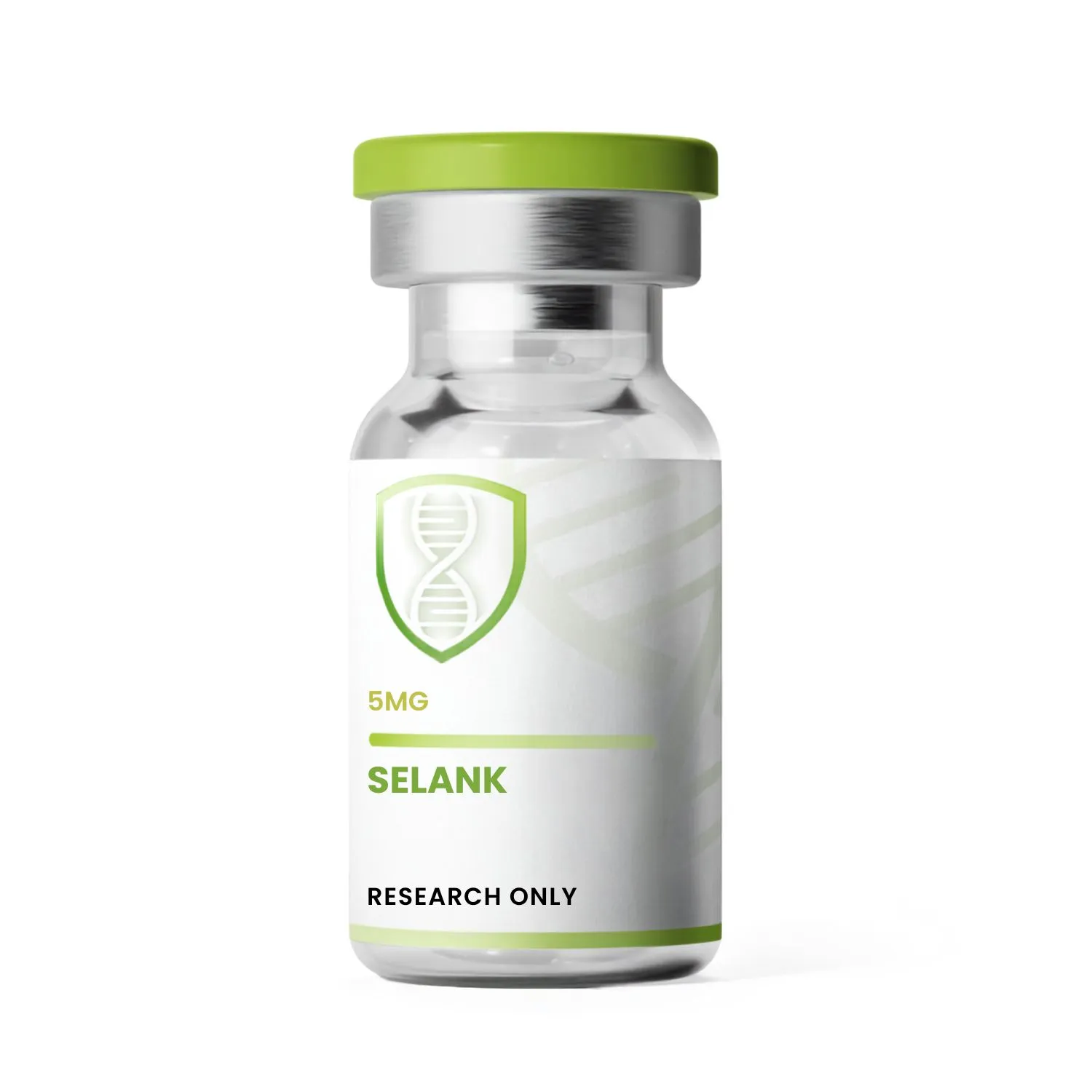
Buy Selank 5mg | Tuftsin-Derived Research Peptide
Selank 5mg is a synthetic heptapeptide developed from tuftsin, a naturally occurring peptide involved in immune regulation. It contains seven amino acids in the sequence Thr-Lys-Pro-Arg-Pro-Gly-Pro (TKPRPGP). Selank has attracted scientific interest because of its possible effects on neuropeptide metabolism, GABA-related signaling, and immune communication. Studies have examined its interaction with enkephalin-degrading enzymes, changes in neurotransmission-related gene expression, and responses in experimental models of stress. At
Orion Peptides, Selank 5mg is listed as a research peptide for laboratory investigation. The 5mg designation refers to the nominal quantity of material supplied in the vial. Selank remains an investigational compound. Although early animal experiments and small human studies have reported biological effects, its safety and effectiveness have not been established through large, well-controlled clinical trials.
For Research Use Only. Not intended for human or veterinary administration. Selank 5mg: Compound Specifications
| Property | Details |
| Compound name | Selank 5mg |
| Alternative name | Selank, TKPRPGP |
| Peptide class | Synthetic tuftsin-derived heptapeptide |
| Amino acid length | 7 residues |
| Peptide sequence | Thr-Lys-Pro-Arg-Pro-Gly-Pro |
| One-letter sequence | TKPRPGP |
| Complete sequence | H-Thr-Lys-Pro-Arg-Pro-Gly-Pro-OH |
| Molecular formula | C₃₃H₅₇N₁₁O₉ |
| Molecular weight | Approximately 751.9 Da |
| CAS number | 129954-34-3 |
| PubChem CID | 11765600 |
| Structural modification | C-terminal Pro-Gly-Pro extension of tuftsin |
| Research areas | Neuropeptide metabolism, GABA-related signaling, immune regulation |
| Nominal vial content | 5mg |
| Intended use | Laboratory research only |
The molecular information above describes standard, unacetylated Selank. N-acetyl Selank and N-acetyl Selank amidate are chemically distinct analogs with different molecular specifications.
Chemical reference: PubChem: Selank.
Understanding Selank: From Tuftsin to a Seven-Amino-Acid Peptide
Selank was developed by extending the naturally occurring tetrapeptide tuftsin. Tuftsin consists of four amino acids:
Thr-Lys-Pro-Arg Selank retains this sequence and adds three residues:
Pro-Gly-Pro The resulting seven-amino-acid structure is:
Thr-Lys-Pro-Arg-Pro-Gly-Pro The Pro-Gly-Pro extension is an important part of the peptide’s design. It was investigated as a way to change the biological behavior and enzymatic stability of the parent tuftsin sequence. Unlike N-acetylated Selank analogs, standard Selank has a free N-terminal amino group. This distinction matters when researchers compare chemical identity, molecular weight, and analytical results.
What Does the Research Say About Selank?
Selank has been investigated through several different lines of research. The most informative findings concern enkephalin metabolism, GABA-related gene expression, and exploratory clinical observations.
1. Selank and Enkephalinase Activity
Enkephalins are naturally occurring neuropeptides involved in signaling within the nervous system. Their activity is regulated partly by enzymes that break them down. A study published in 2001 by Zozulya and colleagues investigated how Selank affects enkephalin degradation. The researchers reported that Selank inhibited the enzymatic breakdown of plasma enkephalin in a concentration-dependent manner. The reported IC₅₀ was approximately 15 µM under the tested conditions. This finding is important because it provides a measurable biochemical response rather than relying solely on behavioral observations. However, inhibition of enkephalin-degrading enzymes in an experimental system does not demonstrate a therapeutic effect in humans.
Published study: The inhibitory effect of Selank on enkephalin-degrading enzymes as a possible mechanism of its anxiolytic activity (2001).
2. Selank and GABA-Related Gene Expression
GABA, or gamma-aminobutyric acid, is a major inhibitory neurotransmitter in the central nervous system. Its signaling pathways have been studied extensively in relation to neuronal activity and stress responses. In 2016, Volkova and colleagues investigated how Selank influenced gene expression in the frontal cortex of rats. The researchers examined 84 genes associated with neurotransmission, including genes related to GABA receptors, ion channels, and other signaling systems. They reported significant changes in several genes following exposure to Selank. The study also identified similarities between certain Selank-related gene-expression changes and those observed after GABA exposure. These results suggest that Selank may influence GABA-related signaling processes. However, gene-expression changes do not prove that Selank binds directly to GABA receptors or produces the same effects as established GABAergic medicines.
Published study: Selank Administration Affects the Expression of Some Genes Involved in GABAergic Neurotransmission (2016).
3. Selank in Early Human Research
Selank has also been investigated in limited human studies. A 2008 study by Zozulya and colleagues included 62 patients diagnosed with generalized anxiety disorder or neurasthenia. Thirty participants received Selank, while 32 received medazepam. The researchers used psychological rating scales and measured aspects of enkephalin activity. The study reported changes in anxiety-related measurements and enkephalin metabolism. Although these findings attracted scientific interest, the study was small and does not establish long-term safety, effectiveness, or clinical equivalence to approved medications. Its findings also cannot be applied to independently manufactured Selank research vials.
Published study: Efficacy and possible mechanisms of action of a new peptide anxiolytic Selank (2008).
How Might Selank Influence Neuronal Signaling?
The mechanism of Selank is not fully understood. Research suggests that its effects may involve more than one biological process.
Neuropeptide metabolism: Selank has demonstrated inhibitory activity against enzymes involved in enkephalin degradation under experimental conditions.
GABA-related signaling: Animal studies have identified changes in genes associated with GABAergic neurotransmission.
Immune-neural communication: Because Selank is derived from tuftsin, researchers have also investigated possible interactions between immune-related pathways and nervous-system signaling. These findings are important, but they represent different types of evidence. For example, a measured change in gene expression is not equivalent to a demonstrated clinical benefit. Further research is needed to determine which mechanisms are most relevant across different experimental systems.
Selank and Neuroplasticity Research
Neuroplasticity describes the ability of the nervous system to change its structure and function in response to activity and experience. Researchers studying neuroplasticity often examine molecules such as brain-derived neurotrophic factor (BDNF), a protein associated with neuronal development and synaptic signaling. Selank has appeared in experimental discussions involving neurotrophic signaling and gene-expression changes. However, the available evidence is not sufficient to conclude that Selank consistently increases BDNF in humans, improves memory, or enhances cognitive performance. Claims about learning, concentration, and neuroplasticity should therefore remain clearly identified as research questions rather than established outcomes.
Selank 5mg vs Selank 10mg
Orion Peptides lists Selank in two vial quantities.
| Feature | Selank 5mg | Selank 10mg |
| Nominal peptide quantity | 5mg | 10mg |
| Amino acid length | 7 | 7 |
| Molecular formula | C₃₃H₅₇N₁₁O₉ | C₃₃H₅₇N₁₁O₉ |
| Research compound | Standard Selank | Standard Selank |
| Main difference | Smaller total quantity | Larger total quantity |
Researchers can review the
Selank 10mg compound at Orion Peptides when comparing available research quantities. Both compounds should be evaluated using their own batch-specific purity, identity, and content records. A larger vial does not automatically mean greater purity or suitability for a particular experiment.
Selank 5mg Purity and Laboratory Verification
Chemical identity is one of the most important factors when working with research peptides. A useful Selank Certificate of Analysis (COA) should distinguish molecular identity from chromatographic purity and actual peptide content.
HPLC Analysis
High-performance liquid chromatography (HPLC) separates peptide material from detectable related components. It can provide a measure of chromatographic purity under defined analytical conditions. A reported 99% HPLC purity result does not necessarily mean that 99% of the vial’s total mass consists of Selank.
Mass Spectrometry
Mass spectrometry helps confirm that a tested sample is consistent with the expected molecular mass of the peptide. Standard Selank has a molecular weight of approximately 751.9 Da. Testing should also distinguish standard Selank from acetylated or amidated variants, which have different chemical properties.
What Should a Selank COA Include?
When reviewing Selank 5mg documentation, laboratories should look for:
- Compound and batch number
- Molecular identity results
- HPLC purity measurements
- Actual peptide content, when measured
- Testing laboratory and analysis date
- Relevant specifications and acceptance criteria
Sterility and endotoxin testing, if performed, should be reported separately. The presence of a COA does not independently establish suitability for human or veterinary administration.
Selank Storage and Laboratory Handling
Selank may be supplied as lyophilized powder for laboratory use. The appropriate storage conditions depend on the compound’s chemical form, formulation, packaging, and supporting stability data. Researchers should follow the validated storage instructions associated with the specific batch. General laboratory precautions include protecting the material from moisture, unnecessary light exposure, and repeated temperature fluctuations. After dissolution, peptide stability may change depending on solvent composition, concentration, temperature, and handling. A fixed post-reconstitution shelf life should not be assumed without compound-specific testing.
Selank 5mg: Common Research Questions
Is Selank a natural peptide?
Selank is a synthetic peptide derived from tuftsin, a naturally occurring four-amino-acid peptide. Selank contains three additional residues, producing a seven-amino-acid structure.
Is Selank the same as N-acetyl Selank?
No. Standard Selank and N-acetyl Selank have different molecular structures and molecular weights. N-terminal acetylation produces a chemically modified analog.
What is the peptide sequence of Selank?
The sequence is Thr-Lys-Pro-Arg-Pro-Gly-Pro, abbreviated TKPRPGP.
What is the molecular weight of Selank?
Standard Selank has a molecular weight of approximately 751.9 Da.
What is the difference between Selank and Semax?
Selank is a tuftsin-derived heptapeptide, while Semax is a synthetic peptide based on an ACTH-related sequence. They have different structures and research backgrounds.
Does Selank interact with GABA receptors?
Selank has been associated with changes in GABA-related gene expression in experimental research. However, direct receptor binding and a complete GABAergic mechanism have not been firmly established.
Has Selank been studied in humans?
Yes. Small human studies have been published, including a 2008 investigation involving 62 participants. These studies do not establish the safety or effectiveness of research-grade Selank compounds.
Is Selank FDA-approved?
No. Selank is not an FDA-approved drug in the United States. Its clinical safety and effectiveness have not been established to the standards required for FDA approval.
What is the difference between Selank 5mg and 10mg?
The primary difference is the nominal total quantity of peptide supplied. The underlying Selank molecule is the same when both compounds use the same chemical form.
Research Use Disclaimer
Selank 5mg supplied by Orion Peptides is intended exclusively for legitimate laboratory and scientific research. It is not an FDA-approved pharmaceutical compound and is not intended for human or veterinary administration, treatment, diagnosis, cognitive enhancement, anxiety management, or personal consumption. Results from animal experiments, cell studies, and limited human investigations do not establish the safety, clinical efficacy, or pharmaceutical quality of independently manufactured research vials. All laboratory work must comply with applicable regulations, institutional requirements, and established safety procedures.
Scientific References
- Zozulya AA, et al. (2001). The inhibitory effect of Selank on enkephalin-degrading enzymes as a possible mechanism of its anxiolytic activity. Bulletin of Experimental Biology and Medicine, 131(4), 315–317. PubMed | DOI.
- Volkova A, et al. (2016). Selank Administration Affects the Expression of Some Genes Involved in GABAergic Neurotransmission. Frontiers in Pharmacology, 7, 31. PubMed | Full text.
- Zozulya AA, et al. (2008). Efficacy and possible mechanisms of action of a new peptide anxiolytic Selank in the therapy of generalized anxiety disorders and neurasthenia. Zhurnal Nevrologii i Psikhiatrii imeni S.S. Korsakova, 108(4), 38–48. PubMed.
- National Center for Biotechnology Information. PubChem Compound Summary for Selank, CID 11765600. PubChem.