

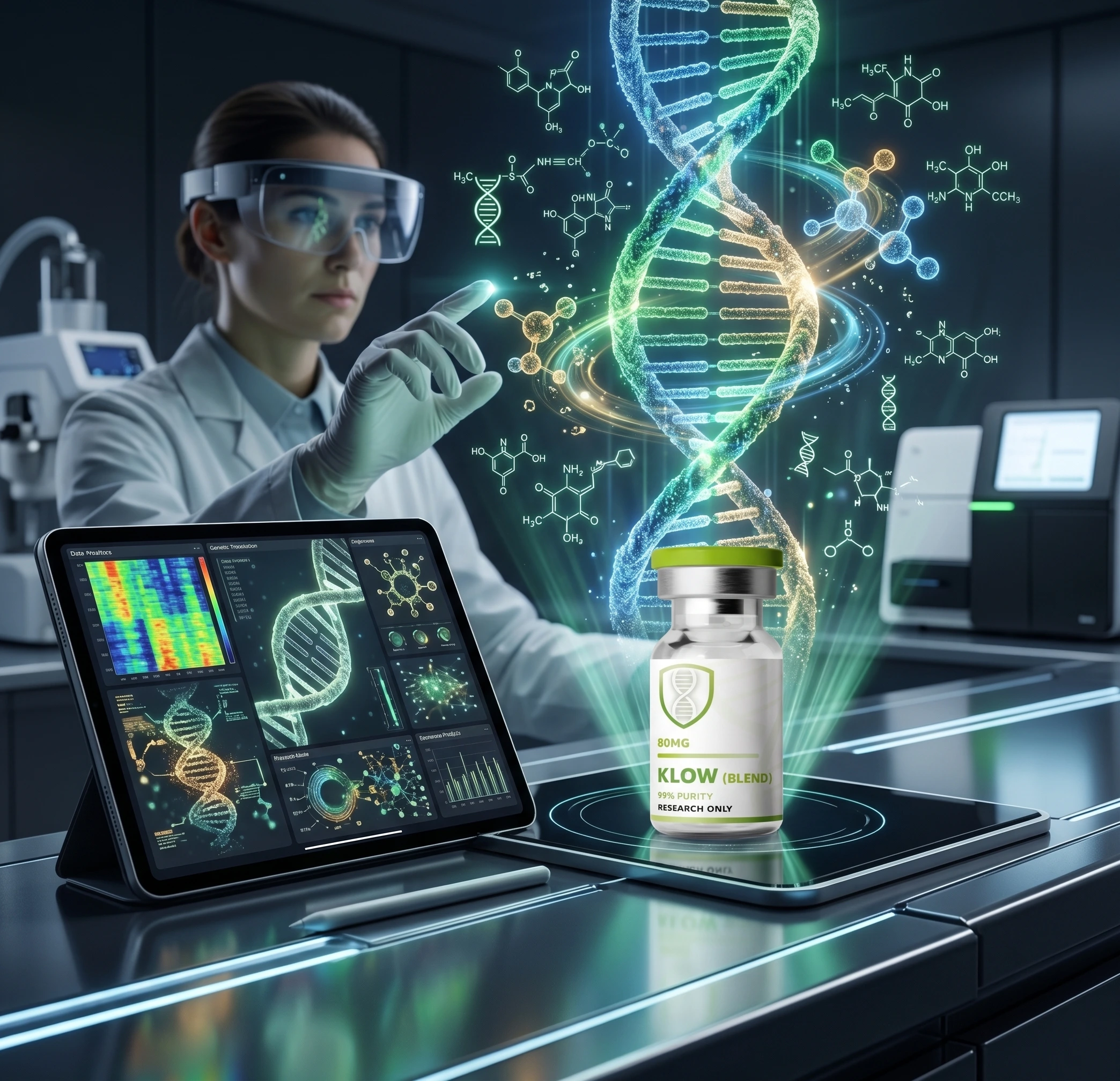
KLOW is a four-peptide research blend consisting of GHK-Cu, BPC-157, TB-500, and KPV. The blend has attracted attention because its individual components have been investigated in several areas of tissue biology, including extracellular matrix activity, cell migration, inflammation, and wound research. A typical KLOW blend contains 50 mg GHK-Cu, 10 mg BPC-157, 10 mg TB-500, and 10 mg KPV.
The scientific interest in KLOW comes from the fact that these four peptides are associated with distinct biological pathways. GHK-Cu has been used in collagen and extracellular matrix research, and BPC-157 has been involved in experimental models of tendon and cell migration. Research on thymosin beta-4 (which is closely related to TB-500 research) has explored cell migration and tissue repair. KPV has been mainly of interest for its anti-inflammatory signaling in experimental models.
But there is still a large evidence gap. The full KLOW blend has not been trialed in a peer-reviewed controlled trial. Thus, the results of the individual peptide studies should not be considered as direct evidence of KLOW itself having the same effects.
This article reviews what the current published research tells us about KLOW and tissue biology, distinguishing between established findings at the component level and hypotheses about the complete blend.
KLOW and Tissue Research at a Glance
KLOW is generally defined as a complex preparation for peptide research, with components including GHK-Cu, BPC-157, TB-500, and KPV. The current common research formula has a total peptide content of 80 milligrams: GHK-Cu accounts for 50 milligrams, and the other three components each account for 10 milligrams. This ratio is only an industry convention, not an approved medicinal standard.
| Components of KLOW | Key tissue research areas |
| GHK-Cu | Collagen and extracellular matrix |
| BPC-157 | Tendon and cell migration models |
| TB-500 | Tissue remodeling and cell migration |
| KPV | Inflammatory signaling |
The research logic underlying this complex formula derives from the distinct biological pathways linked to each component, but relevant evidence must be interpreted with caution. Research conclusions on individual components cannot prove that the full KLOW formula produces the same effects. To date, no controlled studies have tested the effects of the four components used in combination at this ratio, and this distinction remains critically important throughout this paper.
How Tissue Repair Works
The process of tissue repair is complex and includes leukocytes, fibroblasts, endothelial cells, signaling molecules, and extracellular matrix, among other participants. Scientists classify tissue healing into four consecutive stages known as hemostasis, inflammation, proliferation, and remodeling.
a. Hemostasis
The first step is hemostasis, which happens right after tissue injury. Blood vessels constrict, and platelets are activated, leading to clot formation. Platelet aggregates form a provisional matrix that plays a critical role in the repair process.
b. Inflammation
The second stage is the inflammatory reaction, during which neutrophils and macrophages help clear the injured tissue and debris of bacteria. Inflammation ends, and the tissue is prepared for repair.
c. Proliferation
The third step is proliferation, which involves increased cellularity and production of extracellular matrix. New blood vessels, fibroblasts, and epithelial cells aid the proliferation process that rebuilds the skin.
d. Remodeling
The last stage is remodeling – the modified tissue is organized and strengthened further. It involves the extracellular matrix and collagen synthesis.
Researchers are interested in GHK-Cu, BPC-157, TB-500, and KPV’s role in tissue repair and wound healing. They are mostly connected to the inflammatory response, cell migration processes, extracellular matrix, and repair cascade. However, there is no evidence that the cocktail can influence every stage of tissue repair. It remains to be seen whether KLOW will affect all the stages of the tissue repair process.
Tissue Research Areas Associated With KLOW Components
Research on the individual KLOW components covers several areas of tissue biology. The strongest evidence varies by peptide, so each area should be interpreted separately.
Wound and Skin Research
GHK-Cu and thymosin beta-4 have been studied in wound and skin models. GHK-Cu research focuses on collagen production and extracellular matrix remodeling, while thymosin beta-4 research includes cell migration and wound closure.
Tendon and Connective-Tissue Research
BPC-157 has been investigated in experimental tendon models. Studies have examined fibroblast migration, cell survival, and tendon outgrowth, particularly in preclinical systems.
Extracellular Matrix Research
GHK-Cu has particular relevance to extracellular matrix biology. Research has examined collagen synthesis and matrix-regulating enzymes in fibroblast cultures.
Inflammatory Signaling
KPV provides a different research pathway. Experimental studies have examined its effects on inflammatory signaling, including NF-κB activity and pro-inflammatory cytokines.
Cell Migration and Angiogenesis
Research involving BPC-157 and thymosin beta-4 has examined cellular migration and blood-vessel formation. These processes are important parts of tissue repair biology.
Overall, these areas explain the scientific rationale behind the KLOW concept. However, no controlled study has established that the complete four-peptide blend produces these effects together. The available evidence remains primarily component-level research.
GHK-Cu and Extracellular Matrix Research
Extracellular Matrix Research, specifically in relation to fibroblast proliferation, collagen production, extracellular matrix remodeling, and wound biology, is one of the areas in which GHK-Cu has been studied extensively as part of the KLOW mixture. A relevant review on the subject is “The human tripeptide GHK and tissue remodeling,” which provides an overview of GHK-Cu’s role in regulating processes such as collagen and elastin production, fibroblast proliferation, neovascularization, and extracellular matrix remodeling.
The review is based on prior research, including the study titled “Stimulation of collagen synthesis in fibroblast cultures by the tripeptide-copper complex glycyl-L-histidyl-L-lysine-Cu2+,” which investigated the effects of GHK-Cu on fibroblast cultures. The results of this particular study have demonstrated the tripeptide-copper complex’s ability to stimulate collagen production. Since collagen is one of the main structural proteins found in the extracellular matrix, this discovery supports the GHK Cu’s involvement in extracellular matrix remodeling.
Another study titled “The tripeptide-copper complex glycyl-L-histidyl-L-lysine-Cu2+ stimulates matrix metalloproteinase-2 expression by fibroblast cultures” examines the role of matrix metalloproteinase-2 in the extracellular matrix remodeling process. Due to GHK-Cu’s effect on matrix metalloproteinase-2, as stated in the study, this tripeptide-copper complex is capable of influencing various other aspects of the extracellular matrix remodeling.
Nevertheless, the aforementioned research only concerns the GHK-Cu tripeptide and cannot be used to generalize GHK-Cu’s effects when in combination with other peptides, namely BPC-157, TB-500, and KPV, as part of the KLOW mixture.
BPC-157 and Tendon and Soft-Tissue Research
BPC-157 is one of the KLOW components most frequently studied in experimental tissue research. Researchers have examined its potential effects on tendon fibroblasts, cell migration, cell survival, and tissue outgrowth.
A key study, “The promoting effect of pentadecapeptide BPC 157 on tendon healing involves tendon outgrowth, cell survival, and cell migration,” was published in the Journal of Applied Physiology. Researchers studied BPC-157 in tendon explants and cultured tendon fibroblasts. The results showed increased fibroblast outgrowth and migration, along with improved cell survival under oxidative stress.
The study also identified increased activation of the FAK-paxillin signaling pathway. This pathway is involved in cell adhesion and movement, making it relevant to research into how fibroblasts respond around damaged connective tissue.
These findings provide a possible biological explanation for the tissue-repair effects reported in earlier experimental models. However, the evidence remains largely preclinical. The study used tendon explants and cells, with experimental work involving rat tissue, so its findings cannot establish that BPC-157 improves tendon healing in humans.
For KLOW research, BPC-157 therefore provides evidence around fibroblast migration, cellular survival, and connective-tissue biology. It does not, by itself, demonstrate that the complete KLOW blend produces these effects.
TB-500, Thymosin Beta-4, and Tissue Repair Research
TB-500 is one of the most discussed components of KLOW, but its research background requires careful interpretation. TB-500 is commonly described as a synthetic peptide related to thymosin beta-4 (Tβ4), a naturally occurring protein involved in cell migration, angiogenesis, and tissue remodeling. Most published studies focus on full-length thymosin beta-4 rather than TB-500 itself, so this distinction is important when evaluating the evidence.
One of the foundational reviews, “Thymosin β4 Promotes Dermal Healing,” summarized research showing that thymosin beta-4 influences several processes involved in tissue repair, including cell migration, blood vessel formation, inflammation, apoptosis, and extracellular matrix remodeling. The review also discussed findings from animal studies and early human trials involving chronic wounds.
Additional evidence comes from the study “The Regenerative Peptide Thymosin β4 Accelerates the Rate of Dermal Healing in Preclinical Animal Models and in Patients.” Researchers reported improved wound closure in multiple animal models, including diabetic and aged animals, and described earlier phase 2 studies involving pressure ulcers and stasis ulcers. The proposed mechanisms included enhanced cell migration, stem-cell mobilization, and regulation of inflammation and apoptosis.
Experimental studies have also linked thymosin beta-4 to angiogenesis and cytoskeletal remodeling. For example, the study “Thymosin β4 Has a Major Role in Dermal Burn Wound Healing That Involves Actin Cytoskeletal Remodeling via Heat-Shock Protein 70” examined how Tβ4 affected vascularization and actin-related cellular pathways in burn models.
For KLOW research, TB-500 is therefore associated with cell migration, angiogenesis, and tissue remodeling pathways. However, most of this evidence comes from studies involving thymosin beta-4, not the complete KLOW blend. Controlled studies are still needed to determine how TB-500 behaves when combined with GHK-Cu, BPC-157, and KPV.
KPV and Inflammatory Tissue Research
KPV is the smallest component of the KLOW blend, consisting of lysine, proline, and valine. Its tissue research focuses mainly on inflammatory signaling and intestinal epithelial biology, rather than direct structural tissue repair.
A key study, “PepT1-mediated tripeptide KPV uptake reduces intestinal inflammation,” examined KPV in human intestinal epithelial cells, human T cells, and mouse models of colitis. Researchers found that KPV reduced NF-κB activation and pro-inflammatory cytokine signaling. The study also identified PepT1 as a transporter involved in KPV uptake.
Another study, “Melanocortin-derived tripeptide KPV has anti-inflammatory potential in murine models of inflammatory bowel disease,” tested KPV in two mouse models of colitis. KPV-treated animals showed reduced inflammatory changes and improved recovery compared with untreated animals.
These findings make KPV relevant to KLOW because controlling excessive inflammation is an important part of tissue biology. Inflammation must be properly regulated before tissue remodeling can progress.
However, the available evidence remains primarily cellular and preclinical. These studies examined KPV separately, not the complete KLOW combination. Therefore, they support a research rationale for KPV but do not prove that KLOW produces the same anti-inflammatory effects.
What KLOW Research Does Not Prove
The research presented provides KLOW with a scientifically plausible foundation, but it is also important to acknowledge the evidence that is currently missing. First, note that most of the research into this peptide comes from trials involving either KPV, GHK-Cu, BPC-157, or thymosin beta-4 in isolation. Second, current KLOW research sources do not demonstrate that any trial used all four components in combination.
With these facts in mind, the following are not proven by the current body of research on KLOW:
- The ability of KLOW to accelerate tissue repair processes in humans
- Therapeutic efficacy on wounds, tendon damage, or any other condition
- Synergy between any combination of the four peptides
- An established human dosage or treatment regimen
- Long-term safety in humans
- The ability to reproduce the results of animal or cell studies
It is also worth noting the lack of research into TB-500, where most of the studies on tissue repair used full-length thymosin beta-4, not any of the commercial preparations of TB-500 that have since been developed. The results of research into full-length thymosin beta-4 should not be assumed to apply to any particular TB-500 preparation.
The simplest summary of the evidence would be that KLOW possesses research at the level of individual peptides but has not demonstrated any therapeutic benefit from their combination. The proposed benefits of a multi-pathway tissue repair agent remain a compelling hypothesis that requires further study before it can be confidently endorsed by the scientific community.
Frequently Asked Questions
1. What does KLOW research focus on?
Current research interest in KLOW centers on tissue biology, inflammatory signaling, extracellular matrix activity, cell migration, and tissue remodeling. All these research directions are derived from accumulated prior research on each component.
2. Has the complete KLOW blend been studied?
To date, no peer-reviewed controlled studies have tested the combined effects of these four components. The vast majority of available evidence comes from independent studies focused on GHK-Cu, BPC-157, KPV, or thymosin beta-4 alone.
3. What does GHK-Cu contribute to KLOW research?
Research on GHK-Cu focuses on collagen synthesis, fibroblast activity, and extracellular matrix remodeling. These findings make it suitable for studies related to tissue structure and repair.
4. What does BPC-157 contribute?
Research on BPC-157 covers fibroblast migration, cell survival, and experimental tendon models, and most of the related evidence remains at the preclinical stage.
5. What does TB-500 contribute?
TB-500 is often linked to research on thymosin beta-4, with work covering cell migration, angiogenesis, and tissue remodeling. However, researchers must clearly distinguish between research findings for thymosin beta-4 and empirical evidence directly focused on TB-500.
6. What does KPV contribute?
Research on KPV centers mainly on inflammatory signaling, including NF-κB activity and inflammatory responses in experimental intestinal models.
7. Does KLOW have proven synergistic effects?
No controlled studies to date have confirmed that these four peptides, when used as a blended preparation, produce additive or synergistic effects. Claims of synergy come only from logical inference based on the fact that each component targets different biological pathways.
8. Is KLOW approved by the U.S. Food and Drug Administration (FDA)?
No FDA-approved KLOW compounds currently exist. All existing relevant information on KLOW classifies it as an investigational-only agent, not an approved medical treatment.
Researchers handling the formulation can also review our guide to KLOW peptide stability and storage.
Conclusion
Research on KLOW provides an attractive multi-pathway model for tissue biology research. Its four components each have independent research trajectories, covering the fields of inflammation, extracellular matrix activity, fibroblast migration, angiogenesis, and tissue remodeling.
However, when the research conclusions drawn from these individual components are applied to KLOW as an intact mixed preparation, the strength of supporting evidence drops sharply. No controlled study has ever tested GHK-Cu, BPC-157, TB-500, and KPV in combination as a single preparation, and all current claims about their combined or synergistic effects remain only at the level of mechanistic inference.
The most rigorous scientific approach is to conduct separate assessments based on the evidence base of each component: research on GHK-Cu centers on collagen and matrix biology, studies of BPC-157 focus on preclinical work in tissue and tendon research, investigations of KPV concentrate on inflammatory signaling pathways, and most tissue-related research on TB-500 derives from experiments on thymosin beta-4.
For scientific researchers, KLOW is a research direction that requires in-depth exploration, not a mature tissue repair therapy. Direct research at the level of the mixed preparation must be carried out to clarify its pharmacological properties, safety, tissue effects, and potential interactions.
Citations
- https://pubmed.ncbi.nlm.nih.gov/38243683/
- https://pubmed.ncbi.nlm.nih.gov/30524911/
- https://pubmed.ncbi.nlm.nih.gov/18644225/
- https://pubmed.ncbi.nlm.nih.gov/3169264/
- https://pubmed.ncbi.nlm.nih.gov/11045606/
- https://pubmed.ncbi.nlm.nih.gov/21030672/
- https://pubmed.ncbi.nlm.nih.gov/27450738/
- https://pubmed.ncbi.nlm.nih.gov/23050815/
- https://pubmed.ncbi.nlm.nih.gov/25921810/
- https://pubmed.ncbi.nlm.nih.gov/18061177/
- https://pubmed.ncbi.nlm.nih.gov/18092346/
