Popular
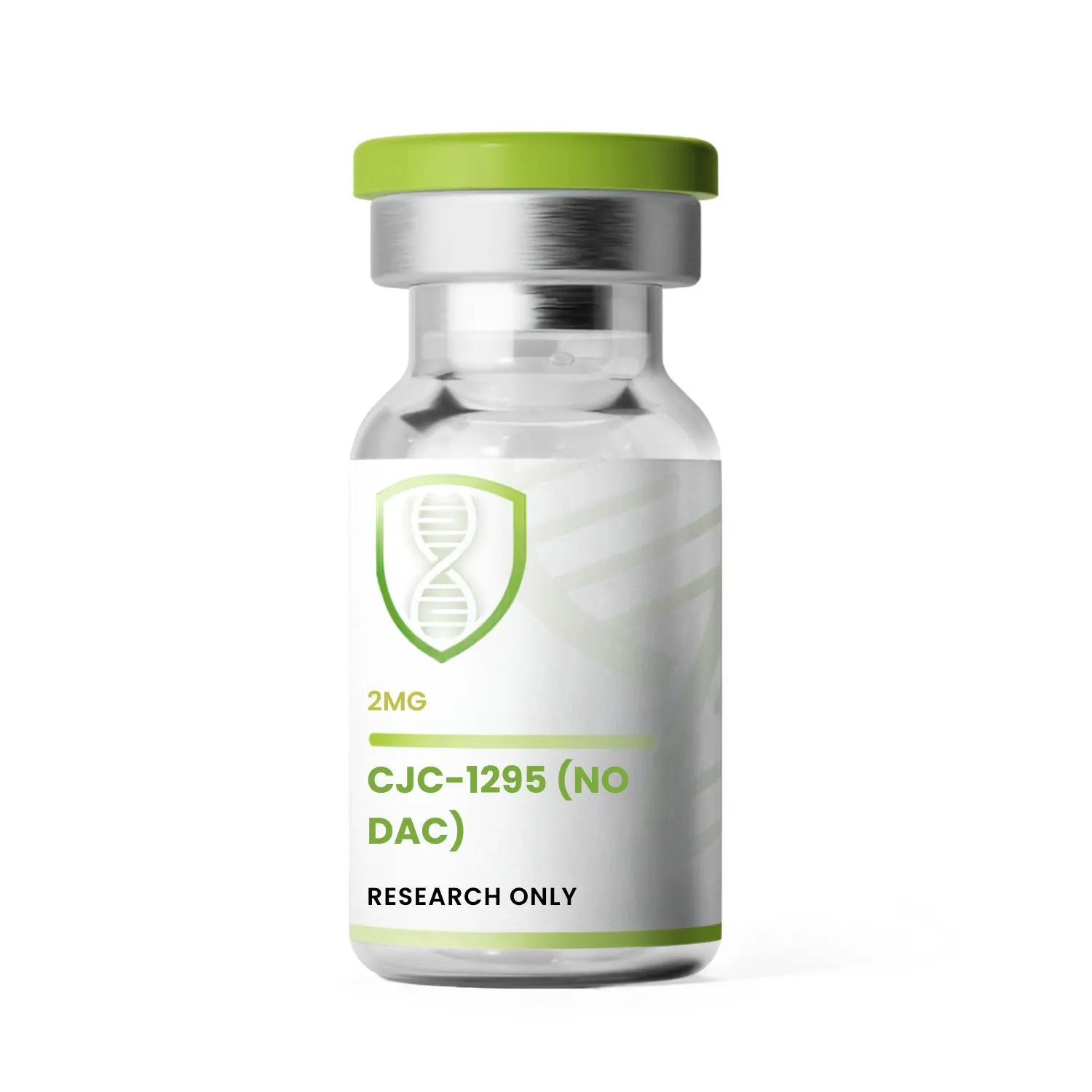
CJC-1295 (No DAC) 2mg for sale

CJC-1295 (No DAC) – 2mg

| Third-Party Tested | 99% Purity | COA Available | Research Use Only

CJC-1295 (no DAC) is also known as Modified GRF 1-29 or Mod GRF (1-29). It is a synthetic peptide analog of the first 29 amino acids of natural growth hormone-releasing hormone. GHRH is also called GRF in research literature.

$45.00

0 out of 5 · 0 ratings
Be the first to rate this compound:

7 in stock

7 in stock

Bulk Pricing – Save More

3
Buy 3 units 5% OFF
$42.75 each Total: $128.25 (Save $6.75)
5
Buy 5 units 10% OFF
$40.50 each Total: $202.50 (Save $22.50)
10
Buy 10 units 15% OFF
$38.25 each Total: $382.50 (Save $67.50)

 Buy CJC-1295 (No DAC) 2mg

CJC-1295 (no DAC) is also known as Modified GRF 1-29 or Mod GRF (1-29). It is a synthetic peptide analog of the first 29 amino acids of natural growth hormone‑releasing hormone. GHRH is also called GRF in research literature. This peptide includes specific amino acid substitutions that improve stability and reduce enzymatic breakdown. These modifications also increase binding to GHRH receptors in laboratory models and help resist DPP‑IV cleavage and oxidation. CJC-1295 (no DAC) is supplied as a high‑purity lyophilized powder, typically showing purity of 99% or higher through HPLC testing. It is commonly available in 2 mg or 5 mg research vials. Researchers use this compound to study pulsatile growth hormone secretion and analyze pituitary signaling and IGF‑1 axis activity. The peptide is intended only for in vitro and in vivo laboratory research and is not approved for human consumption or therapeutic use.

CJC-1295 (No DAC) Mechanism of Action

In preclinical studies, CJC-1295 (no DAC) behaves as a selective GHRH receptor agonist. It binds to receptors on pituitary somatotroph cells and activates Gs‑protein signaling pathways. This interaction increases intracellular cAMP levels and activates protein kinase A, triggering pulsatile release of endogenous growth hormone. The peptide has a short half‑life of about 30 minutes, producing brief and controlled GH pulses that closely mimic natural hypothalamic and pituitary regulation. Unlike DAC variants, it does not cause sustained GH elevation. Cell and animal studies demonstrate increased GH pulse amplitude and IGF‑1 upregulation without receptor desensitization during short exposure.

CJC-1295 (No DAC) Peptide Sequence and Molecular Properties

CJC-1295 (No DAC), also known as Modified GRF (1-29), is a synthetic linear peptide containing 29 amino acids. It features four amino acid substitutions and C-terminal amidation, which are associated with improved resistance to certain degradation pathways.

CJC-1295 (No DAC) Molecular Specifications

Property Details
Peptide Name CJC-1295 (No DAC)
Alternative Name Modified GRF (1-29), Mod GRF 1-29
Peptide Type Synthetic GHRH analog
Amino Acid Length 29
Peptide Sequence Tyr-D-Ala-Asp-Ala-Ile-Phe-Thr-Gln-Ser-Tyr-Arg-Lys-Val-Leu-Ala-Gln-Leu-Ser-Ala-Arg-Lys-Leu-Leu-Gln-Asp-Ile-Leu-Ser-Arg-NH₂
Molecular Formula C₁₅₂H₂₅₂N₄₄O₄₂
Molecular Weight Approximately 3,367.95 Da
CAS Number 863288-34-0
C-Terminal Modification Amidation (-NH₂)
DAC Modification Absent
Research Target Growth hormone-releasing hormone (GHRH) receptor

Key Amino Acid Substitutions

Position Original Amino Acid Modified Amino Acid Research Significance
2 L-Alanine D-Alanine (D-Ala) Increases resistance to DPP-IV enzymatic cleavage
8 Asparagine (Asn) Glutamine (Gln) Reduces susceptibility to asparagine-related degradation
15 Glycine (Gly) Alanine (Ala) Structural modification investigated for its effects on peptide bioactivity
27 Methionine (Met) Leucine (Leu) Reduces susceptibility to methionine oxidation
These structural modifications distinguish CJC-1295 (No DAC) from natural GHRH(1-29). They are relevant to research on peptide stability, receptor signaling, and structure-activity relationships.

CJC-1295 (No DAC) 2 mg and 5 mg

CJC-1295 (no DAC) is available in standard research vial sizes. The 2 mg vial is suitable for small‑scale experiments including cell culture assays and early dose testing, allowing precise concentration control after reconstitution. The 5 mg vial is designed for larger or repeated studies such as long‑term animal models, GH pulse analysis, and IGF‑1 kinetics research. Larger vials also provide improved cost efficiency for extended research work. Both sizes are supplied as white lyophilized powder and require reconstitution using sterile or bacteriostatic water under sterile laboratory conditions.

CJC-1295 (No DAC) Research

Researchers widely use CJC-1295 (no DAC) in preclinical studies involving cell‑based assays and rodent models focused on pulsatile GH secretion. Studies show dose‑dependent increases in GH release along with elevated IGF‑1 levels while maintaining natural GH pulsatility. The peptide supports investigation of endocrine signaling, receptor interactions, and metabolic pathways such as lipolysis and protein synthesis. Research models often examine muscle repair mechanisms and adipose tissue metabolism. Compared with DAC versions, the no‑DAC variant allows improved control over hormone pulse timing, making it useful for studying natural GH rhythms. The compound remains investigational and is not approved for human use.

How to Store and Handle It?

Store unopened vials in a cool, dark, and dry environment. Long‑term storage is recommended at −20°C, while sealed vials may remain stable at 2–8°C for several months. Protect the peptide from light and moisture and avoid temperature fluctuations during storage. After reconstitution, refrigerate the solution at 2–8°C. Use reconstituted solutions within four to six weeks and avoid repeated freeze‑thaw cycles. Always follow sterile handling procedures and use proper PPE to prevent contamination.

Disclaimer

CJC-1295 (no DAC) is an investigational research peptide intended solely for in vitro laboratory research and in vivo animal studies. It is not approved by the FDA, EMA, or any regulatory authority for human use, diagnosis, treatment, or supplementation. The compound is classified as a non‑approved substance and is prohibited in athletic contexts. Preclinical findings do not predict human outcomes, and no claims are made regarding safety or efficacy in humans. Compounds should be handled only in qualified research facilities with institutional oversight and are strictly sold for laboratory research use only.

Referenced Citations

1. Teichman SL, et al. (2006). Prolonged Stimulation of Growth Hormone (GH) and Insulin-Like Growth Factor I Secretion by CJC-1295, a Long-Acting Analog of GH-Releasing Hormone, in Healthy Adults. Journal of Clinical Endocrinology & Metabolism, 91(3), 799–805. 2. Ionescu M, Frohman LA. (2006). Pulsatile Secretion of Growth Hormone (GH) Persists During Continuous Stimulation by CJC-1295, a Long-Acting GH-Releasing Hormone Analog. Journal of Clinical Endocrinology & Metabolism, 91(12), 4792–4797. 3. Alba M, et al. (2006). Once-Daily Administration of CJC-1295, a Long-Acting Growth Hormone-Releasing Hormone (GHRH) Analog, Normalizes Growth in the GHRH Knockout Mouse. American Journal of Physiology – Endocrinology and Metabolism, 291(6), E1290–E1294.

Research Use Only

This compound is intended for laboratory research use only. It is not intended for human or animal consumption, or for use in diagnostic or therapeutic procedures.

Chemical Properties

Molecular Formula C152H252N44O42
Molecular Weight 3367.9 g/mol
Monoisotopic Mass 3365.8935782 Da
Polar Surface Area 1450 Ų
Complexity 7710
XLogP -10.7
Heavy Atom Count 238
Hydrogen Bond Donors 52
Hydrogen Bond Acceptors 48
Rotatable Bonds 118
CID 91976842
InChI
InChI=1S/C152H252N44O42/c1-22-79(15)118(194-125(214)84(20)171-135(224)107(68-115(206)207)181-124(213)81(17)169-126(215)91(155)65-87-41-45-89(201)46-42-87)147(236)189-106(66-86-34-25-24-26-35-86)141(230)196-120(85(21)200)149(238)180-99(51-54-114(158)205)132(221)190-111(72-199)145(234)185-105(67-88-43-47-90(202)48-44-88)140(229)178-96(40-33-59-168-152(164)165)128(217)177-94(37-28-30-56-154)133(222)193-117(78(13)14)146(235)187-100(60-73(3)4)134(223)170-82(18)123(212)175-97(49-52-112(156)203)130(219)183-103(63-76(9)10)138(227)191-109(70-197)143(232)172-83(19)122(211)174-95(39-32-58-167-151(162)163)127(216)176-93(36-27-29-55-153)129(218)182-102(62-75(7)8)137(226)184-101(61-74(5)6)136(225)179-98(50-53-113(157)204)131(220)186-108(69-116(208)209)142(231)195-119(80(16)23-2)148(237)188-104(64-77(11)12)139(228)192-110(71-198)144(233)173-92(121(159)210)38-31-57-166-150(160)161/h24-26,34-35,41-48,73-85,91-111,117-120,197-202H,22-23,27-33,36-40,49-72,153-155H2,1-21H3,(H2,156,203)(H2,157,204)(H2,158,205)(H2,159,210)
InChIKey XOZMWINMZMMOBR-UHFFFAOYSA-N
IUPAC Name: 4-[[1-[[1-[[1-[[1-[[5-amino-1-[[1-[[1-[[1-[[6-amino-1-[[1-[[1-[[1-[[5-amino-1-[[1-[[1-[[1-[[1-[[6-amino-1-[[1-[[1-[[5-amino-1-[[1-[[1-[[1-[[1-[(1-amino-5-carbamimidamido-1-oxopentan-2-yl)amino]-3-hydroxy-1-oxopropan-2-yl]amino]-4-methyl-1-oxopentan-2-yl]amino]-3-methyl-1-oxopentan-2-yl]amino]-3-carboxy-1-oxopropan-2-yl]amino]-1,5-dioxopentan-2-yl]amino]-4-methyl-1-oxopentan-2-yl]amino]-4-methyl-1-oxopentan-2-yl]amino]-1-oxohexan-2-yl]amino]-5-carbamimidamido-1-oxopentan-2-yl]amino]-1-oxopropan-2-yl]amino]-3-hydroxy-1-oxopropan-2-yl]amino]-4-methyl-1-oxopentan-2-yl]amino]-1,5-dioxopentan-2-yl]amino]-1-oxopropan-2-yl]amino]-4-methyl-1-oxopentan-2-yl]amino]-3-methyl-1-oxobutan-2-yl]amino]-1-oxohexan-2-yl]amino]-5-carbamimidamido-1-oxopentan-2-yl]amino]-3-(4-hydroxyphenyl)-1-oxopropan-2-yl]amino]-3-hydroxy-1-oxopropan-2-yl]amino]-1,5-dioxopentan-2-yl]amino]-3-hydroxy-1-oxobutan-2-yl]amino]-1-oxo-3-phenylpropan-2-yl]amino]-3-methyl-1-oxopentan-2-yl]amino]-1-oxopropan-2-yl]amino]-3-[2-[[2-amino-3-(4-hydroxyphenyl)propanoyl]amino]propanoylamino]-4-oxobutanoic acid
IUPAC Name: CCC(C)C(C(=O)NC(CC1=CC=CC=C1)C(=O)NC(C(C)O)C(=O)NC(CCC(=O)N)C(=O)NC(CO)C(=O)NC(CC2=CC=C(C=C2)O)C(=O)NC(CCCNC(=N)N)C(=O)NC(CCCCN)C(=O)NC(C(C)C)C(=O)NC(CC(C)C)C(=O)NC(C)C(=O)NC(CCC(=O)N)C(=O)NC(CC(C)C)C(=O)NC(CO)C(=O)NC(C)C(=O)NC(CCCNC(=N)N)C(=O)NC(CCCCN)C(=O)NC(CC(C)C)C(=O)NC(CC(C)C)C(=O)NC(CCC(=O)N)C(=O)NC(CC(=O)O)C(=O)NC(C(C)CC)C(=O)NC(CC(C)C)C(=O)NC(CO)C(=O)NC(CCCNC(=N)N)C(=O)N)NC(=O)C(C)NC(=O)C(CC(=O)O)NC(=O)C(C)NC(=O)C(CC3=CC=C(C=C3)O)N

Certificate of Analysis

Quality

Every batch of CJC-1295 (No DAC) – 2mg is tested for purity and identity using industry-standard methods.

HPLC Analysis

High-Performance Liquid Chromatography confirms purity ≥99%. Each batch is analyzed to ensure consistent quality.

Mass Spectrometry (MS)

Identity verification via mass spectrometry confirms correct molecular weight of 4113.58 g/mol.

Third-Party Testing

All compounds undergo independent third-party laboratory testing for quality assurance.

Request COA

Certificate of Analysis documents are available for all compounds. Contact us with your order number to request batch-specific documentation.

COA Lab Tests

Each compound batch is tested by independent laboratories to verify purity, identity, and quality. The Certificate of Analysis (COA) provides transparent lab results, ensuring the compound meets strict research-grade standards.

Storage & Handling

Before‌ Recons‌titut‍ion (Powder Form)

  • Store at 2-8°C or 35.6-46.4°F
  • Keep in‍ refrigerator for regular u‌s‌e

After Reconstitution (Liquid Form)

  • Ref‌rigerate immediately at 2-8°C or 35.6‍-46.4°F
  • Use wit‌h⁠in 1-2 weeks of rec‍onsti⁠t‌ution
  • Do‌ not s⁠tore beyond recommended timeframe

For ‍Extended Storage

  • Mi‍nimize degradation fo⁠r long-term preservati⁠on
  • Minimize moi⁠sture exposure al‍l the times

After Reconstitution (Liquid Form)

  • Ref‌rigerate immediately at 2-8°C or 35.6‍-46.4°F
  • Use wit‌h⁠in 1-2 weeks of rec‍onsti⁠t‌ution
  • Do‌ not s⁠tore beyond recommended timeframe

×
On Sale
Out of Stock

Storage

Store at -20°C.
Protect from light and moisture.

Added to cart successfully!

Certificate of Analysis

ORP#00038

Client:
Orion Peptides
Sample:
CJC-1295 (No DAC) 2mg
Batch:
202609CJC2

Tests Requested:
Standard + Endotoxins + Sterility
Appearance:
White Lyophilized Powder in 3mL Vial

Analysis Conducted on:
09/02/2026
Report Issued on:
09/03/2026
Test Method Result Specification  
Identity HPLC-DAD CJC-1295 (No DAC) CJC-1295 (No DAC) Pass
Purity HPLC-DAD 99.64 >99% by HPLC Pass
Quantity HPLC Analyte Concentration Curve Assay 2.05 2mg Pass
Endotoxins LAL ELISA 0.125 EU/mL ≤ 0.5 EU/mL Pass
Sterility Pour Plate No Growth No Growth Pass