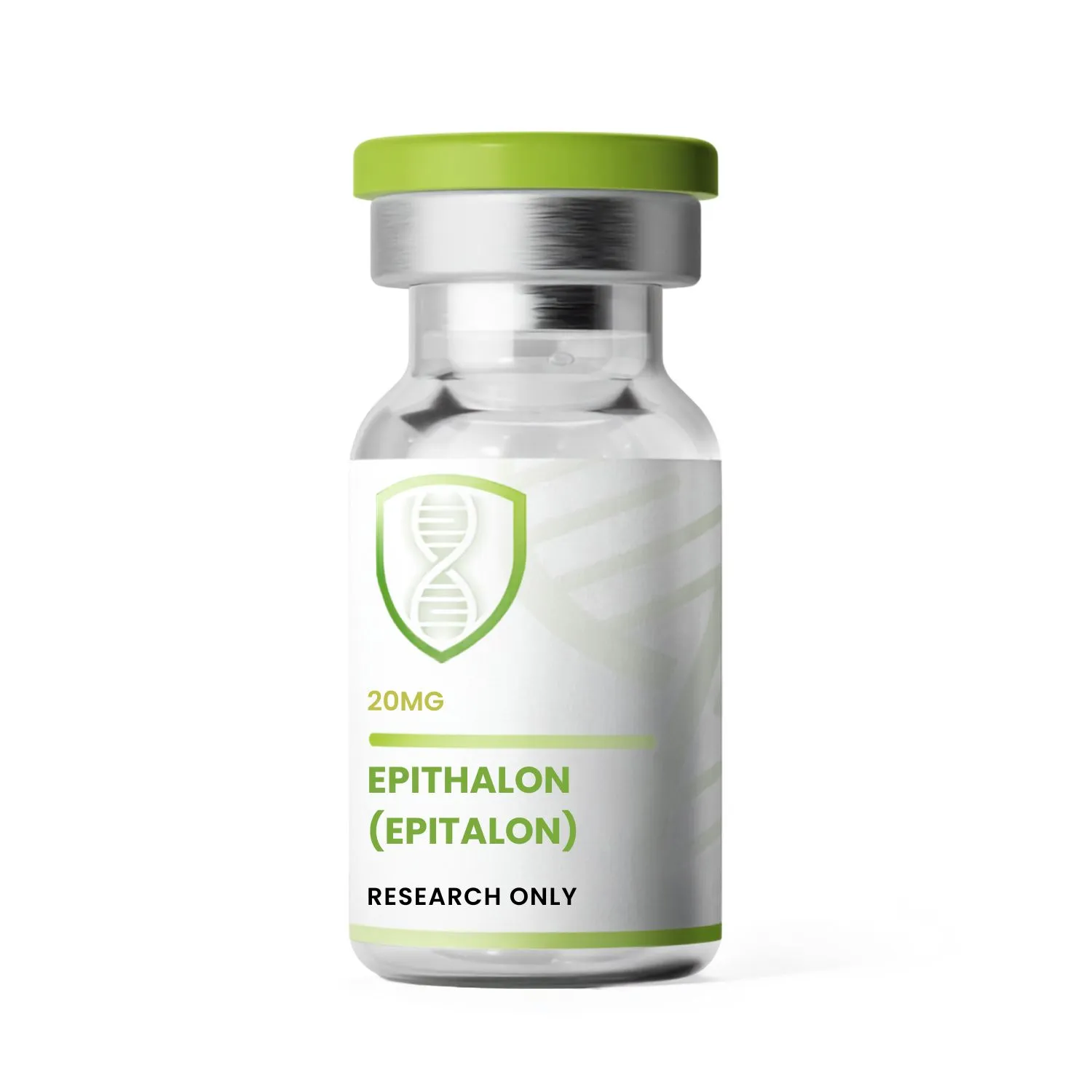
Buy Epithalon 20mg | 99% Purity | Same-Day Shipping
Epithalon 20mg, also known as Epitalon, is a synthetic tetrapeptide studied for its role in telomerase regulation, cellular aging, gene expression, and oxidative stress. The peptide contains four amino acids arranged in the sequence Ala-Glu-Asp-Gly (AEDG). Its small molecular structure makes it useful for laboratory investigations of peptide activity, cellular signaling, and age-related biological changes. At
Orion Peptides, Epithalon 20mg is offered as a lyophilized research peptide for controlled laboratory work. The 20mg presentation provides a nominal quantity of peptide for research experiments requiring a larger amount of material. Researchers should verify the compound’s purity, molecular identity, and actual peptide content using its batch-specific Certificate of Analysis (COA).
For Research Use Only: Epithalon is not FDA-approved for human or veterinary use, anti-aging treatment, or personal consumption.
What Is Epithalon 20mg?
Epithalon is a synthetic peptide developed from research into biologically active peptides associated with the pineal gland. It is structurally related to peptides studied in connection with epithalamin, a peptide-containing extract obtained from pineal gland tissue. However, Epithalon and epithalamin are not the same substance. Epithalon is a defined four-amino-acid peptide, while epithalamin is a mixture of naturally derived components. Epithalon has attracted scientific interest because laboratory studies have examined its effects on telomerase activity, telomere length, cell proliferation, and oxidative stress. Much of the early research was conducted by Khavinson and colleagues using cultured cells and animal models. Although these studies reported interesting biological effects, they do not establish that Epithalon prevents aging or extends human lifespan. The compound remains investigational.
Epithalon Peptide Sequence and Molecular Properties
Epithalon is a linear tetrapeptide consisting of alanine, glutamic acid, aspartic acid, and glycine. Its amino acid sequence is:
Ala-Glu-Asp-Gly The complete chemical sequence can also be written as:
H-Ala-Glu-Asp-Gly-OH | Property | Details |
| Compound name | Epithalon 20mg |
| Alternative names | Epitalon, Epithalone |
| Peptide class | Synthetic tetrapeptide |
| Amino acid sequence | Ala-Glu-Asp-Gly |
| Abbreviated sequence | AEDG |
| Complete sequence | H-Ala-Glu-Asp-Gly-OH |
| Amino acid length | 4 |
| Molecular formula | C₁₄H₂₂N₄O₉ |
| Molecular weight | 390.35 g/mol |
| CAS number | 307297-39-8 |
| PubChem CID | 219042 |
| Physical form | Lyophilized powder |
| Nominal vial content | 20mg |
| Research applications | Telomerase, telomere biology, cellular aging, oxidative stress |
| Intended use | Laboratory research only |
The defined molecular structure allows researchers to investigate the relationship between short peptide sequences and cellular activity.
Chemical reference: PubChem: Epitalon, CID 219042.
Epithalon Mechanism of Action in Research
Epithalon has been investigated for its effects on telomerase activity, cellular proliferation, and gene regulation. Unlike compounds with a well-established receptor-mediated mechanism, Epithalon does not have a fully characterized molecular target. Much of the proposed mechanism comes from experiments examining changes in cellular responses after exposure to the peptide.
Epithalon and Telomerase Activity
Telomerase is an enzyme complex that helps maintain telomeres, the protective structures located at the ends of chromosomes. Telomeres generally become shorter during repeated cell division. When they reach a critically short length, cells may enter replicative senescence. In 2003, Khavinson and colleagues investigated Epithalon in cultured human fetal fibroblasts. The researchers reported that exposure to Epithalon was associated with increased expression of the telomerase catalytic subunit, telomerase enzymatic activity, and telomere elongation. These observations suggested that Epithalon could influence telomerase-related pathways under the experimental conditions. However, the study did not establish direct binding between Epithalon and telomerase. It also did not demonstrate that the compound reverses aging in humans.
Research: Khavinson VK, et al. (2003). Epithalon peptide induces telomerase activity and telomere elongation in human somatic cells.
Epithalon and Cellular Senescence
Cellular senescence occurs when cells stop dividing in response to factors such as telomere shortening, DNA damage, and stress. A follow-up study published in 2004 examined the proliferative behavior of human fetal fibroblasts treated with Epithalon. The researchers reported that treated cell cultures continued dividing for approximately 10 additional passages compared with untreated controls. These findings were associated with changes in telomere length. This research provides an experimental basis for investigating Epithalon in cell-cycle and senescence studies. However, extending the number of divisions in cultured cells is not the same as extending the lifespan of a living organism.
Research: Khavinson VK, et al. (2004). Peptide promotes overcoming of the division limit in human somatic cell.
Epithalon and Gene Regulation
Researchers have also examined whether short regulatory peptides can influence gene expression. A 2003 study by Khavinson, Shataeva, and Chernova investigated potential interactions between regulatory peptide structures and DNA regions involved in transcription. The researchers proposed that Epithalon may influence the transcription of genes associated with cellular activity. These findings remain exploratory and do not establish a complete mechanism of gene regulation.
Research: Khavinson VK, et al. (2003). Effect of regulatory peptides on gene transcription.
Epithalon Research: What Have Studies Found?
Epithalon has been studied across several experimental models, including cultured human cells, mice, rhesus monkeys, and isolated mouse oocytes. The findings provide insight into possible biological activities, but the strength and relevance of the evidence vary considerably between studies.
1. Telomere Length and Cell Division Research
One of the earliest research interests surrounding Epithalon involved telomere biology. Studies published in 2003 and 2004 reported changes in telomerase activity, telomere length, and proliferative capacity in human fetal fibroblast cultures. These experiments are frequently cited in discussions of Epithalon and cellular aging. However, both studies involved cultured cells. They cannot establish whether similar effects occur in humans or whether telomere changes would produce beneficial health outcomes.
2. Epithalon and Animal Longevity Research
In 2003, Anisimov and colleagues published a study involving female Swiss-derived SHR mice. The researchers investigated age-related biomarkers, lifespan, and spontaneous tumor development. The findings included:
- No significant change in average lifespan.
- An increase in maximum lifespan of approximately 12.3%.
- An increase in survival among the longest-lived animals.
- Changes in certain age-related reproductive and chromosomal markers.
- Reduced leukemia incidence in the studied animals, without a reduction in overall spontaneous tumor incidence.
These results suggest that Epithalon may influence certain biological processes associated with aging in this particular mouse model. They do not demonstrate that Epithalon extends average lifespan or prevents cancer in humans.
Research: Anisimov VN, et al. (2003). Effect of Epitalon on biomarkers of aging, life span and spontaneous tumor incidence in female Swiss-derived SHR mice.
3. Epithalon and Circadian Rhythm Research
The pineal gland plays an important role in regulating melatonin production and circadian rhythms. Researchers have investigated whether Epithalon influences age-related changes in neuroendocrine signaling. A study involving female rhesus monkeys examined melatonin and cortisol secretion. The researchers reported changes in evening melatonin production and cortisol rhythms in older animals following exposure to Epithalon. These observations support further investigation into pineal-associated signaling pathways. However, they do not establish that Epithalon treats insomnia, improves sleep quality, or restores circadian rhythms in humans.
Research: Regulatory effect of Epithalon on production of melatonin and cortisol in old monkeys.
4. Epithalon and Oxidative Stress
Oxidative stress occurs when reactive oxygen species (ROS) exceed the capacity of cellular antioxidant systems. Excessive oxidative stress can contribute to damage involving proteins, lipids, and DNA. Researchers have investigated Epithalon in experimental systems where oxidative stress contributes to declining cellular function. A 2022 study examined isolated mouse oocytes undergoing post-ovulatory aging. Researchers reported that Epithalon exposure was associated with several changes:
- Reduced intracellular reactive oxygen species.
- Improved mitochondrial membrane potential.
- Greater preservation of mitochondrial DNA copy number.
- Fewer abnormalities involving meiotic spindle structures.
- Reduced cellular apoptosis markers.
These findings suggest possible effects on oxidative stress and mitochondrial activity under the tested laboratory conditions. The study does not demonstrate improved fertility or reproductive outcomes in humans.
Research: Epitalon protects against post-ovulatory aging-related damage of mouse oocytes in vitro (2022).
Epithalon 20mg Laboratory Research Applications
Epithalon 20mg may be relevant to laboratories investigating several areas of molecular and cellular biology.
Telomerase research: Studying changes in telomerase-related gene expression and enzyme activity in validated experimental systems.
Cellular senescence: Examining the relationship between telomere biology and changes in cellular proliferation.
Oxidative stress: Investigating experimental markers associated with reactive oxygen species and antioxidant responses.
Mitochondrial activity: Evaluating changes in mitochondrial function in appropriate cell-based models.
Gene expression: Exploring the influence of short peptide structures on gene regulation and transcription.
Peptide characterization: Performing analytical studies involving molecular identity, chromatographic purity, and peptide stability. The suitability of Epithalon for a particular experiment depends on the research model, experimental design, and availability of reliable analytical documentation.
Why Choose Epithalon 20mg for Laboratory Research?
The Epithalon 20mg presentation from Orion Peptides provides a nominal 20mg quantity of the synthetic AEDG tetrapeptide. Researchers may select this format for analytical method development, repeated characterization studies, or research programs requiring a greater quantity of material. The appropriate amount depends on the analytical methods, sample preparation requirements, and experimental design. Before selecting any research peptide, laboratories should verify its chemical identity, documented purity, actual content, and recommended storage conditions.
Epithalon 20mg Purity and COA Testing
Research peptide quality is important because impurities and degradation compounds can affect experimental results. A Certificate of Analysis helps laboratories evaluate the material they plan to use.
High-Performance Liquid Chromatography (HPLC)
HPLC is commonly used to examine the chromatographic purity of synthesized peptides. The method separates the main peptide component from detectable impurities under defined analytical conditions. A 99% HPLC result generally refers to the relative chromatographic peak area of the main component. It does not necessarily mean that 99% of the vial’s total mass consists of Epithalon.
Mass Spectrometry
Mass spectrometry helps confirm peptide identity by comparing measured molecular mass with the expected molecular structure. For Epithalon, the expected molecular weight of the parent molecule is approximately 390.35 g/mol.
Certificate of Analysis
A useful Epithalon COA should provide:
- Compound identification and batch number
- Testing laboratory and date
- HPLC purity results
- Molecular identity testing
- Peptide content results, where available
- Analytical methods and acceptance criteria
At Orion Peptides, purity and testing claims should match the documentation for the specific batch being supplied.
Epithalon 20mg Storage and Handling
Epithalon is commonly supplied as a lyophilized research peptide. Appropriate storage helps preserve material integrity and reduce the risk of degradation. Storage conditions should follow the validated specifications supplied with the compound. General laboratory handling considerations include:
- Protect unopened containers from moisture and unnecessary light exposure.
- Maintain the recommended temperature for the specific batch.
- Avoid unnecessary temperature changes.
- Minimize repeated freeze-thaw cycles unless stability has been established.
- Use suitable laboratory protective equipment and institutional handling procedures.
Some suppliers recommend frozen storage for lyophilized peptides, but the ideal conditions and duration depend on the material and available stability data. Following reconstitution, stability can be influenced by solvent composition, temperature, concentration, and handling. Researchers should not assume a universal reconstituted shelf life without supporting evidence.
Frequently Asked Questions About Epithalon 20mg
What is Epithalon 20mg?
Epithalon 20mg is a research compound containing a nominal 20mg quantity of the synthetic tetrapeptide Ala-Glu-Asp-Gly. It is investigated in studies involving telomerase activity, cellular aging, and molecular biology.
Is Epithalon the same as Epitalon?
Yes. Epithalon and Epitalon are alternative spellings commonly used for the same synthetic tetrapeptide, also identified by the sequence AEDG.
What is the amino acid sequence of Epithalon?
The sequence is Ala-Glu-Asp-Gly, also written as H-Ala-Glu-Asp-Gly-OH.
What is the molecular weight of Epithalon?
Epithalon has a molecular weight of approximately 390.35 g/mol.
What is the CAS number of Epithalon?
The commonly listed CAS number is 307297-39-8.
Does Epithalon activate telomerase?
Early cell-culture studies reported increased telomerase activity and telomere elongation in human fetal fibroblasts exposed to Epithalon. These results have not established the same effects in living humans.
Does Epithalon increase lifespan?
A mouse study reported changes in maximum lifespan but found no increase in average lifespan. There is no reliable clinical evidence establishing that Epithalon extends human lifespan.
What is the difference between Epithalon and Epithalamin?
Epithalon is a defined synthetic tetrapeptide made of four amino acids. Epithalamin is a naturally derived pineal gland peptide preparation containing multiple components.
What does 99% Epithalon purity mean?
A 99% HPLC purity result indicates the relative proportion of the main detected chromatographic component under the test conditions. It does not independently establish peptide identity, sterility, or total peptide content.
Is Epithalon approved for human use?
No. Epithalon is not an FDA-approved medication. Its clinical safety and effectiveness have not been established.
How should Epithalon 20mg be stored?
The material should be stored according to the manufacturer’s validated recommendations. Laboratories should review batch-specific guidance covering temperature, moisture protection, and stability.
Important Research Use Disclaimer
Epithalon 20mg sold by Orion Peptides is intended exclusively for legitimate laboratory research. It is not approved for human or veterinary administration, anti-aging treatment, disease prevention, or personal consumption. Research findings from isolated cells and animal models do not establish safety or efficacy in humans. The FDA has identified potential safety concerns involving Epitalon, including immunogenicity and peptide-related impurities, and has stated that important human safety information is lacking. The compound should only be handled in accordance with applicable laws, institutional protocols, and established laboratory safety procedures.
Scientific References
- Khavinson VK, Bondarev IE, Butyugov AA. (2003). Epithalon peptide induces telomerase activity and telomere elongation in human somatic cells. Bulletin of Experimental Biology and Medicine, 135(6), 590–592. PubMed. DOI: 10.1023/A:1025493705728.
- Khavinson VK, Bondarev IE, Butyugov AA, Smirnova TD. (2004). Peptide promotes overcoming of the division limit in human somatic cell. Bulletin of Experimental Biology and Medicine, 137(5), 503–506. PubMed.
- Anisimov VN, et al. (2003). Effect of Epitalon on biomarkers of aging, life span and spontaneous tumor incidence in female Swiss-derived SHR mice. Biogerontology, 4(4), 193–202. PubMed. DOI: 10.1023/A:1025114230714.
- Khavinson VK, Shataeva LK, Chernova AA. (2003). Effect of regulatory peptides on gene transcription. Bulletin of Experimental Biology and Medicine, 136(3), 288–290. PubMed.
- Khavinson V, Goncharova N, Lapin B. (2001). Synthetic tetrapeptide epitalon restores disturbed neuroendocrine regulation in senescent monkeys. Neuroendocrinology Letters, 22(4), 251–254. PubMed.
- Epitalon protects against post-ovulatory aging-related damage of mouse oocytes in vitro (2022). Aging. PubMed | Full text.
- National Center for Biotechnology Information. PubChem Compound Summary for Epitalon, CID 219042. PubChem.
- U.S. Food and Drug Administration. Certain Bulk Drug Substances for Use in Compounding That May Present Significant Safety Risks. FDA safety reference.