

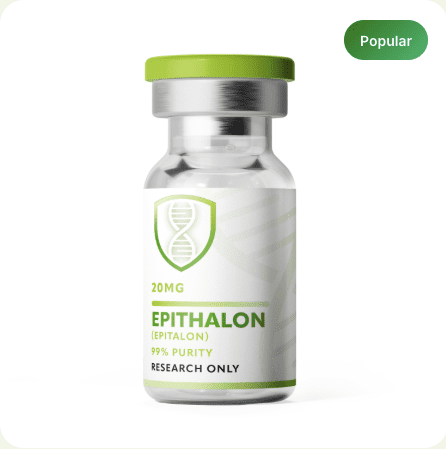
Epithalon (or Epitalon or Epithalone) is a synthetic tetrapeptide with the sequence Ala-Glu-Asp-Gly (AEDG). It is a small bioactive peptide analogue of plant peptides and natural animal peptides derived from the pineal gland extract epithalamin. Epithalon has been studied primarily for its ability to stimulate telomerase activity, support telomere maintenance in somatic cells, regulate pineal gland function, and exert geroprotective (anti-aging) effects in several experimental models.
Research shows that Epithalon can induce telomerase expression, elongate telomeres in human cell lines, normalize melatonin production, reduce oxidative stress markers, and alter gene expression associated with neural growth and repair, as well as immune function and the balance of inflammation. The FDA has not approved it for any therapeutic use and continues to be a strictly investigational compound in the United States and in most countries.
Disclaimer: Epithalon is not FDA-approved for human consumption and is available only in research studies.
Ready to Conduct Your Own Research on Epithalon? Order Now!
Table of Contents
Brief History of Epithalon Peptide
The journey of Epithalon began in the 1970s–1980s with studies on epithalamin—a natural polypeptide complex derived from bovine pineal glands. In early research, Russian scientist Professor Vladimir Khavinson Álex — who initiated and pioneered epithalamin studies at his St. Petersburg Institute of Bioregulation and Gerontology — investigated its geroprotective effects, including normalizing melatonin levels, enhancing immune function, and prolonging life in animal models.
Through experiments in the late 1980s and early 1990s, Khavinson et al showed that AEDG (Ala-Glu-Asp-Gly) is an active tetrapeptide out of epithalamin. They synthesized it in a pure, reproducible form, Epithalon (or Epitalon), to recreate and study these effects. In 2000–2003, the first significant publications of the biological action of Epithalon with activation of telomerase and elongation of telomeres in human somatic (human fibroblast) cells were published, demonstrating exceeding the Hayflick limit in fibroblast culture.
Over two decades, Khavinson’s team and international collaborators conducted research on pineal regulation, neurogenesis, cancer suppression, antioxidant activity, and longevity in rodent models, primates, and cell lines. In 2017, the presence of Epithalon in extracts from human pineal glands was conclusively established as a natural biological marker, confirming its physiological significance.
Epithalon, even today, is one of the most dimensioned short peptides in gerontology and longevity research, but remains investigational and not approved for use in humans outside controlled research protocols.
How Epithalon Peptide Is Used (In The Lab)
Epithalon studies span several disciplines, including aging, cellular biology, and neuroendocrinology. So, here are the key research applications from published studies:
1. Telomerase Activation and Telomere Elongation
Epithalon appears to induce telomerase activity and increase telomere length in somatic human cells (fibroblasts and lymphocytes). This allows cells to escape the Hayflick limit in cell culture, which is useful for studying replicative senescence and cellular aging.
2. Pineal Gland and Melatonin Regulation
It restores melatonin synthesis and circadian rhythms in elderly animals. Studies show that Epithalon reverses pineal gland degeneration in aging models, regulates sleep/wake cycles, and cortisol/melatonin ratios.
3. Geroprotection and Lifespan Extension
Epithalon has been shown to prolong mean and maximum lifespan in rodents and primates, decrease age-related biomarkers, and inhibit spontaneous tumor occurrence. Thus, it is being investigated as a potential geroprotector through antioxidant and neuroendocrine mechanisms.
4. Antioxidant and Anti-Inflammatory Effects
Epithalon inhibits peroxide lipid oxidation, restores glutathione peroxidase activity, and prevents oxidative stress markers. It is studied in the context of oxidative injury and the model of inflammaging.
5. Neurogenesis and Neuroprotection
In retinal and stem cell model systems, it actively enhances gene expression and protein synthesis during neuronal differentiation. Research has examined its epigenetic effects with regard to neurogenesis, retinal aging, and brain repair pathways.
6. Immune System Modulation
Studies investigate its impact on thymus function, thymocyte mitogenic activity, and interleukin-2 mRNA levels in different aging models. It’s being studied as a potential remedy for age-related immune decline.
7. Cancer Suppression Models
Epithalon lowers experimental carcinogenesis and spontaneous tumor onset in animals. Studies have shown that this affects tumor growth inhibition without targeted cytotoxicity.
All applications are restricted to controlled research or animal models. The FDA does not approve epithalon for human consumption.
Begin Your Research Investigation with Epithalon Today!
Epithalon Dosage Guide: In Research Environment
In laboratory research, Epithalon is commonly provided as a lyophilized powder (e.g., 10 mg or 50 mg vials) and reconstituted for use. Dosing differs across models, routes, and studies.
1. Standard Quantitative Range
- Active doses in rodent models: 0.1–10 μg/kg (by intranasal, subcutaneous, or intraperitoneal administration)
- In vitro: 0.1–100 nM concentrations
- Typical dosing range in studies: 1–10 μg/kg per dose
- GOAL: Telomerase activation and neuroendocrine modulation without non-specificity
2. Initial Calibration (Baseline Phase)
- Initial dose: Low end (e.g., 0.1–1 μg/kg)
- Dose: Administered as a single or repeated low-dose
- Reason: Identify the dose-response curve for telomerase activity, melatonin levels, or behavioral endpoints
3. Maintenance and Longitudinal Observation
- Dose: 5–10 μg/kg daily or every other day
- 10–20 days in acute/chronic models, repeated cycles (such as every 6 months) in longevity studies
- Rationale: Telomerase, pineal, antioxidants all find expression; take note of cumulative effects on life span, tumors, markers
Epithalon Preparation for Research Application
This is of utmost importance for peptide stability and experimental accuracy.
1. Supplies Needed Before Mixing
- LyophilizedEpithalon vials (e.g., 10 mg lyophilized / 50 mg lyophilized)
- Bacteriostatic water or saline (sterile)
- Alcohol swabs
- Syringe (sterile syringe, like an insulin syringe)
- Clean, sanitized workspace
2. Step-by-Step Reconstitution Process
- Use alcohol swabs to wipe the tops of the vials.
- Withdraw desired volume of bacteriostatic water into syringe (1,2 mL depending on size of vial used)
- Add water (slowly) down the wall of the vial to prevent foaming.
- Gently swirl (do not shake) until completely dissolved and the solution is clear.
- Store reconstituted vial at 2–8°C, in original packaging.
How Long Does It Take For Epithalon to Work
Research timelines vary by model, route, dose, and endpoint. Telomerase and epigenetic mechanisms often build effects gradually.
PHASE 1: Initial Response (DAY 1–14)
- Acute telomere elongation and melatonin intervention
- Early decrease in signs of oxidative stress and changes in gene expression
- Demonstrable changes in pineal function and indices of antioxidant состояния
Phase 2: Cellular Integration (2–6 Weeks)
- Telomere extension in cellular systems and somatic cells
- Enhanced neuronal differentiation and synaptic plasticity markers
- Decreased levels of inflammatory and age-related markers
Phase 3: Maturation and Optimization (1–6 Months)
- Geroprotective effects peak in longevity models
- Long-term lifespan extension, tumor suppression, and immune restoration
- Neuroendocrine recovery is maximal, and functional recovery
Phase 4: Longitudinal Homeostasis and Maintenance
- Cyclic dosing to support telomerase over time
- In some models, it prevents age-related decline upon withdrawal
- Prolonged alteration of gene expression and adapted resilience
Frequently Asked Questions
Epithalon: What is it, and how does it compare to other peptides?
Epithalon is a synthetic tetrapeptide (Ala-Glu-Asp-Gly) designed after extracts from the pineal gland. One of a kind for telomere/geroprotective research because, unlike growth hormone secretagogues, its main actions are activating telomerase and regulating pineal/melatonin pathways.
How does Epithalon activate telomerase?
Epithalon was shown to induce expression of telomerase catalytic subunits (hTERT), leading to increased telomerase activity in human somatic cells, allowing telomere elongation and extended proliferative capacity in culture.
Is Epithalon safe for research use?
Preclinical studies indicate a manageable safety profile with no marked toxicity at the doses administered. No toxic effects were seen when Na-K salt was daily fed to rats at 25 mg/kg for up to 45 days.1189 It equalizes the activity of antioxidant markers, and no anti-oxidative enzyme adverse effects have been reported in long-term animal models. Human safety data is limited.
How Can Epithalon Be Used In Cancer Research?
It has been investigated in studies for experimental carcinogenesis and spontaneous tumor incidence reduction. Its telomerase effects are under investigation in normal versus malignant cells, but it has not been approved for any cancer-related use.
What is the typical Epithalon research cycle length?
Typical protocols use 10–20-day cycles (5–10 μg/kg daily), with repeats performed 1–2 times per year in longevity models, allowing observation of cumulative effects on telomeres, melatonin, and lifespan biomarkers.
Where is Epithalon primarily researched?
Most of the foundational work has been done by groups led by Vladimir Khavinson at the St. Petersburg Institute of Bioregulation and Gerontology in Russia. However, some international studies involving telomerase and cellular senescence have emerged.
Conclusion
One of the most fascinating research peptides in gerontology, telomere biology, and pineal gland regulation is epithalon. These properties have established it as a staple in longevity peptide research for its telomerase stimulation and telomere elongation benefits, melatonin normalization, oxidative stress reduction options, and lifespan extension in animal models.
Although Epitalon showed promise in preclinical studies, it is not approved for human use. All exploration should remain firmly within the limits of lab and ethical research. While the rest of science advances, Epithalon provides new insights into the core processes underlying aging and maintenance from an almost pure biological perspective.
And then, are you ready to start researching Epithalon? Then ORDER now through a reliable source.
References
1. Khavinson VK, Bondarev IE, Butyugov AA. Epithalon peptide induces telomerase activity and telomere elongation in human somatic cells. Bull Exp Biol Med. 2003;135(6):590-592.
2. Khavinson VK, et al. AEDG Peptide (Epitalon) Stimulates Gene Expression and Protein Synthesis during Neurogenesis: Possible Epigenetic Mechanism. Int J Mol Sci. 2020;21(3):767.
3. Anisimov VN, Khavinson VK. Effect of Epitalon on biomarkers of aging, life span and spontaneous tumor incidence in female Swiss-derived SHR mice. Biogerontology. 2003;4(4):193-202.
4. Khavinson VK. Peptides and Ageing. Neuro Endocrinol Lett. 2002;23(Suppl 3):11-144.
5. Khavinson VK, et al. Epitalon protects against post-ovulatory aging-related damage of mouse oocytes in vitro. Aging (Albany NY). 2022;14(9):3783-3795.
6. Khavinson VK, et al. Overview of Epitalon—Highly Bioactive Pineal Tetrapeptide with Promising Properties. Int J Mol Sci. 2025;26(5):2691.
7. Khavinson VK, et al. Epithalon increases telomere length in human cell lines through telomerase upregulation or ALT activity. Aging (Albany NY). 2025;17(3):1123-1135.
