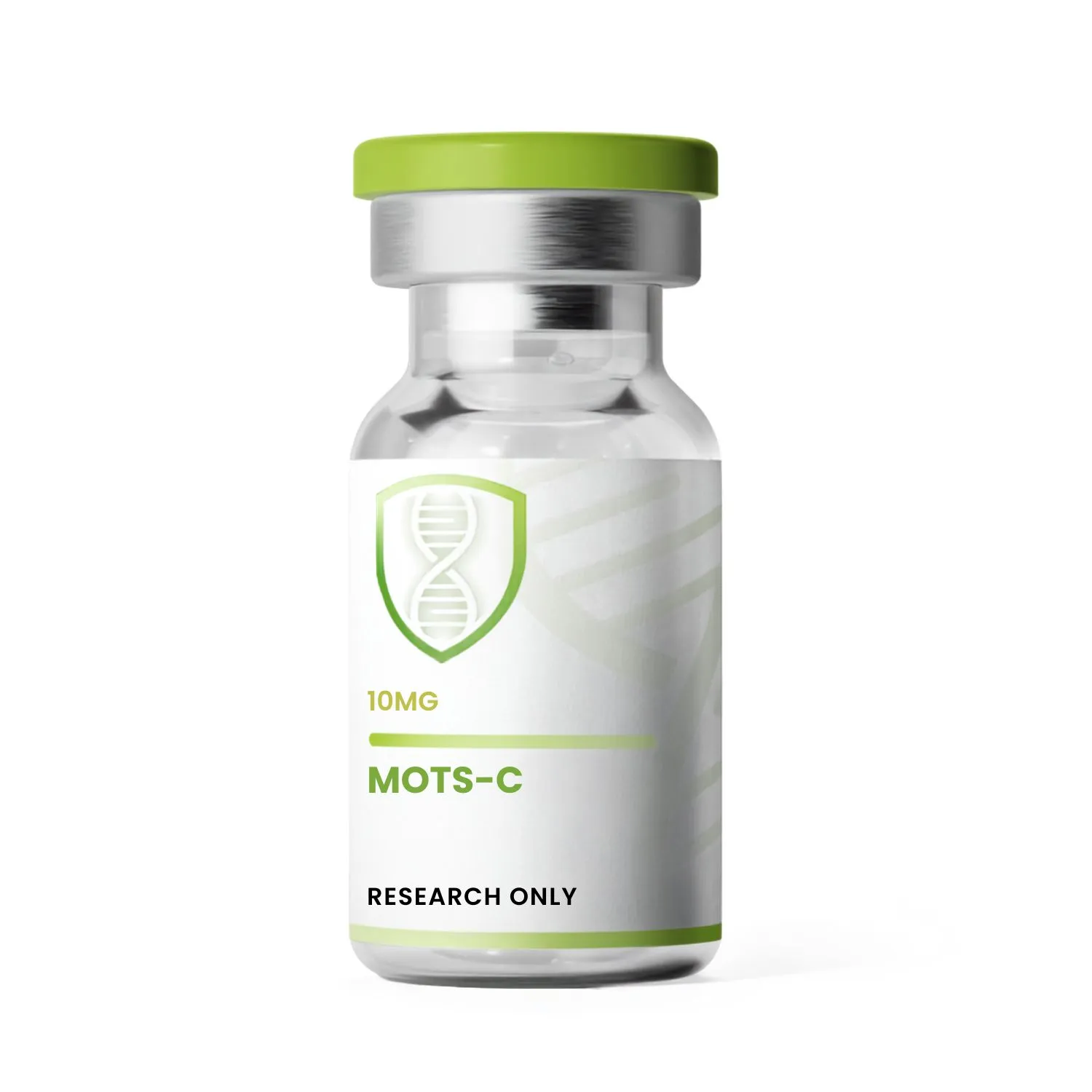
Buy MOTS-C 10mg
MOTS-C 10mg is a synthetic research peptide made up of 16 amino acids. It is based on a naturally occurring peptide encoded by mitochondrial DNA. Researchers study MOTS-C to understand how mitochondria communicate with cells and influence energy metabolism. MOTS-C belongs to a group of compounds called mitochondrial-derived peptides (MDPs). These peptides are involved in cellular signaling and responses to metabolic stress. First identified in 2015, MOTS-C has attracted research interest for its relationship with glucose metabolism, AMPK signaling, muscle function, and aging.
Orion Peptides supplies MOTS-C 10mg for laboratory and scientific research only. This compound is not intended for human or animal consumption.
What Is MOTS-C Peptide?
MOTS-C stands for Mitochondrial Open Reading Frame of the 12S rRNA-c. It is a naturally occurring peptide encoded by a small section of mitochondrial DNA. Mitochondria are parts of cells that help produce energy. They also communicate with other parts of the cell through chemical signals. MOTS-C is one of the peptides involved in this communication. Scientists discovered MOTS-C in 2015 while studying small protein-coding regions within mitochondrial DNA. The discovery showed that mitochondria can produce signaling peptides that affect processes beyond energy production. Since then, laboratory studies have explored how MOTS-C interacts with metabolic pathways, especially those involved in glucose use and cellular stress.
MOTS-C Chemical Properties and Molecular Structure
MOTS-C is a linear peptide consisting of 16 amino acids. Its amino acid sequence is MRWQEMGYIFYPRKLR. The peptide contains no disulfide bonds and has a free carboxyl group at its C-terminus.
| Property | Information |
| Compound Name | MOTS-C |
| Full Name | Mitochondrial Open Reading Frame of the 12S rRNA-c |
| Molecular Formula | C₁₀₁H₁₅₂N₂₈O₂₂S₂ |
| Molecular Weight | Approximately 2174.6 g/mol |
| CAS Number | 1627580-64-6 |
| PubChem CID | 146675088 |
| Amino Acid Length | 16 amino acids |
| Amino Acid Sequence | MRWQEMGYIFYPRKLR |
| Peptide Classification | Mitochondrial-derived peptide |
| Peptide Structure | Linear |
| Disulfide Bonds | None |
| C-Terminal Group | Free carboxyl group (–COOH) |
| Research Focus | Metabolic signaling, AMPK activity, and cellular stress responses |
| Compound Size | 10mg |
These chemical details describe the parent MOTS-C peptide. The exact molecular specifications of a salt form may differ. Researchers should confirm the compound’s form using its batch-specific Certificate of Analysis (COA).
How Does MOTS-C Work in Laboratory Research?
MOTS-C is involved in signaling pathways that help cells respond to changes in energy availability. Most of the current knowledge comes from cell-based experiments and animal studies. Researchers have identified several pathways that may explain its biological activity.
1. AMPK Signaling
AMP-activated protein kinase (AMPK) is an enzyme involved in cellular energy regulation. When energy availability changes, AMPK helps cells adjust how they use and store energy. Research published in
Cell Metabolism in 2015 found that MOTS-C influenced metabolic pathways linked to AMPK activation. The researchers also observed changes in glucose metabolism in experimental models. These findings suggest that MOTS-C may participate in the cellular response to metabolic stress.
2. Glucose Metabolism
Glucose is an important energy source for cells, particularly in tissues such as skeletal muscle. Scientists have studied whether MOTS-C affects the way cells process and use glucose. Early experiments found changes in glucose metabolism and insulin sensitivity in mice exposed to MOTS-C. The findings have made MOTS-C an interesting compound for investigating metabolic regulation. However, animal research does not establish that MOTS-C produces the same effects in humans.
3. Mitochondria-to-Nucleus Communication
Mitochondria and the cell nucleus exchange signals to regulate cellular activity. A 2018 study published in
Cell Metabolism found that MOTS-C can move into the nucleus under certain metabolic stress conditions. Once inside the nucleus, it can influence the activity of genes involved in stress responses. This discovery helped researchers understand another way mitochondria communicate with the rest of the cell.
MOTS-C Research Applications
MOTS-C is studied in several areas of laboratory and preclinical research.
Metabolic Regulation
One major area of MOTS-C research is cellular metabolism. Researchers investigate how this peptide affects the pathways involved in glucose processing and energy balance. A 2015 study reported that MOTS-C influenced insulin sensitivity and metabolic activity in mice. The same research examined its relationship with the folate cycle, purine biosynthesis, and AMPK signaling. These findings provide a foundation for further research into mitochondrial control of metabolism.
Aging and Cellular Stress
Aging is associated with changes in mitochondrial activity, cellular metabolism, and the body’s ability to respond to stress. Scientists are studying whether mitochondrial-derived peptides play a role in these changes. In a 2021 study published in
Nature Communications, researchers examined MOTS-C in young, middle-aged, and older mice. The study found changes in physical performance and muscle-related metabolic pathways following experimental MOTS-C treatment. These findings are limited to the conditions studied and do not establish that MOTS-C slows aging or extends human lifespan.
Exercise and Muscle Metabolism
MOTS-C has also been studied in relation to physical activity. Exercise increases energy demand in skeletal muscle and causes several metabolic changes. A 2021 study found that exercise increased endogenous MOTS-C levels in human skeletal muscle and circulation. The researchers also observed changes in muscle metabolism and physical performance in animal experiments involving MOTS-C. It is important to distinguish these findings. Changes in naturally occurring MOTS-C during exercise do not prove that externally supplied MOTS-C improves human exercise performance.
Cellular Stress Responses
Cells experience stress when exposed to changes in nutrient supply, temperature, and other environmental conditions. Research suggests that MOTS-C participates in some of the signaling pathways involved in these responses. A 2018 study found that MOTS-C influenced gene expression during metabolic stress. Researchers continue to explore how these changes relate to mitochondrial function and cellular adaptation.
MOTS-C 10mg Research Applications at a Glance
| Research Area | What Researchers Investigate |
| Mitochondrial Signaling | Communication between mitochondria and the cell nucleus |
| AMPK Pathway | Cellular energy regulation and metabolic signaling |
| Glucose Metabolism | Glucose processing and insulin-related pathways |
| Muscle Research | Skeletal muscle metabolism and stress adaptation |
| Aging Research | Changes in mitochondrial signaling associated with aging |
| Cellular Stress | Responses to metabolic and environmental stress |
| Gene Expression | Changes in nuclear gene activity under experimental conditions |
These are areas of scientific investigation, not proven medical benefits.
What Do Scientific Studies Say About MOTS-C?
Several published studies have contributed to the current understanding of MOTS-C.
2015: Discovery and Metabolic Research Researchers identified MOTS-C as a mitochondrial-derived peptide and investigated its effects on metabolic activity. The study reported changes in AMPK signaling, insulin sensitivity, and obesity-related measurements in mice.
2018: Nuclear Signaling Research Scientists found that MOTS-C could move into the cell nucleus during metabolic stress. The study showed that MOTS-C was involved in regulating certain genes associated with cellular stress responses.
2021: Exercise and Aging Research Researchers examined the relationship between MOTS-C, physical activity, and muscle function. The study found that exercise increased endogenous MOTS-C in humans. Experiments in mice also reported changes in physical capacity and muscle metabolism.
Research limitations: Although these findings are scientifically interesting, evidence for the safety and effectiveness of externally administered MOTS-C in humans remains insufficient. More research is needed to understand its biological effects and possible risks.
MOTS-C 10mg Storage and Handling
Peptides can lose stability when exposed to unsuitable temperatures, moisture, or repeated handling. Careful storage helps maintain the quality of laboratory research materials. General storage considerations include:
- Keep the lyophilized peptide sealed and protected from moisture.
- Store according to the supplier’s batch-specific temperature instructions.
- Avoid repeated freezing and thawing.
- Protect the material from unnecessary exposure to heat and light.
- Follow validated laboratory procedures when preparing research samples.
- Consult the Certificate of Analysis and Safety Data Sheet before handling.
Storage conditions depend on the compound’s formulation and available stability data. Researchers should not assume that every MOTS-C preparation has identical storage requirements.
MOTS-C 10mg Quality and Research Documentation
When selecting MOTS-C 10mg for laboratory research, compound identity and testing documentation are important. Researchers should check whether the supplier provides information about peptide purity, molecular identity, and batch testing. Key quality details include:
- Verified peptide identity
- Documented purity results
- Batch-specific Certificate of Analysis
- Third-party testing, where available
- Compound quantity and identification
- Storage and handling information
Orion Peptides supplies research peptides for laboratory applications. Compound-specific purity and testing claims should be checked against the available batch documentation. A high purity result does not automatically establish sterility, safety, or suitability for human use.
Frequently Asked Questions About MOTS-C 10mg
What is MOTS-C 10mg?
MOTS-C 10mg is a research compound containing 10 milligrams of synthetic MOTS-C peptide. It is intended for laboratory investigations of mitochondrial signaling, metabolism, and cellular processes.
How many amino acids does MOTS-C contain?
MOTS-C contains 16 amino acids. Its sequence is MRWQEMGYIFYPRKLR.
What is the molecular weight of MOTS-C?
The molecular weight of the parent MOTS-C peptide is approximately 2174.6 g/mol.
Is MOTS-C naturally produced in the body?
Yes. MOTS-C is a naturally occurring mitochondrial-derived peptide encoded by mitochondrial DNA. Its biological activity has been investigated in both cell-based and animal research.
Does MOTS-C affect AMPK signaling?
Laboratory studies suggest that MOTS-C can influence pathways associated with AMPK activation. The exact response depends on the experimental model and research conditions.
Is MOTS-C an exercise-mimetic peptide?
Some researchers study MOTS-C in relation to exercise-responsive metabolic pathways. Animal studies have reported changes in physical performance, but these results do not establish exercise-related benefits in humans.
Does Orion Peptides provide a COA for MOTS-C 10mg?
Researchers should check the compound’s available Certificate of Analysis or contact Orion Peptides for batch-specific testing documentation.
Is MOTS-C FDA-approved?
No. MOTS-C is not an FDA-approved drug. Its safety and effectiveness for medical use have not been established.
Can MOTS-C 10mg be used for human consumption?
No. MOTS-C 10mg supplied by Orion Peptides is intended strictly for laboratory research. It is not intended for human or animal consumption, self-administration, or therapeutic applications.
Regulatory and Safety Disclaimer
MOTS-C 10mg supplied by
Orion Peptides is intended exclusively for laboratory research and scientific investigation. This compound is not intended for human or animal consumption, personal use, diagnostic procedures, or therapeutic applications.
Research-grade MOTS-C sold by Orion Peptides is not an FDA-approved drug compound. Its safety, effectiveness, and suitability for clinical use have not been established. The FDA has identified potential concerns involving immune reactions, peptide-related impurities, and limited safety information for MOTS-C-containing compounded compounds. All research materials should be handled by qualified personnel in accordance with applicable laws, institutional guidelines, and laboratory safety protocols. Researchers should review the Safety Data Sheet, use appropriate protective equipment, and follow suitable storage and disposal procedures. Orion Peptides supplies MOTS-C strictly for research purposes and does not make claims regarding its safety or effectiveness for human or veterinary use.
Scientific References
1. Lee C, et al. (2015) The Mitochondrial-Derived Peptide MOTS-c Promotes Metabolic Homeostasis and Reduces Obesity and Insulin Resistance.
2. Kim KH, et al. (2018) The Mitochondrial-Encoded Peptide MOTS-c Translocates to the Nucleus to Regulate Nuclear Gene Expression in Response to Metabolic Stress.