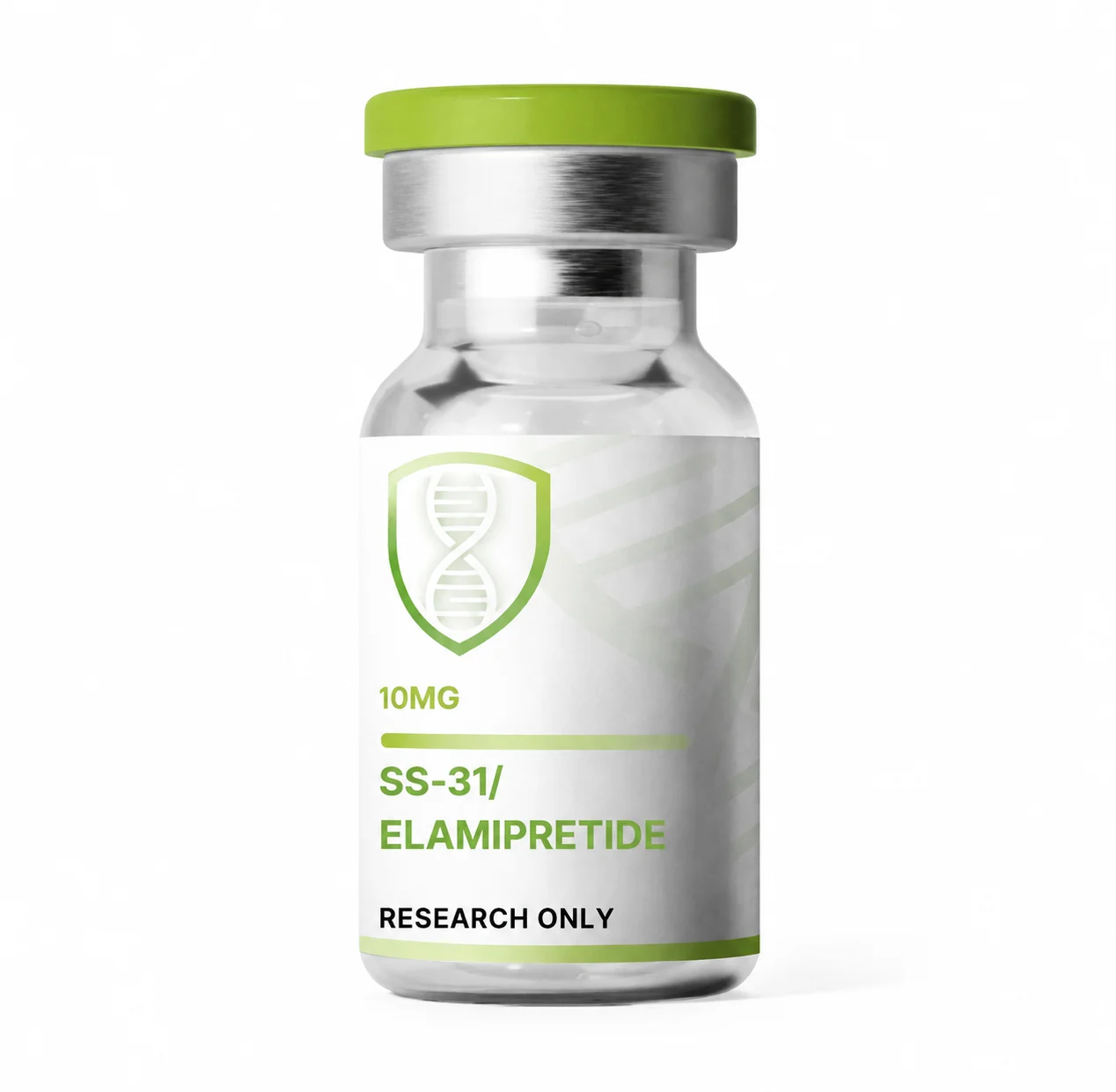
SS-31 (Elamipretide) Peptide 10mg For Sale
SS-31 Peptide 10mg, also known as
Elamipretide or
MTP-131, is a synthetic, mitochondria-targeting tetrapeptide supplied by
Orion Peptides for laboratory research. SS-31 contains four amino-acid residues and belongs to the Szeto-Schiller peptide family. It has attracted scientific interest because of its interaction with cardiolipin, a phospholipid concentrated in the inner mitochondrial membrane. Published biochemical and biophysical research has examined SS-31 in relation to mitochondrial membrane organization, cardiolipin interactions, cytochrome c activity, and membrane electrostatics. Orion Peptides offers SS-31 10mg as a lyophilized research material. Researchers can review the available batch-specific analytical documentation to verify its reported identity and quality characteristics.
For Research Use Only (RUO). Not intended for human or veterinary consumption. SS-31 Peptide 10mg Specifications
| Specification | Details |
| Compound Name | SS-31 Peptide |
| Alternative Name | Elamipretide |
| Research Codes | SS-31, MTP-131, Bendavia |
| Peptide Class | Szeto-Schiller peptide |
| Sequence | D-Arg-Dmt-Lys-Phe-NH₂ |
| Peptide Length | 4 amino-acid residues |
| Molecular Formula | C₃₂H₄₉N₉O₅ |
| Molecular Weight | 639.8 g/mol |
| Exact Mass | 639.38566570 Da |
| CAS Number | 736992-21-5 |
| PubChem CID | 11764719 |
| Declared Quantity | 10mg |
| Physical Form | Lyophilized peptide |
| Intended Use | Laboratory research only |
The molecular formula, molecular weight, and exact mass describe the parent elamipretide structure reported by PubChem. The supplied material’s salt form, net peptide content, and batch-specific characteristics should be confirmed using its Certificate of Analysis. What Is SS-31 Peptide (Elamipretide)?
SS-31 is a synthetic tetrapeptide belonging to the Szeto-Schiller family of aromatic-cationic peptides. Its sequence is
D-Arg-Dmt-Lys-Phe-NH₂, where Dmt represents 2,6-dimethyltyrosine, a modified aromatic amino acid. The peptide contains four residues:
- D-Arginine: A stereochemically modified arginine residue
- 2,6-Dimethyltyrosine (Dmt): A modified aromatic amino acid
- Lysine: A residue containing a positively charged side chain under common physiological conditions
- Phenylalaninamide: An aromatic terminal residue with a C-terminal amide
This arrangement of aromatic and cationic residues contributes to the peptide’s interactions with lipid membrane environments. Much of the scientific literature on SS-31 focuses on its affinity for cardiolipin-containing mitochondrial membranes. Unlike many larger signaling peptides, SS-31 has a compact four-residue structure and has been examined primarily through studies of membrane interactions and mitochondrial biochemistry. Researchers interested in the peptide’s scientific development can explore
The History of SS-31 (Elamipretide): From Discovery to Modern Research.
SS-31 and Mitochondrial Membrane Research
Mitochondria contain an outer membrane and a highly specialized inner membrane. The inner membrane forms structures called cristae, which provide the organized membrane environment necessary for many processes associated with oxidative phosphorylation. A distinctive feature of the inner mitochondrial membrane is its cardiolipin content. Cardiolipin is a phospholipid involved in membrane organization, protein interactions, and the arrangement of respiratory complexes. Research involving SS-31 has examined how short aromatic-cationic peptides interact with these cardiolipin-containing membrane environments. Experimental investigations suggest that SS-31 can associate with mitochondrial membrane interfaces through electrostatic and hydrophobic interactions. These findings have made the peptide relevant to laboratory studies of membrane biophysics and mitochondrial organization. For a more detailed explanation of the underlying biochemical research, see
How SS-31 Works: Understanding Cardiolipin and Mitochondrial Function.
SS-31 and Cardiolipin Interactions
Cardiolipin is a specialized phospholipid found predominantly in the inner mitochondrial membrane. It contributes to several important structural and biochemical processes, including:
- Mitochondrial cristae organization
- Membrane electrostatics
- Respiratory protein interactions
- Oxidative phosphorylation
- Cytochrome c association
- Organization of electron-transport complexes
SS-31 has been investigated as a research compound for examining cardiolipin-dependent membrane interactions. Published laboratory studies have reported strong interactions between SS-31 and cardiolipin-containing lipid systems. For example, biochemical research by Birk and colleagues examined the relationship between SS-31, cardiolipin, and mitochondrial membrane-associated processes. These findings provide a basis for further investigations into how short synthetic peptides interact with specialized mitochondrial lipids. The observations are specific to the experimental systems studied and should not be interpreted as universal biological outcomes.
SS-31 and Cytochrome c Research
Another area of SS-31 research involves cytochrome c. Cytochrome c is a protein associated with the mitochondrial electron transport chain. Its interactions with cardiolipin can influence its biochemical behavior under different experimental conditions. Researchers have examined whether SS-31 modifies these interactions in cardiolipin-containing systems. Published biochemical studies have investigated relationships between SS-31, cardiolipin-associated cytochrome c activity, electron transfer, and membrane oxidation. These investigations provide information about peptide-lipid-protein interactions within mitochondrial membrane environments. However, findings from isolated biochemical systems should be distinguished from results obtained in complex cellular or clinical settings.
Research Into Mitochondrial Membrane Electrostatics
SS-31 has also been studied in relation to the electrical properties of mitochondrial membranes. A 2020 study published in the
Journal of Biological Chemistry examined SS-31 interactions with lipid bilayers and membrane surface electrostatics. The researchers reported that SS-31 associated with the membrane interfacial region and influenced membrane electrostatic characteristics under the experimental conditions studied. The findings suggested that SS-31’s interaction with membranes involves more than simple binding to a single lipid component. Research in this area continues to examine:
- Membrane surface charge
- Lipid packing
- Peptide-lipid interactions
- Cardiolipin-containing membrane interfaces
- Membrane-associated protein organization
These findings are particularly relevant to laboratory investigations involving mitochondrial membrane structure and biophysical characterization.
SS-31 and Mitochondrial Protein Interactions
Although cardiolipin is one of the best-characterized molecular interaction partners associated with SS-31, researchers have also investigated the peptide’s wider mitochondrial interaction environment. Proteomic investigations have examined proteins and protein complexes associated with SS-31 exposure under controlled experimental conditions. These studies have contributed to research into mitochondrial protein organization and the relationship between membrane lipids and protein complexes. However, identifying a protein interaction or association does not necessarily demonstrate a direct functional effect. Such findings require interpretation within the specific analytical and experimental conditions used.
Areas of SS-31 Laboratory Research
Published scientific literature has examined SS-31 in several laboratory and preclinical research contexts.
Mitochondrial Membrane Organization
Researchers investigate how SS-31 interacts with cardiolipin-containing membranes and influences their physical organization in experimental systems.
Cardiolipin Biochemistry
SS-31 has been used to study cardiolipin interactions, membrane association, and cardiolipin-related protein behavior.
Membrane Electrostatics
Biophysical experiments have examined the relationship between SS-31 and membrane surface charge, lipid arrangement, and interfacial properties.
Cytochrome c Interactions
Researchers have investigated how SS-31 may affect interactions between cytochrome c and cardiolipin under defined laboratory conditions.
Mitochondrial Protein Organization
Proteomic and biochemical investigations have explored associations between SS-31 and mitochondrial proteins or protein complexes.
Experimental Oxidative-Stress Models
Some studies have examined SS-31 in cellular and preclinical models involving oxidative changes. Findings from these models must be interpreted according to their experimental methods and should not be presented as established therapeutic outcomes. For an overview of published clinical investigations and their limitations, researchers can also read
SS-31 Clinical Trials: What Scientists Have Discovered So Far.
SS-31 Molecular Structure and Chemical Identification
SS-31 is structurally distinct from many conventional short peptides. Its four-residue sequence contains a D-amino acid, a modified aromatic residue, and a C-terminal amide. These structural characteristics are important for understanding the peptide’s chemical identity and interactions in experimental systems. According to
PubChem’s Elamipretide record, the parent compound has the following properties:
- Molecular formula: C₃₂H₄₉N₉O₅
- Molecular weight: 639.8 g/mol
- Exact mass: 639.38566570 Da
- CAS number: 736992-21-5
- PubChem CID: 11764719
- Sequence: D-Arg-Dmt-Lys-Phe-NH₂
These chemical identifiers are relevant to analytical characterization and compound identification. Researchers should distinguish between the parent peptide structure and any salt or counterion form present in a supplied research material.
SS-31 Peptide 10mg for Laboratory Research
When evaluating
SS-31 peptide 10mg for laboratory research, compound identity, supplied quantity, physical form, and batch-specific analytical documentation are important considerations. Orion Peptides lists
SS-31 10mg as a lyophilized research peptide. Researchers reviewing SS-31 materials should examine:
- Compound identity and peptide sequence
- Molecular formula and molecular weight
- Declared quantity
- Supplied salt or counterion form
- Reported chromatographic purity
- Available mass-spectrometry findings
- Batch or lot identification
- Storage specifications
A Certificate of Analysis can help establish which identity and quality tests were performed for a particular batch. Importantly, HPLC purity, peptide content, and supplied material mass are separate analytical concepts and should not be treated as interchangeable.
SS-31 5mg and 10mg Research Formats
Orion Peptides also lists
SS-31/Elamipretide 5mg as a separate research compound. The two listings have different declared quantities:
Researchers should review each listing for its current availability, compound specifications, and corresponding batch documentation. Differences in labeled quantity should not be interpreted as evidence of different molecular identities.
Storage and Laboratory Handling
SS-31 10mg is listed as a lyophilized peptide. Lyophilized research materials should be stored according to their compound-specific stability documentation. For this compound, the listed dry-storage condition is
−20°C, with protection from light and moisture. General laboratory precautions include:
- Keeping the container securely sealed
- Avoiding unnecessary moisture exposure
- Minimizing repeated temperature fluctuations
- Protecting the material from contamination
- Following the applicable batch documentation and laboratory safety procedures
Storage characteristics can vary according to the peptide’s chemical form, packaging, and experimental preparation. Do not assume that storage instructions for dry material automatically apply to prepared solutions.
Frequently Asked Questions About SS-31 Peptide
1. What is SS-31 peptide?
SS-31 is a synthetic tetrapeptide also known as elamipretide or MTP-131. It belongs to the Szeto-Schiller peptide family and is studied for its interactions with cardiolipin-containing mitochondrial membranes.
2. Is SS-31 the same as elamipretide?
SS-31 and elamipretide are names associated with the same parent peptide structure. However, independently supplied research materials should not automatically be considered equivalent to a regulated pharmaceutical formulation.
3. What is the molecular weight of SS-31?
The molecular weight of the parent elamipretide structure is approximately 639.8 g/mol. The complete chemical form of a supplied preparation may differ depending on its associated salt or counterions.
4. What is the amino acid sequence of SS-31?
The peptide sequence is
D-Arg-Dmt-Lys-Phe-NH₂, where Dmt represents 2,6-dimethyltyrosine.
5. How many amino acids are in SS-31?
SS-31 contains four amino-acid residues and is therefore classified as a tetrapeptide.
6. What is the CAS number for SS-31?
The CAS number associated with the parent elamipretide structure is
736992-21-5.
7. Does SS-31 interact with cardiolipin?
Published biochemical and biophysical studies have reported interactions between SS-31 and cardiolipin-containing membranes. The characteristics of these interactions depend on the experimental conditions.
8. What is the difference between SS-31 5mg and SS-31 10mg?
The principal difference between the two compound designations is the declared quantity. Orion Peptides lists both
SS-31 5mg and SS-31 10mg research formats. Researchers should verify the specifications and analytical documentation associated with each compound.
9. What should researchers check before purchasing SS-31 peptide 10mg?
Important considerations include peptide identity, sequence, chemical form, declared quantity, batch number, analytical testing, and available Certificates of Analysis. Researchers should ensure that the documentation corresponds to the actual material being evaluated.
10. Is SS-31 10mg supplied with a Certificate of Analysis?
Orion Peptides provides access to available SS-31 analytical documentation. Researchers should review the relevant batch-specific Certificate of Analysis to determine which tests were conducted and what results were reported.
11. Is SS-31 FDA-approved?
The U.S. FDA granted accelerated approval to the prescription drug
Forzinity (elamipretide) on September 19, 2025, for a specific indication involving Barth syndrome. This approval does not apply to independently supplied SS-31 research compounds. Orion Peptides SS-31 10mg is not an FDA-approved medication and is not intended for clinical use.
12. Is Orion Peptides SS-31 10mg intended for human use?
No. Orion Peptides supplies SS-31 10mg strictly for laboratory research and analytical investigation. It is not intended for human or veterinary consumption, administration, diagnosis, treatment, or other clinical purposes.
SS-31 Regulatory Information
SS-31 is a research designation associated with elamipretide. On September 19, 2025, the U.S. Food and Drug Administration granted accelerated approval to
Forzinity (elamipretide) for improving muscle strength in adults and children with Barth syndrome weighing at least 30kg. This approval applies to the specific authorized prescription drug and its regulated formulation. It does not establish the clinical safety, pharmaceutical equivalence, or approval status of independently supplied research materials.
Orion Peptides SS-31 10mg is a research-only material and is not an FDA-approved pharmaceutical compound. Official source:
FDA Drug Trials Snapshot — Forzinity.
Scientific References
- National Center for Biotechnology Information. PubChem Compound Summary: Elamipretide, CID 11764719. Molecular formula, sequence, molecular weight, and chemical identifiers.
- Mitchell W, et al. (2020). The Mitochondria-Targeted Peptide SS-31 Binds Lipid Bilayers and Modulates Surface Electrostatics as a Key Component of Its Mechanism of Action. Journal of Biological Chemistry.
- Birk AV, et al. (2013). The Mitochondrial-Targeted Compound SS-31 Re-Energizes Ischemic Mitochondria by Interacting With Cardiolipin. Journal of the American Society of Nephrology.
- Birk AV, et al. (2014). Targeting Mitochondrial Cardiolipin and the Cytochrome c/Cardiolipin Complex to Promote Electron Transport and Optimize Mitochondrial ATP Synthesis. British Journal of Pharmacology.
- Chavez JD, et al. (2020). Mitochondrial Protein Interaction Landscape of SS-31. Proceedings of the National Academy of Sciences.
- U.S. Food and Drug Administration. (2025). Drug Trials Snapshot: Forzinity (Elamipretide). Regulatory information about the FDA-authorized prescription compound.
Research Use Only (RUO) Disclaimer
All compounds offered by
Orion Peptides, including SS-31 Peptide 10mg, are supplied strictly for laboratory research, chemical analysis, and scientific investigation. These materials are not intended for human or veterinary consumption, clinical administration, diagnosis, treatment, cure, or prevention of any disease. The information provided on this page is for scientific and educational purposes only. References to biochemical mechanisms, laboratory investigations, preclinical findings, or FDA-approved pharmaceutical formulations do not establish the safety, efficacy, or clinical suitability of Orion Peptides research materials. Researchers must verify compound identity, chemical form, and batch-specific specifications and follow applicable laboratory safety regulations and institutional requirements.