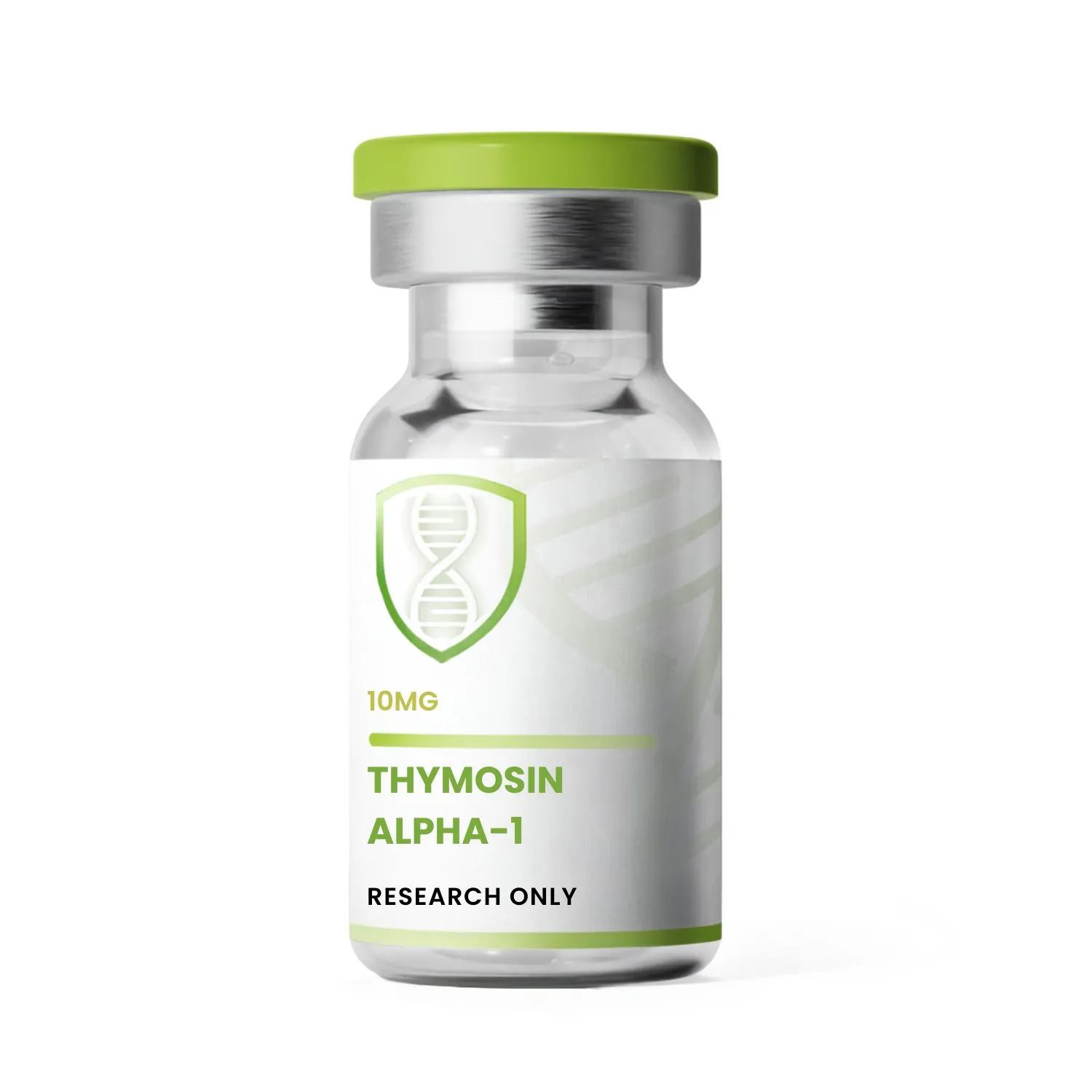
Buy Thymosin Alpha-1 10mg | Research Peptide | Orion Peptides
Thymosin Alpha-1 10mg, also known as TA1 or thymalfasin, is a synthetic 28-amino-acid peptide studied for its role in immune cell signaling and regulation. Thymosin Alpha-1 is naturally produced through the processing of prothymosin alpha, a protein encoded by the PTMA gene. The peptide was originally identified in thymus-derived preparations and has since been investigated in laboratory models and clinical research. Scientists study Thymosin Alpha-1 to understand its interactions with T cells, dendritic cells, natural killer cells, and cytokine signaling pathways. These investigations have contributed to research into how peptides influence innate and adaptive immune responses. At
Orion Peptides, Thymosin Alpha-1 10mg is offered for controlled laboratory research. The 10mg designation refers to the nominal peptide quantity supplied in the research vial.
Research Use Only: This compound is not FDA-approved for human use and is not intended for human or veterinary administration.
What Is Thymosin Alpha-1?
Thymosin Alpha-1 (TA1) is a naturally occurring, N-terminally acetylated peptide consisting of 28 amino acids. It was first isolated from thymosin fraction 5, a preparation obtained from thymus tissue. Researchers subsequently identified its amino acid sequence and developed synthetic versions for scientific investigation. Thymosin Alpha-1 is derived from prothymosin alpha. Although its discovery is closely associated with the thymus gland, prothymosin alpha is expressed in different tissues. The peptide is particularly interesting in immunology because experimental studies have reported effects on cells involved in immune recognition, signaling, and regulation. Research has examined the relationship between Thymosin Alpha-1 and:
- T-cell activation and differentiation
- Dendritic cell function
- Natural killer cell activity
- Toll-like receptor signaling
- Cytokine production
- Innate and adaptive immune responses
Synthetic Thymosin Alpha-1 is also called thymalfasin. It has been investigated in clinical studies involving infections and other immune-related conditions. However, results from regulated clinical compounds do not establish the safety, effectiveness, or suitability of independently manufactured research peptides.
Research reference: Thymosin alpha 1: A comprehensive review of the literature (2020).
Thymosin Alpha-1 Amino Acid Sequence and Molecular Properties
Thymosin Alpha-1 is a linear peptide with 28 amino acid residues and an acetylated N-terminus. Its complete amino acid sequence is:
Ac-Ser-Asp-Ala-Ala-Val-Asp-Thr-Ser-Ser-Glu-Ile-Thr-Thr-Lys-Asp-Leu-Lys-Glu-Lys-Lys-Glu-Val-Val-Glu-Glu-Ala-Glu-Asn-OH The corresponding one-letter sequence is:
SDAAVDTSSEITTKDLKEKKEVVEEAEN | Property | Details |
| Compound name | Thymosin Alpha-1 10mg |
| Alternative names | TA1, Tα1, Thymalfasin |
| Peptide class | Synthetic immunomodulatory peptide |
| Amino acid length | 28 residues |
| Molecular formula | C₁₂₉H₂₁₅N₃₃O₅₅ |
| Molecular weight | Approximately 3,108.3 g/mol |
| CAS number | 62304-98-7 |
| PubChem CID | 16130571 |
| N-terminal modification | Acetylated |
| Parent protein | Prothymosin alpha |
| Associated gene | PTMA |
| Nominal vial content | 10mg |
| Intended use | Laboratory research |
These molecular details refer to the Thymosin Alpha-1 parent peptide. Salt forms, including acetate preparations, may have different molecular specifications. The defined amino acid sequence allows researchers to investigate peptide identity, structure, and chemical stability using appropriate analytical techniques.
Chemical reference: PubChem: Thymalfasin, CID 16130571.
Thymosin Alpha-1 Mechanism of Action
Thymosin Alpha-1 has been studied for its influence on several signaling pathways involved in immune regulation. Unlike peptides that act primarily through a single well-established receptor, Thymosin Alpha-1 appears to have a broader range of effects on immune cells. Research has identified relationships between its activity and Toll-like receptor (TLR) signaling, dendritic cell maturation, and cytokine regulation.
Toll-Like Receptor Signaling
Toll-like receptors help immune cells recognize molecular patterns associated with microorganisms and tissue damage. In experimental research, Thymosin Alpha-1 has been associated with signaling through several TLR-related pathways. These pathways include MyD88-dependent signaling and downstream molecular responses involving NF-κB and interferon regulatory factors. Activation of these pathways can influence how immune cells respond to their environment. However, the exact interactions depend on the cell type and experimental model. Not every reported response demonstrates direct binding between Thymosin Alpha-1 and a particular TLR.
Dendritic Cell Activity
Dendritic cells play an important role in connecting innate and adaptive immunity. They process antigens and help coordinate the activation of other immune cells. A study published in 2004 examined how Thymosin Alpha-1 influenced dendritic cell responses in experimental models involving Aspergillus fumigatus. Researchers reported increased dendritic cell maturation and interleukin-12 production through TLR-associated signaling. The study also examined immune responses in mice. These findings helped establish Thymosin Alpha-1 as a research compound of interest in dendritic cell biology.
Research: Thymosin alpha 1 activates dendritic cells for antifungal Th1 resistance through Toll-like receptor signaling.
T-Cell Signaling
T lymphocytes are involved in adaptive immune responses. Thymosin Alpha-1 has been investigated for its effects on T-cell maturation, activation, and immune communication. Experimental findings suggest that some of its effects may occur indirectly through changes in dendritic cell function and cytokine signaling. Researchers examine these pathways to understand how different immune cell populations communicate during an immune response.
Cytokine Regulation
Cytokines are signaling proteins that help immune cells communicate. They play important roles in inflammation, immune activation, and the regulation of cellular responses. Studies involving Thymosin Alpha-1 have examined changes in cytokines such as interferons and interleukins. These effects can vary between experimental models and physiological conditions. For this reason, Thymosin Alpha-1 should not simply be described as a peptide that always increases immune activity. Some research also suggests context-dependent immunoregulatory effects.
Why Researchers Study Thymosin Alpha-1
Thymosin Alpha-1 has been investigated for several decades in studies involving immune signaling and peptide biology.
1. Innate Immune Signaling
Innate immunity provides an early response to infectious agents and other biological challenges. Researchers study how Thymosin Alpha-1 may influence pathways involving dendritic cells, macrophages, natural killer cells, and Toll-like receptors. These investigations help scientists understand cellular signaling during experimental immune responses.
2. Adaptive Immune Responses
Adaptive immunity involves specialized cells, including T lymphocytes and B lymphocytes. Studies of Thymosin Alpha-1 have examined T-cell activity and the relationship between innate immune signals and adaptive immune responses. These findings are useful for understanding how peptide-mediated signaling may affect interactions between different immune cell populations.
3. Dendritic Cell Research
Thymosin Alpha-1 has been investigated in experiments involving dendritic cell maturation and immune regulation. Research has examined its effects on TLR/MyD88 pathways, cytokine production, and antigen-related signaling. These studies contribute to the broader understanding of dendritic cell biology.
4. Inflammatory Signaling
Inflammation involves complex interactions between immune cells and signaling molecules. Thymosin Alpha-1 has been studied for its effects on different inflammatory pathways. Some experimental findings suggest that its activity may depend on the surrounding immune environment. Researchers investigate these responses to better understand the relationship between immune activation and immune regulation.
5. Peptide Structure and Molecular Analysis
The defined structure of Thymosin Alpha-1 makes it suitable for laboratory analysis. Researchers can examine its molecular identity, chromatographic behavior, peptide-related impurities, and chemical stability. These studies are relevant to analytical method development and peptide characterization.
Thymosin Alpha-1 vs Thymosin Beta-4
Despite their similar names, Thymosin Alpha-1 and Thymosin Beta-4 are different peptides. They have different amino acid sequences, molecular structures, and biological research applications.
| Feature | Thymosin Alpha-1 | Thymosin Beta-4 |
| Alternative name | TA1, thymalfasin | TB4 |
| Amino acid length | 28 | 43 |
| Biological origin | Derived from prothymosin alpha | Widely expressed endogenous peptide |
| Main research area | Immune regulation | Actin dynamics and cell migration |
| Molecular role | Associated with immune signaling pathways | Binds monomeric actin |
| Research models | Immune cells and endocrine-immune interactions | Cell movement, cytoskeletal processes, and tissue responses |
| Chemical identity | Distinct 28-residue sequence | Distinct 43-residue sequence |
Thymosin Alpha-1 is studied primarily in immunology, while Thymosin Beta-4 is widely investigated for its role in actin regulation and cell migration. Researchers should also distinguish full-length Thymosin Beta-4 from shorter peptide fragments marketed under the name TB-500.
Thymosin Alpha-1 5mg vs 10mg
Orion Peptides lists two Thymosin Alpha-1 research quantities.
| Compound | Nominal quantity | Compound link |
| Thymosin Alpha-1 5mg | 5mg | View 5mg |
| Thymosin Alpha-1 10mg | 10mg | Current compound page |
Both strengths refer to the same peptide molecule. The primary difference is the nominal quantity supplied. The selection of a vial size depends on the analytical requirements and experimental design. For either strength, laboratories should confirm the compound’s identity, purity, and actual peptide content using available batch-specific documentation.
Thymosin Alpha-1 Purity and Laboratory Testing
Reliable analytical documentation helps researchers evaluate the identity and quality of peptide materials. Two commonly used techniques are high-performance liquid chromatography and mass spectrometry.
HPLC Purity Testing
High-performance liquid chromatography (HPLC) separates components of a sample under controlled analytical conditions. It can help identify the main peptide peak and certain related impurities. The result is often reported as a percentage of the total detected chromatographic peak area. A 99% HPLC purity result does not automatically mean that 99% of the vial’s total mass consists of Thymosin Alpha-1.
Mass Spectrometry
Mass spectrometry provides information about molecular mass. For Thymosin Alpha-1, the expected molecular weight of the parent peptide is approximately 3,108.3 g/mol. This method helps distinguish correct molecular identity from chromatographic purity.
Certificate of Analysis
A batch-specific Certificate of Analysis should identify the tested compound and provide relevant results. Researchers should look for:
- Compound and batch identification
- HPLC purity results
- Mass spectrometry or other identity testing
- Actual peptide content, when measured
- Testing laboratory
- Analytical methods
- Testing date
A COA should match the specific batch supplied. Sterility, endotoxin levels, and microbiological quality are separate measurements and should not be assumed from HPLC purity alone.
Thymosin Alpha-1 10mg Storage and Handling
Storage conditions can affect the physical and chemical stability of research peptides. Thymosin Alpha-1 is commonly supplied in lyophilized form, which removes water from the peptide preparation. Lyophilization can help preserve peptide integrity, but the storage requirements and shelf life depend on the specific formulation. Laboratories should follow the manufacturer’s validated recommendations. General handling precautions include:
- Protecting the material from moisture and unnecessary light exposure.
- Maintaining the specified storage temperature.
- Avoiding repeated temperature changes.
- Using properly labeled and sealed containers.
- Following institutional laboratory safety procedures.
The stability of peptide solutions depends on factors such as solvent composition, concentration, temperature, and container compatibility. A universal post-reconstitution storage period should not be assumed without compound-specific stability data.
Frequently Asked Questions
What is Thymosin Alpha-1 10mg?
Thymosin Alpha-1 10mg is a research compound containing a nominal 10mg quantity of synthetic Thymosin Alpha-1, a 28-amino-acid peptide studied for its role in immune signaling.
Is Thymosin Alpha-1 the same as TA1?
Yes. Thymosin Alpha-1 is commonly abbreviated as TA1 or Tα1. Its synthetic pharmaceutical name is thymalfasin.
How many amino acids are in Thymosin Alpha-1?
Thymosin Alpha-1 contains 28 amino acid residues and has an acetylated N-terminus.
What is the molecular weight of Thymosin Alpha-1?
The molecular weight of the parent Thymosin Alpha-1 peptide is approximately 3,108.3 g/mol.
What is the CAS number of Thymosin Alpha-1?
CAS number 62304-98-7 is commonly associated with Thymosin Alpha-1. Researchers should verify the exact chemical form being supplied.
What is Thymosin Alpha-1 used for in research?
It is investigated in studies of dendritic cells, T-cell signaling, Toll-like receptor pathways, cytokines, and broader immune regulation.
Is Thymosin Alpha-1 the same as TB-500?
No. Thymosin Alpha-1 and TB-500 are different substances. The term TB-500 is often used in the peptide market for materials associated with Thymosin Beta-4 or its fragments, and the exact identity should be checked.
Is Thymosin Alpha-1 FDA-approved?
No. Thymosin Alpha-1 is not an FDA-approved drug in the United States. Certain thymalfasin medicinal compounds have been used under regulatory frameworks in other countries, but those compounds are not equivalent to research-only vials.
What is the difference between Thymosin Alpha-1 5mg and 10mg?
Both strengths contain the same peptide compound. The difference is the nominal quantity of material supplied.
How can researchers verify Thymosin Alpha-1 purity?
Researchers can review batch-specific HPLC results, mass spectrometry data, and the Certificate of Analysis. Purity and actual peptide content should be evaluated separately.
Important Research Disclaimer
Thymosin Alpha-1 10mg offered by Orion Peptides is intended exclusively for legitimate scientific and laboratory research. It is not an FDA-approved medicine and is not intended for human or veterinary administration, diagnosis, treatment, prevention of disease, or personal use. Published studies involving thymalfasin or Thymosin Alpha-1 do not establish that independently manufactured research-grade peptides are safe or effective for human administration. The FDA has identified safety concerns involving Thymosin Alpha-1 in compounded compounds, including potential immunogenicity, peptide-related impurities, and difficulties with compound characterization. All laboratory activities must comply with applicable laws, institutional requirements, and appropriate research safety standards.
Scientific Research References
- Hadden JW, et al. (2016). Immune Modulation with Thymosin Alpha 1 Treatment. Vitamins and Hormones. PubMed.
- Romani L, et al. (2004). Thymosin alpha 1 activates dendritic cells for antifungal Th1 resistance through Toll-like receptor signaling. Blood. PubMed.
- Romani L, et al. (2007). Thymosin alpha1: An endogenous regulator of inflammation, immunity, and tolerance. Annals of the New York Academy of Sciences. PubMed.
- Thymosin Alpha 1: A Comprehensive Review of the Literature (2020). World Journal of Virology. PubMed | Full text.
- Thymosin α1 and Its Role in Viral Infectious Diseases: The Mechanism and Clinical Application (2023). Molecules. PubMed | Full text.
- National Center for Biotechnology Information. PubChem Compound Summary for Thymalfasin, CID 16130571. PubChem.
- U.S. Food and Drug Administration. Certain Bulk Drug Substances for Use in Compounding That May Present Significant Safety Risks. FDA reference.