

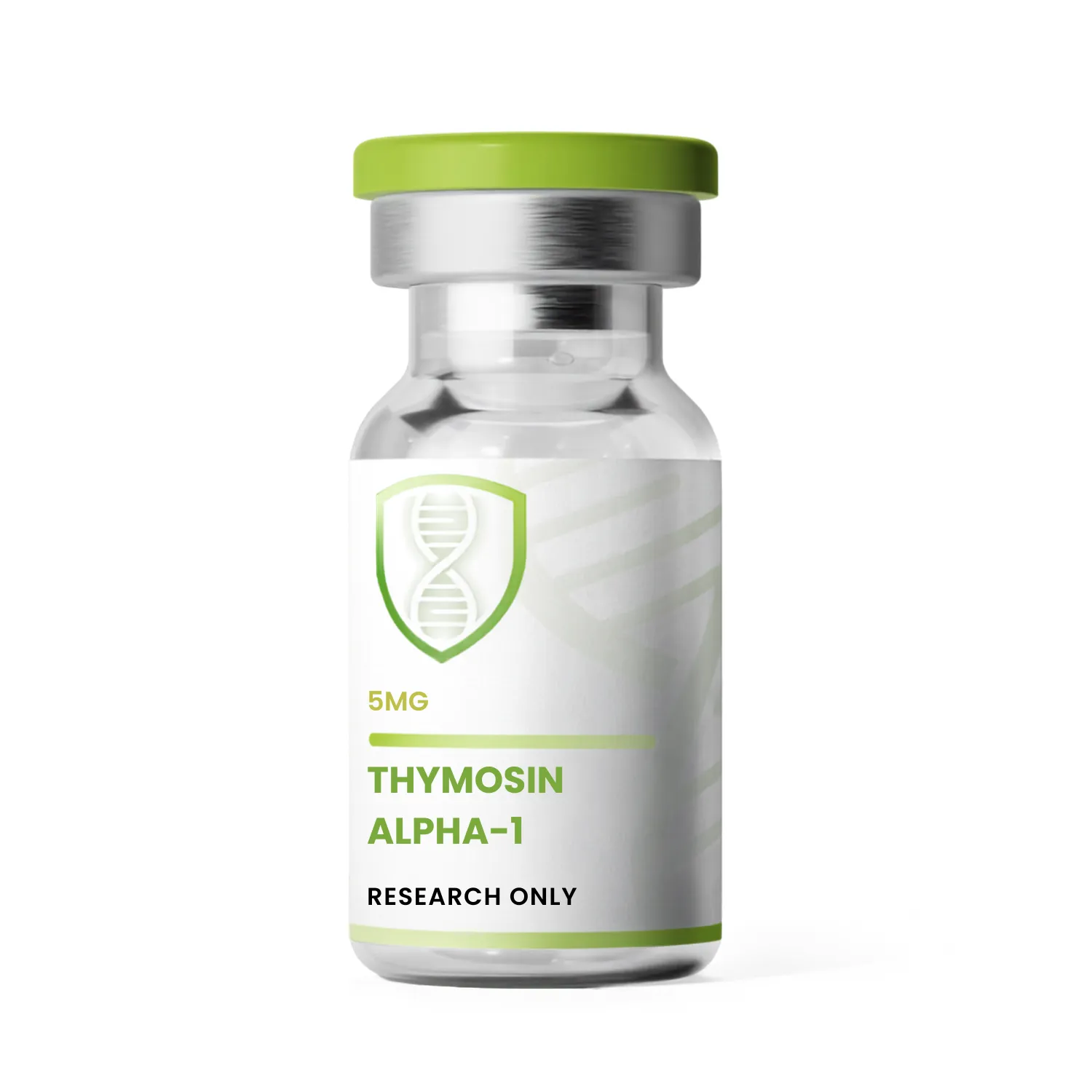
Thymosin Alpha-1 is a synthetic 28-amino acid peptide derived from thymosin fraction 5 of the bovine thymus gland.
$53.00
17 in stock
17 in stock
| Property | Correct Information |
|---|---|
| Compound Name | Thymosin Alpha-1 |
| Alternative Names | Thymalfasin, Tα1, TA-1 |
| Molecular Formula | C₁₂₉H₂₁₅N₃₃O₅₅ |
| Molecular Weight | 3,108.3 g/mol |
| CAS Number | 62304-98-7 |
| PubChem CID | 16130571 |
| Amino Acid Length | 28 amino acids |
| One-Letter Sequence | SDAAVDTSSEITTKDLKEKKEVVEEAEN |
| Full Sequence | Ac-SDAAVDTSSEITTKDLKEKKEVVEEAEN-OH |
| Peptide Classification | Synthetic or naturally occurring polypeptide |
| Peptide Structure | Linear |
| N-Terminal Modification | Acetylated (Ac–) |
| C-Terminal Group | Free carboxyl group (–COOH) |
| Disulfide Bonds | None |
| Research Applications | Immune cell signaling, T-cell activity, and immune regulation |
This compound is intended for laboratory research use only. It is not intended for human or animal consumption, or for use in diagnostic or therapeutic procedures.
| Molecular Formula | C129H215N33O55 |
| Molecular Mass | 3108.3 g/mol |
| Monoisotopic Mass | 3106.5041281 Da |
| Polar Area | 1460 Ų |
| Complexity | 7190 |
| XLogP | -24 |
| Heavy Atom Count | 217 |
| Hydrogen Bond Donor Count | 49 |
| Hydrogen Bond Acceptor Count | 59 |
| Rotatable Bond Count | 111 |
| CID | 16130571 |
| InChI | InChI=1S/C129H215N33O55/c1-18-59(10)98(159-114(201)76(36-42-91(181)182)146-120(207)83(53-164)154-121(208)84(54-165)155-127(214)99(63(14)166)160-118(205)80(51-94(187)188)152-123(210)95(56(4)5)156-104(191)62(13)135-102(189)60(11)137-115(202)78(49-92(183)184)151-119(206)82(52-163)138-66(17)169)125(212)161-101(65(16)168)128(215)162-100(64(15)167)126(213)147-70(30-22-26-46-133)109(196)150-79(50-93(185)186)117(204)149-77(47-55(2)3)116(203)142-69(29-21-25-45-132)108(195)144-73(33-39-88(175)176)110(197)141-67(27-19-23-43-130)106(193)140-68(28-20-24-44-131)107(194)145-75(35-41-90(179)180)113(200)157-97(58(8)9)124(211)158-96(57(6)7)122(209)148-74(34-40-89(177)178)111(198)143-71(31-37-86(171)172)105(192)136-61(12)103(190)139-72(32-38-87(173)174)112(199)153-81(129(216)217)48-85(134)170/h55-65,67-84,95-101,163-168H,18-54,130-133H2,1-17H3,(H2,134,170)(H,135,189)(H,136,192)(H,137,202)(H,138,169)(H,139,190)(H,140,193)(H,141,197)(H,142,203)(H,143,198)(H,144,195)(H,145,194)(H,146,207)(H,147,213)(H,148,209)(H,149,204)(H,150,196)(H,151,206)(H,152,210)(H,153,199)(H,154,208)(H,155,214)(H,156,191)(H,157,200)(H,158,211)(H,159,201)(H,160,205)(H,161,212)(H,162,215)(H,171,172)(H,173,174)(H,175,176)(H,177,178)(H,179,180)(H,181,182)(H,183,184)(H,185,186)(H,187,188)(H,216,217)/t59-,60-,61-,62-,63+,64+,65+,67-,68-,69-,70-,71-,72-,73-,74-,75-,76-,77-,78-,79-,80-,81-,82-,83-,84-,95-,96-,97-,98-,99-,100-,101-/m0/s1 |
| InChIKey | NZVYCXVTEHPMHE-ZSUJOUNUSA-N |
| IUPAC Name | (4S)-4-[[(2S)-2-[[(2S)-2-[[(2S)-2-[[(2S)-2-[[(2S)-2-[[(2S)-2-[[(2S)-2-[[(2S)-2-[[(2S)-2-[[(2S)-2-[[(2S)-2-[[(2S)-2-[[(2S)-2-[[(2S)-2-[[(2S,3R)-2-[[(2S,3R)-2-[[(2S,3S)-2-[[(2S)-2-[[(2S)-2-[[(2S)-2-[[(2S,3R)-2-[[(2S)-2-[[(2S)-2-[[(2S)-2-[[(2S)-2-[[(2S)-2-[[(2S)-2-acetamido-3-hydroxypropanoyl]amino]-3-carboxypropanoyl]amino]propanoyl]amino]propanoyl]amino]-3-methylbutanoyl]amino]-3-carboxypropanoyl]amino]-3-hydroxybutanoyl]amino]-3-hydroxypropanoyl]amino]-3-hydroxypropanoyl]amino]-4-carboxybutanoyl]amino]-3-methylpentanoyl]amino]-3-hydroxybutanoyl]amino]-3-hydroxybutanoyl]amino]-6-aminohexanoyl]amino]-3-carboxypropanoyl]amino]-4-methylpentanoyl]amino]-6-aminohexanoyl]amino]-4-carboxybutanoyl]amino]-6-aminohexanoyl]amino]-6-aminohexanoyl]amino]-4-carboxybutanoyl]amino]-3-methylbutanoyl]amino]-3-methylbutanoyl]amino]-4-carboxybutanoyl]amino]-4-carboxybutanoyl]amino]propanoyl]amino]-5-[[(1S)-3-amino-1-carboxy-3-oxopropyl]amino]-5-oxopentanoic acid |
| Smiles | CC[C@H](C)[C@@H](C(=O)N[C@@H]([C@@H](C)O)C(=O)N[C@@H]([C@@H](C)O)C(=O)N[C@@H](CCCCN)C(=O)N[C@@H](CC(=O)O)C(=O)N[C@@H](CC(C)C)C(=O)N[C@@H](CCCCN)C(=O)N[C@@H](CCC(=O)O)C(=O)N[C@@H](CCCCN)C(=O)N[C@@H](CCCCN)C(=O)N[C@@H](CCC(=O)O)C(=O)N[C@@H](C(C)C)C(=O)N[C@@H](C(C)C)C(=O)N[C@@H](CCC(=O)O)C(=O)N[C@@H](CCC(=O)O)C(=O)N[C@@H](C)C(=O)N[C@@H](CCC(=O)O)C(=O)N[C@@H](CC(=O)N)C(=O)O)NC(=O)[C@H](CCC(=O)O)NC(=O)[C@H](CO)NC(=O)[C@H](CO)NC(=O)[C@H]([C@@H](C)O)NC(=O)[C@H](CC(=O)O)NC(=O)[C@H](C(C)C)NC(=O)[C@H](C)NC(=O)[C@H](C)NC(=O)[C@H](CC(=O)O)NC(=O)[C@H](CO)NC(=O)C |
Every batch of Thymosin Alpha-1 – 5mg is tested for purity and identity using industry-standard methods.
High-Performance Liquid Chromatography confirms purity ≥99%. Each batch is analyzed to ensure consistent quality.
Identity verification via mass spectrometry confirms correct molecular weight of 4113.58 g/mol.
All compounds undergo independent third-party laboratory testing for quality assurance.
Certificate of Analysis documents are available for all compounds. Contact us with your order number to request batch-specific documentation.
Each compound batch is tested by independent laboratories to verify purity, identity, and quality. The Certificate of Analysis (COA) provides transparent lab results, ensuring the compound meets strict research-grade standards.
Store at -20°C.
Protect from light and moisture.

| Test | Method | Result | Specification | |
|---|---|---|---|---|
| Identity | HPLC-DAD | Thymosin Alpha-1 | Thymosin Alpha-1 | Pass |
| Purity | HPLC-DAD | 99.75 | >99% by HPLC | Pass |
| Quantity | HPLC Analyte Concentration Curve Assay | 4.98mg | 5mg | Pass |
| Endotoxins | LAL ELISA | 0.223 EU/mL | ≤ 0.5 EU/mL | Pass |
| Sterility | Pour Plate | No Growth | No Growth | Pass |

Popular research articles

This site supplies research compounds strictly for laboratory research. You must confirm both statements below to enter.
Compounds are supplied for laboratory research use only and are not for human or veterinary use.
