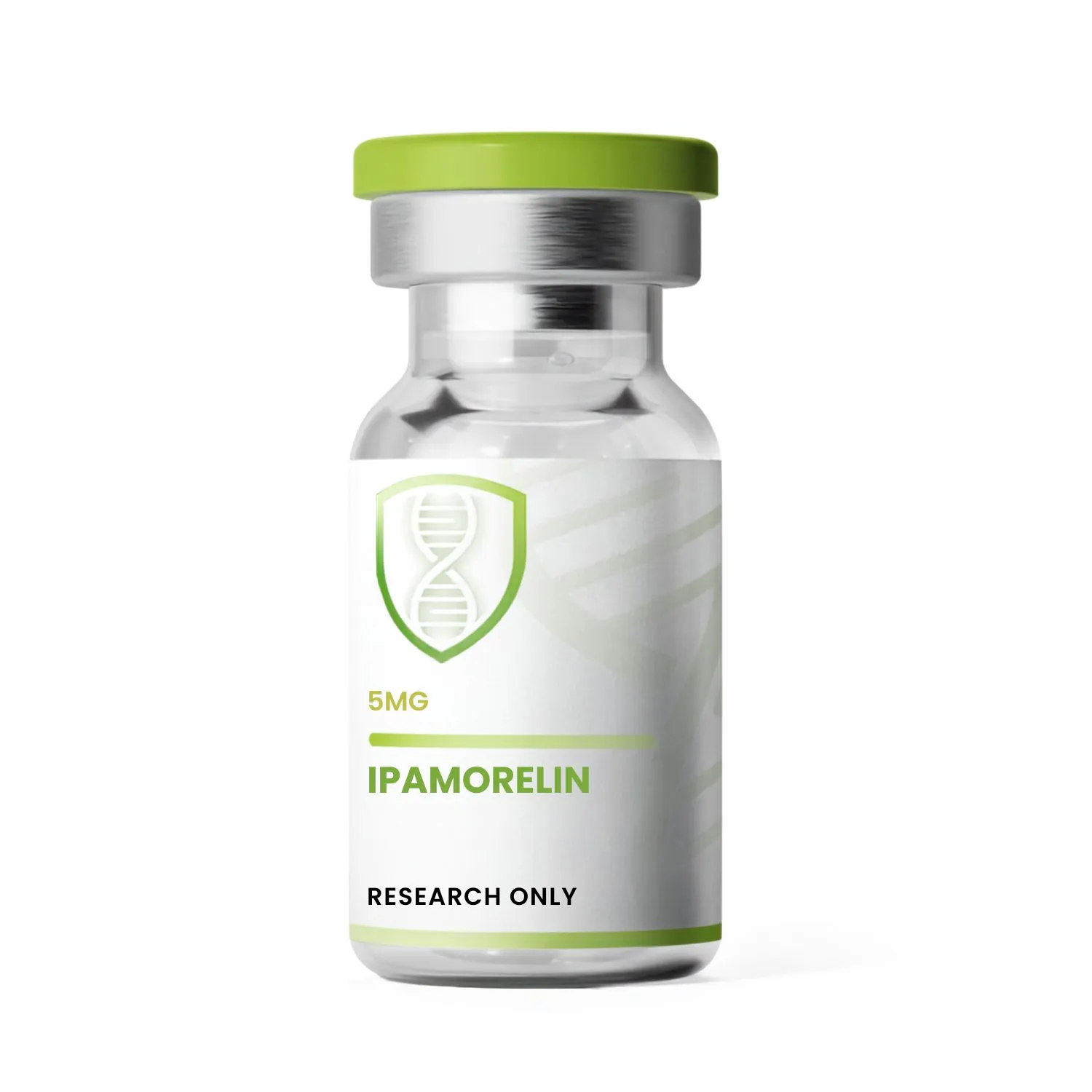
Buy Ipamorelin 5mg | 99% Purity | COA | Lab Tested
Ipamorelin 5mg is a synthetic research peptide belonging to the growth hormone secretagogue family. It is a pentapeptide made up of five amino acid residues and is studied for its interaction with the growth hormone secretagogue receptor (GHS-R1a). Ipamorelin was first described in published research in 1998. Scientists investigated its receptor activity and its ability to stimulate growth hormone (GH) release in laboratory and animal models. Early findings showed that Ipamorelin displayed selectivity for GH secretion compared with certain older growth hormone-releasing peptides. Ipamorelin 5mg is supplied as a lyophilized powder for laboratory research, peptide characterization, and controlled analytical experiments. The compound is not approved by the FDA for human or veterinary use. It is intended strictly for qualified laboratory research.
What Is Ipamorelin 5mg?
Ipamorelin is a synthetic pentapeptide originally developed during research into growth hormone secretagogues. Growth hormone secretagogues are compounds that interact with receptors involved in regulating growth hormone release. Ipamorelin acts as an agonist of the growth hormone secretagogue receptor, also called GHS-R1a. Unlike growth hormone-releasing hormone (GHRH), which activates a different receptor, Ipamorelin belongs to the ghrelin receptor agonist class. This distinction makes the compound relevant to researchers comparing different endocrine signaling pathways. The 5 mg specification refers to the nominal quantity of peptide supplied in a single research vial. Actual peptide content and purity should be confirmed using batch-specific analytical documentation. Ipamorelin has also been investigated in clinical research, including studies of postoperative gastrointestinal motility. However, it is not an approved medication, and these investigations do not establish its safety or effectiveness for personal use.
Scientific reference: Raun K, et al. (1998).
Ipamorelin, the first selective growth hormone secretagogue.
Ipamorelin 5mg Compound Specifications
| Property | Details |
| Compound name | Ipamorelin 5mg |
| Compound name | Ipamorelin |
| Alternative identifier | NNC-26-0161 |
| CAS number | 170851-70-4 |
| Molecular formula | C₃₈H₄₉N₉O₅ |
| Molecular weight | Approximately 711.9 g/mol |
| Peptide length | 5 amino acid residues |
| Peptide sequence | Aib-His-D-2-Nal-D-Phe-Lys-NH₂ |
| Peptide class | Growth hormone secretagogue |
| Primary research receptor | GHS-R1a |
| Physical form | Lyophilized powder |
| Nominal vial content | 5 mg |
| Intended use | Laboratory research only |
| FDA approval | Not approved for human use |
The molecular formula and weight above describe the parent Ipamorelin molecule. A salt form, such as Ipamorelin acetate, may have different composition and mass specifications.
Chemical reference: PubChem, Ipamorelin, CID 9831659.
Ipamorelin Molecular Formula and Peptide Sequence
The molecular formula of Ipamorelin is
C₃₈H₄₉N₉O₅, with an average molecular weight of approximately
711.9 g/mol. Ipamorelin consists of five amino acid residues arranged in the following sequence:
Aib-His-D-2-Nal-D-Phe-Lys-NH₂ Each residue contributes to the compound’s structural properties.
| Residue | Full name |
| Aib | 2-Aminoisobutyric acid |
| His | Histidine |
| D-2-Nal | D-2-Naphthylalanine |
| D-Phe | D-Phenylalanine |
| Lys-NH₂ | C-terminally amidated lysine |
The sequence contains nonstandard and D-configured amino acid residues. These structural characteristics distinguish Ipamorelin from naturally occurring peptide sequences. The C-terminal amide group is another important feature of the molecule. For laboratory analysis, researchers can use mass spectrometry to compare the measured molecular mass against the expected Ipamorelin structure. High-performance liquid chromatography can also be used to assess chromatographic purity and detect certain peptide-related impurities.
Ipamorelin Mechanism of Action
Ipamorelin acts on the growth hormone secretagogue receptor, GHS-R1a, a receptor associated with ghrelin signaling. Ghrelin is a naturally occurring hormone involved in several physiological processes, including signaling related to growth hormone secretion. Ipamorelin is a synthetic agonist of this receptor. When a suitable experimental model is exposed to Ipamorelin, receptor activation can trigger intracellular signaling pathways associated with growth hormone secretion. The main pathway involves the following steps:
- Ipamorelin interacts with the growth hormone secretagogue receptor.
- Receptor activation initiates G-protein-mediated intracellular signaling.
- Signaling pathways involving phospholipase C and intracellular calcium can contribute to the cellular response.
- In responsive pituitary models, these events can lead to growth hormone secretion.
This mechanism differs from that of GHRH receptor agonists, such as Modified GRF (1-29). Researchers investigate these differences to understand how separate receptor systems contribute to pituitary signaling.
What Did Early Ipamorelin Research Find?
In 1998, Raun and colleagues investigated Ipamorelin using primary rat pituitary cells and animal models. In isolated rat pituitary cells, Ipamorelin produced a growth hormone response with potency in a similar range to GHRP-6. The researchers reported an EC₅₀ of approximately 1.3 ± 0.4 nmol/L for Ipamorelin, compared with 2.2 ± 0.3 nmol/L for GHRP-6. The study also examined changes in ACTH and cortisol. Compared with GHRP-2 and GHRP-6, Ipamorelin showed greater selectivity for growth hormone release under the tested experimental conditions. These results contributed to interest in Ipamorelin as a research compound for studying receptor selectivity and endocrine signaling. The findings do not establish human safety, therapeutic effectiveness, or long-term outcomes.
Source: Raun K, et al. European Journal of Endocrinology, 1998.
Ipamorelin Research Applications
Ipamorelin has been investigated in several areas of preclinical and experimental research.
1. Growth Hormone Secretagogue Receptor Research
One of the main research applications of Ipamorelin is studying GHS-R1a receptor signaling. Researchers use experimental models to examine how synthetic peptide agonists interact with the receptor and influence downstream signaling. These investigations help scientists compare receptor activation across different growth hormone secretagogues.
2. Growth Hormone Secretion Studies
Ipamorelin has been evaluated for its effects on GH secretion in cell-based assays and animal models. Early research compared its activity with GHRP-6 and other secretagogues. These studies focused on the relationship between receptor stimulation, peptide structure, and hormone release.
3. Hormone Selectivity Research
A distinguishing feature of Ipamorelin is the selectivity observed in early pharmacological studies. Raun and colleagues found that the compound stimulated GH release without producing the same ACTH and cortisol responses seen with some related peptides under the conditions tested. This made Ipamorelin useful for studying how structurally different peptides influence endocrine signaling. However, selectivity in an experimental model does not mean that a compound is free of adverse effects.
4. Structure-Activity Relationship Studies
Ipamorelin contains modified amino acid residues that contribute to its receptor activity. Researchers can examine how these structural features affect receptor interaction, peptide conformation, and biological responses. Such studies are part of the broader field of peptide design and molecular pharmacology.
5. Gastrointestinal Motility Research
The growth hormone secretagogue receptor is also involved in pathways associated with gastrointestinal function. Ipamorelin has therefore been investigated in research involving postoperative gastrointestinal motility. A randomized phase 2 clinical study published in 2014 examined intravenous Ipamorelin in patients recovering from bowel surgery. The study did not demonstrate a statistically significant improvement in its primary efficacy endpoint. This clinical investigation should not be interpreted as evidence supporting other therapeutic or personal uses.
Reference: Beck DE, et al. (2014). Prospective, randomized, controlled, proof-of-concept study of the ghrelin mimetic Ipamorelin.
Ipamorelin vs GHRP-6: Research Differences
Ipamorelin and GHRP-6 are both synthetic growth hormone secretagogues, but they have different molecular structures and research profiles.
| Feature | Ipamorelin | GHRP-6 |
| Peptide length | 5 residues | 6 residues |
| Peptide class | Growth hormone secretagogue | Growth hormone secretagogue |
| Research receptor | GHS-R1a | GHS-R1a |
| Molecular structure | Modified pentapeptide | Synthetic hexapeptide |
| GH response in early studies | Demonstrated in preclinical models | Demonstrated in preclinical models |
| ACTH/cortisol findings | Lower responses in the original comparative study | Greater responses under certain tested conditions |
| Research interest | Receptor selectivity and GH signaling | GH secretagogue pharmacology and endocrine responses |
The original comparison by Raun and colleagues is particularly useful for understanding why Ipamorelin attracted research interest. Its observed GH selectivity distinguished it from some earlier compounds in the same research category. However, differences in experimental hormone responses do not prove superior safety or efficacy in humans.
Ipamorelin 5mg Purity, HPLC Testing, and COA
Research peptide quality is important because unwanted impurities, incorrect identity, or differences in peptide content can affect experimental results. Researchers evaluating Ipamorelin 5mg should examine the analytical documentation associated with the specific manufacturing batch.
HPLC Purity Testing
High-performance liquid chromatography separates compounds according to their interaction with the chromatographic system. For research peptides, HPLC is commonly used to measure the relative amount of the main detected peptide component and related impurities. When a batch is reported as having 99% HPLC purity, the result should be supported by the relevant chromatographic data.
Mass Spectrometry for Identity
Mass spectrometry helps verify the molecular identity of Ipamorelin. The measured mass can be compared with the theoretical mass expected from its chemical structure. HPLC and mass spectrometry serve different purposes. A high HPLC purity result alone does not confirm that the compound contains the correct peptide.
Certificate of Analysis
A batch-specific Certificate of Analysis provides documented information about the tested material. A useful Ipamorelin COA should include:
- Compound name and batch identification
- Testing date
- HPLC purity results
- Molecular identity testing
- Relevant analytical specifications
- Laboratory identification
- Peptide content, when measured
Important: A claimed purity of 99% should be verified against the actual batch being sold. HPLC purity does not independently establish sterility, endotoxin levels, or net peptide content.
Why Choose an Ipamorelin 5mg Research Vial?
A 5 mg vial provides a defined nominal quantity of Ipamorelin for research planning. Researchers may select this format for analytical method development, molecular characterization, and experiments requiring small quantities of a single peptide compound. The suitability of the vial depends on the specific analytical requirements, available documentation, and intended laboratory procedures. Before selecting an Ipamorelin research compound, laboratories should review its molecular specifications, batch purity, chemical identity, and storage information.
How to Store Ipamorelin 5mg
Storage conditions can influence peptide integrity over time. Ipamorelin is commonly supplied in lyophilized form, which removes water through freeze-drying and can support peptide preservation. However, lyophilization alone does not establish a particular shelf life. Research laboratories should follow validated supplier storage recommendations. General laboratory considerations include:
- Protecting the material from moisture and unnecessary light exposure.
- Maintaining appropriate, documented storage temperatures.
- Avoiding repeated temperature fluctuations.
- Keeping samples in properly labeled and sealed containers.
- Using validated procedures when preparing solutions for laboratory assays.
Frozen storage around −20°C is commonly recommended for long-term preservation of many lyophilized research peptides. The appropriate temperature and duration for a specific Ipamorelin compound must be supported by its stability information. Reconstituted solutions may have different stability characteristics depending on solvent composition, concentration, temperature, and handling. No universal post-reconstitution shelf life should be assumed without supporting data.
Frequently Asked Questions About Ipamorelin 5mg
What is Ipamorelin 5mg?
Ipamorelin 5mg is a research compound containing a nominal 5 mg quantity of synthetic Ipamorelin peptide. The compound is a GHS-R1a receptor agonist investigated in endocrine and receptor-signaling research.
What is the molecular formula of Ipamorelin?
The molecular formula of the parent Ipamorelin molecule is C₃₈H₄₉N₉O₅, and its molecular weight is approximately 711.9 g/mol.
What is the Ipamorelin peptide sequence?
The sequence is Aib-His-D-2-Nal-D-Phe-Lys-NH₂. It consists of five amino acid residues, including modified and D-configured residues.
What is the CAS number of Ipamorelin?
The CAS number of Ipamorelin is 170851-70-4.
What is Ipamorelin used for in research?
Ipamorelin is studied in experimental research involving growth hormone secretagogue receptors, pituitary signaling, hormone selectivity, and peptide structure-activity relationships.
Is Ipamorelin the same as GHRP-6?
No. Ipamorelin and GHRP-6 are different compounds. Both belong to the growth hormone secretagogue family, but they have different structures and demonstrated differences in experimental hormone selectivity.
Is Ipamorelin FDA-approved?
No. Ipamorelin is not an FDA-approved medication. The FDA has also identified safety concerns involving Ipamorelin-related substances, including possible immunogenicity and serious adverse events reported in clinical research.
What does 99% Ipamorelin purity mean?
A 99% HPLC purity result generally describes the proportion of the main peptide peak relative to detected chromatographic components, according to the testing method. It does not automatically mean that 99% of the vial’s total mass consists of Ipamorelin.
How can researchers check Ipamorelin purity?
Researchers can review the batch-specific Certificate of Analysis, HPLC chromatograms, and mass spectrometry results. Additional testing may be necessary depending on the research requirements.
Is Ipamorelin 5mg intended for human use?
No. Ipamorelin sold as a research peptide is intended for legitimate laboratory research only. It is not approved for personal use, self-administration, or human or veterinary treatment.
Research Use Only Disclaimer
Ipamorelin 5mg is supplied exclusively for legitimate scientific and laboratory research. It is not an FDA-approved medication and is not intended for human or veterinary consumption, personal administration, bodybuilding, performance enhancement, diagnosis, treatment, or prevention of disease. Published research findings do not establish the safety or effectiveness of Ipamorelin for personal or therapeutic purposes. The FDA has raised concerns about Ipamorelin-related substances, including immunogenicity, peptide-related impurities, and reported serious adverse events in clinical investigations. All laboratory work must follow applicable laws, institutional requirements, and established safety procedures.
Scientific References
- Raun K, Hansen BS, Johansen NL, et al. (1998). Ipamorelin, the first selective growth hormone secretagogue. European Journal of Endocrinology, 139(5), 552–561. PubMed. DOI: 10.1530/eje.0.1390552.
- Beck DE, Sweeney WB, McCarter MD, et al. (2014). Prospective, randomized, controlled, proof-of-concept study of the ghrelin mimetic Ipamorelin for the management of postoperative ileus in bowel resection patients. International Journal of Colorectal Disease, 29, 1527–1534. PubMed. DOI: 10.1007/s00384-014-2030-8.
- National Center for Biotechnology Information. PubChem Compound Summary for Ipamorelin, CID 9831659. PubChem.
- U.S. Food and Drug Administration. Certain Bulk Drug Substances for Use in Compounding That May Present Significant Safety Risks. FDA reference.
- U.S. Food and Drug Administration. Pharmacy Compounding Advisory Committee, October 29, 2024. Ipamorelin and Ipamorelin Acetate Safety and Evidence Review. FDA meeting document.