

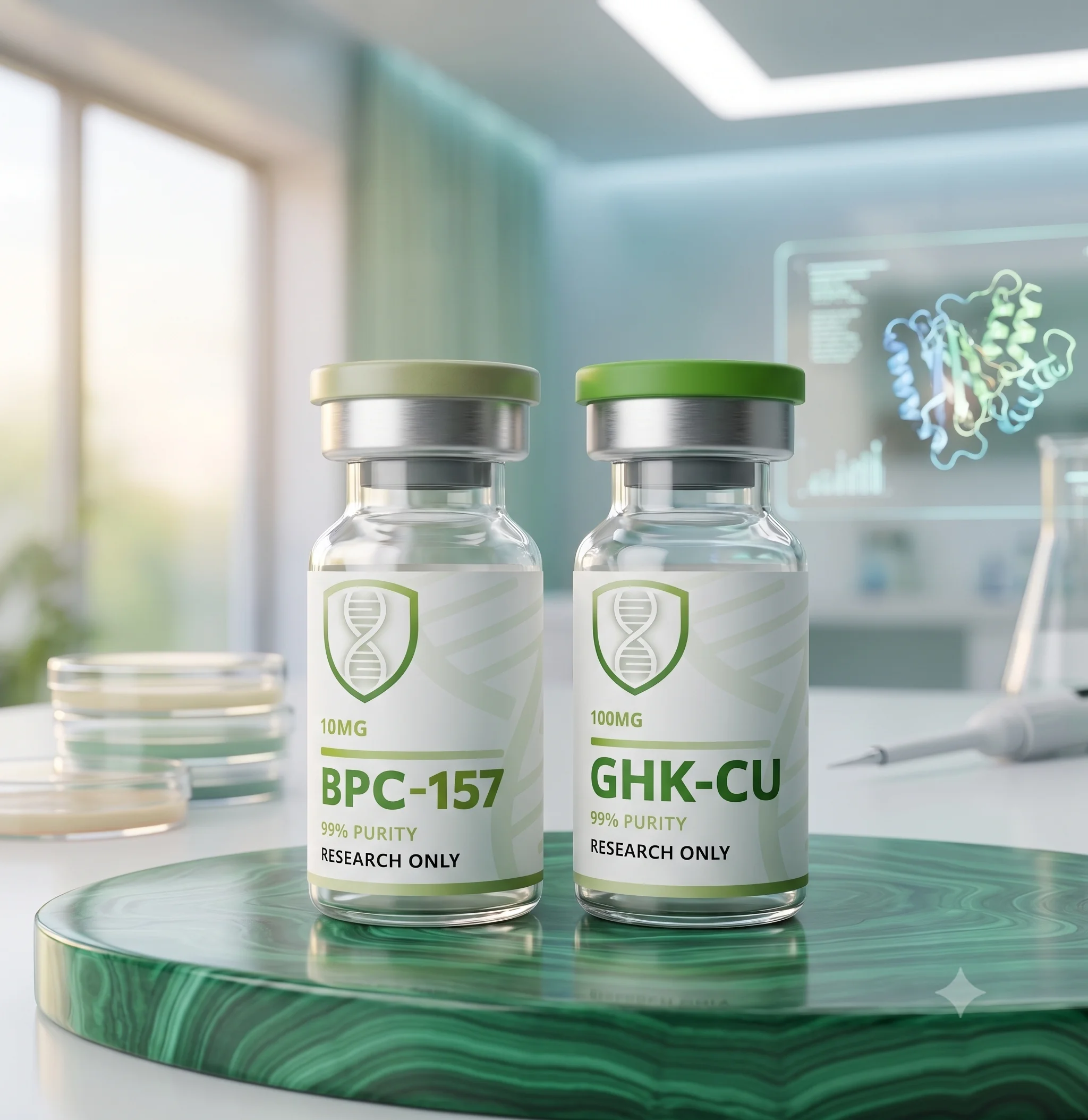
BPC-157 and GHK-Cu have a significant overlap in wound healing, angiogenesis, collagen remodeling, and anti-inflammatory effects. Both peptides are prevalent in regenerative research, but they act via different mechanisms: BPC-157 offers broad systemic protection, and GHK-Cu is more targeted to matrix remodeling and gene modulation. Many researchers study them together as their combined actions may improve tissue repair outcomes.
What Is BPC-157?
BPC-157 is a synthetic 15-amino acid peptide that is derived from a protective protein found in human gastric juice. In preclinical studies, it showed potent regenerative and protective effects in multiple tissues.
Major areas of research include angiogenesis, neuroprotection, gastrointestinal repair, and tendon/ligament healing.
What Is GHK-Cu?
GHK-Cu is a copper-binding tripeptide (Glycyl-L-Histidyl-L-Lysine). This tripeptide can be found naturally within human plasma, saliva, and urine. GHK-Cu decreases naturally with age. At age 20, its plasma level is 200 ng/mL, while at age 60 it drops to 80 ng/mL. It is extensively studied for the regeneration of skin, collagen synthesis, antioxidant activity, and gene expression modulation.
BPC-157 vs GHK-Cu: A Comparison Table
| Characteristics | BPC-157 | GHK-Cu | Level of overlapping |
| Major research focus | Musculoskeletal, systemic repair, and gut | Skin, anti-aging, extracellular matrix | Medium |
| Healing of the wound | Strong | Strong | High |
| Formation of new blood vessels (angiogenesis) | Strong (VEGF upregulation) | Moderate to Strong (endothelial support) | High |
| Effects against inflammation | Strong (vast cytokine modulation) | Strong (NF-κB and ROS reduction) | High |
| Gene expression | Normal | Very strong (4,000+ genes) | Low |
| Neuroprotection | Strong | Moderate | Medium |
| Synthesis of collagen | Moderate (helps deposition) | Very Strong (direct fibroblast activation) | High |
| Typical models | Injury of Tendon, colitis, and muscle tears | Skin injuries, photoaging, dermal fibroblasts | Moderate |
Major Overlapping Areas Research
1. Wound Healing and Tissue Repair
Both peptides have the ability to accelerate wound closure in animal models. The BPC-157 stimulates quick granulation tissue and more organized alignment of collagen, and GHK-Cu promotes matrix organization and tensile strength. They are being used together with growing interest in their synergistic healing effects.
2. Angiogenesis
They both promote the growth of new blood vessels. BPC-157 increases VEGF expression, and GHK-Cu maintains endothelial cell function. This overlap renders them applicable to vascular repair and chronic wound studies.
3. Anti-Inflammatory Pathways
Both lower the inflammatory markers. BPC-157 regulates the pro-inflammatory cytokines in gut and joint models; GHK-Cu regulates oxidative stress and NF-κB signaling.
4. Collagen and Extracellular Matrix Support
GHK-Cu is a powerful stimulator of collagen and elastin. BPC-157 stimulates collagen deposition—especially in tendons and ligaments. Such a combination is a good possibility for connective tissue research.
Unique Strengths of Both Peptides
BPC-157 performs best in deeper musculoskeletal injuries, gastrointestinal protection, and systemic repair models.
GHK-Cu is distinguished by skin-specific regeneration, strong gene modulation, and antioxidant defense.
Current Research Limitations (2026)
The majority of data is still in the exploratory stage (animal and cell testing). There are limited human clinical trials for both peptides. Neither BPC-157 nor GHK-Cu is FDA-approved for any therapeutic indications. They are only research chemicals.
Practical Considerations for Researchers
- For musculoskeletal, gut, or systemic studies, use BPC-157.
- For skin biology, dermal remodeling, or gene expression studies, use GHK-Cu.
- Combination approaches remain experimental
They are usually both provided in a stable lyophilized powder.
Frequently Asked Questions
1. Is there overlap between research on BPC-157 and GHK-Cu?
Yes, research publications exist demonstrating overlap in connective tissue biology, fibroblast proliferation, collagen remodeling and structure, angiogenesis, and extracellular matrix organization.
2. Are BPC-157 and GHK-Cu the same peptide?
No, BPC-157 is a synthetically designed pentadecapeptide discovered in the study of gastric proteins, while GHK-Cu is a naturally derived copper-binding tripeptide.
3. Which peptide, BPC-157 or GHK-Cu, has more tendon research?
Currently, there is more published research involving tendons and ligament models for BPC-157 than for GHK-Cu.
4. Which peptide, BPC-157 or GHK-Cu, focuses more on gene expression?
The literature suggests that GHK-Cu has been widely studied for gene expression and extracellular matrix biology.
5. Can either of these peptides be considered therapeutic?
Neither BPC-157 nor GHK-Cu can be viewed as therapeutic based on the current data outlined in this review and should only be viewed as laboratory research peptides.
Final Thoughts
Two of the most exciting peptides in the field of regeneration are BPC-157 and GHK-Cu, as they have a strong overlap in their wound healing, angiogenesis, anti-inflammatory effect, and matrix support properties. Combined studies of their complementary mechanisms are exciting prospects for advancing tissue repair science.
With preclinical development ongoing in 2026, more information on these peptides’ molecular interactions will likely be available. For the time being, they’re still useful instruments for researchers to investigate new avenues of regeneration.
All information is for educational and research purposes only. BPC-157 and GHK-Cu are provided for laboratory and research only. They are not for human consumption or therapeutic use. Always follow institutional guidelines.
References
1. Sikiric P, et al. BPC 157 and Standard Angiogenesis Models. Curr Pharm Des. 2018.
https://pubmed.ncbi.nlm.nih.gov/29998800
2. Pickart L, et al. GHK Peptide as a Natural Modulator of Multiple Cellular Pathways in Skin Regeneration. Biochim Biophys Acta. 2015.
https://pubmed.ncbi.nlm.nih.gov/25519642
3. Seiwerth S, et al. BPC 157 and Its Healing Effects on Tendon and Ligament Injuries. J Physiol Pharmacol. 2020.
https://pmc.ncbi.nlm.nih.gov/articles/PMC13026520
4. Siméon A, et al. Effects of GHK-Cu on Wound Healing and Metalloproteases. J Invest Dermatol. 2000.
