Popular
Buy GHK-Cu – 100mg

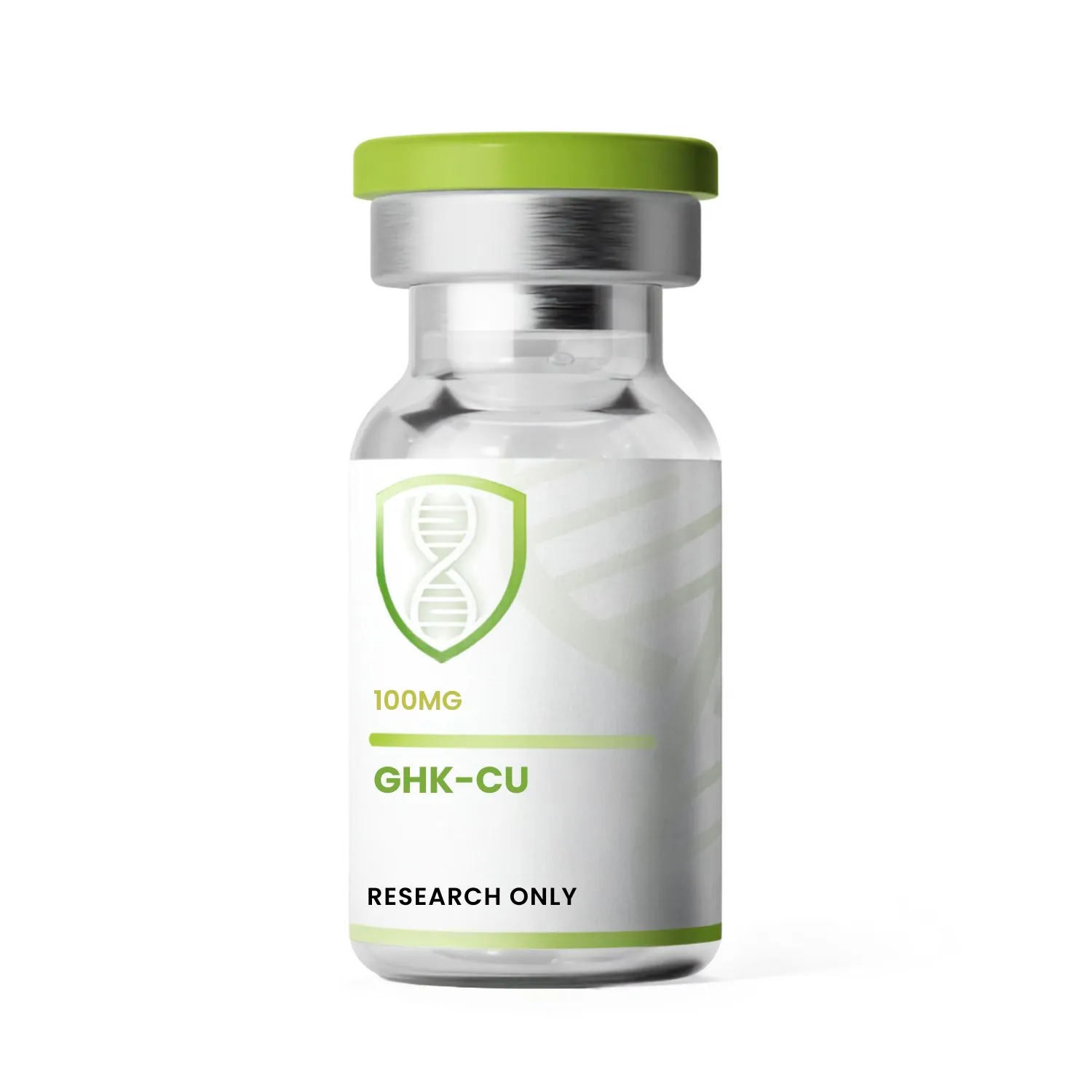
GHK-Cu – 100mg

| Third-Party Tested | 99% Purity | COA Available | Research Use Only

GHK‑Cu is a small peptide that naturally binds copper. It is found in human blood, saliva, and urine. In the lab, researchers use it to see how cells respond to copper and small peptides.

$47.00

0 out of 5 · 0 ratings
Be the first to rate this compound:

22 in stock

22 in stock

Bulk Pricing – Save More

3
Buy 3 units 5% OFF
$44.65 each Total: $133.95 (Save $7.05)
5
Buy 5 units 10% OFF
$42.30 each Total: $211.50 (Save $23.50)
10
Buy 10 units 15% OFF
$39.95 each Total: $399.50 (Save $70.50)

⁠Buy GHK-Cu 100mg |99% Purity| COA Available

GHK‑Cu is a small peptide that naturally binds copper. It is found in human blood, saliva, and urine. In the lab, researchers use it to see how cells respond to copper and small peptides. This peptide is not a drug or supplement. It is only for research. Scientists study how it interacts with cells, proteins, and other molecules. They look at how it may affect certain pathways and biochemical processes.

GHK-Cu 100mg Molecular Structure and Chemical Properties

GHK-Cu is a copper-binding tripeptide made from three amino acids: glycine, histidine, and lysine. When the GHK peptide binds to a copper(II) ion (Cu²⁺), it forms the GHK-Cu complex. Researchers study GHK-Cu to understand copper transport, cellular signaling, enzyme activity, and protein regulation.

GHK-Cu Chemical Properties Table

Property Correct Information
Compound Name GHK-Cu (Copper Tripeptide-1)
Alternative Name Prezatide Copper
Amino Acid Sequence Gly-His-Lys
One-Letter Sequence GHK
Amino Acid Length 3 amino acids
Molecular Formula (GHK-Cu 1:1 Complex) C₁₄H₂₂CuN₆O₄
Molecular Weight (1:1 Complex) Approximately 401.9 g/mol
Molecular Formula (Free GHK) C₁₄H₂₄N₆O₄
Molecular Weight (Free GHK) 340.38 g/mol
CAS Number (GHK-Cu) 89030-95-5
PubChem CID (Prezatide Copper) 71587328
Peptide Classification Copper-binding tripeptide
Metal Ion Copper(II), Cu²⁺
Peptide Structure Linear tripeptide forming a copper coordination complex
Disulfide Bonds None
Research Applications Copper binding, cellular signaling, protein regulation, and enzyme activity
Compound Size 100mg
Chemical identifiers and structures are documented in PubChem. Different GHK-Cu coordination forms have separate chemical records.

Research Applications of  GHK-Cu

In research studies, scientists add GHK‑Cu to cells and watch what happens over time. They may check how the cells grow or change. Sometimes, they look at how genes turn on or off. Other times, they see how enzymes or proteins react. They may also study how it works with copper in the cells. The results can be different depending on the type of cells or tissue, the amount of peptide used, and how the experiment is set up. Every study can show slightly different changes. Results are not always the same in every study. They can change based on how the experiment is designed, how much peptide is used, and what type of cells or tissue are tested. The purpose of this research is to observe basic chemical and cellular behavior, not applied or clinical effects.

Mechanistic and Pathway Context

Research suggests that GHK-Cu interacts with cell components that are sensitive to copper. This interaction may influence how copper is processed inside the cell. In laboratory settings, researchers observe how this peptide impacts cell signals, protein function, and gene activity over time. Some studies also look at tissue-level changes in experimental models. All observations are made under controlled lab conditions. This work is strictly preclinical and exploratory.

Preclinical Research Summary

Preclinical studies use cells or animals to see how GHK‑Cu works in a lab setting. Researchers often measure things like copper levels, enzyme activity, or cell responses. They may watch how proteins or genes change when exposed to the peptide. These studies are exploratory. Results depend on the system, the dose, and how the experiment is designed. They are not meant to predict effects in humans.

Formulation and Analytical Testing

GHK‑Cu is supplied as a lyophilized powder, 100 mg per vial, 10 mg per vial, or 50 mg per vial. It is handled in labs for precise experiments. Common checks include:
  • Confirming identity
  • Testing purity
  • Verifying copper content
It should be stored in a cool, dry place. Use normal lab safety procedures. It is not for injection or human use.

References

Pickart L, Thaler MM: Copper peptide in human plasma. Science. 1973;180(4088):868–870. Hong SJ, Kang SS, Dan DH:  Effects of copper-peptide complexes on cultured cells: biochemical modulation studies. Pickart L: Peptide-copper complexes and gene expression modulation. Mol Cell Biochem. 2006;286(1–2):1–15.  

Research Use Only

This compound is intended for laboratory research use only. It is not intended for human or animal consumption, or for use in diagnostic or therapeutic procedures.

Chemical Properties

Molecular Formula C28H48CuN12O8
Molecular Weight 744.3 g/mol
Monoisotopic Mass 743.301404 Da
Polar Surface Area 352 Ų
Complexity 952
XLogP N/A
Heavy Atom Count 49
Hydrogen Bond Donors 12
Hydrogen Bond Acceptors 14
Rotatable Bonds 22
CID 133697840
InChIKey RIPDSRHLQNAZOH-XTQNZXNBSA-N
IUPAC Name bis((2S)-6-amino-2-[[(2S)-2-[(2-aminoacetyl)amino]-3-(1H-imidazol-5-yl)propanoyl]amino]hexanoic acid);copper
SMILES C1=C(NC=N1)C[C@@H](C(=O)N[C@@H](CCCCN)C(=O)O)NC(=O)CN.C1=C(NC=N1)C[C@@H](C(=O)N[C@@H](CCCCN)C(=O)O)NC(=O)CN.[Cu]

Certificate of Analysis

Quality

Every batch of GHK-Cu – 100mg is tested for purity and identity using industry-standard methods.

HPLC Analysis

High-Performance Liquid Chromatography confirms purity ≥99%. Each batch is analyzed to ensure consistent quality.

Mass Spectrometry (MS)

Identity verification via mass spectrometry confirms correct molecular weight of 4113.58 g/mol.

Third-Party Testing

All compounds undergo independent third-party laboratory testing for quality assurance.

Request COA

Certificate of Analysis documents are available for all compounds. Contact us with your order number to request batch-specific documentation.

COA Lab Tests

Each compound batch is tested by independent laboratories to verify purity, identity, and quality. The Certificate of Analysis (COA) provides transparent lab results, ensuring the compound meets strict research-grade standards.

Storage & Handling

Before Reconsti‍tution (Powder⁠ Form)‌

  • Store at -20°C or lower in the freezer
  • Keep in lyophilize‍d form for stabil⁠i⁠ty
  • Mainta‍in consist‌ently cold te‍mperature
  • Protect f‍rom light exposure at⁠ all times
  • Keep away f‌rom⁠ moistur⁠e
  • Store‍ in sealed‌, air⁠tigh⁠t container
  • Use ligh‍t-resist‍a⁠nt packag⁠ing‍

Aft⁠er Recon‌stitutio‌n (L‍iquid Fo‌rm)

  • Use promptly afte⁠r reconstitution when possible
  • Store at 4°C‍ for short-term u‌se only‍
  • Keep refrigerated between us⁠es
  • Limit storage duratio‍n for‌ optimal bioactivity

Travel and Transport

  • Us‍e insulated cooler or bag⁠ for⁠ travel
  • Inc‍lude ice pa⁠cks to maintain cold temperature
  • Avoid d⁠irect contact between pept‍ide and i⁠ce
  • Monitor temperature during transport
  • Keep in origi‍n‍al seale⁠d container

Aft⁠er Recon‌stitutio‌n (L‍iquid Fo‌rm)

  • Use promptly afte⁠r reconstitution when possible
  • Store at 4°C‍ for short-term u‌se only‍
  • Keep refrigerated between us⁠es
  • Limit storage duratio‍n for‌ optimal bioactivity

×
On Sale
Out of Stock

Storage

Store at -20°C.
Protect from light and moisture.

Added to cart successfully!

Certificate of Analysis

ORP#00019

Client:
Orion Peptides
Sample:
GHK-Cu 100mg
Batch:
202601GHK100

Tests Requested:
Standard + Endotoxins + Sterility
Appearance:
Blue Lyophilized Powder in 3mL Vial

Analysis Conducted on:
01/02/2026
Report Issued on:
08/01/2026
Test Method Result Specification  
Identity HPLC-DAD GHK-Cu GHK-Cu Pass
Purity HPLC-DAD 99.87 >99% by HPLC Pass
Quantity HPLC Analyte Concentration Curve Assay 114.54mg 100mg Pass
Endotoxins LAL ELISA 0.189 EU/mL ≤ 0.5 EU/mL Pass
Sterility Pour Plate No Growth No Growth Pass