

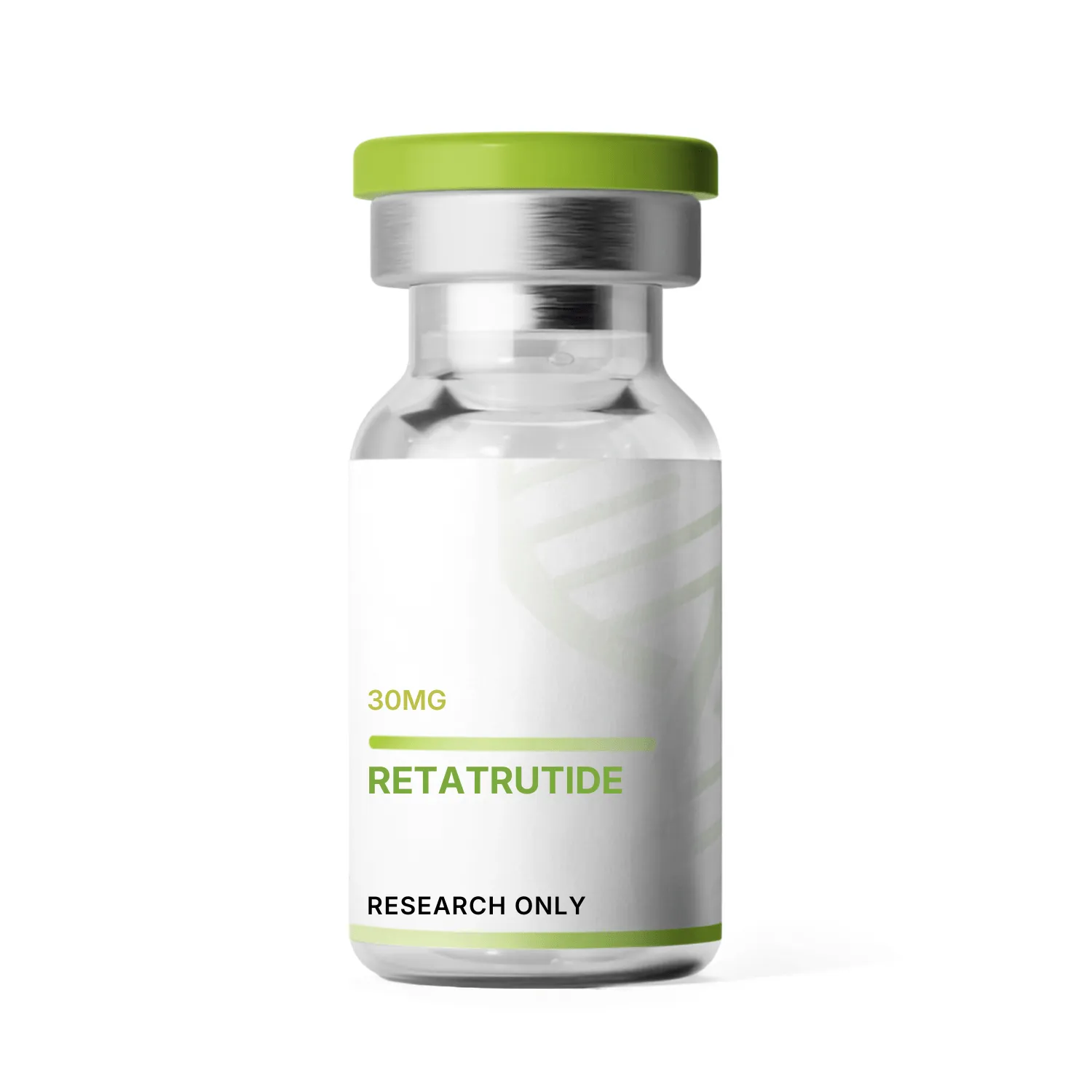
RT, also known as LY3437943, is an investigational synthetic peptide.
$193.00
Out of stock
Out of stock
RT (LY3437943) is an investigational peptide studied by researchers in the labs. It’s designed as a triple receptor agonist, meaning it works on G.L.P-1, G.I.P, and glucagon receptors at the same time. Because of this unique mechanism, researchers are exploring its potential in obesity, type 2 diabetes, and other metabolic conditions like NAFLD and MASH.
However, it’s important to understand that RT is still in the research phase and isn’t approved for general use or commercial sale. Even if you see listings such as RT 30mg for sale, these are typically positioned for research purposes only.
As of 2026, RT remains in Phase 3 trials under the TRIUMPH program. It has not been approved by major regulatory bodies such as the FDA, EMA, or MHRA. For now, its use is limited strictly to research settings, including laboratory studies, animal models, and approved clinical trials—not for personal, off-label, or veterinary use.
RT acts as a balanced triple agonist. It binds to G.L.P-1, G.I.P, and glucagon receptors. Binding affinity occurs at nanomolar levels.
This combined activity reduces food intake and improves insulin sensitivity. It also increases metabolic rate. Animal and human studies show greater fat loss than lean mass loss. The peptide structure supports sustained receptor activation. This profile differs from single or dual agonists.
| Property | Correct Information |
|---|---|
| Compound Name | RT |
| Research Code | LY3437943 |
| Molecular Formula | C₂₂₁H₃₄₂N₄₆O₆₈ |
| Molecular Weight | Approximately 4,731 g/mol |
| CAS Number | 2381089-83-2 |
| PubChem CID | 171390338 (Triple G structural record) |
| Amino Acid Length | 39 residues |
| Peptide Type | Synthetic lipidated peptide |
| Receptor Targets | G.L.P-1R, GIPR, and GCGR |
| Physical Form | Lyophilized powder (supplier-dependent) |
| Research Status | Investigational compound |
RT shows strong results in metabolic research. Data come from preclinical studies and phase 2 trials.
A phase 2 randomized trial published in NEJM included 338 adults. Participants had obesity or overweight with comorbidities. Once-weekly RT produced dose-dependent weight loss. At 48 weeks, the 12 mg dose achieved about 24 percent weight reduction. Placebo groups showed minimal change.
Most participants reached significant milestones. Over 90 percent lost at least 10 percent body weight, and more than 80 percent lost at least 15 percent. Improvements were also noted in waist size, lipid levels, and blood pressure.
HbA1c reductions up to 2.02 percent were in phase 2 trials. Results exceeded those of the placebo and some comparator arms. Participants also experienced substantial weight loss.
In participants with elevated liver fat, RT reduced hepatic fat by over 80 percent. Most high-dose participants reached normal liver fat levels.
Phase 3 TRIUMPH trials study osteoarthritis, cardiovascular risk, kidney disease, and MASH. Some trials report weight loss of nearly 29 percent at 68 weeks. Pain reduction in knee osteoarthritis is also under evaluation.
Safety data show mostly mild gastrointestinal effects. These include nausea, diarrhea, and vomiting. Events are dose-related and often improve with titration. Serious hypoglycemia and major cardiac events remain rare in trials.
Early data suggest greater efficacy than dual agonists. RT serves as a benchmark compound in triple-hormone research.
Store unopened vials at 2 to 8 degrees Celsius. Protect them from light and moisture. Do not freeze the powder.
Reconstitute under sterile conditions. Use bacteriostatic water or approved diluents as required by the protocol. Refrigerate reconstituted solutions.
Use solutions within defined stability windows. Follow trial or institutional guidelines. Always use sterile tools and protective equipment.
RT is an investigational research compound. Currently, in 2026, it remains in phase 3 clinical trials. It is not approved for prescription or commercial use. Any non-trial compounds labeled as RT may be counterfeit. Such compounds pose serious safety risks. Clinical and preclinical data do not guarantee future approval.
No claims are made regarding safety or efficacy. Use is limited to qualified research settings. IRB or ethics approval is required for human studies. Regulatory restrictions may apply.
This compound is intended for laboratory research use only. It is not intended for human or animal consumption, or for use in diagnostic or therapeutic procedures.
| Property | Value |
|---|---|
| Molecular Formula | C221H342N46O68 |
| Molecular Mass | 4731 g/mol |
| Monoisotopic Mass | 4728.4717592 Da |
| Polar Surface Area | 1780 Ų |
| Complexity | 11500 |
| XLogP | -6.3 |
| Heavy Atom Count | 335 |
| Hydrogen Bond Donor Count | 58 |
| Hydrogen Bond Acceptor Count | 70 |
| Rotatable Bond Count | 159 |
| PubChem CID | 171390338 |
| InChI | InChI=1S/C221H342N46O68/c1-23-124(11)179(208(322)241-144(83-88-176(291)292)192(306)245-150(105-134-69-75-137(276)76-70-134)196(310)244-148(100-121(5)6)194(308)243-147(99-120(3)4)193(307)240-142(82-87-175(289)290)187(301)230-110-169(282)229-113-173(286)264-92-51-61-161(264)206(320)253-158(116-270)203(317)251-157(115-269)189(303)232-111-170(283)233-128(15)212(326)266-94-53-63-163(266)214(328)267-95-54-64-164(267)213(327)265-93-52-62-162(265)207(321)250-156(114-268)183(226)297)258-200(314)152(103-131-55-41-39-42-56-131)242-185(299)127(14)235-216(331)219(18,19)262-205(319)145(80-85-166(225)279)237-184(298)126(13)234-190(304)140(60-48-50-90-227-172(285)119-335-98-97-334-96-91-228-167(280)86-81-146(215(329)330)236-168(281)65-45-37-35-33-31-29-27-25-26-28-30-32-34-36-38-46-66-174(287)288)238-191(305)141(59-47-49-89-222)239-198(312)154(107-177(293)294)247-195(309)149(101-122(7)8)256-218(333)221(22,109-123(9)10)263-211(325)180(125(12)24-2)259-204(318)160(118-272)252-197(311)151(106-135-71-77-138(277)78-72-135)246-199(313)155(108-178(295)296)248-202(316)159(117-271)254-210(324)182(130(17)274)260-201(315)153(104-132-57-43-40-44-58-132)249-209(323)181(129(16)273)257-171(284)112-231-188(302)143(79-84-165(224)278)255-217(332)220(20,21)261-186(300)139(223)102-133-67-73-136(275)74-68-133/h39-44,55-58,67-78,120-130,139-164,179-182,268-277H,23-38,45-54,59-66,79-119,222-223H2,1-22H3,(H2,224,278)(H2,225,279)(H2,226,297)(H,227,285)(H,228,280)(H,229,282)(H,230,301)(H,231,302)(H,232,303)(H,233,283)(H,234,304)(H,235,331)(H,236,281)(H,237,298)(H,238,305)(H,239,312)(H,240,307)(H,241,322)(H,242,299)(H,243,308)(H,244,310)(H,245,306)(H,246,313)(H,247,309)(H,248,316)(H,249,323)(H,250,321)(H,251,317)(H,252,311)(H,253,320)(H,254,324)(H,255,332)(H,256,333)(H,257,284)(H,258,314)(H,259,318)(H,260,315)(H,261,300)(H,262,319)(H,263,325)(H,287,288)(H,289,290)(H,291,292)(H,293,294)(H,295,296)(H,329,330)/t124-,125-,126-,127-,128-,129+,130+,139-,140-,141-,142-,143-,144-,145-,146-,147-,148-,149-,150-,151-,152-,153-,154-,155-,156-,157-,158-,159-,160-,161-,162-,163-,164-,179?,180?,181-,182-,221+/m0/s1 |
| InChIKey | MLOLQJNKXBNWFW-SAGGEDDASA-N |
| IUPAC Name | 20-[[(1S)-4-[2-[2-[2-[[(5S)-5-[[(2S)-6-amino-2-[[(2S)-2-[[(2S)-2-[[(2R)-2-[[(3S)-2-[[(2S)-2-[[(2S)-2-[[(2S)-2-[[(2S)-2-[[(2S,3R)-2-[[(2S)-2-[[(2S,3R)-2-[[2-[[(2S)-5-amino-2-[[2-[[(2S)-2-amino-3-(4-hydroxyphenyl)propanoyl]amino]-2-methylpropanoyl]amino]-5-oxopentanoyl]amino]acetyl]amino]-3-hydroxybutanoyl]amino]-3-phenylpropanoyl]amino]-3-hydroxybutanoyl]amino]-3-hydroxypropanoyl]amino]-3-carboxypropanoyl]amino]-3-(4-hydroxyphenyl)propanoyl]amino]-3-hydroxypropanoyl]amino]-3-methylpentanoyl]amino]-2,4-dimethylpentanoyl]amino]-4-methylpentanoyl]amino]-3-carboxypropanoyl]amino]hexanoyl]amino]-6-[[(2S)-1-[[(2S)-5-amino-1-[[1-[[(2S)-1-[[(2S)-1-[[(3S)-1-[[(2S)-1-[[(2S)-1-[[(2S)-1-[[(2S)-1-[[(2S)-1-[[2-[[2-[(2S)-2-[[(2S)-1-[[(2S)-1-[[2-[[(2S)-1-[(2S)-2-[(2S)-2-[(2S)-2-[[(2S)-1-amino-3-hydroxy-1-oxopropan-2-yl]carbamoyl]pyrrolidine-1-carbonyl]pyrrolidine-1-carbonyl]pyrrolidin-1-yl]-1-oxopropan-2-yl]amino]-2-oxoethyl]amino]-3-hydroxy-1-oxopropan-2-yl]amino]-3-hydroxy-1-oxopropan-2-yl]carbamoyl]pyrrolidin-1-yl]-2-oxoethyl]amino]-2-oxoethyl]amino]-4-carboxy-1-oxobutan-2-yl]amino]-4-methyl-1-oxopentan-2-yl]amino]-4-methyl-1-oxopentan-2-yl]amino]-3-(4-hydroxyphenyl)-1-oxopropan-2-yl]amino]-4-carboxy-1-oxobutan-2-yl]amino]-3-methyl-1-oxopentan-2-yl]amino]-1-oxo-3-phenylpropan-2-yl]amino]-1-oxopropan-2-yl]amino]-2-methyl-1-oxopropan-2-yl]amino]-1,5-dioxopentan-2-yl]amino]-1-oxopropan-2-yl]amino]-6-oxohexyl]amino]-2-oxoethoxy]ethoxy]ethylamino]-1-carboxy-4-oxobutyl]amino]-20-oxoicosanoic acid |
| SMILES | CC[C@H](C)C(C(=O)N[C@@H](CCC(=O)O)C(=O)N[C@@H](CC1=CC=C(C=C1)O)C(=O)N[C@@H](CC(C)C)C(=O)N[C@@H](CC(C)C)C(=O)N[C@@H](CCC(=O)O)C(=O)NCC(=O)NCC(=O)N2CCC[C@H]2C(=O)N[C@@H](CO)C(=O)N[C@@H](CO)C(=O)NCC(=O)N[C@@H](C)C(=O)N3CCC[C@H]3C(=O)N4CCC[C@H]4C(=O)N5CCC[C@H]5C(=O)N[C@@H](CO)C(=O)N)NC(=O)[C@H](CC6=CC=CC=C6)NC(=O)[C@H](C)NC(=O)C(C)(C)NC(=O)[C@H](CCC(=O)N)NC(=O)[C@H](C)NC(=O)[C@H](CCCCNC(=O)COCCOCCNC(=O)CC[C@@H](C(=O)O)NC(=O)CCCCCCCCCCCCCCCCCCC(=O)O)NC(=O)[C@H](CCCCN)NC(=O)[C@H](CC(=O)O)NC(=O)[C@H](CC(C)C)NC(=O)[C@@](C)(CC(C)C)NC(=O)C([C@@H](C)CC)NC(=O)[C@H](CO)NC(=O)[C@H](CC7=CC=C(C=C7)O)NC(=O)[C@H](CC(=O)O)NC(=O)[C@H](CO)NC(=O)[C@H]([C@@H](C)O)NC(=O)[C@H](CC8=CC=CC=C8)NC(=O)[C@H]([C@@H](C)O)NC(=O)CNC(=O)[C@H](CCC(=O)N)NC(=O)C(C)(C)NC(=O)[C@H](CC9=CC=C(C=C9)O)N |
Every batch of RT – 30mg is tested for purity and identity using industry-standard methods.
High-Performance Liquid Chromatography confirms purity ≥99%. Each batch is analyzed to ensure consistent quality.
Identity verification via mass spectrometry confirms correct molecular weight of 4113.58 g/mol.
All compounds undergo independent third-party laboratory testing for quality assurance.
Certificate of Analysis documents are available for all compounds. Contact us with your order number to request batch-specific documentation.
Each compound batch is tested by independent laboratories to verify purity, identity, and quality. The Certificate of Analysis (COA) provides transparent lab results, ensuring the compound meets strict research-grade standards.
Store at -20°C.
Protect from light and moisture.

| Test | Method | Result | Specification | |
|---|---|---|---|---|
| Identity | HPLC-DAD | Retatrutide | Retatrutide | Pass |
| Purity | HPLC-DAD | 99.30 | >99% by HPLC | Pass |
| Quantity | HPLC Analyte Concentration Curve Assay | 30.86 | 30mg | Pass |
| Endotoxins | LAL ELISA | 0.081 EU/mL | ≤ 0.5 EU/mL | Pass |
| Sterility | Pour Plate | No Growth | No Growth | Pass |

Popular research articles

This site supplies research compounds strictly for laboratory research. You must confirm both statements below to enter.
Compounds are supplied for laboratory research use only and are not for human or veterinary use.
