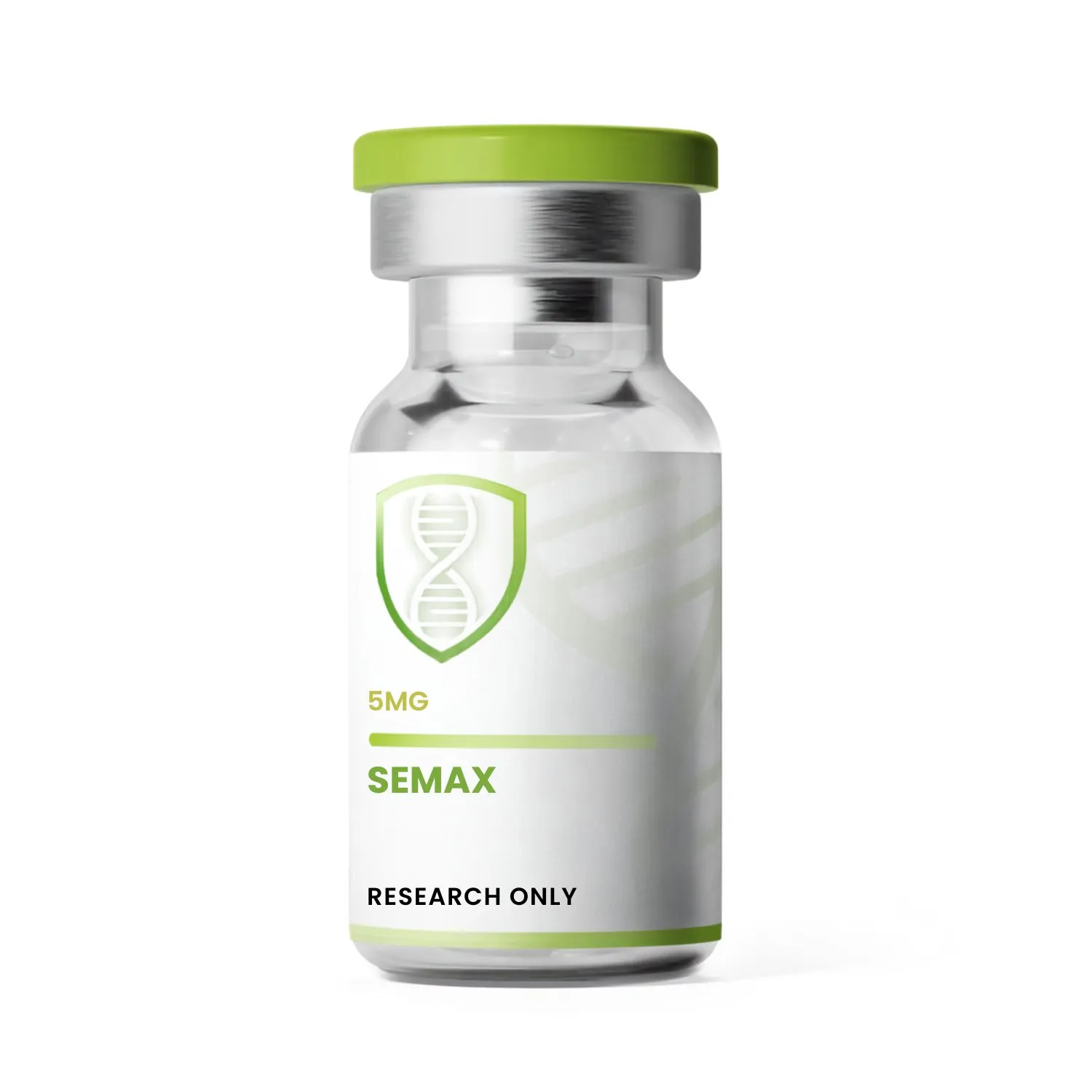
Buy Semax 5mg | Research Peptide | Orion Peptides
Semax 5mg is a synthetic heptapeptide developed from a fragment of adrenocorticotropic hormone (ACTH). Its seven-amino-acid sequence, Met-Glu-His-Phe-Pro-Gly-Pro, has been investigated in research involving neurotrophin gene expression, neuronal signaling, and experimental cerebral ischemia. Semax is built from the ACTH(4-7) sequence with an added Pro-Gly-Pro segment. This structure makes it different from the natural ACTH hormone and has attracted interest in studies of peptide stability and nervous-system biology. At
Orion Peptides, Semax 5mg is offered as a lyophilized research peptide. The 5mg vial provides a defined nominal quantity for laboratory analysis and controlled scientific experiments. Published studies have reported changes in brain-derived neurotrophic factor (BDNF), nerve growth factor (NGF), and other molecular markers in experimental models. However, these findings do not establish that Semax improves memory, treats neurological disease, or provides clinical benefits in humans.
Research Use Only: Not intended for human or veterinary administration, therapeutic treatment, or personal consumption.
What Is Semax?
Semax is a synthetic peptide originally developed through research involving fragments of adrenocorticotropic hormone. ACTH is a naturally occurring peptide hormone involved in the regulation of adrenal activity. Scientists have also investigated shorter ACTH-derived sequences because some fragments have biological properties different from those of the full hormone. Semax combines four amino acids from ACTH(4-7) with a three-amino-acid Pro-Gly-Pro extension. The resulting molecule contains seven residues and is commonly described as ACTH(4-7)-PGP. Researchers have examined Semax in laboratory studies involving changes in gene expression, neuronal signaling, and cellular responses to ischemic injury. Much of the published research comes from animal experiments and cell-based models. Small human investigations have also been reported, but large, high-quality clinical trials remain limited. These findings make Semax relevant to neuroscience research, while leaving important questions about its precise mechanism, safety, and clinical effectiveness unresolved.
Semax 5mg Chemical Specifications
| Property | Details |
| Compound name | Semax 5mg |
| Alternative name | ACTH(4-7)-PGP |
| Peptide class | Synthetic ACTH-derived heptapeptide |
| Amino acid length | 7 |
| Three-letter sequence | Met-Glu-His-Phe-Pro-Gly-Pro |
| One-letter sequence | MEHFPGP |
| Complete sequence | H-Met-Glu-His-Phe-Pro-Gly-Pro-OH |
| Molecular formula | C₃₇H₅₁N₉O₁₀S |
| Molecular weight | Approximately 813.9 Da |
| CAS number | 80714-61-0 |
| PubChem CID | 9811102 |
| Structural feature | C-terminal Pro-Gly-Pro extension |
| N-terminal acetylation | Absent in standard Semax |
| Nominal vial quantity | 5mg |
| Physical form | Lyophilized powder |
| Intended use | Laboratory research only |
The specifications describe standard Semax. N-acetyl Semax and other modified forms have different chemical properties and should not be treated as identical compounds.
Chemical reference: PubChem: Semax, CID 9811102.
Why Does the Semax Sequence Matter?
Semax has a simple but distinctive chemical structure. Its first four amino acids are derived from ACTH(4-7):
Met-Glu-His-Phe The remaining three amino acids form the Pro-Gly-Pro sequence:
Pro-Gly-Pro These segments create the complete heptapeptide:
Met-Glu-His-Phe-Pro-Gly-Pro The Pro-Gly-Pro segment is important because it changes the structure of the parent ACTH fragment and has been investigated for its contribution to peptide stability and biological activity. Unlike full-length ACTH, Semax is not primarily studied for stimulating adrenal hormone secretion. Instead, researchers have examined its effects on neurotrophin-related gene expression and other signaling processes. Standard Semax does not contain an N-terminal acetyl group. This is an important detail for researchers reviewing mass spectrometry data or comparing different commercial peptide compounds.
Semax Mechanism of Action: What Has Research Found?
The complete mechanism of Semax is not established. Unlike a peptide with one clearly identified receptor target, Semax has been associated with several molecular changes in experimental studies. The best-documented areas include neurotrophin gene expression, transcriptional responses after cerebral ischemia, and pathways involved in neuronal stress.
Semax and BDNF Expression
Brain-derived neurotrophic factor (BDNF) is a signaling protein involved in neuronal survival, synaptic function, and plasticity. It plays an important role in the development and maintenance of the nervous system. In 2007, researchers examined the effect of Semax on BDNF and NGF gene expression in the brains of rats. The investigators reported increased expression of both neurotrophin genes in the hippocampus following Semax exposure. This finding suggested that Semax could influence pathways related to neurotrophic signaling. However, increased BDNF gene expression in an animal model does not prove improved cognition or neuroprotection in humans.
Research: Neurotrophin gene expression in rat brain under the action of Semax, an analogue of ACTH 4-10 (2007).
Semax and Nerve Growth Factor
Nerve growth factor (NGF) is another protein involved in neuronal development and maintenance. Researchers have examined whether Semax changes the expression of genes associated with NGF signaling. In a study involving rats with experimental cerebral ischemia, Semax influenced the transcription of several neurotrophins and their receptors. The investigators reported time-dependent changes involving BDNF, NGF, and neurotrophin receptor genes. These findings support further study of Semax in molecular neuroscience. They do not establish that the peptide repairs damaged brain tissue or improves neurological recovery in patients.
Research: Semax and Pro-Gly-Pro activate the transcription of neurotrophins and their receptor genes after cerebral ischemia (2009).
Semax and Cellular Stress Responses
Cerebral ischemia occurs when blood flow to a region of the brain is reduced or interrupted. Experimental models of ischemia are used to investigate changes in metabolism, inflammation, and gene expression. Researchers have examined whether Semax influences some of these molecular responses. These studies have identified changes in genes associated with immune communication, inflammatory signaling, and neurotrophic processes. However, the observed results differ depending on the experimental model and the time at which measurements are taken. For this reason, it would be inaccurate to describe Semax as a peptide that universally suppresses inflammation or protects all neuronal cells.
Three Areas of Semax Research
1. Neurotrophin and Neuroplasticity Research
Semax has attracted interest because of findings involving BDNF and NGF gene expression. These proteins participate in processes associated with neuronal development and synaptic function. Researchers use experimental models to examine whether changes in neurotrophin expression influence downstream cellular signaling. The available findings are mainly molecular and preclinical. They do not establish clinical cognitive enhancement.
2. Experimental Cerebral Ischemia
Several Semax studies have used rodent models of cerebral ischemia. A 2014 genome-wide transcriptional analysis examined how Semax affected gene expression in ischemic rat brain tissue. The researchers observed changes in genes linked to immune responses and vascular-related pathways. At different observation points, the patterns of gene expression varied. These findings contribute to the understanding of biological responses following experimental ischemia.
Research: The peptide Semax affects the expression of genes related to the immune and vascular systems in rat brain focal ischemia (2014).
3. Inflammatory Gene Expression
Inflammatory signaling is one of the many biological responses that can occur after ischemic injury. A later investigation examined Semax-related changes in messenger RNA transcripts associated with pro-inflammatory mediators. The researchers reported that Semax influenced the expression of several genes in a reversible cerebral ischemia model. These experiments suggest that Semax may affect inflammatory signaling at the transcriptional level under certain conditions. However, changes in gene expression do not necessarily demonstrate a reduction in inflammatory disease or improved clinical outcomes.
Research: The Peptide Drug ACTH(4-7)PGP (Semax) Suppresses mRNA Transcripts Encoding Proinflammatory Mediators Induced by Reversible Ischemia of the Rat Brain (2021).
Selank vs Semax: Are They Similar?
Selank and Semax are both synthetic heptapeptides, but their structures and research backgrounds are different.
| Feature | Semax | Selank |
| Amino acid length | 7 | 7 |
| Parent sequence | ACTH(4-7) | Tuftsin |
| One-letter sequence | MEHFPGP | TKPRPGP |
| Molecular weight | Approximately 813.9 Da | Approximately 751.9 Da |
| Main research interest | Neurotrophin signaling and ischemia-related gene expression | Enkephalin metabolism and GABA-related signaling |
| Structural feature | C-terminal Pro-Gly-Pro extension | C-terminal Pro-Gly-Pro extension |
Both peptides contain the Pro-Gly-Pro sequence, but their first four amino acids differ. This difference is important when examining molecular identity, biological responses, and structure-activity relationships. The results of a study involving Selank should not automatically be applied to Semax.
Semax 5mg vs 10mg at Orion Peptides
Orion Peptides offers two Semax research quantities.
Both compounds contain the same Semax molecule when the chemical form matches. The difference is the quantity of peptide associated with each vial. Researchers should select material based on their experimental requirements and review the analytical documentation for the specific compound batch. The 5mg and 10mg quantities describe vial content, not clinical doses.
Orion Peptides Semax 5mg: Purity and COA Information
For research involving synthetic peptides, the identity and purity of the material can affect experimental results. Orion Peptides lists batch-specific analytical results for its Semax 5mg compound. The currently displayed report identifies batch
202609SEMAX5, with the following results:
| Test | Reported result |
| HPLC purity | 99.61% |
| Measured peptide quantity | 5.03mg |
| HPLC-DAD identity | Pass |
| Endotoxin test | 0.071 EU/mL |
| Sterility test | No growth under the stated method |
| Report date | September 4, 2026 |
These results apply to the identified sample and batch. They should not be presented as universal specifications for every Semax compound.
Why Do HPLC and Molecular Identity Matter?
High-performance liquid chromatography (HPLC) separates the main peptide from certain detectable impurities. A high HPLC purity percentage does not independently confirm that a sample contains the correct molecule. Mass spectrometry can provide complementary information about molecular mass and identity. Researchers should also distinguish chromatographic purity from the measured amount of peptide in a vial.
Reviewing the Certificate of Analysis
Before selecting a research peptide, laboratories should review the batch-specific Certificate of Analysis (COA). Useful details include:
- Compound name and batch number
- Testing laboratory and date
- Molecular identity findings
- HPLC purity results
- Actual peptide content
- Other relevant analytical results
A sterility or endotoxin test result applies to the tested sample and method. It should not be interpreted as approval for human or veterinary administration.
Semax Storage and Handling
Semax may be supplied as lyophilized powder for laboratory use. Suitable storage conditions depend on the formulation, packaging, and available stability information. Researchers should follow the supplier’s documented recommendations for the relevant batch. General laboratory precautions include protecting material from moisture, unnecessary light exposure, and excessive temperature changes. Once a peptide has been dissolved, its stability may depend on the solvent, concentration, pH, container, and storage conditions. A universal post-reconstitution shelf life cannot be established without compound-specific stability data.
Frequently Asked Questions About Semax 5mg
What is Semax 5mg?
Semax 5mg is a research compound containing a nominal 5mg quantity of the synthetic heptapeptide Met-Glu-His-Phe-Pro-Gly-Pro. It is investigated in studies of neurotrophin gene expression and neuronal signaling.
What is the amino acid sequence of Semax?
The sequence of standard Semax is Met-Glu-His-Phe-Pro-Gly-Pro, abbreviated MEHFPGP.
What is the molecular formula of Semax?
Standard Semax has the molecular formula C₃₇H₅₁N₉O₁₀S.
What is the molecular weight of Semax?
The molecular weight is approximately 813.9 Da.
Is Semax the same as N-acetyl Semax?
No. Standard Semax has a free N-terminus. N-acetyl Semax contains an additional acetyl group and is a chemically modified analog.
Is Semax derived from ACTH?
Yes. Semax contains the ACTH(4-7) amino acid fragment joined to a Pro-Gly-Pro extension.
Does Semax increase BDNF?
Some animal studies have reported increased BDNF gene expression after Semax exposure. The magnitude and direction of the observed changes depend on the tissue, timing, and experimental model. These findings do not prove cognitive benefits in humans.
Is Semax the same as Selank?
No. Both contain seven amino acids, but Semax is derived from an ACTH fragment and Selank is derived from tuftsin.
What does a Semax COA show?
A COA may include identity testing, HPLC purity, measured peptide content, and other analytical results associated with a specific batch.
Is Semax FDA-approved?
No. Semax is not an FDA-approved medicine in the United States. Its clinical safety and effectiveness have not been established to FDA approval standards.
Important Research Use Disclaimer
Semax 5mg supplied by Orion Peptides is intended exclusively for legitimate laboratory research. It is not an FDA-approved pharmaceutical compound and is not intended for human or veterinary administration, diagnosis, treatment, cognitive enhancement, stroke treatment, or personal consumption. Results from preclinical experiments and limited clinical investigations do not establish the clinical safety or effectiveness of independently manufactured Semax research materials. All laboratory work must comply with applicable laws, institutional requirements, and established laboratory safety procedures.
Scientific References
- National Center for Biotechnology Information. PubChem Compound Summary for Semax, CID 9811102. PubChem.
- Shadrina MI, et al. (2007). Neurotrophin gene expression in rat brain under the action of Semax, an analogue of ACTH 4–10. PubMed.
- Semax and Pro-Gly-Pro activate the transcription of neurotrophins and their receptor genes after cerebral ischemia (2009). Molecular and Cellular Neuroscience. PubMed | DOI.
- The peptide Semax affects the expression of genes related to the immune and vascular systems in rat brain focal ischemia: genome-wide transcriptional analysis (2014). BMC Genomics. PubMed.
- The Peptide Drug ACTH(4-7)PGP (Semax) Suppresses mRNA Transcripts Encoding Proinflammatory Mediators Induced by Reversible Ischemia of the Rat Brain (2021). PubMed.