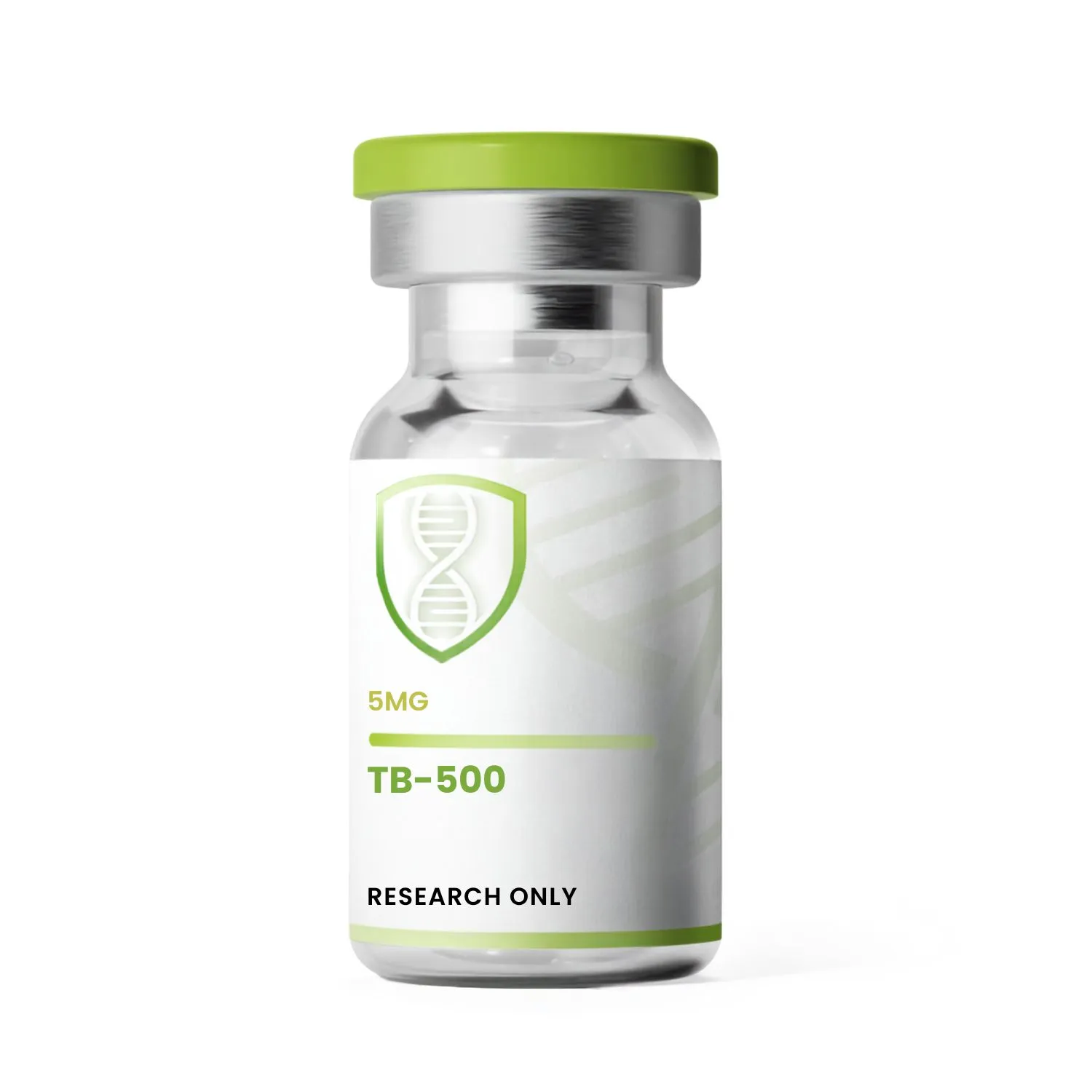
Buy TB-500 5mg | Research Peptide | Orion Peptides
TB-500 5mg is a synthetic research peptide commonly identified as the N-terminally acetylated 17–23 fragment of Thymosin Beta-4 (Tβ4). It contains seven amino acids in the sequence Ac-Leu-Lys-Lys-Thr-Glu-Thr-Gln, abbreviated Ac-LKKTETQ. The peptide comes from a region of Thymosin Beta-4 associated with actin-related research. Scientists have investigated this sequence, its structural properties, and the way the acetylated fragment breaks down in biological systems. At
Orion Peptides, TB-500 5mg is listed as a research compound for controlled laboratory investigations. The 5mg designation refers to the nominal peptide quantity supplied in the vial. Research into TB-500 includes peptide characterization, metabolism, analytical detection, and cell-based studies. However, findings from full-length Thymosin Beta-4 cannot automatically be applied to the shorter TB-500 fragment.
For Research Use Only. Not intended for human or veterinary administration. What Is TB-500?
TB-500 is a name used in the research peptide market for compounds associated with Thymosin Beta-4. In analytical research, TB-500 has been identified as the acetylated seven-amino-acid fragment Ac-LKKTETQ. This sequence corresponds to residues 17–23 of full-length Thymosin Beta-4. Thymosin Beta-4 is a naturally occurring peptide involved in actin regulation and several cellular processes. It has been widely investigated in experimental models of cell migration and tissue responses. The TB-500 fragment contains only a small portion of the parent peptide. This distinction matters because the two molecules have different molecular weights, chemical structures, and available research evidence. A study published in 2012 by Esposito and colleagues identified Ac-LKKTETQ in a commercial TB-500 preparation using high-resolution mass spectrometry. The researchers also synthesized the fragment to establish an analytical reference for its identification.
Scientific reference: Esposito S, et al. (2012). Synthesis and characterization of the N-terminal acetylated 17–23 fragment of thymosin beta-4 identified in TB-500.
TB-500 5mg Molecular Properties
The following specifications describe the acetylated seven-residue TB-500 fragment.
| Property | Details |
| Compound name | TB-500 5mg |
| Alternative name | Acetylated Thymosin Beta-4 fragment 17–23 |
| Peptide class | Synthetic acetylated heptapeptide |
| Amino acid length | 7 residues |
| Amino acid sequence | Leu-Lys-Lys-Thr-Glu-Thr-Gln |
| One-letter sequence | LKKTETQ |
| Complete sequence | Ac-Leu-Lys-Lys-Thr-Glu-Thr-Gln-OH |
| Molecular formula | C₃₈H₆₈N₁₀O₁₄ |
| Molecular weight | Approximately 889.0 Da |
| CAS number | 885340-08-9 |
| PubChem CID | 62707662 |
| N-terminal modification | Acetylation |
| Parent peptide | Thymosin Beta-4 |
| Nominal vial quantity | 5mg |
| Intended use | Laboratory research only |
These molecular specifications should be checked against the COA for the actual Orion compound. The name TB-500 is not always used consistently among peptide suppliers. Some compounds identified as TB-500 contain full-length Thymosin Beta-4 rather than the seven-residue fragment. For accurate research, the amino acid sequence and molecular identity are more reliable than the compound name alone.
TB-500 vs Thymosin Beta-4: What’s the Difference?
TB-500 and Thymosin Beta-4 are closely related, but they should not be treated as identical compounds.
| Feature | TB-500 fragment | Thymosin Beta-4 |
| Peptide length | 7 amino acids | 43 amino acids |
| Molecular weight | Approximately 889 Da | Approximately 4,963 Da |
| Molecular formula | C₃₈H₆₈N₁₀O₁₄ | C₂₁₂H₃₅₀N₅₆O₇₈S |
| Chemical structure | Acetylated fragment | Full-length peptide |
| Sequence | Ac-LKKTETQ | Complete Thymosin Beta-4 sequence |
| Main research evidence | Identity, metabolism, and limited cell-based studies | Actin regulation, cell migration, angiogenesis, and wound models |
| Relationship | Derived from a region of TB4 | Parent peptide |
Full-length Thymosin Beta-4 has been studied more extensively in biological experiments. The shorter fragment has a smaller direct evidence base. Researchers should identify which compound was used in a study before applying its findings to a compound labeled TB-500.
TB-500 and Actin: Understanding the Research
Actin is a protein involved in cell structure, movement, and several cellular processes. It exists in different forms, including globular actin (G-actin) and filamentous actin (F-actin). Thymosin Beta-4 is known for its ability to interact with G-actin and influence actin availability within cells. The LKKTETQ sequence is located in a region associated with the actin-binding activity of the parent peptide. This has made the region interesting to researchers studying peptide structure and cell movement. However, identifying an actin-related region does not prove that an isolated acetylated fragment reproduces all the functions of full-length Thymosin Beta-4. The activity of TB-500 must be investigated using experiments involving the specific fragment.
What Have Studies Found About TB-500?
Direct research on the acetylated TB-500 fragment is more limited than research on full-length Thymosin Beta-4. The most useful publications focus on chemical identification and peptide metabolism.
1. Identification of the TB-500 Peptide
In 2012, Esposito and colleagues investigated a compound identified as TB-500. Using high-performance liquid chromatography and mass spectrometry, they identified the acetylated seven-amino-acid peptide Ac-LKKTETQ. The researchers also synthesized the fragment to support analytical identification. This study established an important chemical reference for identifying TB-500. It did not demonstrate that the peptide accelerates wound healing or improves physical recovery.
Reference: Esposito et al. (2012).
2. TB-500 Metabolism and Its Breakdown Compounds
A 2024 study by Rahaman and colleagues investigated the metabolism of TB-500 and several peptide fragments formed during degradation. The researchers examined the parent peptide in human serum, experimental enzyme systems, and rat samples. They also developed an analytical method for measuring TB-500 and its metabolites. The study identified several breakdown compounds, including:
Ac-LK was a major metabolite observed during the early sampling period in rats. Ac-LKK was detected for a longer period, extending to 72 hours under the study conditions. These findings provide useful information about how the peptide may be processed in experimental biological systems.
Reference: Rahaman KA, et al. (2024). Simultaneous quantification of TB-500 and its metabolites.
3. TB-500 and Cell Migration Research
The 2024 investigation also examined wound-healing activity in a fibroblast-based laboratory assay. The researchers compared the parent TB-500 molecule with several of its metabolites. One metabolite, Ac-LKKTE, showed significant wound-healing activity compared with the control. The parent acetylated TB-500 fragment did not demonstrate the same significant effect in that assay. This result is important because it suggests that some observed biological activity may be associated with breakdown compounds rather than the original peptide. It also demonstrates why research involving TB-500 should distinguish the parent molecule from its metabolites.
4. Thymosin Beta-4 Wound-Healing Research
A frequently cited study by Malinda and colleagues, published in 1999, investigated full-length Thymosin Beta-4 in a rat wound model. The researchers reported increased re-epithelialization, including a 61% improvement compared with saline controls at the seventh day of observation. They also observed differences in wound contraction, collagen deposition, and angiogenesis. These findings are relevant to the biological research background of Thymosin Beta-4. However, the study did not establish that the acetylated TB-500 fragment produces the same results. The distinction between the parent peptide and its fragment should be maintained when citing these findings.
Reference: Malinda KM, et al. (1999). Thymosin beta-4 accelerates wound healing.
Research Applications of TB-500 5mg
The defined structure of the TB-500 fragment makes it relevant to several types of analytical and molecular investigations.
Peptide Structure and Characterization
TB-500 provides a model for studying a short acetylated peptide derived from a larger naturally occurring protein. Researchers can examine its molecular composition, chromatographic behavior, and structural identity.
Peptide Metabolism
The breakdown of TB-500 into shorter fragments has been examined using analytical techniques such as liquid chromatography and mass spectrometry. These investigations help researchers understand the identification and measurement of peptide metabolites.
Actin-Binding Sequence Research
The LKKTETQ sequence occurs within a region of Thymosin Beta-4 associated with actin interaction. Researchers can compare the shorter fragment with the parent peptide to examine the contribution of this sequence to molecular activity.
Cell-Based Wound Models
Studies involving fibroblast migration and wound-closure assays can be used to investigate the biological activity of peptide fragments and their metabolites. However, existing findings should not be interpreted as proof of tendon repair, muscle recovery, pain reduction, or faster healing in humans.
TB-500 5mg and 10mg Research Vials
Orion Peptides lists TB-500 in different research quantities.
Both compound pages should identify the specific chemical form supplied. A 5mg or 10mg label describes the nominal amount of material in the vial, not an experimental dose or concentration. Researchers should compare actual peptide content, purity, identity, and available batch documentation.
TB-500 5mg Purity and COA Documentation
Compound identity is particularly important for TB-500 because the name is used for different peptide structures in the research market. A laboratory selecting TB-500 should verify that the compound’s molecular identity matches its advertised sequence.
HPLC Purity Testing
High-performance liquid chromatography helps separate the main peptide component from detectable impurities. HPLC results are useful for evaluating chromatographic purity. However, an HPLC purity percentage alone does not prove whether the compound contains the acetylated seven-residue fragment or full-length Thymosin Beta-4.
Mass Spectrometry
Mass spectrometry helps verify molecular identity by measuring mass-to-charge ratios. For the acetylated TB-500 fragment, the theoretical average molecular weight is approximately 889.0 Da. Full-length Thymosin Beta-4 has a much larger molecular weight of approximately 4,963 Da. This difference is important when examining a laboratory report.
Certificate of Analysis
A useful batch-specific TB-500 COA should include:
- Compound name and lot number
- Verified peptide sequence or chemical identity
- Molecular mass confirmation
- HPLC purity result
- Actual peptide content, when measured
- Testing laboratory and date
- Relevant analytical methods
A COA should identify the exact compound supplied. Chromatographic purity, measured peptide content, sterility, and endotoxin testing are separate specifications.
TB-500 Storage and Handling
TB-500 may be supplied as a lyophilized peptide for laboratory research. Storage stability depends on the molecular form, formulation, packaging, and environmental conditions. Researchers should follow validated supplier recommendations for the specific batch. General laboratory precautions include:
- Protecting material from moisture and unnecessary light exposure.
- Maintaining appropriate documented storage conditions.
- Avoiding repeated temperature fluctuations.
- Using properly labeled sample containers.
- Following institutional laboratory safety procedures.
The stability of a dissolved peptide may vary with solvent composition, concentration, temperature, and handling. A universal shelf life should not be assumed without compound-specific stability data.
Frequently Asked Questions About TB-500 5mg
What is TB-500 5mg?
TB-500 5mg is a research compound containing a nominal 5mg quantity of material identified as TB-500. In analytical literature, TB-500 has been identified as the acetylated seven-amino-acid Thymosin Beta-4 fragment Ac-LKKTETQ.
Is TB-500 the same as Thymosin Beta-4?
No. The acetylated TB-500 fragment contains seven amino acids, while full-length Thymosin Beta-4 contains 43. Some commercial suppliers use the names interchangeably, so chemical identity should be verified through testing.
What is the TB-500 peptide sequence?
The sequence is Ac-Leu-Lys-Lys-Thr-Glu-Thr-Gln-OH, abbreviated Ac-LKKTETQ.
What is the molecular weight of TB-500?
The acetylated seven-residue TB-500 fragment has a molecular weight of approximately 889.0 Da.
What is the molecular formula of TB-500?
The formula of the acetylated fragment is C₃₈H₆₈N₁₀O₁₄.
What is the CAS number of TB-500?
CAS number 885340-08-9 is associated with the acetylated seven-residue TB-500 fragment.
Does TB-500 directly improve wound healing?
Direct evidence for the acetylated TB-500 fragment is limited. A 2024 study identified wound-healing activity in one of its metabolites during a fibroblast-based assay, while the parent peptide did not show the same significant result.
Why is TB-500 associated with tissue-repair research?
TB-500 is derived from a region of Thymosin Beta-4, which has been investigated in experimental models involving actin regulation, cell migration, and wound repair. These findings should not automatically be attributed to the isolated fragment.
What does a TB-500 COA show?
A COA may document peptide identity, molecular mass, chromatographic purity, actual peptide content, and other batch-specific analytical results.
Is TB-500 FDA-approved?
No. TB-500 is not an FDA-approved medication and is not established as safe or effective for human therapeutic use.
Research Use Only Disclaimer
TB-500 5mg supplied by Orion Peptides is intended exclusively for legitimate laboratory and scientific research. It is not an FDA-approved pharmaceutical compound and must not be used for human or veterinary administration, injury treatment, sports recovery, bodybuilding, or personal consumption. Findings involving full-length Thymosin Beta-4 do not establish the safety or biological effectiveness of the shorter acetylated TB-500 fragment. All laboratory activities must follow applicable laws, institutional protocols, and established safety standards.
Scientific References
- Esposito S, Deventer K, Goeman J, et al. (2012). Synthesis and characterization of the N-terminal acetylated 17–23 fragment of thymosin beta-4 identified in TB-500, a compound suspected to possess doping potential. Drug Testing and Analysis, 4(9), 733–738. PubMed | DOI.
- Rahaman KA, Muresan AR, Min H, et al. (2024). Simultaneous quantification of TB-500 and its metabolites in in-vitro experiments and rats by UHPLC-Q-Exactive Orbitrap MS/MS and their screening by wound healing activities in-vitro. Journal of Chromatography B, 1235, 124033. PubMed | DOI.
- Malinda KM, Sidhu GS, Mani H, et al. (1999). Thymosin beta-4 accelerates wound healing. Journal of Investigative Dermatology, 113(3), 364–368. PubMed | DOI. This study investigated full-length Thymosin Beta-4.
- National Center for Biotechnology Information. PubChem compound reference for TB-500, CID 62707662. PubChem.