

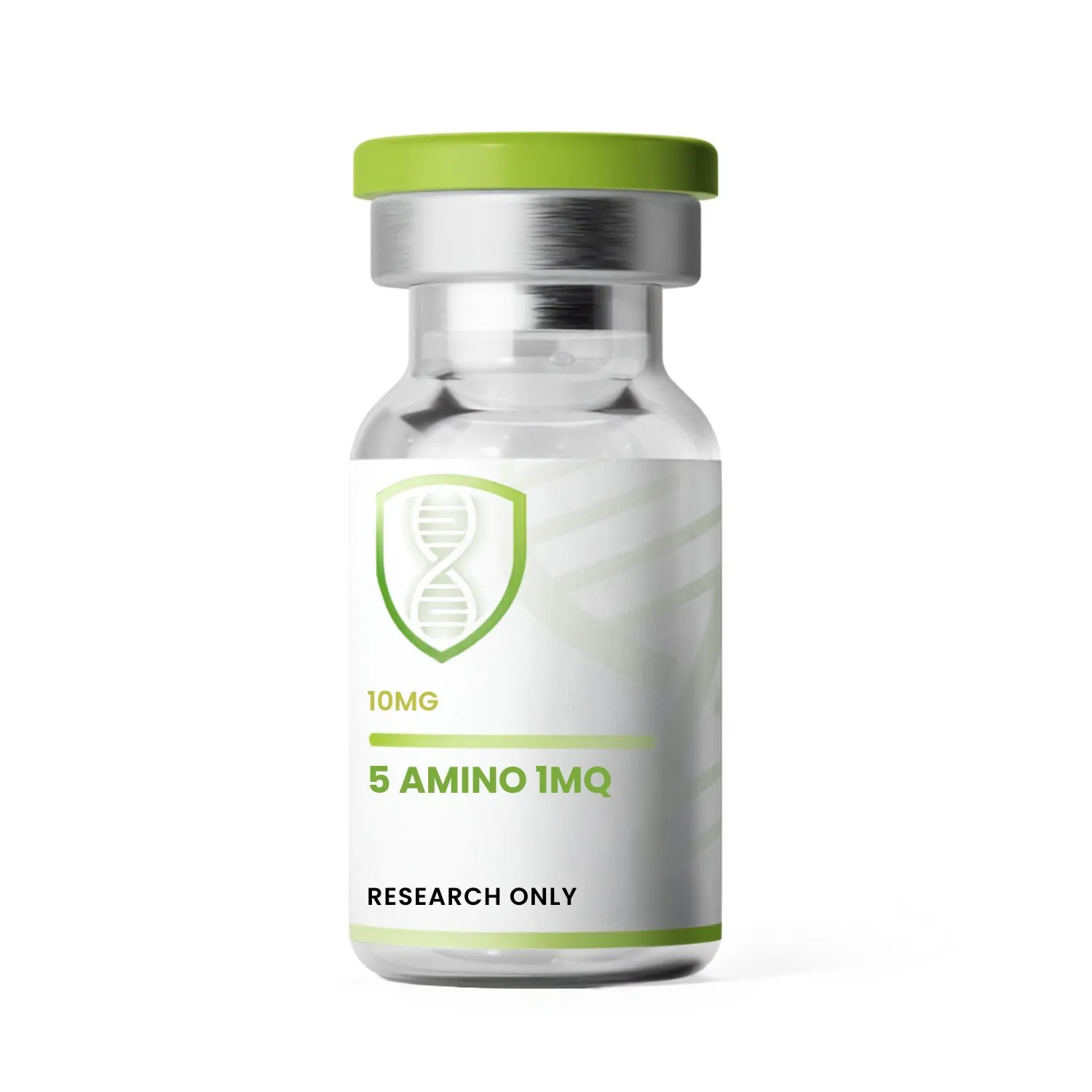
5-Amino-1MQ is a small-molecule inhibitor of nicotinamide N-methyltransferase (NNMT), an enzyme involved in nicotinamide metabolism and cellular methyl-group transfer reactions.
NNMT has attracted research interest because it connects two important biochemical systems: nicotinamide processing and the use of S-adenosyl-L-methionine (SAM) as a methyl donor.
Scientists investigate 5-Amino-1MQ to understand what happens when NNMT activity is reduced under controlled experimental conditions.
Published research has examined the compound in purified enzyme assays, cultured cells, and preclinical animal models. These studies provide information about NNMT inhibition, enzyme kinetics, and the biochemical pathways associated with nicotinamide methylation.
However, these findings should not be confused with established clinical applications. 5-Amino-1MQ remains an investigational research compound.
This article explains how 5-Amino-1MQ interacts with NNMT, how the enzyme normally works, and how researchers measure inhibition in the laboratory.
What Is Nicotinamide N-Methyltransferase (NNMT)?
Nicotinamide N-methyltransferase, abbreviated NNMT, is an enzyme that catalyzes the transfer of a methyl group to nicotinamide.
Nicotinamide is a form of vitamin B3 and is involved in biochemical pathways related to nicotinamide adenine dinucleotide (NAD⁺).
NNMT uses S-adenosyl-L-methionine, commonly called SAM, as the methyl-group donor.
During the reaction, nicotinamide is converted into 1-methylnicotinamide (1-MNA), while SAM is converted into S-adenosyl-L-homocysteine (SAH).
The overall reaction is:
Nicotinamide + SAM → 1-Methylnicotinamide + SAH
This process is a methylation reaction.
Methylation involves transferring a chemical group consisting of one carbon atom and three hydrogen atoms (–CH₃) from a donor molecule to another molecule.
NNMT is classified as a methyltransferase because it catalyzes this type of chemical transformation.
NNMT at a Glance
| Property | Description |
|---|---|
| Full name | Nicotinamide N-methyltransferase |
| Abbreviation | NNMT |
| Enzyme class | Methyltransferase |
| Enzyme Commission number | EC 2.1.1.1 |
| Substrate | Nicotinamide |
| Methyl donor | S-adenosyl-L-methionine |
| Methylated compound | 1-Methylnicotinamide |
| Additional compound | S-adenosyl-L-homocysteine |
| Research relevance | Nicotinamide metabolism, methylation, enzyme inhibition |
Researchers study NNMT because its activity can affect the distribution of nicotinamide and methyl-donor metabolites within experimental systems.
A comprehensive scientific overview is available in Mechanisms and Inhibitors of Nicotinamide N-Methyltransferase.
What Is 5-Amino-1MQ?
5-Amino-1MQ, also written as 5A1MQ, is the abbreviated name for 5-amino-1-methylquinolinium.
It is a synthetic quinolinium-based organic compound investigated as an NNMT inhibitor.
The compound belongs to a class of small molecules containing a nitrogen-bearing aromatic ring system.
It is not an amino acid, protein, or peptide.
The name can be broken into three structural features:
- 5-Amino: An amino group is attached at position 5 of the quinolinium ring system.
- 1-Methyl: A methyl group is attached to the ring nitrogen at position 1.
- Quinolinium: The compound contains a positively charged nitrogen-bearing fused aromatic ring system.
These characteristics distinguish 5-Amino-1MQ from conventional peptide research compounds.
For more about this chemical distinction, read Is 5-Amino-1MQ a Peptide? Chemical Classification Explained.
Chemical Identity of 5-Amino-1MQ
| Property | Value |
|---|---|
| Chemical name | 5-Amino-1-methylquinolinium |
| Abbreviation | 5-Amino-1MQ / 5A1MQ |
| Chemical class | Quinolinium small molecule |
| Parent cation formula | C₁₀H₁₁N₂⁺ |
| Parent cation molecular weight | Approximately 159.21 g/mol |
| PubChem CID | 950107 |
| Primary investigated enzyme | NNMT |
| Peptide classification | Not a peptide |
The compound may be supplied in different salt forms, including iodide and chloride preparations.
These forms have different complete molecular formulas and molecular weights because they contain different counterions.
Researchers should therefore distinguish the parent molecular ion from the complete chemical form of a supplied laboratory material.
How Does 5-Amino-1MQ Inhibit NNMT?
An enzyme inhibitor is a substance that reduces the measured activity of an enzyme under specified conditions.
Some inhibitors compete with a natural substrate for access to an enzyme’s binding site.
Others interact with different regions of the enzyme or affect catalytic processes through alternative mechanisms.
5-Amino-1MQ has been investigated as an inhibitor of NNMT’s nicotinamide-associated catalytic activity.
The Normal NNMT Reaction
Under suitable conditions, NNMT catalyzes methyl transfer from SAM to nicotinamide.
The reaction produces 1-MNA and SAH.
This conversion can be measured in laboratory experiments by examining the amount of compound formed, the rate of substrate consumption, or related analytical signals.
NNMT Inhibition by 5-Amino-1MQ
5-Amino-1MQ contains a quinolinium-based chemical structure that has been studied for its interaction with NNMT.
Research has found that this class of compounds can inhibit NNMT activity by interacting with the enzyme’s substrate-binding environment.
In a biochemical assay, this can lead to a reduction in the measured formation of 1-MNA.
The degree of inhibition depends on variables such as inhibitor concentration, substrate concentration, enzyme preparation, and the experimental method.
What Does the IC₅₀ Value Mean?
An IC₅₀ value is the concentration of an inhibitor required to reduce a measured activity by 50% under the specific conditions of an experiment.
In published research, 5-Amino-1MQ exhibited an NNMT IC₅₀ of approximately 1.2 µM in the reported assay.
This is a laboratory measurement of inhibitory activity.
It does not represent a clinical dose, and it cannot be directly converted into a recommended amount for human administration.
IC₅₀ values can also change across assays because different experimental conditions may affect the results.
For example, the measured value may depend on the enzyme source, substrate concentration, incubation conditions, and method used to detect the reaction compound.
Researchers should therefore compare IC₅₀ measurements only when the underlying assay conditions are understood.
Reference: Kraus and colleagues’ study of selective NNMT inhibitors.
Why Do Researchers Study NNMT Inhibition?
NNMT is connected to several biochemical systems, making it a useful experimental target.
Scientists use NNMT inhibitors to examine the consequences of changing enzyme activity in a controlled setting.
The goal is to determine whether observed biochemical changes are associated with NNMT-dependent reactions.
1. Nicotinamide Metabolism
Nicotinamide participates in pathways associated with NAD⁺ metabolism.
NNMT converts nicotinamide into 1-MNA.
Other pathways use nicotinamide in reactions contributing to NAD⁺ synthesis and recycling.
Researchers investigate how NNMT activity may influence the balance between these pathways.
However, inhibiting NNMT does not automatically mean that NAD⁺ concentrations will increase in every cell type or experimental system.
That relationship must be measured rather than assumed.
2. Methyl-Donor Metabolism
SAM serves as a methyl donor in a wide range of biochemical reactions.
Because NNMT consumes SAM during nicotinamide methylation, it can contribute to the distribution of methyl-donor metabolites.
Scientists may examine SAM, SAH, and related metabolites when studying NNMT activity.
The results depend on the surrounding metabolic system and the experimental conditions.
3. Enzyme Selectivity Research
A compound that inhibits one enzyme may also interact with other enzymes.
Researchers therefore evaluate inhibitor selectivity to determine whether a compound primarily affects the intended target under the tested conditions.
For NNMT inhibitors, selectivity studies may involve other methyltransferases or biochemical targets.
This helps establish whether changes observed in an experiment can reasonably be attributed to NNMT inhibition.
4. Cellular Research Models
NNMT activity has been examined in different cultured cell models.
Researchers can evaluate enzyme inhibition alongside measurements of relevant metabolites, gene expression, or other experimentally defined endpoints.
Such studies can provide information about molecular mechanisms, but cell-culture results do not establish clinical outcomes.
What Have Published Studies Found About 5-Amino-1MQ?
Several scientific publications have examined 5-Amino-1MQ and NNMT inhibition.
The evidence is primarily preclinical.
Kraus et al. — Small-Molecule NNMT Inhibitors
A study published in Biochemical Pharmacology investigated selective and membrane-permeable inhibitors of NNMT.
The researchers examined the inhibitory activity of several quinolinium-derived compounds, including 5-Amino-1MQ.
Their findings included:
- NNMT inhibition in biochemical assays
- Structure-activity relationships among related compounds
- Experimental assessment of membrane permeability
- Measurements involving NNMT-associated metabolites
- Further investigation in cellular and mouse models
The work helped establish 5-Amino-1MQ as a chemical tool for examining NNMT inhibition.
The reported inhibitory activity was dependent on the experimental systems used.
Babula et al. — NNMT Inhibition in Mouse Models
A subsequent study published in 2024 examined NNMT inhibition in diet-induced obese mice.
Researchers measured metabolic variables and tissue characteristics during experimental investigation of 5A1MQ.
The study reported changes in several measured outcomes in the mouse model.
These findings contributed to research into NNMT-related metabolic biology.
However, results from animal models cannot establish that the same outcomes would occur in humans.
The study does not provide proof of clinical effectiveness or safety for human use.
Later NNMT Enzyme-Kinetics Research
A 2025 study in the Journal of Biological Chemistry examined the mechanisms and kinetics of a class of NNMT inhibitors.
Researchers investigated enzyme binding, catalytic turnover, inhibitor formation, and compound release using structural and biophysical methods.
This study provides broader context for how NNMT inhibitors can interact with the enzyme.
It should not be interpreted as demonstrating that every NNMT inhibitor has the same mechanism.
Read the 2025 enzyme-kinetics study.
How Do Researchers Measure NNMT Inhibition?
Laboratory studies can examine NNMT activity using several different analytical approaches.
The appropriate method depends on the experimental question and available equipment.
Enzyme Activity Assays
An enzyme activity assay measures a biochemical reaction under defined conditions.
For NNMT, an assay may measure the formation of 1-MNA or changes in a related reaction component.
Researchers can compare measurements obtained with and without an inhibitor to assess whether enzyme activity changes.
High-Performance Liquid Chromatography
High-Performance Liquid Chromatography (HPLC) separates chemical components based on their interactions with the chromatographic system.
Suitable HPLC methods may be used to analyze nicotinamide, 1-MNA, or other compounds involved in NNMT research.
The method must be appropriate for the substances being measured.
Liquid Chromatography–Mass Spectrometry
Liquid Chromatography–Mass Spectrometry (LC-MS) combines chromatographic separation with mass-based detection.
It can be used to characterize and quantify selected metabolites when appropriate analytical standards and validated procedures are available.
Researchers may use LC-MS to examine changes in 1-MNA or related compounds.
Enzyme Kinetics
Enzyme kinetics investigates how reaction rates change under different experimental conditions.
For inhibitor studies, researchers may examine:
- Reaction velocity
- Substrate dependence
- Inhibitor concentration
- Apparent inhibition constants
- Assay reproducibility
These measurements help researchers understand inhibitory behavior.
Structural and Biophysical Studies
Techniques such as crystallography, nuclear magnetic resonance spectroscopy, and biosensor-based measurements can provide additional evidence about enzyme-ligand interactions.
Such methods may help researchers investigate binding and catalytic mechanisms.
No single technique necessarily establishes every aspect of a compound’s selectivity, cellular activity, or chemical identity.
NNMT Inhibition vs. NNMT Expression: What Is the Difference?
NNMT inhibition and NNMT expression describe different biological measurements.
NNMT inhibition refers to a reduction in measured enzyme activity.
NNMT expression refers to the amount of NNMT messenger RNA or protein present within a biological system.
A compound could reduce the measured activity of an enzyme without necessarily reducing the amount of enzyme protein present.
Likewise, a change in NNMT expression does not automatically establish that enzyme activity has changed by the same proportion.
Researchers should therefore distinguish:
| Measurement | What it describes |
|---|---|
| NNMT enzymatic activity | Rate of the catalyzed chemical reaction |
| NNMT protein abundance | Amount of NNMT protein detected |
| NNMT gene expression | Amount of NNMT-related RNA |
| 1-MNA concentration | Concentration of a reaction compound |
| Inhibitor potency | Inhibition measured under defined conditions |
These values provide different types of evidence and should not be interpreted interchangeably.
Is 5-Amino-1MQ a Peptide or a Small Molecule?
Although 5-Amino-1MQ is sometimes listed alongside peptides, it is not chemically a peptide.
Peptides consist of amino acid residues linked through peptide bonds.
5-Amino-1MQ instead contains a quinolinium ring system.
Its classification as a small molecule is important when interpreting molecular weight, chemical stability, analytical testing, and compound documentation.
For a detailed structural comparison, see Is 5-Amino-1MQ a Peptide? Chemical Classification Explained.
Researchers can also review 5-Amino-1MQ 10mg at Orion Peptides for the available compound specifications and batch-specific analytical information.
5-Amino-1MQ Laboratory Research Materials
When evaluating 5-Amino-1MQ as a laboratory research compound, chemical identity and analytical documentation are essential considerations.
Researchers should distinguish between the parent 5-amino-1-methylquinolinium ion and any supplied salt form.
The parent cation has a molecular weight of approximately 159.21 g/mol.
Different counterions can change the overall formula and molecular weight of the isolated material.
Compound identity, salt form, purity, and declared quantity should therefore be considered separately.
Orion Peptides lists 5-Amino-1MQ 10mg for research purposes and provides access to available analytical documentation.
A relevant batch-specific Certificate of Analysis may include chemical identity information, chromatographic purity, measured quantity, and testing details.
Researchers should verify that the documentation corresponds to the material being evaluated.
5-Amino-1MQ supplied by Orion Peptides is intended strictly for laboratory research and is not for human or veterinary consumption.
Frequently Asked Questions
What is NNMT?
NNMT stands for nicotinamide N-methyltransferase. It is an enzyme that transfers a methyl group from SAM to nicotinamide, producing 1-MNA and SAH.
What is an NNMT inhibitor?
An NNMT inhibitor is a compound that reduces NNMT enzyme activity under specified experimental conditions.
Does 5-Amino-1MQ inhibit NNMT?
Published biochemical studies have demonstrated inhibition of NNMT by 5-Amino-1MQ under defined laboratory conditions.
What is the IC₅₀ of 5-Amino-1MQ?
One published biochemical study reported an NNMT IC₅₀ of approximately 1.2 µM. This value is assay-specific and should not be interpreted as a clinical administration amount.
What does 5-Amino-1MQ stand for?
The abbreviation refers to 5-amino-1-methylquinolinium, a quinolinium-based organic compound.
Is 5-Amino-1MQ a peptide?
No. It is a small-molecule compound without an amino acid chain or peptide bonds.
What is the relationship between NNMT and NAD⁺?
NNMT methylates nicotinamide, which is also a component of pathways involved in NAD⁺ metabolism. Researchers investigate how NNMT activity relates to these interconnected processes.
Does NNMT inhibition automatically increase NAD⁺?
No. Changes in NAD⁺ depend on multiple metabolic pathways and experimental conditions. NNMT inhibition alone does not establish a particular NAD⁺ response.
How is NNMT enzyme activity measured?
Researchers may use biochemical assays, chromatography, mass spectrometry, or related techniques to measure substrates, reaction compounds, and enzyme kinetics.
Can NNMT inhibition be measured using 1-MNA?
Yes. 1-MNA is a compound of the NNMT-catalyzed reaction. Its concentration can be measured as part of suitable experimental designs, although interpretation may require consideration of other biochemical processes.
What is the difference between NNMT inhibition and NNMT expression?
NNMT inhibition refers to reduced enzyme activity, while NNMT expression describes the amount of NNMT RNA or protein detected.
Is 5-Amino-1MQ approved for human use?
5-Amino-1MQ remains an investigational compound and is not an FDA-approved medication. Orion Peptides supplies it exclusively for research purposes.
Conclusion
5-Amino-1MQ and NNMT research focuses on understanding enzyme inhibition and nicotinamide methylation under controlled laboratory conditions.
NNMT catalyzes the transfer of a methyl group from SAM to nicotinamide, producing 1-MNA and SAH.
5-Amino-1MQ is a quinolinium-based small molecule that has demonstrated NNMT inhibitory activity in published biochemical experiments.
Researchers use such compounds to investigate enzyme kinetics, substrate interactions, cellular metabolites, and related biochemical pathways.
Although preclinical studies have produced valuable findings, they do not establish clinical safety or effectiveness.
For additional information, explore Orion Peptides’ 5-Amino-1MQ 10mg research compound and our guide explaining why 5-Amino-1MQ is not a peptide.
Scientific References
- Kraus D, et al. (2018). Selective and Membrane-Permeable Small Molecule Inhibitors of Nicotinamide N-Methyltransferase. Biochemical Pharmacology. Research into NNMT inhibition, compound selectivity, and cellular activity.
- Gao Y, et al. (2021). Mechanisms and Inhibitors of Nicotinamide N-Methyltransferase. Review of NNMT chemistry and inhibitor classes.
- Babula JJ, et al. (2024). Nicotinamide N-Methyltransferase Inhibition Mitigates Obesity-Related Metabolic Dysfunction. Preclinical research involving NNMT inhibition in mouse models.
- Akerud T, et al. (2025). Mechanism and Kinetics of Turnover Inhibitors of Nicotinamide N-Methyl Transferase In Vitro and In Vivo. Journal of Biological Chemistry. Enzyme kinetics, binding, and inhibitor mechanism research.
- National Center for Biotechnology Information. PubChem: 5-Amino-1-methylquinolinium. Chemical structure and compound identifiers.
Research Use Only (RUO) Disclaimer
All compounds offered by Orion Peptides, including 5-Amino-1MQ 10mg, are intended strictly for laboratory research, chemical analysis, and scientific investigation.
These materials are not intended for human or veterinary consumption, clinical administration, diagnosis, treatment, cure, or prevention of any disease.
This article is provided for scientific and educational purposes only. Biochemical assays, cellular observations, and animal studies do not establish the clinical safety or effectiveness of 5-Amino-1MQ.
Researchers must verify compound identity, chemical form, and batch-specific analytical documentation and follow applicable laboratory safety requirements.
