

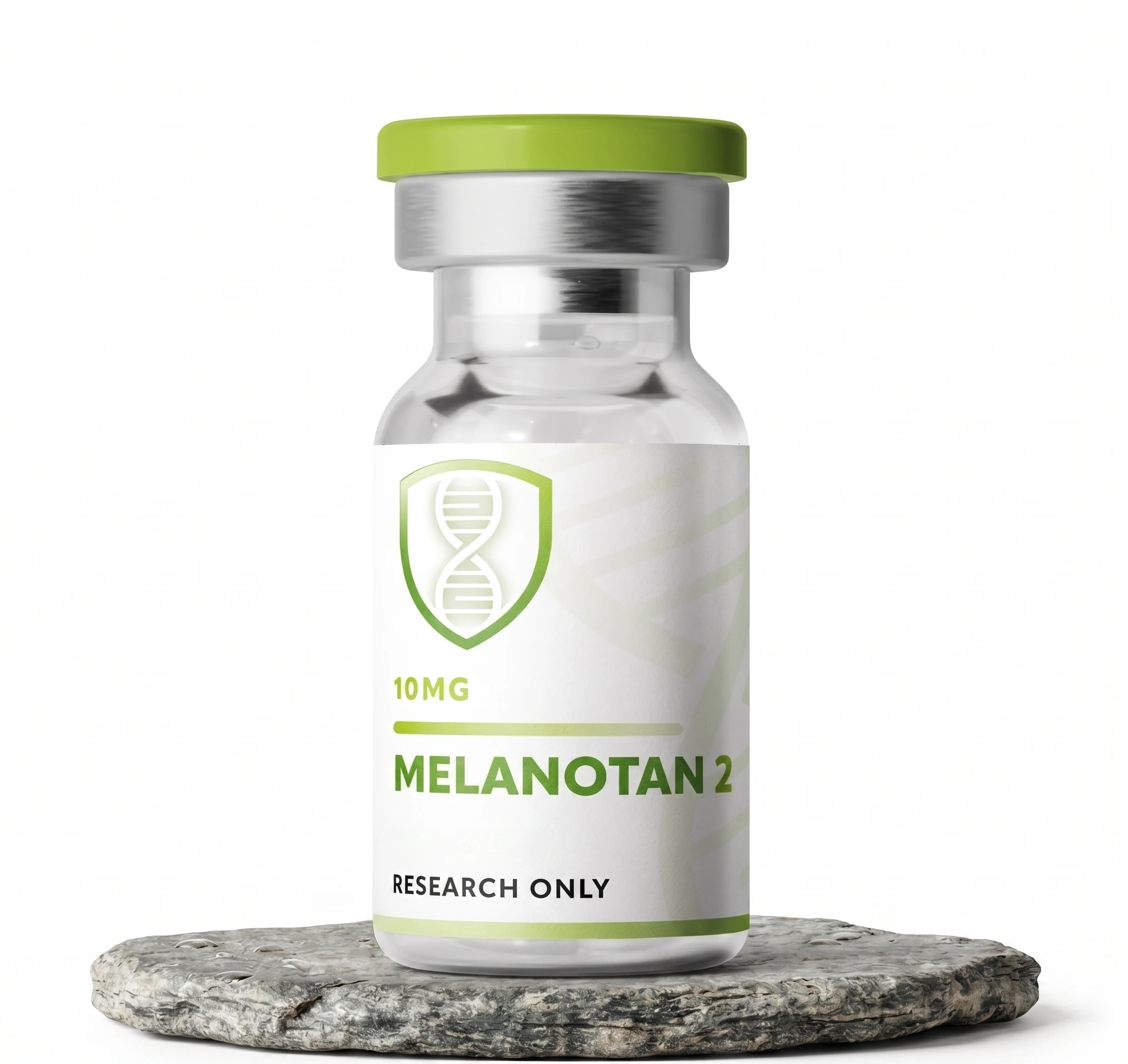
Melanotan II is a synthetic peptide that was developed as an analogue of α-melanocyte-stimulating hormone (α-MSH), a naturally occurring melanocortin involved in skin pigmentation and other physiological processes. Unlike a selective pigmentation-focused compound, Melanotan II interacts with multiple melanocortin receptors, which helps explain why research has associated it with pigmentation as well as effects on sexual function and other physiological responses.
The initial interest in the substance Melanotan II lay in its potential for promoting pigmentation via the melanocortin pathway without depending solely on UV exposure. Initial human studies showed that not only could the peptide produce pigmentation, but there were also other effects associated with it. According to Dorr et al., some cutaneous pigmentation activity was found in Phase I clinical trials of the substance, along with other effects like yawning and erectile responses.
What is Melanotan II?
Melanotan II is a synthetic, cyclic melanotropic peptide meant to emulate certain biological effects of α-MSH. The mechanism of its pharmacologic activity is linked to the stimulation of melanocortin receptors, a class of G-protein-coupled receptors participating in such biological processes as pigmentation, energy metabolism, and sexual activity.
The receptor that is most important for melanotan-induced skin pigmentation is MC1R. MC1R is a receptor protein, which is found on melanocytes and serves an essential function in regulation of melanin synthesis. Stimulation of MC1R enhances intracellular signaling that promotes pigmentation and the kind of pigments produced. Guida et al. describe MC1R as a major regulator of human pigmentation and highlight other biological functions of this protein.
This biological background provides a basis for understanding how Melanotan II affects skin pigmentation. Yet, it should be stressed that Melanotan II is not an MC1R-specific drug.
How Does Melanotan II Work?
Melanotan II is often referred to as a non-selective melanocortin-receptor agonist, which implies that it interacts not only with one but several receptor types. This is what distinguishes Melanotan II from compounds targeted specifically to MC1R.
There are five types of melanocortin receptors with specific distribution and biological functions. According to Guida et al., MC1R is a type of G protein-coupled receptor whose activation regulates melanogenesis through intracellular signal transduction via cyclic AMP. Melanin pigment synthesis is increased following the activation of MC1R due to stimulation of eumelanin biosynthesis in melanocytes.
Therefore, receptor activation triggers intracellular signaling that influences the process of pigmentation, whereas interactions with other receptors in addition to MC1R may result in some other physiological responses.
How Does Melanotan II Affect Skin Pigmentation?
One of the most notable actions related to Melanotan II is increased skin pigmentation.
When signals through melanocortin receptors stimulate the activity of the MC1R receptor in melanocytes, cellular processes lead to enhanced melanogenesis. It may result in a switch towards eumelanin synthesis and increased concentration of melanin in the skin. As Guida et al., state, the process of MC1R signaling is closely related to pigmentation, ultraviolet action, and melanin production regulation.
There is also evidence related to the effect of Melanotan II on skin pigmentation among humans. In one of the first Phase I clinical studies, the volunteers were injected with several doses of the peptide, and increased skin pigmentation was observed in some cases. The researchers found that Melanotan II had cutaneous pigmentation action in humans. There was also a noted stretching-and-yawning action and spontaneous erectile responses among the effects of Dorr et al.
It is worth noting that increased pigmentation does not mean increased resistance to ultraviolet light.

Why Does Melanotan II Have Effects Beyond Pigmentation?
The broader effects of Melanotan II are related to its activity across the melanocortin system.
Melanocortin receptors are involved in several physiological pathways, and some are expressed outside the skin. This helps explain why a compound with nonselective melanocortin activity can produce effects that are not limited to melanogenesis.
One of the most studied examples is sexual function. In a controlled human study involving men with erectile dysfunction, Wessells et al. reported that Melanotan II produced erectile responses in the absence of sexual stimulation in many participants and was also associated with increased sexual desire. Nausea and yawning were among the frequently reported adverse effects.
These findings are scientifically important because they demonstrate that Melanotan II’s pharmacology extends beyond the skin. They also contributed to broader research into melanocortin receptors and sexual function.
What Have Human Studies Shown?
The human evidence for Melanotan II is relatively limited compared with that for approved medicines.
The early Phase I study provided evidence of pigmentation and documented several short-term physiological effects. Dorr et al. reported increased pigmentation following administration and observed spontaneous erectile responses and stretching/yawning responses.
Further research focused on the sexual side-effects. In a study by Wessells et al., Melanotan II was tested in patients suffering from erectile dysfunction in a double-blind, placebo-controlled cross-over trial. The researchers observed erectile responses and increased sexual desire in some participants, while nausea and yawning were also reported.
These studies demonstrate the biological activity in humans; however, it should not be regarded as the proof of efficacy of Melanotan II as a treatment for cutaneous pigmentation , erectile dysfunction, or any other disease. There are limited clinical data, and Melanotan II does not have the history of clinical development of the therapeutic agent.
What Side Effects Have Been Reported?
Safety is an essential aspect of the scientific discourse about Melanotan II.
The common side effects in clinical studies include nausea, yawning, flushing, and spontaneous erectile responses. For instance, nausea was observed in many subjects, and some patients experienced severe nausea in the study by Wessells et al. Other complications that were described in case reports include systemic toxicity, including rhabdomyolysis and renal dysfunction, due to Melanotan II administration, according to Nelson et al. Another case report described renal infarction that could possibly be associated with Melanotan II use. According to Peters et al., the mechanism of possible renal damage is unclear and might include thrombotic and toxic mechanisms.
Although case reports do not prove the causality between Melanotan II use and these complications, they show that this issue must be taken into consideration.
Is Melanotan II Approved for Human Use?
Melanotan II must not be confused with an approved prescription drug.
According to the FDA in the United States, Melanotan II is an unapproved new compound. The FDA’s files show enforcement action against the promotion of Melanotan II as an injectable compound. Also, the FDA has warned about the possible immunogenicity problems linked to the compound drugs containing Melanotan II, including aggregation and peptide impurities.
Different regulations may apply in various countries. In the case of Australia, the Therapeutic Goods Administration of Australia mentions that Melanotan II has not been approved for cutaneous pigmentation and has kept on taking actions against the unapproved supply and advertisement of Melanotan II.
Thus, the findings from the research cannot be interpreted to imply that commercially available Melanotan II is approved and standard.
Why Is Melanotan II Scientifically Interesting?
Melanotan II is of scientific interest due to its demonstration of the integration of different biological mechanisms through the melanocortin system.
Stimulation of receptors by Melanotan II allowed scientists to explore the connection between activation of the receptors, pigmentation, sexual activity, and other physiological reactions. On the other hand, the non-selectivity of Melanotan II serves as a good example of the fundamental principle in pharmacology: stimulation of different receptors’ pathways can lead to different biological reactions, including side effects.
FAQs
Q1. Is Melanotan II an artificial peptide?
Yes, Melanotan II is an artificial melanotropic peptide that imitates some properties of α-MSH and acts on melanocortin receptors.
Q2. Can Melanotan II stimulate production of melanin?
Yes, Human studies have demonstrated that Melanotan II can increase skin pigmentation. . According to Dorr et al., Melanotan II induces pigmentation during a Phase I clinical study.
Q3. Does Melanotan II have any effect on sexuality?
Experiments in humans have shown effects on sexual functions like erectile responses and sexual desire. Wessells et al. reported these effects while also documenting adverse effects such as nausea and yawning.
Q4. Is Melanotan II FDA approved?
Not. Melanotan II not FDA-approved for human use. The FDA has identified it as an unapproved new drug.
Q5. Does Melanotan II protect the skin from UV radiation?
Increased pigmentation should not be treated as a substitute for UV protection. A darker appearance does not eliminate the biological damage caused by ultraviolet exposure.
Conclusion
Melanotan II is a synthetic melanocortin peptide whose scientific importance comes from its broad receptor activity and its effects on several physiological systems. Its best-known action is stimulation of pigmentation through melanocortin signaling, particularly involving MC1R.
Moreover, human experiments have found an effect on sexual functions and adverse reactions, including nausea and yawning. Dorr et al., demonstrated increased pigmentation in an early Phase I clinical study, while Wessells et al. reported physiological effects of Melanotan II beyond the skin, including effects on sexual function.
But it doesn’t mean that Melanotan II can be considered as a medicinal or cutaneous pigmentation agent. Authorities regard this substance as an unapproved compound, and some case studies brought new concerns about the safety of Melanotan II.
And here we come to the key scientific conclusion: Melanotan II is a pharmacologically active, nonselective agonist of melanocortin receptors affecting the process of pigmentation and many other physiological systems.
References
- Dorr, R. T., Lines, R., Levine, N., Brooks, C., Xiang, L., Hruby, V. J., & Hadley, M. E. (1996). Evaluation of melanotan-II, a superpotent cyclic melanotropic peptide in a pilot phase-I clinical study. Life Sciences, 58(20), 1777-1784.
- Wessells, H., Levine, N., Hadley, M. E., Dorr, R., & Hruby, V. (2000). Melanocortin receptor agonists, penile erection, and sexual motivation: human studies with Melanotan II. International journal of impotence research, 12(4), S74-S79.
- Wessells, H., Gralnek, D., Dorr, R., Hruby, V. J., Hadley, M. E., & Levine, N. (2000). Effect of an alpha-melanocyte stimulating hormone analog on penile erection and sexual desire in men with organic erectile dysfunction. Urology, 56(4), 641-646.
- Guida, S., Guida, G., & Goding, C. R. (2022). MC1R functions, expression, and implications for targeted therapy. Journal of Investigative Dermatology, 142(2), 293-302.
- Nelson, M. E., Bryant, S. M., & Aks, S. E. (2012). Melanotan II injection resulting in systemic toxicity and rhabdomyolysis. Clinical Toxicology, 50(10), 1169-1173.
- Peters, B., Hadimeri, H., Wahlberg, R., & Afghahi, H. (2020). Melanotan II: a possible cause of renal infarction: review of the literature and case report. CEN case reports, 9(2), 159-161.

