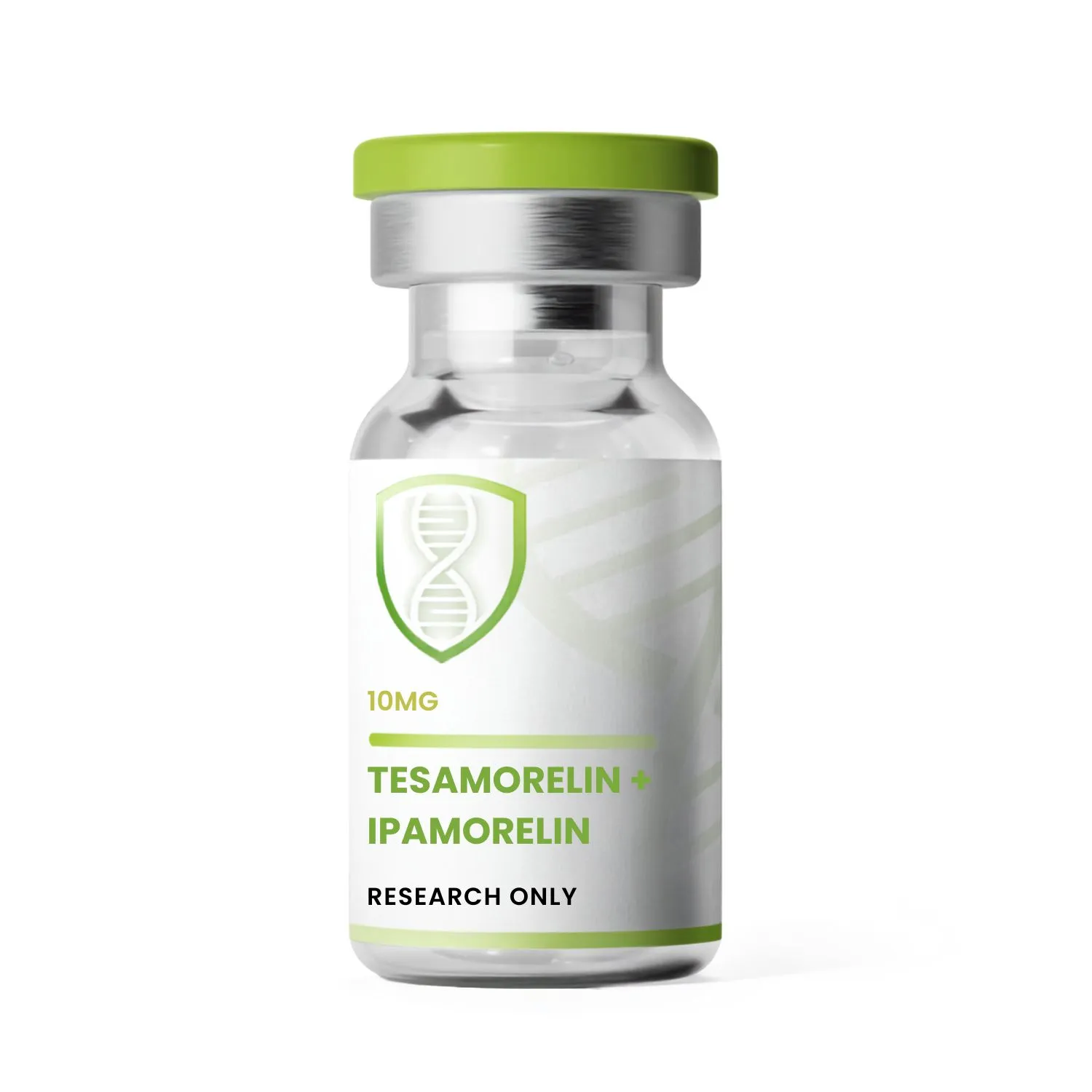
Buy Tesamorelin + Ipamorelin 10mg | Research Peptide Blend
Tesamorelin + Ipamorelin 10mg is a synthetic research peptide blend containing two compounds that interact with different receptors involved in growth hormone (GH) signaling.
Research background: Tesamorelin research profile · AOD-9604 vs Tesamorelin
Tesamorelin is a 44-amino-acid analog of growth hormone-releasing hormone (GHRH). Ipamorelin is a five-amino-acid growth hormone secretagogue that acts on the ghrelin receptor, GHS-R1a.
These differences make the combination relevant to research involving pituitary signaling, growth hormone regulation, receptor interactions, and the GH–IGF-1 axis.
At Orion Peptides, Tesamorelin + Ipamorelin 10mg is listed as a research blend for controlled laboratory investigation.
Although Tesamorelin and Ipamorelin have been investigated separately, published research on their specific combination is very limited. Findings involving either peptide alone cannot establish the effects or safety of the combined preparation.
Research Use Only: Not intended for human or veterinary administration, therapeutic use, or personal consumption.
What Is Tesamorelin + Ipamorelin?
Tesamorelin + Ipamorelin combines two synthetic peptides associated with the regulation of growth hormone secretion.
The compounds differ in their chemical structures and receptor targets.
Tesamorelin is derived from natural GHRH(1-44). It retains the 44-amino-acid sequence and includes an N-terminal trans-3-hexenoyl modification.
This structure allows Tesamorelin to act as an agonist of GHRH receptors found on pituitary somatotroph cells.
Ipamorelin is a synthetic pentapeptide that acts as an agonist of the growth hormone secretagogue receptor, GHS-R1a.
This receptor is also activated by ghrelin, a naturally occurring hormone involved in several physiological processes.
Because GHRH receptors and GHS-R1a receptors use different intracellular signaling pathways, researchers have investigated whether activating both systems can influence the resulting growth hormone response.
Studies involving GHRH and other growth hormone secretagogues have demonstrated interactions between these pathways.
However, the same response has not been established in controlled clinical trials of the specific Tesamorelin + Ipamorelin blend.
Tesamorelin + Ipamorelin Molecular Specifications
The blend contains two separate peptide molecules. Each has its own amino acid sequence, molecular formula, and molecular weight.
| Property | Tesamorelin | Ipamorelin |
| Peptide class | GHRH analog | Growth hormone secretagogue |
| Amino acid length | 44 | 5 |
| Molecular formula | C₂₂₁H₃₆₆N₇₂O₆₇S | C₃₈H₄₉N₉O₅ |
| Molecular weight | Approximately 5,135.9 Da | Approximately 711.9 Da |
| CAS number | 218949-48-5 | 170851-70-4 |
| Research receptor | GHRH receptor | GHS-R1a |
| Structural feature | N-terminal trans-3-hexenoyl group | Modified pentapeptide with C-terminal amidation |
| Main research area | Pituitary and GH–IGF-1 signaling | Ghrelin receptor signaling |
The specifications describe the individual parent peptide molecules.
Because this is a mixture, the compound does not have a single molecular formula or molecular weight.
The nominal 10mg blend quantity must be accompanied by the specific amount of Tesamorelin and Ipamorelin present in the vial.
Tesamorelin + Ipamorelin Mechanism of Action
Tesamorelin and Ipamorelin act through distinct receptor pathways associated with growth hormone regulation.
How Tesamorelin Works
Tesamorelin binds to the GHRH receptor on pituitary somatotroph cells.
Receptor activation stimulates Gs-protein signaling and increases intracellular cyclic AMP (cAMP).
This signaling contributes to growth hormone synthesis and secretion in responsive pituitary cells.
Growth hormone also influences downstream endocrine pathways, including the production of insulin-like growth factor 1 (IGF-1).
Tesamorelin has been studied extensively in clinical investigations involving the GH–IGF-1 axis and visceral adipose tissue.
How Ipamorelin Works
Ipamorelin activates the growth hormone secretagogue receptor, GHS-R1a.
Unlike the GHRH receptor, GHS-R1a is primarily associated with Gq/11-mediated signaling.
This pathway involves phospholipase C and changes in intracellular calcium signaling.
In early preclinical research, Ipamorelin stimulated growth hormone release in experimental models and showed greater selectivity for GH responses than some older secretagogues under the conditions tested.
Research reference: Raun K, et al. (1998). Ipamorelin, the first selective growth hormone secretagogue.
Why Are Tesamorelin and Ipamorelin Studied Together?
The research interest in this combination comes from the relationship between GHRH receptor signaling and growth hormone secretagogue receptor signaling.
In 2002, Cunha and Mayo investigated these two receptor pathways in cells engineered to express both receptors.
The researchers found that coactivation increased the cAMP response to GHRH compared with GHRH receptor activation alone.
The study reported approximately twice the cAMP response under certain experimental conditions.
This finding suggests that the two signaling pathways can interact at the cellular level.
However, the study did not test the specific Tesamorelin + Ipamorelin blend, and a stronger cellular cAMP response does not automatically establish a greater clinical benefit.
Research reference: Cunha SR, Mayo KE. (2002). Ghrelin and growth hormone secretagogues potentiate GHRH-induced cAMP production.
Tesamorelin + Ipamorelin Research Applications
The blend is relevant to several areas of endocrine and molecular research.
1. GHRH and GHS-R1a Receptor Signaling
Researchers study how GHRH receptors and ghrelin receptors respond to different ligands.
Because these receptor systems use distinct intracellular signaling mechanisms, they offer a model for investigating interactions between G-protein-coupled receptor pathways.
2. Growth Hormone Regulation
Growth hormone secretion is regulated by several hypothalamic and peripheral signals.
GHRH stimulates GH release, while ghrelin and synthetic secretagogues can also influence pituitary responses.
Research involving both signaling systems helps scientists understand how different regulatory pathways contribute to GH secretion.
3. GH–IGF-1 Axis Research
Growth hormone influences the production of IGF-1, particularly in the liver.
Scientists investigate this endocrine relationship when studying growth hormone signaling, feedback mechanisms, and metabolic regulation.
Tesamorelin clinical studies have reported increases in circulating IGF-1. These findings cannot be used to predict the effects of a combined Tesamorelin + Ipamorelin research vial.
4. Receptor Interaction Studies
Experimental research can examine how activation of one receptor system influences the cellular response to another.
These studies may involve receptor-expressing cell models and measurements of downstream signaling.
The research aim is to understand molecular interactions rather than assume that combined exposure is automatically more effective than either compound alone.
5. Peptide Structure and Analytical Research
The two peptides differ substantially in molecular size and chemical structure.
Tesamorelin contains 44 amino acids, while Ipamorelin contains five.
This creates analytical considerations when identifying and quantifying both compounds in the same sample.
Researchers may examine mixture composition, chemical stability, chromatographic separation, and molecular identity using validated laboratory methods.
Tesamorelin vs Ipamorelin: Key Differences
| Feature | Tesamorelin | Ipamorelin |
| Peptide length | 44 amino acids | 5 amino acids |
| Receptor | GHRH receptor | GHS-R1a |
| Main signaling pathway | Gs/cAMP | Gq/11/PLC/Ca²⁺ |
| Molecular design | Modified natural GHRH analog | Synthetic pentapeptide |
| Individual clinical research | Extensive research, including approved pharmaceutical use | Limited clinical development without FDA approval |
| Main scientific interest | GHRH receptor and metabolic signaling | Ghrelin receptor selectivity and GH signaling |
The two peptides are not interchangeable.
Tesamorelin targets the GHRH receptor, whereas Ipamorelin activates the growth hormone secretagogue receptor.
Both pathways are associated with GH secretion, but the strength and duration of their responses can depend on the experimental model and conditions.
Tesamorelin + Ipamorelin 10mg Purity and COA
Research involving peptide blends requires accurate identification and measurement of each compound.
A certificate showing only the overall mixture purity may not establish how much Tesamorelin or Ipamorelin is present.
HPLC Testing
High-performance liquid chromatography (HPLC) can separate mixture components under suitable analytical conditions.
For a two-peptide blend, researchers should review testing that identifies and measures the individual components.
Mass Spectrometry
Mass spectrometry helps confirm the molecular identities of Tesamorelin and Ipamorelin.
Because their molecular weights differ significantly, analytical methods can distinguish the expected molecules when properly validated.
Certificate of Analysis
A useful batch-specific COA for Tesamorelin + Ipamorelin should include:
- Compound and batch identification
- The declared amount of each peptide
- Measured Tesamorelin content
- Measured Ipamorelin content
- Relevant HPLC purity results
- Molecular identity confirmation
- Testing date and laboratory information
The total content, individual peptide quantities, and chromatographic purity are separate measurements.
HPLC purity alone does not establish sterility, endotoxin limits, or pharmaceutical suitability.
Tesamorelin + Ipamorelin Storage and Handling
Research peptide blends may be supplied as lyophilized powder.
The stability of a mixture depends on the chemical properties of both components, the formulation, the packaging, and storage conditions.
Laboratories should follow compound-specific validated storage instructions.
General considerations include protecting the material from moisture, unnecessary light exposure, and repeated temperature fluctuations.
After dissolution, stability depends on factors such as solvent composition, concentration, container compatibility, and storage temperature.
Storage recommendations for individual peptides or FDA-approved medicines should not automatically be applied to a combined research formulation.
Frequently Asked Questions
What is Tesamorelin + Ipamorelin 10mg?
Tesamorelin + Ipamorelin 10mg is a research peptide blend containing two synthetic compounds associated with growth hormone signaling. Tesamorelin targets the GHRH receptor, while Ipamorelin acts through GHS-R1a.
What is the difference between Tesamorelin and Ipamorelin?
Tesamorelin is a 44-amino-acid GHRH analog. Ipamorelin is a five-amino-acid growth hormone secretagogue. They differ in chemical structure, receptor targets, and intracellular signaling pathways.
Does the combination have a single molecular formula?
No. Tesamorelin and Ipamorelin remain separate chemical compounds in the blend. Each has its own molecular formula and molecular weight.
Does Tesamorelin + Ipamorelin have proven synergistic effects?
Related experimental studies have reported interactions between GHRH and growth hormone secretagogue receptor pathways. However, controlled clinical evidence has not established synergistic effects for the specific Tesamorelin + Ipamorelin blend.
Does 10mg mean 10mg of each peptide?
Not necessarily. The label must specify the individual quantities. A 10mg total blend, for example, could have a different composition from a compound containing 10mg of Tesamorelin plus additional Ipamorelin.
What research is available for Tesamorelin?
Tesamorelin has been investigated in controlled clinical studies involving the GH–IGF-1 axis and HIV-associated abdominal fat accumulation. A specific prescription tesamorelin compound has FDA approval for a defined medical indication.
What research is available for Ipamorelin?
Early experiments examined Ipamorelin’s GH secretagogue activity and endocrine selectivity. It has also undergone limited clinical investigation, but it is not an FDA-approved medication.
Is Tesamorelin + Ipamorelin FDA-approved?
No. The combined research blend is not an FDA-approved medication. Approval of a specific pharmaceutical Tesamorelin formulation does not apply to an independently manufactured combination containing Ipamorelin.
What should researchers check before selecting a peptide blend?
Researchers should examine the declared composition, batch-specific identity testing, individual peptide content, chromatographic purity, and supplier storage specifications.
Important Research Disclaimer
Tesamorelin + Ipamorelin supplied by Orion Peptides is intended exclusively for legitimate scientific and laboratory research.
This combination is not an FDA-approved pharmaceutical compound and is not intended for human or veterinary administration, diagnosis, treatment, bodybuilding, anti-aging therapy, or personal consumption.
Studies involving individual peptides and other GHRH/GHS-R agonists do not establish the safety or effectiveness of this combination.
All research activities must follow applicable laws, institutional requirements, and established laboratory safety procedures.
Scientific References
- Raun K, et al. (1998). Ipamorelin, the first selective growth hormone secretagogue. European Journal of Endocrinology, 139(5), 552–561. PubMed | DOI.
- Wang Y, Tomlinson B. (2009). Tesamorelin, a human growth hormone releasing factor analogue. Expert Opinion on Investigational Drugs, 18(3), 303–310. PubMed | DOI.
- Cunha SR, Mayo KE. (2002). Ghrelin and growth hormone secretagogues potentiate GH-releasing hormone-induced cyclic AMP production in cells expressing transfected GHRH and GH secretagogue receptors. Endocrinology, 143(12), 4570–4582. PubMed | DOI.
- Falutz J, et al. (2010). Effects of tesamorelin, a growth hormone-releasing factor, in HIV-infected patients with abdominal fat accumulation: a randomized placebo-controlled trial with a safety extension. Journal of Acquired Immune Deficiency Syndromes. PubMed.
- Beck DE, et al. (2014). Prospective, randomized, controlled, proof-of-concept study of the ghrelin mimetic Ipamorelin for the management of postoperative ileus in bowel resection patients. International Journal of Colorectal Disease. PubMed.