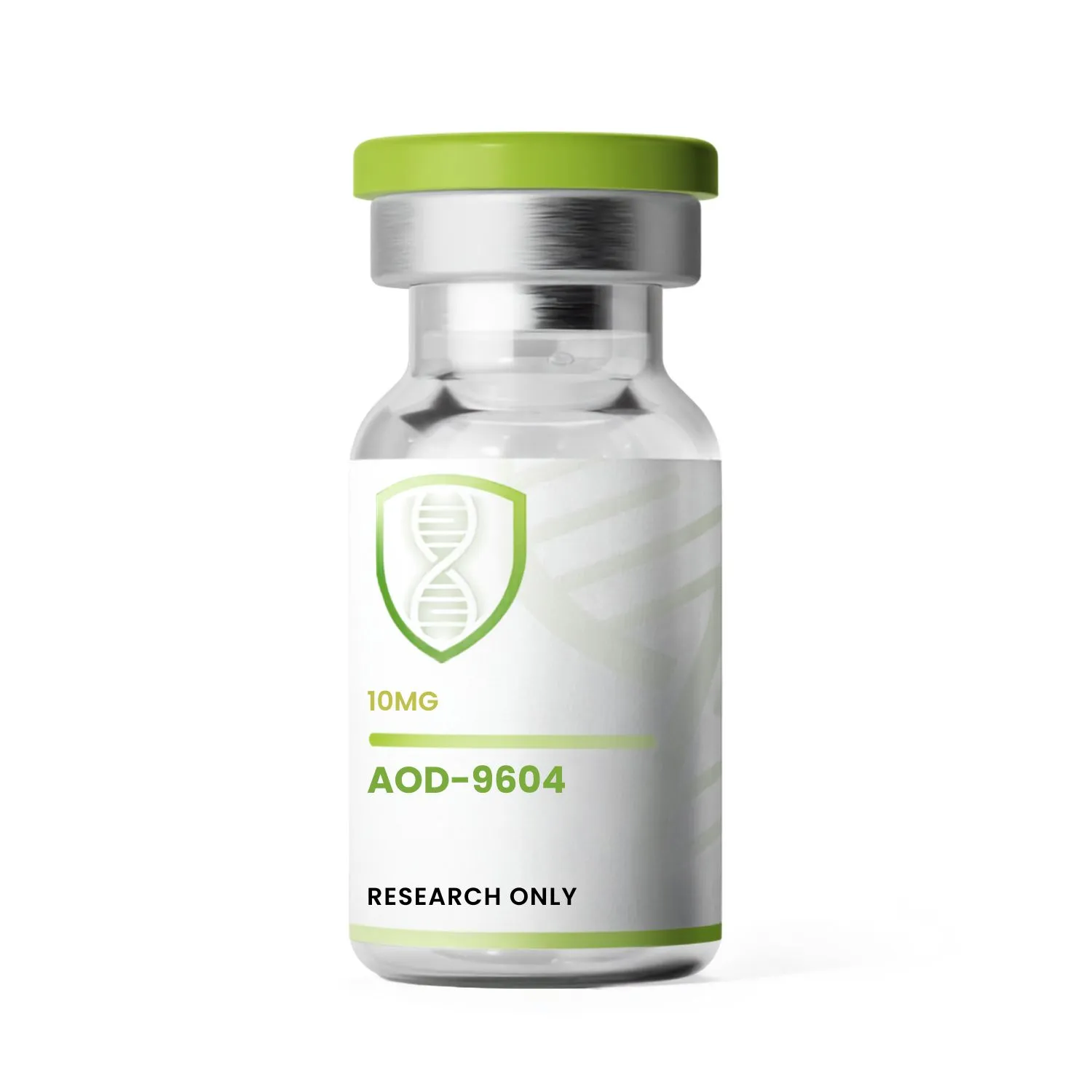
Buy AOD-9604 10mg
AOD-9604 is an artificial fragment of the growth hormone C-terminal peptide. It comprises residues 177–191 of growth hormone with an additional tyrosine at the N-terminus. Researchers use it in laboratory studies of fat metabolism under controlled conditions. The peptide promotes lipolysis without influencing broader growth hormone effects such as IGF-1 stimulation.
Research background: AOD-9604 research profile · AOD-9604 vs Tesamorelin · AOD-9604 vs MOTS-C
This selective activity enables researchers to study lipid degradation and fat-store management without extensive hormonal effects. AOD-9604 is supplied as a lyophilized powder, stable and suitable for precise experimental use. Its structure resists degradation, supporting longer laboratory procedures.
Preclinical research focuses on metabolism, cartilage signaling, and obesity models. All studies are restricted to laboratory and research environments.
AOD-9604 Molecular Formula
AOD-9604 is a 16-amino-acid peptide with a disulfide bridge and the molecular formula C78H123N23O23S2, with a molecular weight of approximately 1815.1 daltons. The cyclic disulfide bond increases stability in laboratory conditions, ensuring consistent results in fat metabolism studies.
What is AOD-9604 10 MG?
The 10 mg vial contains high-purity lyophilized powder for laboratory research. It is suitable for extended or high-volume experiments, including multi-phase studies in cell cultures or animal models of fat metabolism.
This larger supply reduces the need for reordering and supports multi-phase research protocols. The 10 mg vial is freeze-dried for stability and can be reconstituted with bacteriostatic water to produce a clear solution for in vitro or preclinical use.
Structural Profile of AOD-9604
AOD-9604 consists of the sequence:
Tyr-Leu-Arg-Ile-Val-Gln-Cys-Arg-Ser-Val-Glu-Gly-Ser-Cys-Gly-Phe
The two cysteine residues form a disulfide bond, creating a cyclic structure that enhances stability. This design mirrors the lipolytic region of growth hormone while avoiding broader growth-promoting effects.
Its compact size resists enzymatic degradation, making it suitable for long-duration laboratory studies of fat metabolism.
Laboratory Research on AOD-9604
AOD-9604 is primarily studied in preclinical models to investigate fat metabolism. In obese rodent models, it promotes lipolysis by breaking down stored fats into free fatty acids without stimulating growth hormone pathways such as IGF-1.
Cell culture studies show stimulation of beta-3 adrenergic receptors in adipocytes, increasing fat oxidation while inhibiting lipogenesis through acetyl CoA carboxylase blockade. Other research explores cartilage support, maintaining joint matrix and reducing degradation markers in osteoarthritis models.
Peptide Interaction in Laboratory Studies
AOD-9604 interacts with adipose cells to promote fat breakdown without activating full growth hormone receptor pathways. Beta-oxidation and beta-3 adrenergic signaling are selectively stimulated, enabling detailed studies of lipid metabolism and energy regulation.
Production Methodology & Quality Controls
AOD-9604 is synthesized using solid-phase peptide synthesis. Amino acids are sequentially added to resin, followed by cleavage, controlled oxidation to form the disulfide bond, and purification.
Each batch is verified with HPLC for >99% purity and mass spectrometry to confirm molecular identity. Additional tests ensure proper composition and absence of solvents or toxic residues.
Synthesis & Batch Standards
Batches undergo rigorous quality controls, including HPLC and mass spectrometry, to ensure research-grade consistency. Endotoxins and solvents are checked to guarantee safe and reliable laboratory experiments.
Storing AOD-9604
Store lyophilized AOD-9604 vials at -20°C for long-term stability. Protect from light and moisture using original packaging or opaque containers. Short-term storage at room temperature is acceptable for a few weeks without significant quality loss.
After reconstitution with bacteriostatic water or a suitable solvent, store at 2–8°C and use within a limited timeframe. Avoid repeated freeze–thaw cycles to maintain stability and ensure reproducible experimental results.
Regulatory and Safety Disclaimer
AOD-9604 5mg supplied by Orion Peptides is intended strictly for laboratory research and scientific investigation. This compound is not intended for human or animal consumption, diagnostic procedures, self-administration, or therapeutic applications.
AOD-9604 is not an FDA-approved drug. Its safety and effectiveness for human use have not been established. The FDA has identified potential safety concerns, including immunogenicity, peptide-related impurities, and limited clinical safety information.
All research materials must be handled by qualified personnel following applicable laws, institutional safety standards, and established laboratory protocols. Orion Peptides does not make claims regarding the safety, effectiveness, or suitability of AOD-9604 for clinical or personal use.
Reference Studies:
- The effects of human GH and its lipolytic fragment (AOD9604) on lipid metabolism following chronic treatment in obese mice and beta(3)-AR knock-out mice
- Increase of fat oxidation and weight loss in obese mice caused by chronic treatment with human growth hormone or a modified C-terminal fragment