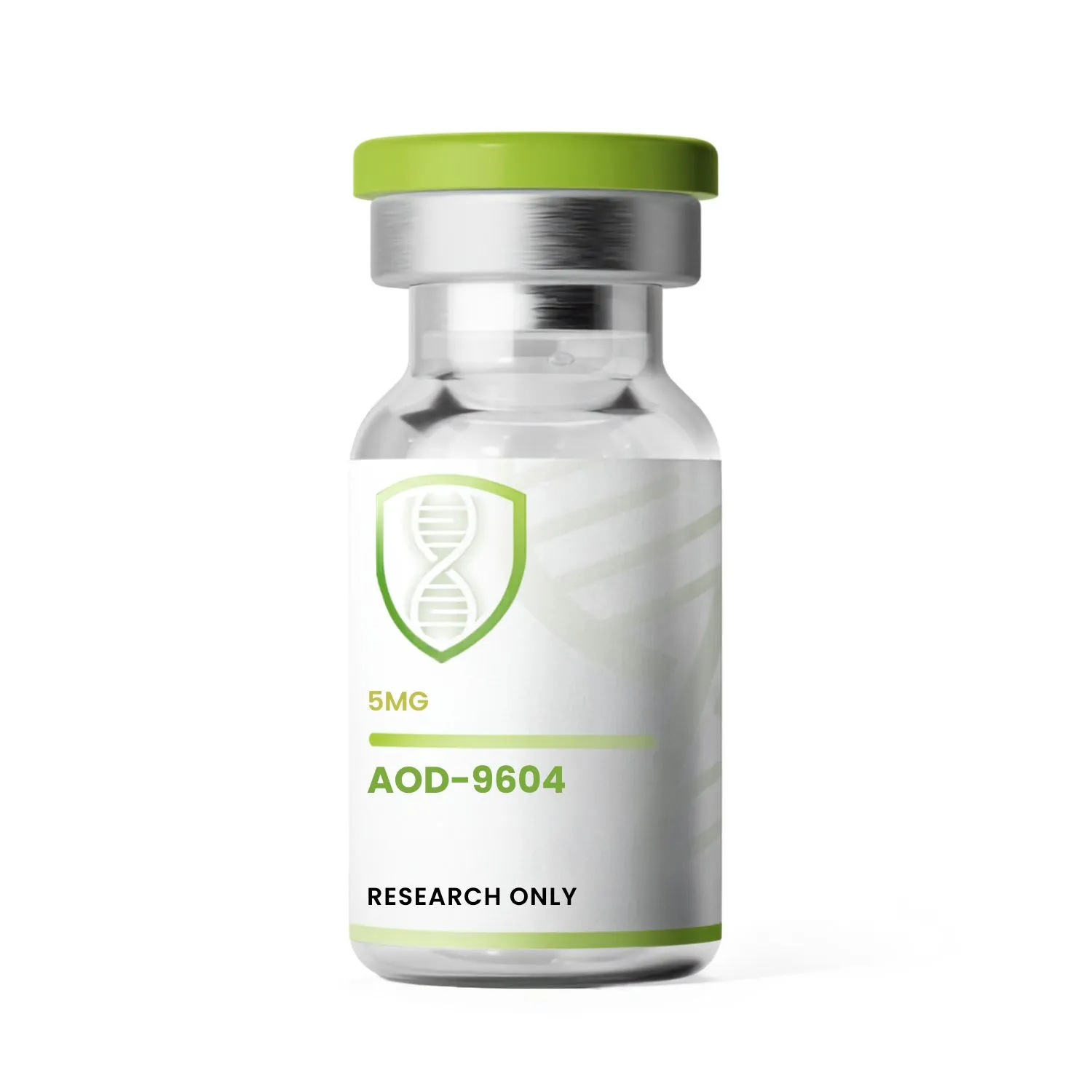
Buy AOD-9604 5mg
AOD-9604 5mg is a synthetic peptide derived from the C-terminal region of human growth hormone (hGH). It contains 16 amino acids and has been studied for its role in lipid metabolism, fat oxidation, and cellular signaling.
Research background: AOD-9604 research profile · AOD-9604 vs Tesamorelin · AOD-9604 vs MOTS-C
AOD-9604 is also known as a modified human growth hormone fragment. Researchers use it to investigate how certain regions of growth hormone interact with metabolic processes.
Orion Peptides supplies AOD-9604 5mg for laboratory and scientific research only. It is not intended for human consumption, personal use, or therapeutic applications.
What Is AOD-9604 Peptide?
AOD-9604 stands for Anti-Obesity Drug 9604. It was developed as a modified fragment of human growth hormone.
Human growth hormone is a protein made up of 191 amino acids. AOD-9604 contains a much smaller section of that protein, with an added tyrosine residue at the beginning of its sequence.
Scientists developed this peptide to study whether the metabolic activity of growth hormone could be separated from its effects on growth and cell proliferation.
Early laboratory studies examined its relationship with fat breakdown, energy metabolism, and beta-adrenergic signaling.
In a 2001 study published in Endocrinology, researchers investigated AOD-9604 in obese mice and found changes in lipid metabolism and beta-3 adrenergic receptor expression. These findings were specific to the experimental models and do not establish effectiveness in humans.
AOD-9604 Chemical Properties and Molecular Structure
AOD-9604 contains 16 amino acids. Its structure includes a disulfide bond between two cysteine residues, which forms a ring within the peptide chain.
| Property | Information |
| Compound Name | AOD-9604 |
| Alternative Names | AOD9604, Tyr-hGH (177-191) |
| CAS Number | 221231-10-3 |
| Molecular Formula | C₇₈H₁₂₃N₂₃O₂₃S₂ |
| Molecular Weight | 1815.1 g/mol |
| PubChem CID | 71300630 |
| Amino Acid Length | 16 amino acids |
| One-Letter Sequence | YLRIVQCRSVEGSCGF |
| Peptide Classification | Synthetic hGH fragment analog |
| Peptide Structure | Disulfide-bridged peptide |
| Disulfide Bond | Cys⁷–Cys¹⁴ |
| Research Applications | Lipid metabolism, metabolic signaling, and fat oxidation |
| Compound Size | 5mg |
The molecular formula, sequence, molecular weight, and PubChem identifier are documented in the PubChem AOD-9604 record.
How Does AOD-9604 Work in Laboratory Research?
AOD-9604 has been studied for its effects on lipid metabolism and related cellular pathways.
Researchers have examined its ability to influence fat breakdown in experimental models.
1. Lipid Metabolism
Lipid metabolism is the process through which cells store, break down, and use fats.
Early research investigated how AOD-9604 interacts with these processes.
A study published in the International Journal of Obesity in 2001 reported increased fat oxidation and changes in lipid metabolism in obese mice exposed to AOD-9604.
The same study found that AOD-9604 did not bind to the growth hormone receptor in the cell model used by the researchers.
These results help explain why researchers continue to study the relationship between growth hormone fragments and metabolic pathways.
2. Beta-Adrenergic Signaling
Beta-adrenergic receptors are involved in metabolic regulation and cellular responses to certain signaling molecules.
AOD-9604 has been investigated for its effects on beta-3 adrenergic receptor expression.
A 2001 animal study found that AOD-9604 influenced beta-3 receptor expression in obese mice. However, the researchers also found that its lipid-related activity was not directly dependent on these receptors.
This suggests that additional signaling mechanisms may be involved.
3. Fat Oxidation Research
Fat oxidation is the process through which fatty acids are broken down to produce energy.
Researchers have examined whether AOD-9604 can influence this process under controlled experimental conditions.
Preclinical studies reported changes in fat oxidation and energy metabolism following exposure to AOD-9604. However, these findings do not establish that the peptide produces the same effects in humans.
Research Applications of AOD-9604 5mg
AOD-9604 is used as an experimental compound in several areas of peptide research.
| Research Area | What Researchers Study |
| Lipid Metabolism | How the peptide interacts with fat metabolism pathways |
| Fat Oxidation | Changes in fatty acid use in experimental models |
| Cellular Signaling | Interactions with metabolic signaling pathways |
| Growth Hormone Fragments | Biological differences between full-length hGH and modified peptide fragments |
| Beta-Adrenergic Receptors | Changes in receptor expression and related cellular activity |
| Peptide Structure | The relationship between peptide sequence, molecular structure, and biological activity |
These are research areas, not established therapeutic benefits.
What Do Scientific Studies Say About AOD-9604?
AOD-9604 has been examined in animal experiments and human clinical research.
Early animal studies reported metabolic changes, including increased fat oxidation and changes in body weight.
A 2013 publication reviewed safety data from six randomized human trials involving approximately 900 participants. The authors reported that AOD-9604 did not significantly affect IGF-1 levels or glucose metabolism in those studies.
However, these findings do not establish long-term safety or clinical effectiveness. The FDA has also identified limitations in the available safety evidence and potential risks associated with AOD-9604, including immunogenicity and peptide-related impurities.
AOD-9604 remains a compound of research interest, and its potential clinical applications have not been established.
AOD-9604 5mg Storage and Handling
Peptides can be affected by heat, moisture, light, and repeated changes in temperature.
Proper laboratory storage helps protect the physical and chemical integrity of research materials.
General handling considerations include:
-
Store the lyophilized peptide according to the manufacturer’s instructions.
-
Keep the vial tightly sealed when not in use.
-
Protect the material from excessive heat, direct sunlight, and moisture.
-
Avoid unnecessary temperature changes.
-
Check the compound’s COA and stability documentation before selecting storage conditions.
-
Use appropriate laboratory safety equipment when handling research peptides.
Storage requirements may differ depending on the peptide’s salt form, formulation, and packaging. Researchers should follow the batch-specific instructions provided by the supplier.
AOD-9604 5mg Quality and Research Documentation
When purchasing AOD-9604 5mg for laboratory research, researchers should review the compound’s identity, purity, and available testing documentation.
Orion Peptides provides research-grade peptides for scientific and laboratory applications.
Researchers should verify the following information before purchasing:
-
Peptide identity and molecular specifications
-
Batch-specific purity results
-
Third-party testing documentation, where available
-
Certificate of Analysis (COA)
-
Compound quantity and labeling
-
Recommended storage conditions
A stated purity percentage should be supported by actual batch testing. Purity also does not establish sterility, safety, or suitability for human use.
Frequently Asked Questions About AOD-9604 5mg
What is AOD-9604 5mg?
AOD-9604 5mg is a research peptide containing 5 milligrams of a synthetic human growth hormone fragment analog. It is studied in laboratory settings for its relationship with lipid metabolism and metabolic signaling.
How many amino acids are in AOD-9604?
AOD-9604 contains 16 amino acids. Its sequence is YLRIVQCRSVEGSCGF, with a disulfide bond between cysteine residues 7 and 14.
Is AOD-9604 the same as human growth hormone?
No. AOD-9604 is a modified fragment derived from a small region of human growth hormone. It is not the same compound as full-length hGH.
What is the molecular weight of AOD-9604?
The molecular weight of the parent AOD-9604 peptide is approximately 1815.1 g/mol.
Does AOD-9604 have a Certificate of Analysis?
Researchers should request the batch-specific Certificate of Analysis from Orion Peptides to confirm compound identity, purity, and testing results.
Is AOD-9604 FDA-approved?
No. AOD-9604 is not an FDA-approved drug. The FDA has raised safety concerns regarding its use in compounded drug compounds, including potential immune reactions and insufficient safety data.
Can AOD-9604 be used for human consumption?
No. AOD-9604 5mg supplied by Orion Peptides is intended strictly for laboratory research. It is not sold for human or animal consumption, self-administration, or therapeutic use.
Regulatory and Safety Disclaimer
AOD-9604 5mg supplied by Orion Peptides is intended strictly for laboratory research and scientific investigation.
This compound is not intended for human or animal consumption, diagnostic procedures, self-administration, or therapeutic applications.
AOD-9604 is not an FDA-approved drug. Its safety and effectiveness for human use have not been established. The FDA has identified potential safety concerns, including immunogenicity, peptide-related impurities, and limited clinical safety information.
All research materials must be handled by qualified personnel following applicable laws, institutional safety standards, and established laboratory protocols.
Orion Peptides does not make claims regarding the safety, effectiveness, or suitability of AOD-9604 for clinical or personal use.
Scientific References
1. Heffernan MA et al. (2001). The effects of human GH and its lipolytic fragment (AOD9604) on lipid metabolism following chronic treatment in obese mice and beta(3)-AR knock-out mice. Endocrinology. Read research paper.
2. Heffernan MA et al. (2001). Increase of fat oxidation and weight loss in obese mice caused by chronic treatment with human growth hormone or a modified C-terminal fragment. International Journal of Obesity. Read research paper.
3. Ng FM et al. (2000). Metabolic studies of a synthetic lipolytic domain (AOD9604) of human growth hormone. Read research paper.
4. Stier H, Vos E, Kenley D. (2013). Safety and Tolerability of the Hexadecapeptide AOD9604 in Humans. Journal of Endocrinology and Metabolism. Read research paper.
5. PubChem. AOD-9604 Chemical Structure and Properties, CID 71300630. View chemical data.
6. U.S. FDA. Certain Bulk Drug Substances for Use in Compounding That May Present Significant Safety Risks. Read FDA safety information.