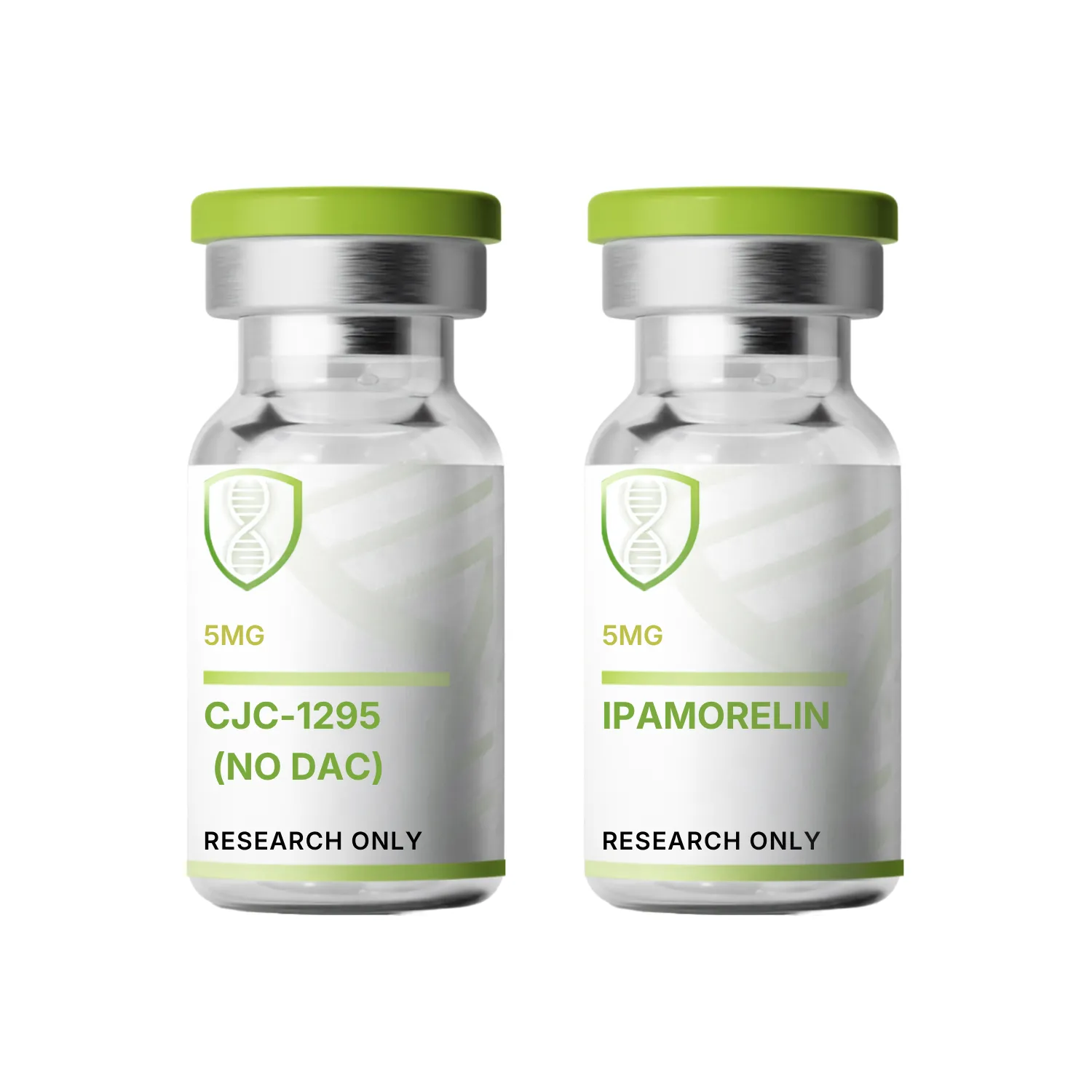
Buy CJC-1295 No DAC (5mg) + Ipamorelin (5mg) Blend
CJC-1295 No DAC (5mg) + Ipamorelin (5mg) is a research peptide blend containing two synthetic peptides investigated for their interactions with different components of the growth hormone signaling system. The formulation combines CJC-1295 without Drug Affinity Complex (DAC), also known as Modified GRF (1-29), with Ipamorelin, a synthetic pentapeptide studied as a growth hormone secretagogue. The two compounds are associated with distinct receptor pathways. CJC-1295 No DAC is a synthetic analogue of growth hormone-releasing hormone (GHRH), while Ipamorelin has been investigated for its interaction with the growth hormone secretagogue receptor (GHS-R1a). The 5mg/5mg formulation provides an equal-mass blend of both compounds in one lyophilized preparation. Orion Peptides provides this 10mg research formulation with compound specifications and available analytical documentation for laboratory evaluation.
CJC-1295 No DAC + Ipamorelin Blend Specifications
| Property | Specification |
| Compound name | CJC-1295 No DAC + Ipamorelin Blend |
| Total compound quantity | 10mg |
| CJC-1295 No DAC quantity | 5mg |
| Ipamorelin quantity | 5mg |
| Composition ratio | 1:1 by labeled mass |
| CJC-1295 classification | Synthetic GHRH analogue |
| Ipamorelin classification | Synthetic pentapeptide |
| CJC-1295 alternative name | Modified GRF (1-29) |
| Ipamorelin alternative name | NNC 26-0161 |
| Physical format | Lyophilized peptide blend |
| Salt form | Listed as acetate form; confirm against batch documentation |
| Analytical documentation | COA available |
| Intended application | Laboratory research only |
What Is CJC-1295 No DAC?
CJC-1295 No DAC, commonly known as Modified GRF (1-29) or Mod GRF 1-29, is a synthetic 29-amino-acid analogue of growth hormone-releasing hormone. It is structurally related to the first 29 amino acids of endogenous GHRH, with four amino acid substitutions that distinguish it from the original peptide. These substitutions include:
- D-Alanine at position 2.
- Glutamine at position 8.
- Alanine at position 15.
- Leucine at position 27.
The modified structure is investigated in relation to peptide stability and interactions with the GHRH receptor.
CJC-1295 No DAC Molecular Properties
| Property | Specification |
| Compound name | CJC-1295 No DAC |
| Alternative name | Modified GRF (1-29) |
| Peptide length | 29 amino acids |
| Molecular formula | C₁₅₂H₂₅₂N₄₄O₄₂ |
| Average molecular weight | Approximately 3,367.9 g/mol |
| Monoisotopic mass | Approximately 3,365.8936 Da |
| PubChem CID | 91976842 |
| Structure | Linear peptide |
| C-terminal modification | Amidated |
Reference:
PubChem – CJC-1295 Without DAC. The values above describe the reference peptide structure. The acetate salt form has additional counterion mass and must be distinguished from the free-base molecular specifications.
What Is Ipamorelin?
Ipamorelin is a synthetic pentapeptide originally developed by researchers at Novo Nordisk. It belongs to the growth hormone secretagogue class of compounds and has been investigated for its interaction with the growth hormone secretagogue receptor, also known as GHS-R1a. Unlike GHRH analogues, Ipamorelin is associated with the ghrelin-receptor signaling pathway. Its five-residue amino acid sequence is:
Aib-His-D-2-Nal-D-Phe-Lys-NH₂ The sequence includes:
- Aib: 2-Aminoisobutyric acid
- His: Histidine
- D-2-Nal: D-2-Naphthylalanine
- D-Phe: D-Phenylalanine
- Lys: Lysine
Ipamorelin Molecular Properties
| Property | Specification |
| Compound name | Ipamorelin |
| Alternative identifier | NNC 26-0161 |
| Peptide length | 5 amino acids |
| Molecular formula | C₃₈H₄₉N₉O₅ |
| Average molecular weight | Approximately 711.9 g/mol |
| CAS number | 170851-70-4 (free-base reference) |
| PubChem CID | 9831659 |
| Amino acid sequence | Aib-His-D-2-Nal-D-Phe-Lys-NH₂ |
| Peptide classification | Synthetic pentapeptide |
Reference:
PubChem – Ipamorelin. As with CJC-1295 No DAC, these specifications describe the parent peptide rather than automatically establishing the exact molecular mass of its supplied salt form.
Understanding the Two Different Signaling Pathways
One reason CJC-1295 No DAC and Ipamorelin are investigated together is that they are associated with different components of growth hormone regulation. Understanding these pathways provides useful scientific context for evaluating the formulation.
1. Growth Hormone-Releasing Hormone Receptor
CJC-1295 No DAC is a synthetic GHRH analogue. GHRH is an endogenous signaling molecule involved in regulating growth hormone secretion through receptors expressed in the anterior pituitary. The GHRH receptor belongs to the G-protein-coupled receptor family. Its activation is associated with intracellular signaling involving cyclic adenosine monophosphate (cAMP) and protein kinase A (PKA). Researchers investigate this pathway to understand the regulation of growth hormone synthesis and secretion.
2. Growth Hormone Secretagogue Receptor
Ipamorelin has been investigated as an agonist of GHS-R1a, a receptor associated with ghrelin signaling. GHS-R1a is another G-protein-coupled receptor involved in the regulation of growth hormone secretion. Research into Ipamorelin has examined receptor selectivity, peptide structure, and its activity in experimental systems. The distinction between these receptor pathways provides a scientific basis for investigating the two compounds separately and examining their potential interactions. Importantly, different receptor pathways do not automatically establish that a combined formulation produces synergistic effects or superior biological outcomes.
Scientific Research on CJC-1295 and Ipamorelin
Both peptides have appeared in published scientific literature. However, the available evidence must be evaluated separately for each compound. Research involving CJC-1295 with DAC should not be confused with research involving Modified GRF (1-29), and findings involving Ipamorelin alone should not be presented as proof of the efficacy of the combined formulation.
1. Research on Ipamorelin as a Selective Growth Hormone Secretagogue
A foundational study was published in 1998 by Raun and colleagues in the
European Journal of Endocrinology. The paper, titled “Ipamorelin, the First Selective Growth Hormone Secretagogue,” examined the pharmacological characteristics of Ipamorelin. The researchers investigated its activity in experimental systems and evaluated its selectivity in comparison with other growth hormone secretagogues. The study helped establish the scientific background for understanding Ipamorelin as a distinct synthetic peptide.
Original research paper: Ipamorelin, the First Selective Growth Hormone Secretagogue (1998) 2. Development of Ipamorelin-Derived Peptides
Another important paper was published by Ankersen and colleagues in 1998. The study, “A New Series of Highly Potent Growth Hormone-Releasing Peptides Derived from Ipamorelin,” investigated the chemical development and pharmacological properties of related synthetic compounds. The research provides additional information about peptide structure, medicinal chemistry, and the development of growth hormone-releasing peptide analogues.
Original research paper: A New Series of Highly Potent Growth Hormone-Releasing Peptides Derived from Ipamorelin (1998) 3. Human Research on CJC-1295
A frequently cited CJC-1295 investigation was published in 2006 by Teichman and colleagues in the
Journal of Clinical Endocrinology and Metabolism. The study evaluated a long-acting GHRH analogue in healthy adults and investigated its pharmacokinetic and pharmacodynamic characteristics. The researchers reported changes in circulating growth hormone and insulin-like growth factor 1 (IGF-1) measurements following administration. However, this investigation used the DAC-modified CJC-1295 compound. It should therefore not be treated as direct human clinical evidence for CJC-1295 No DAC or Modified GRF (1-29).
Original research paper: Prolonged Stimulation of Growth Hormone and IGF-I Secretion by CJC-1295 in Healthy Adults (2006) 4. Investigation of Growth Hormone Secretion Patterns
Ionescu and Frohman published another investigation in 2006 examining growth hormone secretion patterns during stimulation with CJC-1295. The study assessed hormonal measurements in healthy adult participants and examined whether pulsatile growth hormone secretion persisted following administration. The research reported that pulsatile secretion remained present during the observed hormonal response. As with the previous investigation, the compound was the long-acting DAC-modified form. Consequently, the findings provide background on GHRH analogue research but do not establish the pharmacological characteristics of the no-DAC formulation.
Original research paper: Pulsatile Secretion of Growth Hormone Persists During Continuous Stimulation by CJC-1295 (2006) 5. Human Investigation of Ipamorelin in Postoperative Ileus
Ipamorelin has also been investigated in a clinical setting unrelated to growth hormone deficiency. A 2014 Phase 2 study examined the ghrelin-receptor agonist in patients undergoing bowel resection, focusing on postoperative ileus and gastrointestinal motility. The investigation used a randomized, double-blind, placebo-controlled design. The study provides an example of how Ipamorelin has been investigated in human research, but it does not establish the effectiveness of Ipamorelin for growth hormone-related outcomes or demonstrate the effectiveness of the CJC-1295/Ipamorelin blend.
Original research paper: Prospective, Randomized, Controlled, Proof-of-Concept Study of Ipamorelin for Postoperative Ileus (2014) Has the CJC-1295 No DAC + Ipamorelin Combination Been Studied in Humans?
An important distinction must be made between studies of the individual compounds and research involving the exact combination. The available literature includes investigations of Ipamorelin independently and human studies of DAC-modified CJC-1295. However, a published controlled human clinical trial specifically evaluating the CJC-1295 No DAC + Ipamorelin 5mg/5mg blend has not been identified in the literature reviewed for this compound description. Therefore, claims that this exact combination has demonstrated clinical synergy, improved body composition, enhanced recovery, or superior hormonal outcomes would go beyond the available evidence. The blend is best described through its individual peptide identities, chemical properties, and associated research pathways.
CJC-1295 No DAC vs. CJC-1295 With DAC
These two names are frequently used interchangeably in commercial peptide discussions, but they refer to different molecular configurations. The Drug Affinity Complex (DAC) is an additional structural modification associated with albumin binding.
| Characteristic | CJC-1295 No DAC | CJC-1295 With DAC |
| Alternative name | Modified GRF (1-29) | DAC-modified CJC-1295 |
| Structural modification | No DAC component | Contains DAC modification |
| Albumin-binding modification | Absent | Present |
| Molecular configuration | 29-amino-acid analogue | DAC-modified analogue |
| Human research | Limited direct evidence | Published human studies available |
| Research focus | GHRH-related signaling | Extended GHRH analogue activity |
The distinction is particularly important when interpreting published studies or comparing analytical results from different peptide preparations. For further chemical information, researchers can consult the
PubChem CJC-1295 No DAC record and the relevant FDA evaluation documents.
Analytical Testing and Certificate of Analysis
A Certificate of Analysis (COA) is an important document for evaluating the stated identity and analytical characteristics of a research peptide preparation. For a two-component blend, the analytical documentation should identify both peptide components rather than simply report a combined purity figure. Relevant analytical information may include:
- Identification of CJC-1295 No DAC.
- Identification of Ipamorelin.
- HPLC purity results and analytical methodology.
- Mass spectrometry results for both components.
- Quantity or content assay for each peptide.
- Batch or lot identification.
- Endotoxin results, where tested.
- Sterility results, where tested.
HPLC and mass spectrometry provide different types of analytical information. HPLC can help assess chromatographic purity, while mass spectrometry can support molecular identity through mass measurements. A reported purity percentage does not independently establish the quantity of each peptide, sterility, or the absence of all impurities. Researchers should consult the actual batch documentation when evaluating these properties. View the available
Orion Peptides COA verification documentation.
Frequently Asked Questions
What is CJC-1295 No DAC + Ipamorelin?
It is a research peptide blend containing two synthetic peptides: CJC-1295 without DAC, also known as Modified GRF (1-29), and Ipamorelin.
What does 5mg/5mg mean?
The formulation contains a labeled 5mg quantity of CJC-1295 No DAC and 5mg of Ipamorelin, giving a combined labeled quantity of 10mg.
What is the difference between CJC-1295 No DAC and CJC-1295 With DAC?
The DAC version contains an additional Drug Affinity Complex modification associated with albumin binding. The no-DAC version is also known as Modified GRF (1-29).
What is the molecular weight of CJC-1295 No DAC?
The reference free-base molecular weight is approximately 3,367.9 g/mol.
What is the molecular weight of Ipamorelin?
The reference free-base molecular weight of Ipamorelin is approximately 711.9 g/mol.
Do CJC-1295 and Ipamorelin activate the same receptor?
No. CJC-1295 No DAC is a GHRH analogue associated with GHRH receptor signaling, whereas Ipamorelin has been investigated as an agonist of the GHS-R1a receptor.
Has the exact blend been clinically tested?
A published controlled human clinical trial evaluating this exact CJC-1295 No DAC and Ipamorelin combination has not been identified in the literature reviewed here.
Is the blend FDA-approved?
No. The combination is not an FDA-approved medicine. The FDA has separately identified safety and characterization concerns relating to CJC-1295 and Ipamorelin-related bulk drug substances in the context of pharmacy compounding.
Where can I find the Certificate of Analysis?
Researchers can review available documentation through the
Orion Peptides COA verification page. Batch-specific results should be matched to the relevant compound and lot.
Is this compound intended for human consumption?
No. The compound is supplied strictly for laboratory research. It is not intended for human or veterinary consumption, self-administration, diagnosis, or therapeutic applications.
Research Use Only Disclaimer
CJC-1295 No DAC (5mg) + Ipamorelin (5mg) is supplied exclusively for laboratory research and scientific investigation. The compound is not intended for human or veterinary consumption, self-administration, diagnosis, or therapeutic use. Published research involving individual peptides or related molecular compounds should not be interpreted as evidence of clinical efficacy or safety for this specific blend. All research findings should be interpreted according to the experimental model, compound identity, and limitations of the underlying scientific study.