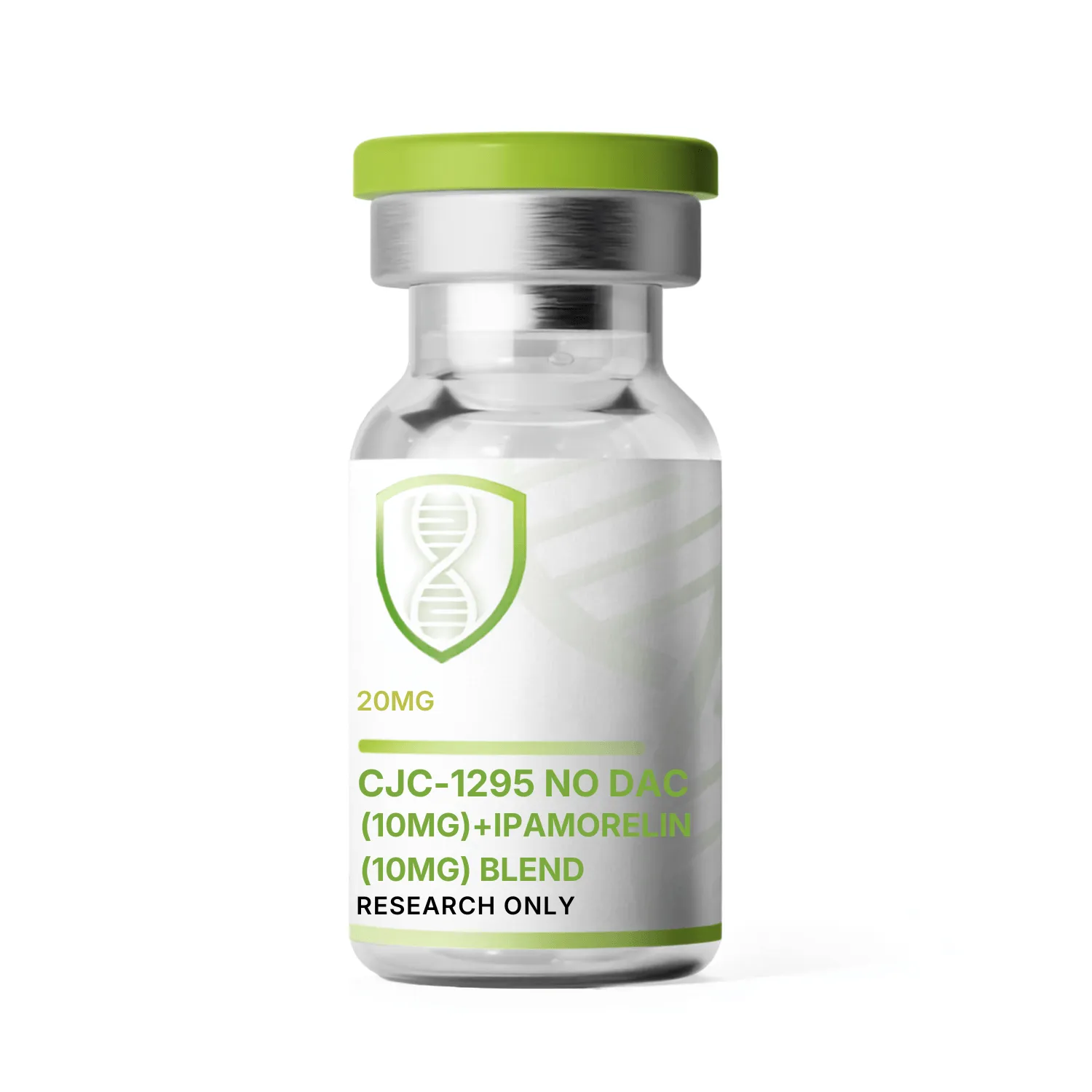
CJC-1295 No DAC (10mg) + Ipamorelin Blend (10mg)
CJC-1295 No DAC (10mg) + Ipamorelin Blend (10mg) adds two well-researched growth hormone secretagogues in an equal ratio, i.e., 1:1. CJC-1295 (no DAC) (Mod GRF 1-29) works as a short-acting GHRH analog, while Ipamorelin acts as a selective ghrelin mimetic and GHS-R agonist.
Research background: CJC-1295 No DAC research profile
Together, in laboratory models, they assist the research of synergistic GH release mechanisms, pulsatile secretion patterns, and downstream IGF-1 signaling.
This pre-mixed format simplifies reconstitution and dosing for in vitro assays, cell culture experiments, or small-animal protocols.
The blend is intended exclusively for in vitro and in vivo laboratory research. It is not for human consumption, therapeutic use, or any non-research application.
For research use only. Strictly not for human consumption.
Biochemical Characteristics
CJC-1295 No DAC (Mod GRF 1-29) is a 29-amino-acid GHRH analog with four substitutions (D-Ala², Gln⁸, Ala¹⁵, Leu²⁷) for enhanced stability and receptor affinity.
Molecular weight: ≈3367 Da.
Half-Time: ~30 minutes.
Ipamorelin is a pentapeptide ghrelin mimetic (Aib-His-D-2-Nal-D-Phe-Lys-NH₂).
Molecular weight: 711.85 Da. Half-life: ~2 hours.
The blend is provided as a single lyophilized powder having equal parts of the two peptides in acetate salt form.
This combination enables researchers to study complementary pathways: GHRH receptor activation plus selective GHS-R stimulation, with minimal off-target effects on prolactin, cortisol, or ACTH.
Research Application
The CJC-1295 ((No DAC) + Ipamorelin blend is used in endocrine, metabolic, and aging research to:
-
Examine synergistic amplification of pulsatile GH secretion
-
Investigate IGF-1 axis dynamics and downstream anabolic/catabolic balance
-
Model natural GH regularity without prolonged receptor desensitization
-
Investigate particular secretagogue consequences on body composition, lipolysis, and protein formation in cellular/animal systems
-
Estimate possible neuroprotective, regenerative, or anti-inflammatory outcomes associated with GH/IGF-1 signaling
-
In multi-dose experiments or comparative protocols, the pre-blended 20mg/20mg composition helps an effective workflow.
Mechanism of Action
G_s-protein-coupled pathways are activated when CJC-1295 (No DAC) binds to pituitary GHRH receptors.
This trigers pulsatile GH transcription and release from somatotrophs, increases cyclic AMP, and activates protein kinase A.
Its brief half-life (about 30 minutes) avoids constant stimulation by imitating physiological GHRH pulses.
The ghrelin receptor (GHS-R1a) on pituitary and hypothalamic neurons is specifically activated by ipamorelin. Through intracellular calcium mobilization, phospholipase C, and G_q-protein signaling, this causes a fast GH pulse.
The selectivity of ipamorelin reduces spillover to the prolactin, cortisol, or ACTH pathways.
Ipamorelin brings extra pulse frequency and selectivity, while CJC-1295 No DAC increases GH pulse amplitude and duration.
Investigations into additive or supra-additive effects on GH/IGF-1 output, metabolic rate, and tissue responses in controlled models are facilitated by the combination.
Preclinical Research Summary
Preclinical and early clinical literature on the CJC-1295 No DAC + Ipamorelin combination highlights enhanced GH secretion profiles.
In vitro pituitary cell studies show the blend increases GH release more than either peptide alone.
Co-administration increases peak GH and IGF-1 levels in rodent models while maintaining pulsatile patterns. Studies show that animals have been explored in preclinical models for their potential effects on improving lean mass accrual, the potential to help in fat oxidation, and recovery markers.
Because CJC-1295 (No DAC) is short-acting, it avoids the prolonged GH elevation and possible receptor downregulation associated with DAC versions.
In comparative studies, ipamorelin’s clean profile lessens undesired endocrine side effects.
Applications in wound healing, sarcopenia models, metabolic regulation, and age-related endocrine decline are being investigated in ongoing laboratory work.
There is no widespread human approval for this blend; all data are still investigational. Form and Analytical Testing
Form: Sterile, lyophilized powder blend
Purity: ≥99% (HPLC for each component)
Identity: Confirmed by mass spectrometry
Endotoxin: <0.1 EU/μg
Solubility: Excellent in bacteriostatic water
Appearance: White to off-white cake
Storage (unopened): 2–8°C, protected from light and moisture
Reconstitution: Use sterile bacteriostatic water under aseptic conditions
Stability: Stable 24–36 months refrigerated when sealed; reconstituted stable 4–6 weeks at 2–8°C (avoid repeated freeze-thaw)
All batches undergo third-party analytical testing for purity, identity, and the presence of contaminants.
Referenced Citations
-
Teichman SL, et al. (2006). Prolonged stimulation of growth hormone (GH) and insulin-like growth factor I secretion by CJC-1295… Journal of Clinical Endocrinology & Metabolism. doi:10.1210/jc. 2005-1536.
-
Raun K, et al. (1998). Ipamorelin is the first selective growth hormone secretagogue. European Journal of Endocrinology. 139(5):552–561.
-
Sigalos JT, Pastuszak AW. (2018). The safety and efficacy of growth hormone secretagogues. Sexual Medicine Reviews. 6(1):69–78.
-
Additional sources: Supplier data (purity ≥99%, blend ratio 1:1, research-only status); preclinical synergy studies on GH pulsatility.
RUO Disclaimer
The CJC-1295 No DAC + Ipamorelin Blend (20mg) is an investigational research compound intended solely for in vitro laboratory research and in vivo animal studies. The FDA, EMA, or any regulatory authority for human therapeutic use, diagnosis, treatment, or supplementation does not approve it.
Compounds may carry risks, including immunogenicity or impurities, if mishandled. Handle only in qualified research facilities with institutional biosafety oversight. All sales are for laboratory research use only, not for human or veterinary consumption.