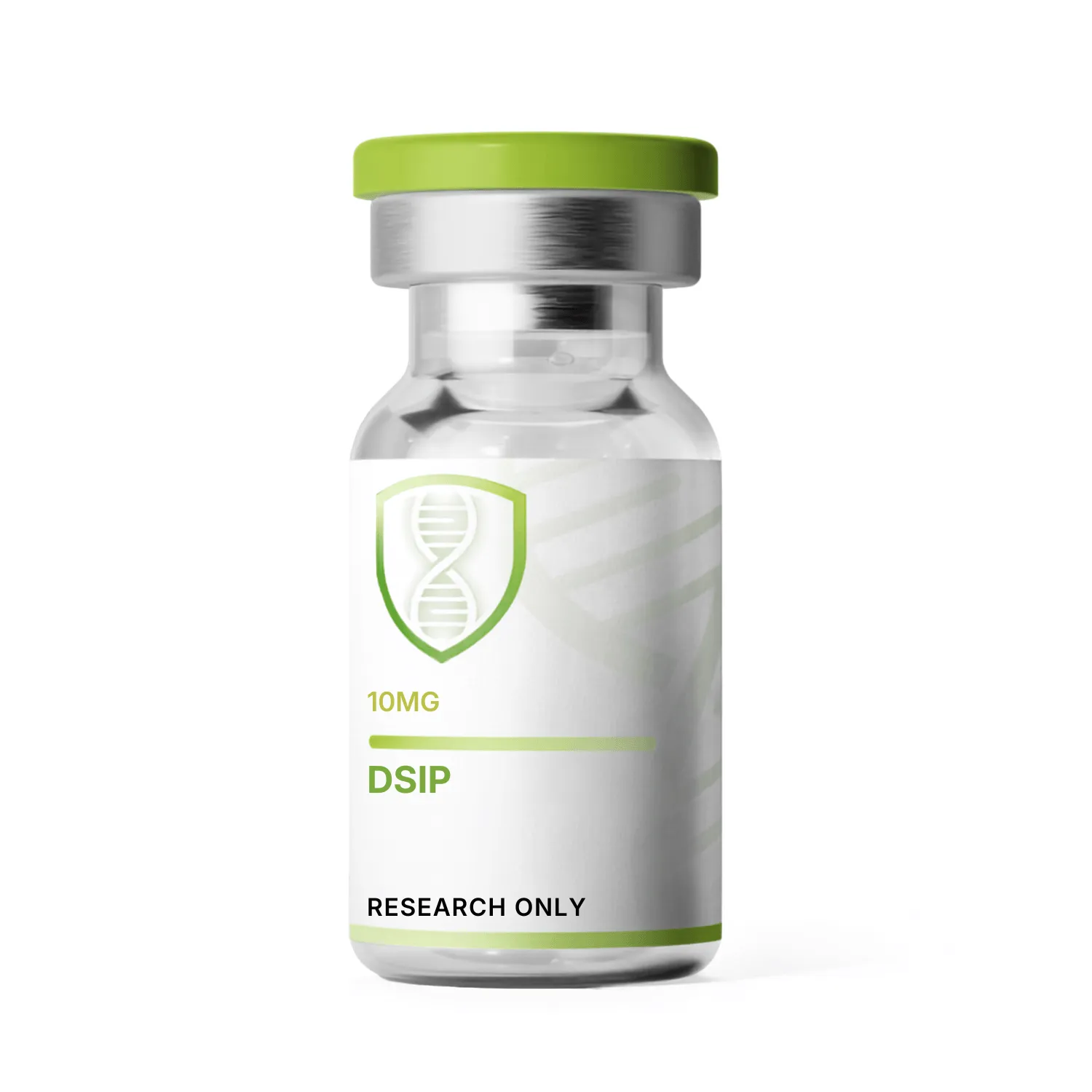
Buy DSIP (Delta Sleep-Inducing Peptide) 10mg for Laboratory Research
DSIP 10mg (Delta Sleep-Inducing Peptide), also known as Emideltide, is a synthetic nonapeptide consisting of nine amino acids. Its sequence is Trp-Ala-Gly-Gly-Asp-Ala-Ser-Gly-Glu (WAGGDASGE). Originally investigated for its relationship with slow-wave sleep and neurophysiological activity, DSIP has been the subject of scientific research since its isolation in the 1970s. Subsequent investigations have explored its relationship with sleep architecture, circadian activity, stress responses, and neuroendocrine signaling. Orion Peptides provides DSIP 10mg in lyophilized powder format for laboratory research. Researchers can review the compound’s molecular specifications and available analytical documentation when evaluating the material for experimental purposes.
DSIP 10mg compound specifications: - Compound: Delta Sleep-Inducing Peptide (DSIP)
- Alternative name: Emideltide
- Quantity: 10mg per vial
- Peptide classification: Synthetic nonapeptide
- Amino acid sequence: Trp-Ala-Gly-Gly-Asp-Ala-Ser-Gly-Glu
- One-letter sequence: WAGGDASGE
- Physical form: Lyophilized powder
- CAS number: 62568-57-4 (verify chemical form against batch documentation)
- Documentation: COA information available
- Intended use: Laboratory research only
Review COA Documentation ·
View Shipping Information What Is DSIP (Delta Sleep-Inducing Peptide)?
Delta Sleep-Inducing Peptide (DSIP) is a small neuropeptide originally isolated from rabbit cerebral venous blood in research published in 1977. The compound was identified by researchers investigating biological factors associated with delta-wave electroencephalographic (EEG) activity during sleep. DSIP is a nonapeptide, meaning its molecular structure contains nine amino acid residues arranged in a defined sequence. The original discovery attracted scientific interest because experimental administration produced changes in EEG activity in animal models. Subsequent research investigated whether the peptide was involved in sleep regulation and other physiological processes. However, its precise biological role remains unresolved. Research findings have varied across experimental models, and the proposed sleep-regulating mechanism has not been firmly established. For this reason, DSIP remains a subject of experimental neuropeptide research rather than an established sleep therapy.
DSIP 10mg Molecular Structure and Chemical Properties
DSIP, also known as Emideltide, is a linear synthetic nonapeptide with a defined nine-residue amino acid sequence. Its molecular structure is represented by:
H-Trp-Ala-Gly-Gly-Asp-Ala-Ser-Gly-Glu-OH The sequence begins with tryptophan and ends with glutamic acid. It contains no cysteine residues and therefore has no intramolecular disulfide bonds.
DSIP Chemical Specifications
| Property | Specification |
| Compound name | Delta Sleep-Inducing Peptide |
| Alternative name | Emideltide |
| Peptide classification | Synthetic nonapeptide |
| Molecular formula | C₃₅H₄₈N₁₀O₁₅ |
| Average molecular weight | Approximately 848.8 g/mol |
| Monoisotopic mass | Approximately 848.3301 Da |
| CAS number | 62568-57-4 |
| PubChem CID | 68816 |
| Amino acid length | 9 residues |
| Amino acid sequence | Trp-Ala-Gly-Gly-Asp-Ala-Ser-Gly-Glu |
| One-letter sequence | WAGGDASGE |
| Peptide structure | Linear |
| Disulfide bonds | None |
| N-terminal group | Free amino group |
| C-terminal group | Free carboxyl group |
| Compound quantity | 10mg per vial |
Chemical values refer to the parent DSIP free-base structure represented in PubChem. Acetate salt and other chemical forms have different specifications. Confirm the supplied form and batch-specific analytical data before assigning these values to a particular lot. For additional chemical information, consult
PubChem’s DSIP compound record.
What Does Scientific Research Say About DSIP?
DSIP has been investigated for several decades, particularly in relation to sleep architecture, slow-wave sleep, and neurophysiological signaling. The research history includes early animal experiments, small human investigations, and subsequent reviews evaluating the proposed biological activity of the peptide.
1. Original Discovery and Delta-Wave Activity
The original DSIP research was published in 1977 by Schoenenberger and Monnier in the
Proceedings of the National Academy of Sciences (PNAS). The researchers isolated a peptide from rabbit cerebral venous blood and investigated its effects on electroencephalographic activity. Experimental administration through intracerebroventricular infusion produced increases in slow-wave (delta) and spindle EEG activity in rabbits. The investigators identified its nine-amino-acid sequence and introduced the name Delta Sleep-Inducing Peptide. This research established the initial scientific basis for investigating DSIP in relation to sleep-related neurophysiology.
Original research: Characterization of a Delta-Electroencephalogram (Sleep)-Inducing Peptide (1977).
2. DSIP and Sleep Architecture
Early research investigated whether DSIP influenced different stages and measurements of sleep. A 1984 review by Graf and Kastin examined the available experimental literature, including findings from rabbits, rats, mice, and other animal models. The review discussed differences in sleep responses between species and reported that DSIP-related effects varied according to experimental conditions. Researchers also investigated slow-wave sleep, REM sleep, EEG patterns, and the timing of peptide administration. These findings helped establish the historical research background of DSIP, although they did not establish a consistent sleep-regulating mechanism.
Scientific review: Delta-Sleep-Inducing Peptide (DSIP): A Review (1984).
3. Human Research and Sleep Investigations
DSIP has also been examined in small human research studies. A 1981 investigation by Schneider-Helmert and colleagues examined acute and delayed effects of DSIP on sleep behavior in six healthy volunteers. The study used a double-blind crossover design and reported changes in certain sleep measurements following experimental administration. However, the very small sample size limits the generalizability of its findings.
Original research: Acute and Delayed Effects of DSIP on Human Sleep Behavior (1981). A separate 1987 investigation by Monti and colleagues examined DSIP in patients with chronic insomnia. The study compared DSIP with placebo using polysomnographic measurements. Although some sleep measurements changed during the investigation, the researchers concluded that the overall clinical significance was limited. This is an important distinction when evaluating the proposed sleep-related properties of DSIP.
Original research: Study of DSIP Efficacy in Improving Sleep on Short-Term Administration to Chronic Insomniacs (1987).
4. Neuroendocrine and Other Physiological Research
Beyond sleep architecture, DSIP has been investigated in relation to several physiological processes. Historical experimental literature has examined:
- Circadian and sleep-wake activity.
- Neurotransmitter-related processes.
- Stress-associated physiological responses.
- Hormonal signaling.
- Electrophysiological activity.
- Pain-related experimental responses.
However, these research areas involve different experimental models and should not be interpreted as established biological functions or clinical benefits. A 1988 review by Yehuda and Carasso discussed several physiological observations associated with DSIP research, including thermoregulation, cardiovascular measurements, and pain thresholds.
Scientific review: DSIP – A Tool for Investigating the Sleep Onset Mechanism (1988).
Is the Sleep-Inducing Mechanism of DSIP Established?
Despite decades of research, the precise biological mechanism associated with DSIP remains uncertain. A particularly important review was published in 2006 by Kovalzon and Strekalova in the
Journal of Neurochemistry. The authors described the relationship between DSIP and sleep as an unresolved scientific question. They highlighted several limitations, including the absence of an established DSIP gene, identified precursor protein, and confirmed receptor associated with the proposed sleep-related activity. The review also discussed findings involving DSIP analogues and the possibility that some previously observed biological activity might not be attributable to the original peptide itself. These observations demonstrate why the historical name of a peptide should not be treated as proof of a confirmed physiological mechanism.
Research review: Delta Sleep-Inducing Peptide (DSIP): A Still Unresolved Riddle (2006).
DSIP and Modern Scientific Research
Modern evaluation of DSIP requires careful consideration of the limitations of its historical research. Although early investigations reported changes in sleep-related measurements, subsequent studies produced mixed findings. Several questions remain important:
- What molecular target is responsible for the reported biological activity?
- How does DSIP interact with neurophysiological signaling systems?
- Are the reported effects reproducible across different experimental models?
- How do different chemical forms influence analytical and biological characteristics?
- What are the long-term safety and stability characteristics of the material?
A 2026 FDA briefing document also evaluated Emideltide-related bulk drug substances in the context of pharmacy compounding. The FDA review identified limitations in the available effectiveness, safety, and physical and chemical characterization data. It also discussed potential immunogenicity concerns associated with injectable formulations. This document is particularly relevant to understanding the current evidence limitations surrounding DSIP. It is an FDA staff evaluation prepared for an advisory committee, not a final FDA approval or ban determination.
Read the FDA Briefing Document on Emideltide (DSIP).
DSIP COA and Analytical Documentation
When evaluating DSIP 10mg, researchers should review the available analytical documentation and compare it with the stated compound specifications. A Certificate of Analysis can provide information about the testing performed on a particular sample or production batch. Relevant analytical information may include:
- Compound identity.
- Batch or lot identification.
- HPLC purity measurements.
- Mass spectrometry results, where performed.
- Analytical testing methods.
- Reported impurity information.
- Laboratory identification and report details.
HPLC purity and molecular identity are different analytical characteristics. Similarly, a reported purity percentage does not automatically establish the exact peptide quantity in a vial or demonstrate sterility. Researchers should evaluate the reported methods and results against their laboratory’s analytical requirements. Review the available
COA verification documentation before making decisions based on a particular batch.
DSIP 10mg Compound Information
Orion Peptides provides DSIP in a 10mg lyophilized format for laboratory research. The compound listing identifies the compound using its established nine-amino-acid sequence and published molecular specifications. Researchers comparing different DSIP formats can also review the
DSIP 5mg compound listing. When comparing different listings, check the chemical form, stated quantity, batch documentation, and available analytical information rather than relying on the compound name alone.
Frequently Asked Questions About DSIP 10mg
What is DSIP peptide?
DSIP stands for Delta Sleep-Inducing Peptide. It is a nonapeptide consisting of nine amino acids and is also known as Emideltide.
What is the amino acid sequence of DSIP?
The sequence is Trp-Ala-Gly-Gly-Asp-Ala-Ser-Gly-Glu, abbreviated WAGGDASGE.
What is another name for DSIP?
Emideltide is another recognized name for Delta Sleep-Inducing Peptide. The compound is also identified by its nine-amino-acid sequence.
What does DSIP 10mg mean?
DSIP 10mg identifies the nominal quantity of peptide supplied per vial. It is a compound specification, not a dosage recommendation or administration instruction.
What is the molecular weight of DSIP?
The average molecular weight of the DSIP free-base peptide is approximately 848.8 g/mol. Its monoisotopic mass is approximately 848.3301 Da.
Is DSIP a naturally occurring peptide?
DSIP was originally isolated from rabbit cerebral venous blood during research into sleep-related physiological processes. The Orion compound is a synthetic research formulation.
What is DSIP studied for?
Published research has investigated DSIP in relation to slow-wave sleep, sleep architecture, circadian activity, neuroendocrine signaling, and other physiological processes.
Does scientific research confirm that DSIP improves sleep?
No definitive conclusion has been established. Historical studies have reported different findings, and subsequent reviews have highlighted limitations in the evidence and uncertainty surrounding its proposed mechanism.
Can I review the DSIP Certificate of Analysis?
Available documentation can be reviewed through Orion Peptides’
COA verification page. For a specific batch, confirm that the report corresponds to the supplied lot.
Is DSIP FDA-approved?
DSIP (Emideltide) is not an FDA-approved medicine. FDA staff evaluated emideltide-related bulk drug substances in 2026 and identified concerns regarding their characterization, effectiveness, and safety in the context of pharmacy compounding.
Is Orion DSIP intended for human consumption?
No. The compound is supplied exclusively for laboratory research. It is not intended for human or veterinary consumption, self-administration, diagnosis, or treatment.
Research Use Only
DSIP (Delta Sleep-Inducing Peptide) 10mg is supplied exclusively for laboratory research and scientific investigation. This material is not intended for human or animal consumption, self-administration, diagnostic procedures, or therapeutic applications. Published research findings describe specific experimental observations and should not be interpreted as proof of clinical efficacy or safety. The information provided is intended for scientific and educational reference only.