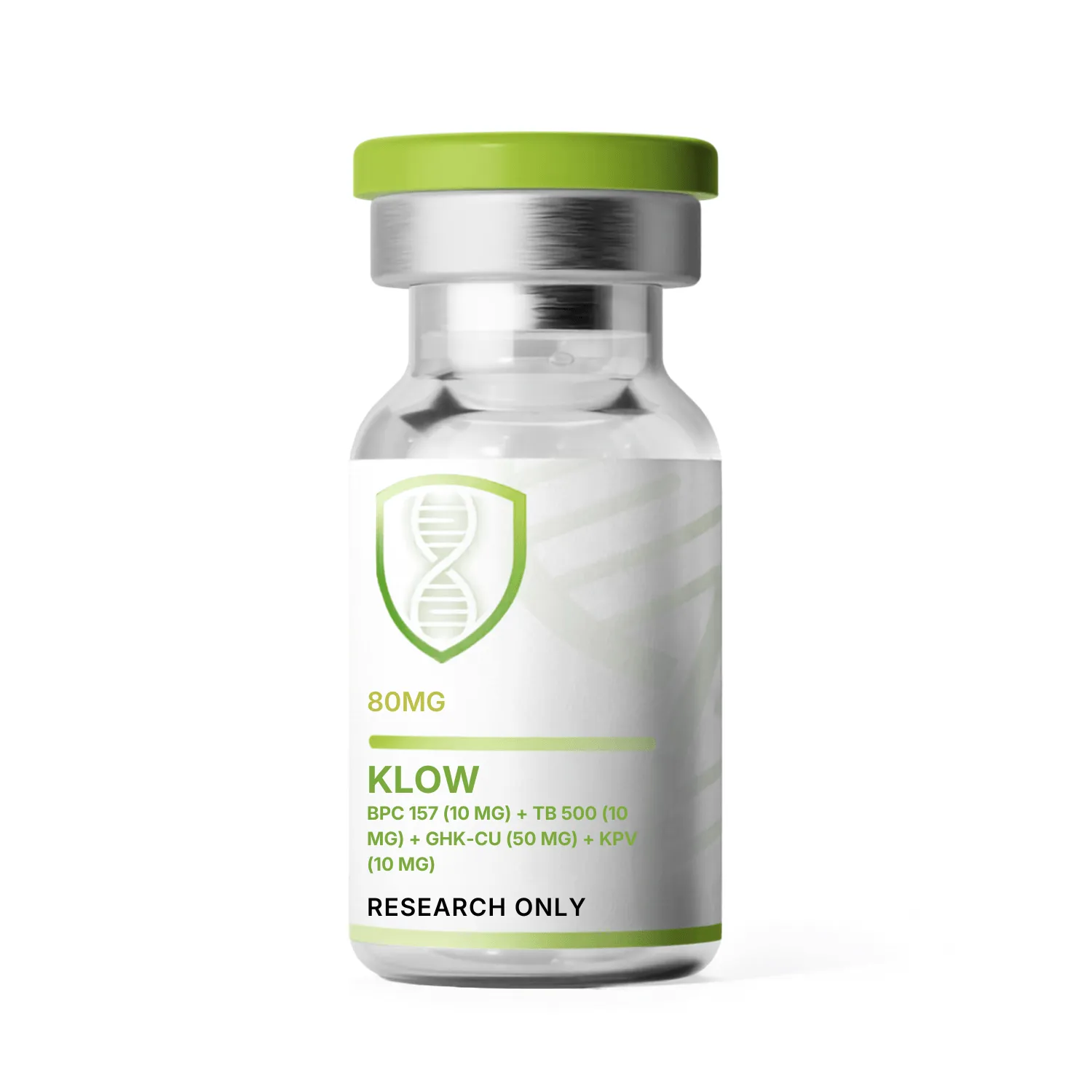
Buy Klow Blend 80mg |99% Purity| COA Available
Klow Blend is a research peptide formulation that combines BPC-157, TB-500, GHK-Cu, and KPV in a single vial. Each peptide has its own unique molecular structure and biological properties. Researchers study these peptides to understand different cellular processes, signaling pathways, and molecular interactions. By combining them in one formulation, researchers can investigate how multiple peptide components behave within controlled laboratory research settings. Klow Blend is intended for research purposes only and is not intended for human use. Researchers can buy Klow Blend at Orion Peptides for laboratory research purposes.
Research background: BPC-157 research profile · GHK-Cu research profile · The Wolverine peptide (BPC-157 + TB-500) explained
| Specification | Details |
| Compound Name | Klow Blend |
| Total Peptide Content | 80 mg |
| BPC-157 | 10 mg |
| TB-500 | 10 mg |
| GHK-Cu | 50 mg |
| KPV | 10 mg |
| Form | Lyophilized peptide blend |
| Packaging | Single sealed vial |
| Intended Use | Laboratory and in-vitro research only |
| Composition Ratio | 50:10:10:10 mg |
| Research Focus | Cellular signaling, peptide interactions, inflammatory pathways, extracellular matrix research, and cellular response |
Klow Blend: Peptide Composition
| Peptide | Amount | Research Focus |
| BPC-157 | 10 mg | Studied in research involving tissue response, cellular signaling, and repair-related processes |
| TB-500 | 10 mg | Investigated for cytoskeletal organization, cellular migration, and related biological processes |
| GHK-Cu | 50 mg | Researched for copper-binding activity, collagen synthesis, and extracellular matrix regulation |
| KPV | 10 mg | Studied for its interactions with inflammatory signaling pathways |
| Total Blend | 80 mg | Combined formulation for controlled laboratory and scientific research |
Research Applications of Klow Blend
The Klow Blend combines BPC-157, TB-500, GHK-Cu, and KPV, allowing researchers to examine several peptide-related biological processes within a controlled experimental framework. The individual components have been investigated in areas including cellular migration, tissue-related signaling, inflammatory pathways, extracellular matrix activity, and molecular interactions.
However, findings from studies of individual peptides should not be interpreted as evidence that the complete Klow Blend produces the same effects or has established synergistic activity.
1. Tissue and Cellular Response Studies
BPC-157 has been investigated in experimental models involving cellular migration, angiogenesis, collagen deposition, and tissue-related responses. For example, laboratory research has reported effects on endothelial cell proliferation and migration, as well as ERK1/2-related signaling.
Researchers may therefore study BPC-157 within controlled models to examine:
- Cell migration and proliferation
- Endothelial cell responses
- Angiogenesis-related signaling
- Collagen deposition
- ERK1/2 signaling activity
- Cellular responses to experimental stress
2. Cytoskeletal and Cell Migration Research
TB-500 is commonly described as a peptide fragment or derivative associated with thymosin β4 research. Much of the published literature concerns thymosin β4 itself rather than commercially supplied TB-500 preparations
Research involving this pathway may examine:
- Actin filament organization
- Cytoskeletal dynamics
- Cell migration
- Endothelial cell movement
- Cellular adhesion
- Migration-associated signaling
Studies have also investigated the relationship between thymosin β4 and matrix metalloproteinase activity during epithelial cell migration.
3. Inflammatory Pathway Research
KPV is the C-terminal tripeptide of α-MSH and has been investigated in several experimental inflammation models. Research has examined its effects on NF-κB signaling, inflammatory cytokine activity, and cellular inflammatory responses.
Research applications involving KPV may include:
- NF-κB pathway analysis
- Cytokine signaling studies
- Inflammatory cell responses
- MAP kinase pathway research
- Epithelial cell signaling
- Experimental models of intestinal inflammation
Importantly, much of the available evidence comes from cellular and animal models, so these findings should not be presented as established human effects.
4. Extracellular Matrix and Collagen Studies
GHK-Cu has been studied extensively in connection with fibroblast activity, collagen synthesis, and extracellular matrix regulation. Early in-vitro research found that GHK-Cu stimulated collagen synthesis in fibroblast cultures.
Additional research has examined its effects on extracellular matrix components and matrix-remodeling processes, including metalloproteinase expression.
Researchers may investigate GHK-Cu in relation to:
- Collagen synthesis
- Fibroblast activity
- Extracellular matrix remodeling
- Matrix metalloproteinases
- Proteoglycan expression
- Connective-tissue-related molecular processes
5. Multi-Peptide Interaction Analysis
Because Klow Blend contains four different peptide components, researchers can investigate how their individual molecular properties may interact within the same experimental system. Potential research areas include:
- Peptide-to-peptide interactions
- Changes in cellular signaling profiles
- Comparative pathway analysis
- Molecular response patterns
- Independent versus combined peptide activity
Klow Blend vs. Individual Peptides
| Research Material | Composition | General Research Focus |
| BPC-157 | Single peptide | Cellular signaling and migration-related research |
| TB-500 | Single peptide | Actin dynamics and cellular movement research |
| GHK-Cu | Copper-binding peptide | Collagen and extracellular matrix research |
| KPV | Tripeptide | Inflammatory signaling research |
| Klow Blend | Four-peptide formulation | Combined investigation of multiple peptide-related pathways |
Klow Blend vs. Glow Blend
Klow Blend and Glow Blend share three of the same research peptides: BPC-157, TB-500, and GHK-Cu. The main difference is that Klow Blend contains KPV as a fourth component. Commonly listed formulations contain 70 mg in Glow Blend and 80 mg in Klow Blend.
| Peptide | Glow Blend | Klow Blend | General Research Area |
| BPC-157 | 10 mg | 10 mg | Cellular signaling and migration-related research |
| TB-500 | 10 mg | 10 mg | Cytoskeletal organization and cell migration research |
| GHK-Cu | 50 mg | 50 mg | Collagen and extracellular matrix research |
| KPV | — | 10 mg | Inflammatory signaling research |
| Total | 70 mg | 80 mg | Multi-peptide research |
Intended Research Use
This peptide blend is intended exclusively for laboratory and scientific research purposes.
- In vitro experiments
- Cell culture studies
- Biochemical research protocols
- Approved preclinical research models
All usage must comply with institutional research guidelines, ethical approvals, and applicable regulatory requirements.
Klow Blend Storage Guidelines
For research use, Klow Blend should be stored according to the supplier’s compound specifications and applicable laboratory protocols. General considerations include:
| Storage Stage | Recommended Practice |
| Before Reconstitution | Keep the sealed vial in a cool, dry, temperature-controlled environment and protect it from direct light. |
| After Reconstitution | Store the prepared research solution under appropriate refrigerated conditions and minimize unnecessary temperature changes. |
| Light Exposure | Keep the vial protected from direct light and prolonged exposure to strong laboratory lighting. |
| Temperature Changes | Avoid repeated freezing and thawing, as temperature cycling can affect peptide stability. |
| Container | Keep the material in its original, properly sealed vial whenever possible. |
| Handling | Use clean laboratory techniques and avoid unnecessary exposure to air, moisture, or contaminants. |
| Long-Term Storage | Follow the manufacturer’s specific stability and storage information for long-term research storage. |
Regulatory and Safety Disclaimer
This compound is supplied strictly for laboratory research use only. It is not approved by the FDA or any regulatory authority for human or veterinary use.
The compound is intended solely for qualified research professionals operating within controlled scientific environments. No claims are made regarding safety, efficacy, or therapeutic application outside laboratory research.
Users must comply with all applicable laws, institutional safety procedures, and ethical standards. Refer to the Material Safety Data Sheet (MSDS) and dispose of materials according to approved laboratory waste protocols. The supplier assumes no responsibility for misuse or improper handling.
Frequently Asked Questions
1. What is Klow Blend?
Klow Blend is a research peptide formulation containing BPC-157, TB-500, GHK-Cu, and KPV in a single vial.
2. How much peptide is in Klow Blend?
The formulation contains 80 mg of total peptide material: 10 mg BPC-157, 10 mg TB-500, 50 mg GHK-Cu, and 10 mg KPV.
3. What is Klow Blend studied for?
The individual components are studied across areas including cellular signaling, cell migration, inflammatory pathways, actin dynamics, collagen synthesis, and extracellular matrix activity.
4. Is Klow Blend intended for human use?
No. The compound is supplied for laboratory and scientific research purposes only and is not intended for human or veterinary use.
5. How should Klow Blend be stored?
Storage should follow the supplier’s compound-specific instructions and applicable laboratory protocols. Protect the material from unnecessary light, moisture, and temperature fluctuations.
KLOW Research Resources
Research References:
https://pubmed.ncbi.nlm.nih.gov/3169264/

https://pubmed.ncbi.nlm.nih.gov/18092346/

https://pubmed.ncbi.nlm.nih.gov/24382810/