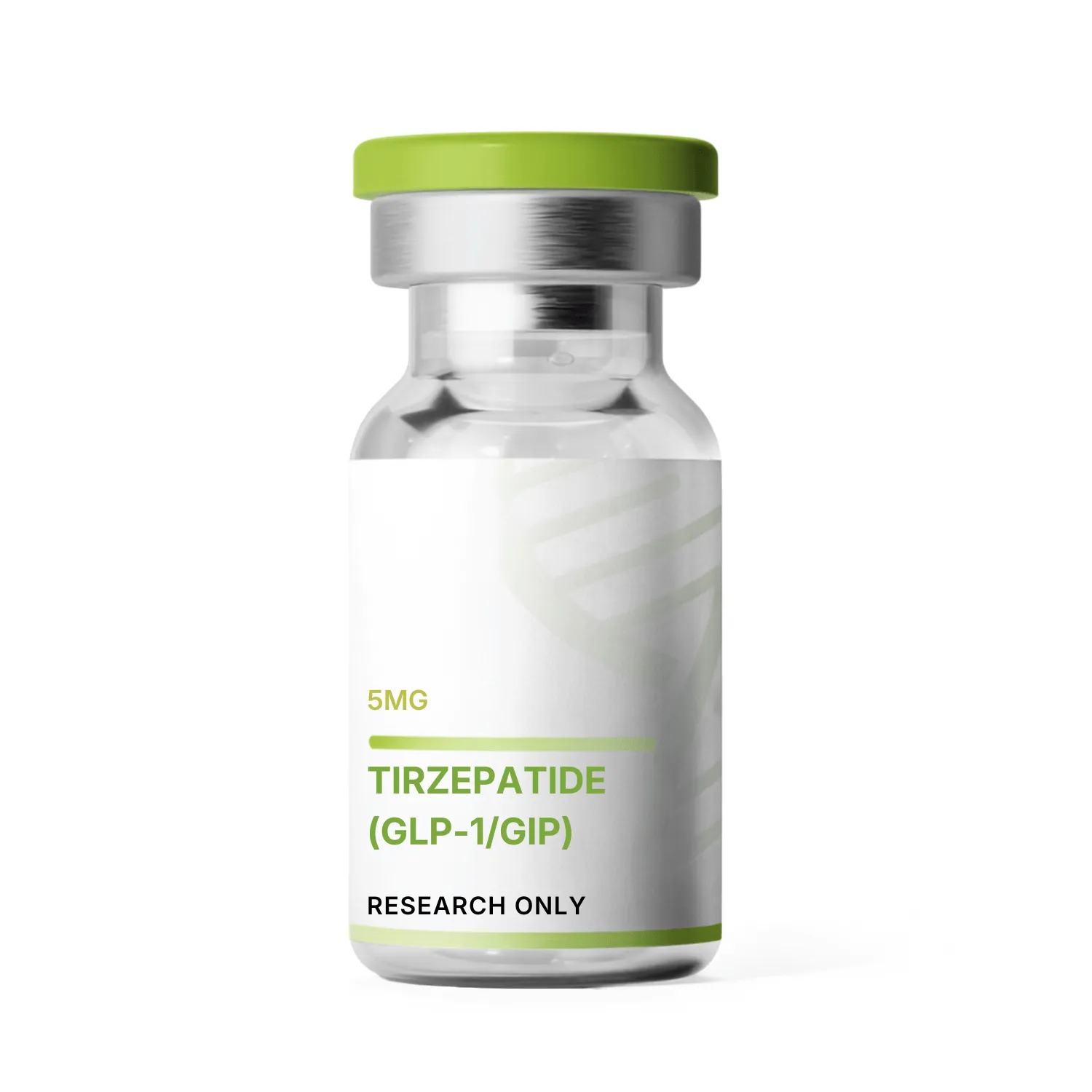
Buy Tirz (G.L.P) 5mg | G.L.P-1/G.I.P Research Peptide
Tirz (G.L.P) 5mg is a synthetic, 39-amino-acid peptide studied for its interaction with two important metabolic receptors: glucose-dependent insulinotropic polypeptide (G.I.P) and glucagon-like peptide-1 (G.L.P-1) receptors. Unlike peptides that activate only one incretin receptor, Tirz (G.L.P) acts on both G.I.P and G.L.P-1 receptors. This dual activity has made it an important compound in research involving glucose-dependent signaling, pancreatic function, appetite regulation, and metabolic pathways. At
Orion Peptides, Tirz (G.L.P) 5mg is listed as a research peptide for controlled laboratory investigations. The 5mg designation describes the nominal quantity of material supplied, not a recommended experimental concentration or clinical dose. The molecule has been extensively investigated in laboratory models and human clinical trials. However, findings involving approved pharmaceutical formulations do not establish the safety or quality of independently manufactured research vials.
Research Use Only: Not intended for human or veterinary administration, treatment, or personal consumption.
What Is Tirz (G.L.P) 5mg?
Tirz (G.L.P) is a synthetic peptide originally developed under the research identifier LY3298176. Its molecular structure is based on the naturally occurring G.I.P hormone, with modifications that also allow it to activate G.L.P-1 receptors. Both G.I.P and G.L.P-1 belong to the incretin hormone family. They help regulate insulin secretion in response to glucose and participate in other metabolic processes. Scientists developed Tirz (G.L.P) to investigate whether activating both receptors could produce different biological responses compared with activating a single incretin receptor. The peptide includes structural modifications that help protect it from rapid degradation and prolong its circulation time. Tirz (G.L.P) has an elimination half-life of approximately five days in humans, based on pharmacokinetic studies of pharmaceutical formulations. The molecule has been investigated in research involving glucose regulation, metabolic signaling, energy intake, and receptor pharmacology.
Scientific reference: Coskun T, et al. (2018). LY3298176, a novel dual G.I.P and G.L.P-1 receptor agonist.
Tirz (G.L.P) 5mg Molecular Specifications
Tirz (G.L.P) is a linear peptide containing 39 amino acid residues and a chemically attached fatty diacid group.
| Property | Details |
| Compound name | Tirz (G.L.P) 5mg |
| Compound | Tirz (G.L.P) |
| Research identifier | LY3298176 |
| Peptide class | Dual G.I.P/G.L.P-1 receptor agonist |
| Amino acid length | 39 residues |
| Molecular formula | C₂₂₅H₃₄₈N₄₈O₆₈ |
| Molecular weight | Approximately 4,813.53 g/mol |
| CAS number | 2023788-19-2 |
| PubChem CID | 156588324 |
| Chemical modification | C20 fatty diacid side chain |
| C-terminal structure | Amidated |
| Research targets | G.I.P and G.L.P-1 receptors |
| Nominal vial content | 5mg |
| Intended use | Laboratory research only |
These chemical specifications describe Tirz (G.L.P) itself. They do not independently verify the identity, purity, or quantity of material in a particular manufactured vial.
Chemical reference: PubChem: Tirz (G.L.P).
Tirz (G.L.P) Peptide Structure
Tirz (G.L.P) contains 39 amino acid residues with several modifications that distinguish it from naturally occurring G.I.P. Two important structural features are the presence of aminoisobutyric acid (Aib) residues and a long-chain fatty diacid attached through a chemical linker.
Aminoisobutyric Acid Modifications
Tirz (G.L.P) contains Aib residues at positions 2 and 13. These nonstandard amino acid residues contribute to the peptide’s structural and pharmacological characteristics. The modification at position 2 also helps protect the peptide against rapid enzymatic breakdown.
C20 Fatty Diacid Side Chain
A C20 fatty diacid is attached to the lysine residue at position 20 through a linker. This modification promotes binding to serum albumin and contributes to Tirz (G.L.P)’s extended circulation time. The combination of amino acid substitutions and fatty acid attachment makes Tirz (G.L.P) useful for studying how peptide structure affects receptor activity and pharmacokinetics.
Research reference: Coskun et al. (2018), Molecular Metabolism.
Tirz (G.L.P) Mechanism of Action
Tirz (G.L.P) activates both G.I.P and G.L.P-1 receptors. These receptors belong to the G-protein-coupled receptor family and are involved in cellular signaling pathways associated with metabolic regulation. Both receptors can activate Gs-protein signaling, increasing intracellular cyclic AMP (cAMP). This signaling contributes to cellular responses involved in glucose-dependent insulin secretion.
G.L.P-1 Receptor Activity
G.L.P-1 receptors are expressed in several tissues, including pancreatic cells and parts of the nervous system. In appropriate experimental models, G.L.P-1 receptor activation can influence:
- Glucose-dependent insulin secretion
- Glucagon regulation
- Gastric emptying
- Appetite-related neural signaling
These processes have been extensively investigated in incretin research.
G.I.P Receptor Activity
G.I.P receptors also participate in glucose-dependent insulin signaling. G.I.P is naturally released from intestinal K cells after nutrient intake. Researchers study G.I.P receptor activation to understand its contribution to pancreatic signaling and broader metabolic regulation.
Dual Receptor Activation
The distinctive feature of Tirz (G.L.P) is its ability to activate both receptors. Early pharmacological studies examined this dual activity using receptor-expressing cell systems and animal models. Researchers investigated receptor activation, insulin secretion, glucose regulation, and changes in metabolic responses. These studies helped establish Tirz (G.L.P) as an important reference compound in dual-incretin pharmacology. The observed response can vary by receptor system, experimental model, and exposure conditions.
Tirz (G.L.P) Research Applications
Tirz (G.L.P) has been investigated in several areas of metabolic and molecular research.
1. Incretin Receptor Signaling
Scientists study how Tirz (G.L.P) interacts with G.I.P and G.L.P-1 receptors. These investigations involve receptor activation, intracellular cAMP signaling, and the relationship between molecular structure and receptor response. Comparative studies may also examine how dual receptor activation differs from selective G.L.P-1 receptor activation.
2. Glucose Metabolism Research
Tirz (G.L.P) has been extensively evaluated in research involving glucose-dependent insulin secretion and metabolic regulation. The SURPASS-2 clinical trial, published in 2021, compared pharmaceutical Tirz (G.L.P) with semaglutide in adults with type 2 diabetes. The trial included 1,879 participants and examined changes in glycated hemoglobin (HbA1c), body weight, and safety outcomes. The results demonstrated greater average HbA1c reductions with the studied Tirz (G.L.P) regimens than with the comparator semaglutide regimen. However, these findings involve approved or investigational pharmaceutical formulations under controlled clinical conditions. They do not establish equivalent outcomes for research-grade compounds.
Reference: Frías JP, et al. (2021). Tirz (G.L.P) versus Semaglutide Once Weekly in Patients with Type 2 Diabetes.
3. Energy Balance and Appetite Signaling
G.I.P and G.L.P-1 receptors are involved in several processes associated with energy balance. Researchers investigate how dual incretin signaling affects neural and metabolic responses in suitable experimental models. Clinical investigations have also evaluated pharmaceutical Tirz (G.L.P) in weight-management research. For example, the SURMOUNT-1 trial studied Tirz (G.L.P) in adults with obesity or overweight and reported significant changes in body weight during a 72-week study. Gastrointestinal adverse reactions were common, particularly during dose escalation. These findings should not be interpreted as evidence that unapproved research vials are suitable for clinical use.
Reference: Jastreboff AM, et al. (2022). Tirz (G.L.P) Once Weekly for the Treatment of Obesity.
4. Peptide Structure and Stability Research
Tirz (G.L.P) is also relevant to peptide engineering. Its molecular design provides an example of how amino acid substitutions and fatty acid conjugation can influence the behavior of a synthetic peptide. Laboratory investigations may examine structural identity, degradation pathways, and chemical stability.
5. Comparative G.L.P-1 and G.I.P Research
Researchers compare Tirz (G.L.P) with selective G.L.P-1 receptor agonists to investigate differences in receptor activation. These comparisons can help identify how individual incretin pathways contribute to cellular and physiological responses. Because Tirz (G.L.P) activates two receptor systems, it offers a distinct model for investigating dual incretin signaling.
Tirz (G.L.P) vs Semaglutide
Tirz (G.L.P) and semaglutide are both synthetic incretin-based peptides, but they differ in structure and receptor activity.
| Feature | Tirz (G.L.P) | Semaglutide |
| Peptide length | 39 amino acids | 31 amino acids |
| Receptor targets | G.I.P and G.L.P-1 | G.L.P-1 |
| Molecular weight | 4,813.53 g/mol | 4,113.58 g/mol |
| Molecular formula | C₂₂₅H₃₄₈N₄₈O₆₈ | C₁₈₇H₂₉₁N₄₅O₅₉ |
| Structural design | Modified G.I.P-based peptide | Modified G.L.P-1 analog |
| Fatty acid modification | C20 fatty diacid | C18 fatty diacid |
| Approximate human half-life | 5 days | 7 days |
| Main research focus | Dual incretin signaling | Selective G.L.P-1 signaling |
Both compounds have been extensively studied, but they activate different receptor systems. Their pharmacological differences make them relevant to comparative incretin research.
Tirz (G.L.P) 5mg, 10mg, and 15mg
Orion Peptides lists several research quantities of Tirz (G.L.P).
The primary difference between these listings is the nominal amount of peptide associated with each compound. A 5mg vial does not necessarily represent a lower experimental exposure than a 10mg or 15mg vial. Exposure depends on the design of the experiment, not simply on the total amount supplied. Researchers should review chemical identity, actual content, purity, and documentation for each batch.
Tirz (G.L.P) 5mg Purity and COA Testing
Peptide purity and identity are important when selecting material for laboratory research. Researchers should examine analytical documentation associated with the specific Tirz (G.L.P) 5mg batch.
HPLC Purity
High-performance liquid chromatography (HPLC) is commonly used to evaluate chromatographic purity. A reported purity result should be supported by the relevant test method and batch report. HPLC purity does not independently establish peptide identity or the actual amount of material present.
Mass Spectrometry
Mass spectrometry helps verify whether a tested sample matches the expected molecular structure. Tirz (G.L.P) has a theoretical molecular weight of approximately 4,813.53 g/mol. The observed mass may vary depending on the analytical method and detected ion species.
Certificate of Analysis
A useful batch-specific COA should include:
- Compound name and batch number
- HPLC purity result
- Molecular identity testing
- Actual peptide content, when measured
- Testing date
- Laboratory identification
- Relevant analytical methods
Sterility, endotoxin limits, and microbiological quality are separate characteristics and should not be inferred from HPLC purity alone.
Tirz (G.L.P) 5mg Storage and Handling
Research-grade Tirz (G.L.P) may be supplied as lyophilized powder. Proper storage is important because peptides can undergo degradation under unsuitable environmental conditions. The appropriate storage temperature and shelf life depend on the formulation, packaging, and stability data. Laboratories should follow the supplier’s validated instructions. General considerations include protecting peptide material from moisture, unnecessary light exposure, and excessive temperature fluctuations. After dissolution, stability depends on the solvent, concentration, pH, container, and storage temperature. Storage instructions for FDA-approved Tirz (G.L.P) medicines should not automatically be applied to research-grade compounds with different formulations.
Frequently Asked Questions
What is Tirz (G.L.P) 5mg?
Tirz (G.L.P) 5mg is a research compound containing a nominal 5mg quantity of Tirz (G.L.P), a synthetic 39-amino-acid peptide that activates both G.I.P and G.L.P-1 receptors.
How many amino acids does Tirz (G.L.P) contain?
Tirz (G.L.P) contains 39 amino acid residues and a chemically attached C20 fatty diacid group.
What is Tirz (G.L.P)’s molecular formula?
Its molecular formula is C₂₂₅H₃₄₈N₄₈O₆₈.
What is the molecular weight of Tirz (G.L.P)?
Tirz (G.L.P) has a molecular weight of approximately 4,813.53 g/mol.
What is the CAS number of Tirz (G.L.P)?
The commonly listed CAS number is 2023788-19-2.
Is Tirz (G.L.P) a G.L.P-1 peptide?
Tirz (G.L.P) is a dual G.I.P and G.L.P-1 receptor agonist. Unlike selective G.L.P-1 receptor agonists, it activates both receptor types.
What is the difference between Tirz (G.L.P) 5mg and 10mg?
The primary difference is the nominal amount of peptide supplied. These compound quantities should not be interpreted as experimental doses or administration instructions.
How does Tirz (G.L.P) differ from semaglutide?
Tirz (G.L.P) activates both G.I.P and G.L.P-1 receptors, while semaglutide activates G.L.P-1 receptors. They also differ in amino acid sequence, molecular weight, and structural modifications.
How can researchers verify Tirz (G.L.P) purity?
Researchers can examine batch-specific HPLC results, mass spectrometry data, and the Certificate of Analysis. Purity and actual peptide content should be evaluated separately.
Is Tirz (G.L.P) 5mg FDA-approved?
The Tirz (G.L.P) molecule is used in FDA-approved prescription medicines, including Mounjaro and Zepbound. However, independently manufactured Tirz (G.L.P) 5mg research vials are not FDA-approved pharmaceutical compounds.
Research Use Only Disclaimer
Tirz (G.L.P) 5mg supplied by Orion Peptides is intended exclusively for legitimate laboratory and scientific research. It is not an FDA-approved pharmaceutical compound and is not intended for human or veterinary administration, personal consumption, or therapeutic use. Clinical findings involving regulated Tirz (G.L.P) medicines do not establish the safety, effectiveness, sterility, or pharmaceutical equivalence of independently manufactured research material. The FDA has warned about unapproved Tirz (G.L.P) and other G.L.P-1 compounds sold under research-only labels for human use. Research materials must be handled according to applicable laws, institutional requirements, and appropriate laboratory safety procedures.
Scientific References
- Coskun T, et al. (2018). LY3298176, a novel dual G.I.P and G.L.P-1 receptor agonist for the treatment of type 2 diabetes mellitus: From discovery to clinical proof of concept. Molecular Metabolism, 18, 3–14. PubMed | Full text. DOI: 10.1016/j.molmet.2018.09.009.
- Frías JP, et al. (2021). Tirz (G.L.P) versus Semaglutide Once Weekly in Patients with Type 2 Diabetes. New England Journal of Medicine, 385, 503–515. PubMed. DOI: 10.1056/NEJMoa2107519.
- Jastreboff AM, et al. (2022). Tirz (G.L.P) Once Weekly for the Treatment of Obesity. New England Journal of Medicine, 387, 205–216. PubMed. DOI: 10.1056/NEJMoa2206038.
- National Center for Biotechnology Information. PubChem Compound Summary for Tirz (G.L.P), CID 156588324. PubChem.
- U.S. Food and Drug Administration. Zepbound (Tirz (G.L.P)), Prescribing Information. FDA reference.
- U.S. Food and Drug Administration. FDA’s Concerns with Unapproved G.L.P-1 Drugs Used for Weight Loss. FDA safety information.