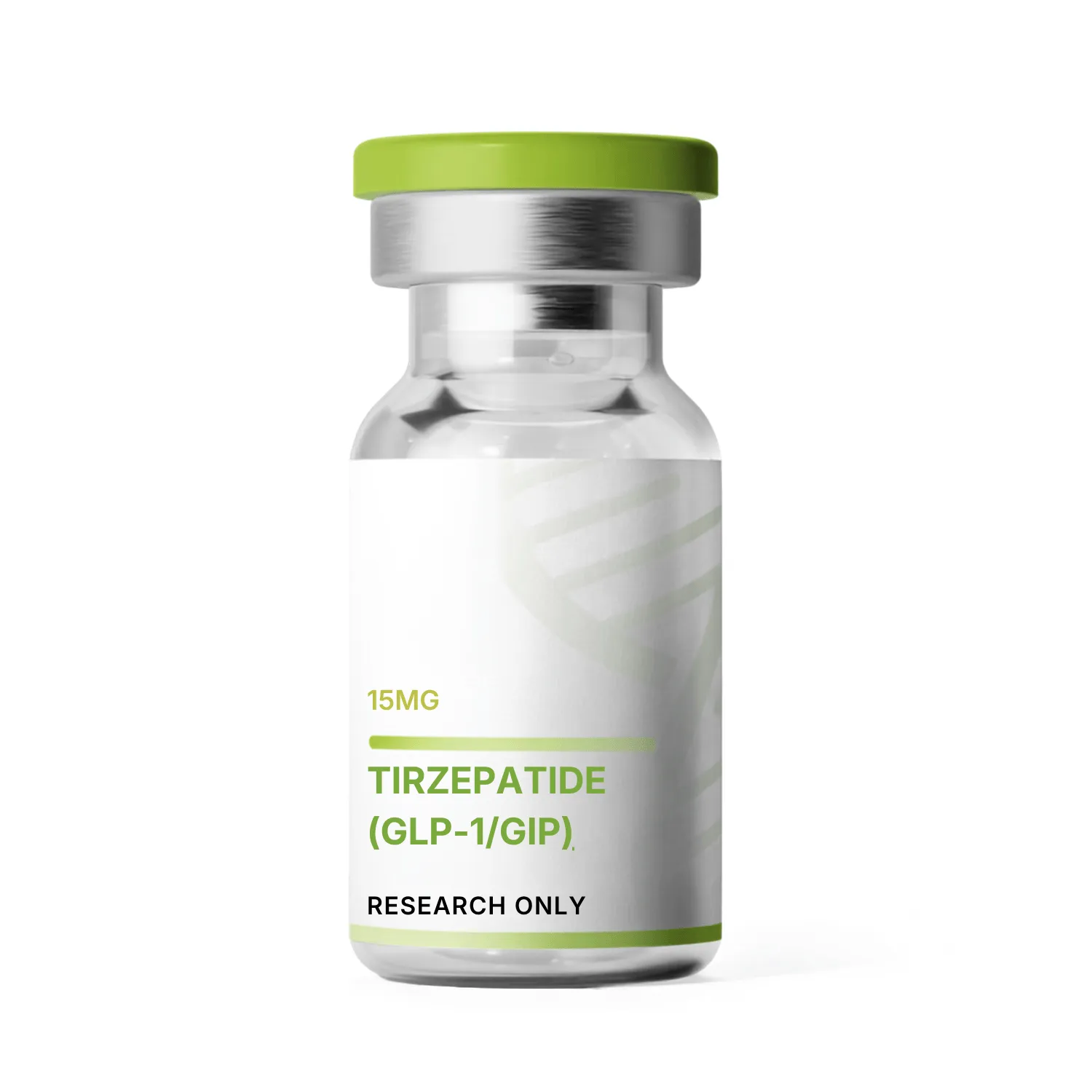
Buy Tirz (G.L.P) 15mg | Dual G.I.P/G.L.P-1 Research Peptide
Tirz (G.L.P) 15mg is a synthetic 39-amino-acid peptide that activates both glucose-dependent insulinotropic polypeptide (G.I.P) and glucagon-like peptide-1 (G.L.P-1) receptors. These two receptors are involved in glucose-dependent insulin secretion and other metabolic signaling pathways. Tirz (G.L.P) is different from single-receptor G.L.P-1 agonists because it interacts with two incretin receptor systems. Its molecular structure includes a C20 fatty diacid side chain that promotes albumin binding and helps extend its duration of activity. At
Orion Peptides, Tirz (G.L.P) 15mg is listed as a research compound for laboratory investigations. The 15mg presentation refers to the nominal total peptide quantity in the vial. Researchers use Tirz (G.L.P) as a reference compound when investigating receptor signaling, peptide structure, and metabolic pathways. Its pharmacology has been studied extensively, but findings from regulated pharmaceutical compounds do not establish the quality or clinical suitability of research-grade vials.
For Research Use Only. Not intended for human or veterinary administration. Tirz (G.L.P) 15mg: Molecular Specifications
Tirz (G.L.P) was developed under the research identifier LY3298176. It is based on the G.I.P peptide sequence with modifications that support activity at both G.I.P and G.L.P-1 receptors.
| Property | Details |
| Compound name | Tirz (G.L.P) 15mg |
| Compound | Tirz (G.L.P) |
| Development identifier | LY3298176 |
| Peptide class | Dual G.I.P/G.L.P-1 receptor agonist |
| Amino acid length | 39 residues |
| Molecular formula | C₂₂₅H₃₄₈N₄₈O₆₈ |
| Molecular weight | Approximately 4,813.53 g/mol |
| CAS number | 2023788-19-2 |
| PubChem CID | 156588324 |
| Fatty acid modification | C20 fatty diacid |
| C-terminal modification | Amidation |
| Receptor targets | G.I.PR and G.L.P-1R |
| Nominal vial content | 15mg |
| Intended use | Laboratory research only |
These molecular properties describe the Tirz (G.L.P) compound. Actual purity, identity, and peptide quantity must be established using batch-specific analytical documentation.
Chemical reference: PubChem: Tirz (G.L.P).
What Makes Tirz (G.L.P) Different From Other G.L.P-1 Peptides?
Tirz (G.L.P) belongs to the incretin peptide family. Incretins are hormones released by the intestine in response to nutrients. Two well-studied incretins are G.I.P and G.L.P-1. Both are involved in glucose-dependent insulin secretion, but they act through separate receptors. Most conventional G.L.P-1 receptor agonists focus on the G.L.P-1 pathway. Tirz (G.L.P) was designed to activate both G.I.P and G.L.P-1 receptors. This dual-receptor activity is the main reason Tirz (G.L.P) has received attention in metabolic research. Its structure is based on G.I.P, but selected amino acid changes give it activity at the G.L.P-1 receptor as well. The original development research by Coskun and colleagues described the compound’s receptor activity, molecular design, and experimental metabolic responses.
Reference: Coskun T, et al. (2018). LY3298176, a novel dual G.I.P and G.L.P-1 receptor agonist.
Tirz (G.L.P) Structure and Chemical Modifications
Tirz (G.L.P) contains 39 amino acids and several structural features that influence its pharmacological properties.
Aib Amino Acid Substitutions
Tirz (G.L.P) contains modified amino acid residues, including 2-aminoisobutyric acid (Aib) at positions 2 and 13. The substitution at position 2 helps protect the molecule against rapid enzymatic cleavage. These modifications are important when studying peptide degradation and structure-activity relationships.
C20 Fatty Diacid Modification
A long-chain C20 fatty diacid is attached to the lysine residue at position 20 through a linker. This modification increases binding to serum albumin. Albumin binding contributes to slower elimination and helps explain Tirz (G.L.P)’s longer circulation time compared with unmodified incretin peptides.
Tirz (G.L.P) Half-Life
Published pharmacokinetic research has established an elimination half-life of approximately five days in humans. This value refers to the pharmaceutical compound under studied clinical conditions. It should not automatically be applied to every animal model, isolated tissue preparation, or cell-based experiment. The structural modifications provide an important example of how peptide engineering can change molecular stability and pharmacokinetic behavior.
How Tirz (G.L.P) Interacts With G.I.P and G.L.P-1 Receptors
Both G.I.P and G.L.P-1 receptors belong to the G-protein-coupled receptor family. When activated, these receptors can initiate intracellular signaling involving cyclic AMP (cAMP). Tirz (G.L.P) is designed to activate both systems.
G.I.P Receptor Signaling
G.I.P is a naturally occurring hormone released by intestinal K cells in response to food intake. It binds to the G.I.P receptor and participates in glucose-dependent insulin signaling. Tirz (G.L.P)’s G.I.P receptor activity has been investigated through laboratory assays and metabolic studies. Researchers examine receptor activation and downstream cellular responses to understand the contribution of G.I.P signaling.
G.L.P-1 Receptor Signaling
G.L.P-1 is an incretin hormone released primarily from intestinal L cells. Its receptor is involved in several pathways, including glucose-dependent insulin secretion, glucagon regulation, and gastrointestinal signaling. Tirz (G.L.P) activates this receptor as part of its dual-agonist action.
Why Dual Activation Matters
The two receptors share certain signaling pathways, but they are not identical. Scientists have investigated whether their combined activation produces different cellular responses compared with selective activation of one receptor. Early experimental studies demonstrated the dual receptor activity of Tirz (G.L.P) and supported further investigation into its metabolic effects. However, the magnitude and nature of the response depend on the experimental system.
Key Areas of Tirz (G.L.P) Research
1. Glucose-Dependent Insulin Signaling
One of the most established areas of Tirz (G.L.P) research involves glucose-dependent insulin secretion. Activation of incretin receptors can influence pancreatic beta-cell responses when glucose concentrations are elevated. Researchers study these processes using receptor assays, metabolic measurements, and controlled experimental models. The SURPASS-2 clinical trial, published in 2021, compared pharmaceutical Tirz (G.L.P) with semaglutide in 1,879 adults with type 2 diabetes. The study reported greater average reductions in HbA1c with the investigated Tirz (G.L.P) regimens than with the semaglutide comparator. The trial also documented adverse effects, particularly gastrointestinal symptoms. These clinical findings cannot be used to establish the effectiveness or safety of independently manufactured research vials.
Research: Frías JP, et al. (2021). Tirz (G.L.P) versus Semaglutide Once Weekly in Patients with Type 2 Diabetes.
2. Pancreatic Beta-Cell Research
Pancreatic beta cells are responsible for insulin production and release. Researchers investigate how G.I.P and G.L.P-1 receptor activation affects beta-cell signaling and function. In a 2024 analysis of the SURPASS-2 trial, investigators examined markers of pancreatic islet cell function and insulin sensitivity. The findings contributed to understanding how Tirz (G.L.P) affects the metabolic pathways associated with glucose regulation.
Research: Frías JP, et al. (2024). Tirz (G.L.P) Improved Markers of Islet Cell Function and Insulin Sensitivity.
3. Appetite and Energy Balance Research
G.I.P and G.L.P-1 receptors participate in several pathways related to energy intake and metabolic regulation. These include signaling processes in the gastrointestinal system, pancreas, and nervous system. The SURMOUNT-1 trial investigated pharmaceutical Tirz (G.L.P) in adults with obesity or overweight. The study examined body-weight changes and associated safety outcomes over 72 weeks. These findings contribute to research on incretin biology but do not establish that laboratory-grade Tirz (G.L.P) is suitable for personal or clinical use.
Research: Jastreboff AM, et al. (2022). Tirz (G.L.P) Once Weekly for the Treatment of Obesity.
4. Metabolic Signaling and Liver Research
Scientists have also investigated Tirz (G.L.P) in models involving liver metabolism, lipid regulation, and metabolic dysfunction. Research includes studies of gene expression and cellular pathways associated with lipid transport and metabolism. These findings are relevant to understanding the broader effects of incretin receptor activation. However, changes observed in isolated cells or animal models should not be presented as established outcomes in humans.
5. Peptide Engineering and Molecular Stability
Tirz (G.L.P) is relevant to research into long-acting peptide design. Its modified amino acid sequence and fatty diacid conjugation allow scientists to investigate how chemical changes affect peptide behavior. Research in this area can focus on receptor activation, molecular characterization, degradation, and analytical method development.
Tirz (G.L.P) 15mg vs Semaglutide
Tirz (G.L.P) and semaglutide are both synthetic peptides studied in incretin research. Their main difference is receptor activity.
| Feature | Tirz (G.L.P) | Semaglutide |
| Peptide length | 39 residues | 31 residues |
| Receptor activity | G.I.P and G.L.P-1 | G.L.P-1 |
| Molecular weight | 4,813.53 g/mol | 4,113.58 g/mol |
| Molecular formula | C₂₂₅H₃₄₈N₄₈O₆₈ | C₁₈₇H₂₉₁N₄₅O₅₉ |
| Fatty acid modification | C20 fatty diacid | C18 fatty diacid |
| Approximate human elimination half-life | 5 days | 7 days |
| Molecular design | G.I.P-based dual agonist | Modified G.L.P-1 analog |
Because the compounds differ structurally and pharmacologically, they are useful for comparing selective and dual incretin receptor signaling. Clinical trial comparisons involve particular pharmaceutical formulations, study populations, and controlled conditions. These outcomes cannot establish that research-grade versions are equivalent to approved medicines.
Tirz (G.L.P) Research Vial Quantities at Orion Peptides
Orion Peptides lists Tirz (G.L.P) in several research quantities.
These quantities describe the total nominal material supplied. They do not define experimental concentrations, exposure levels, or dosing schedules. The appropriate compound quantity depends on laboratory requirements and the availability of suitable analytical documentation.
Tirz (G.L.P) 15mg Purity and Quality Documentation
Accurate characterization is important for laboratories working with synthetic peptides. Tirz (G.L.P) should be evaluated using methods suitable for verifying identity, purity, and actual peptide content.
HPLC Purity Testing
High-performance liquid chromatography (HPLC) separates the main peptide component from detectable impurities. Results are typically reported according to the validated test method. A claimed purity of 99% should be supported by the actual batch-specific analysis.
Mass Spectrometry
Mass spectrometry can help determine whether a sample matches the expected molecular identity of Tirz (G.L.P). The theoretical molecular weight is approximately 4,813.53 g/mol. This value should not be confused with semaglutide’s molecular weight of approximately 4,113.58 g/mol.
Certificate of Analysis
Before using Tirz (G.L.P) 15mg in laboratory work, researchers should review the relevant Certificate of Analysis. A useful COA includes:
- Compound name and batch number
- Testing laboratory and date
- HPLC purity results
- Molecular identity confirmation
- Actual peptide content, when measured
- Analytical methods and acceptance criteria
HPLC purity and the amount of peptide contained in a vial are different measurements. Sterility and endotoxin levels also require separate testing and should not be inferred from chromatographic purity.
Tirz (G.L.P) 15mg Storage and Handling
Tirz (G.L.P) research material may be supplied as a lyophilized powder. Its stability depends on several factors, including formulation, packaging, moisture exposure, and storage temperature. Laboratories should follow the validated storage recommendations provided with the specific compound batch. General handling considerations include keeping the material properly sealed, protecting it from unnecessary light and moisture exposure, and avoiding excessive temperature fluctuations. Once dissolved, peptide stability may change depending on solvent composition, pH, temperature, concentration, and handling. Storage instructions for FDA-approved Tirz (G.L.P) medicines should not automatically be applied to research-grade formulations.
Frequently Asked Questions About Tirz (G.L.P) 15mg
What is Tirz (G.L.P) 15mg?
Tirz (G.L.P) 15mg is a research presentation containing a nominal 15mg quantity of Tirz (G.L.P), a synthetic peptide that activates both G.I.P and G.L.P-1 receptors.
Is Tirz (G.L.P) a G.L.P-1 or G.I.P peptide?
Tirz (G.L.P) is a dual G.I.P/G.L.P-1 receptor agonist. It is designed to interact with both incretin receptor systems.
How many amino acids does Tirz (G.L.P) contain?
Tirz (G.L.P) contains 39 amino acid residues and a C20 fatty diacid modification.
What is the molecular weight of Tirz (G.L.P)?
Approximately 4,813.53 g/mol.
What is the molecular formula of Tirz (G.L.P)?
C₂₂₅H₃₄₈N₄₈O₆₈.
What is the CAS number of Tirz (G.L.P)?
2023788-19-2.
Does Tirz (G.L.P) 15mg contain more active peptide than 5mg?
The nominal labeled quantity is greater. The actual amount present should be established through quantitative batch testing. Vial content does not determine experimental exposure.
Is Tirz (G.L.P) the same as semaglutide?
No. Tirz (G.L.P) activates both G.I.P and G.L.P-1 receptors, while semaglutide acts as a G.L.P-1 receptor agonist. They have different molecular structures.
What should a Tirz (G.L.P) COA include?
A COA should identify the tested batch and provide relevant results for chemical identity, chromatographic purity, and peptide quantity where available.
Is Tirz (G.L.P) 15mg FDA-approved?
Certain prescription medicines containing Tirz (G.L.P), including Mounjaro and Zepbound, are FDA-approved for specific indications. Orion Peptides’ research-grade Tirz (G.L.P) 15mg vial is not an FDA-approved pharmaceutical compound.
Research Use Only Disclaimer
Tirz (G.L.P) 15mg supplied by Orion Peptides is intended exclusively for legitimate laboratory and scientific research. This research compound is not an FDA-approved medicine and is not intended for human or veterinary administration, diagnosis, treatment, weight management, or personal consumption. Results from clinical studies involving approved Tirz (G.L.P) medicines do not establish the sterility, safety, effectiveness, or pharmaceutical equivalence of independently manufactured research material. All research activities must comply with applicable laws, institutional requirements, and established laboratory safety procedures.
Scientific References
- Coskun T, et al. (2018). LY3298176, a novel dual G.I.P and G.L.P-1 receptor agonist for the treatment of type 2 diabetes mellitus: From discovery to clinical proof of concept. Molecular Metabolism, 18, 3–14. PubMed | Full text. DOI: 10.1016/j.molmet.2018.09.009.
- Frías JP, et al. (2021). Tirz (G.L.P) versus Semaglutide Once Weekly in Patients with Type 2 Diabetes. New England Journal of Medicine, 385, 503–515. PubMed. DOI: 10.1056/NEJMoa2107519.
- Jastreboff AM, et al. (2022). Tirz (G.L.P) Once Weekly for the Treatment of Obesity. New England Journal of Medicine, 387, 205–216. PubMed. DOI: 10.1056/NEJMoa2206038.
- Frías JP, et al. (2024). Tirz (G.L.P) Improved Markers of Islet Cell Function and Insulin Sensitivity in People With Type 2 Diabetes (SURPASS-2). Journal of Clinical Endocrinology & Metabolism. PubMed.
- National Center for Biotechnology Information. PubChem Compound Summary for Tirz (G.L.P). PubChem.
- U.S. Food and Drug Administration. FDA’s Concerns with Unapproved G.L.P-1 Drugs Used for Weight Loss. FDA safety information.