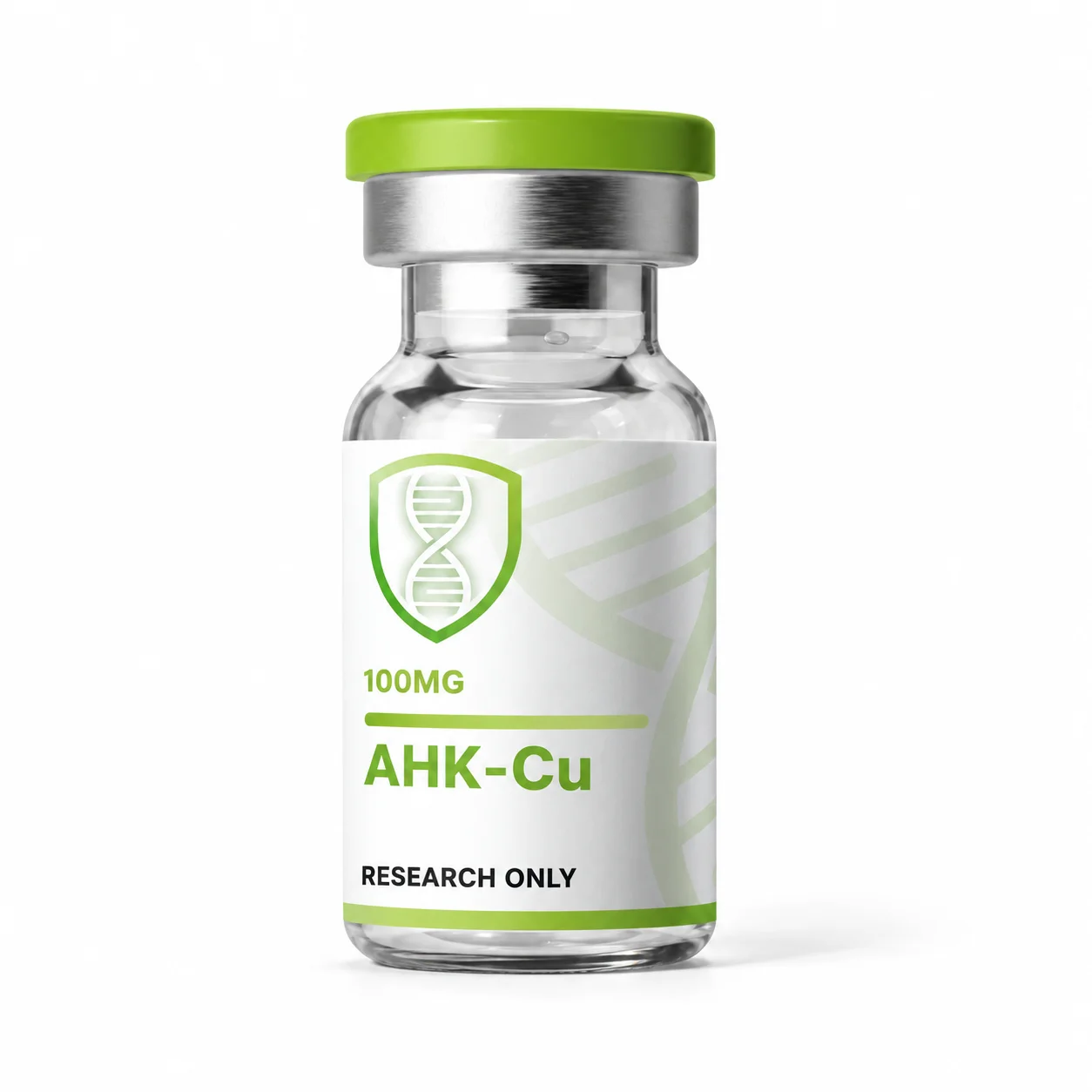
AHK-Cu 100mg For Sale
AHK-Cu 100mg from Orion Peptides is a research-grade copper-binding tripeptide designed for laboratory investigations into cellular signaling, peptide–metal interactions, and hair follicle biology. Also known as alanyl-histidyl-lysine copper, AHK-Cu is a three-amino-acid peptide complex studied for its interactions with human dermal papilla cells and experimental hair follicle models.
Research background: AHK-Cu research profile
AHK-Cu is structurally related to GHK-Cu but has a distinct amino acid sequence. This difference makes it particularly relevant to comparative studies examining copper-binding peptides and their biological characteristics.
Orion Peptides supplies AHK-Cu 100mg for research use, supported by independent testing and batch-specific analytical documentation.
For laboratory research use only. Not intended for human or animal consumption.
What Is AHK-Cu Peptide?
AHK-Cu is a copper tripeptide complex composed of alanine, histidine, and lysine coordinated with a copper(II) ion.
The peptide is represented by the amino acid sequence Ala-His-Lys (AHK). Its molecular structure enables researchers to investigate interactions between short peptide sequences, copper ions, and biological systems.
AHK-Cu has attracted scientific interest because of experimental observations involving cultured dermal papilla cells and isolated human hair follicles.
A 2007 study published in Archives of Pharmacal Research investigated the effects of AHK-Cu on human hair follicles maintained outside the body and dermal papilla cells grown in culture. The researchers observed increased follicle elongation and dermal papilla cell proliferation under specific experimental conditions.
These findings remain preliminary and do not establish effectiveness or safety in living humans.
AHK-Cu Molecular Structure and Chemical Properties
| Property | Description |
| Compound name | AHK-Cu |
| Full name | Alanyl-Histidyl-Lysine Copper |
| Peptide sequence | Ala-His-Lys |
| One-letter sequence | AHK |
| Classification | Copper-binding tripeptide |
| Amino acid residues | 3 |
| Metal ion | Copper(II), Cu²⁺ |
| Research quantity | 100mg |
| Primary research areas | Hair follicle biology, dermal papilla cells, peptide–copper interactions |
| Intended application | Laboratory research only |
The chemical properties of copper–peptide complexes can vary depending on coordination chemistry, formulation, and experimental conditions. Batch-specific analytical documentation should be used to verify compound identity.
AHK-Cu Research Applications
1. Hair Follicle Biology Research
AHK-Cu has been investigated in laboratory studies involving human hair follicles and dermal papilla cells.
Dermal papilla cells are specialized cells located near the base of hair follicles. They participate in biological signaling associated with follicle development and growth cycles.
In a 2007 experimental study, AHK-Cu exposure was associated with increased elongation of isolated human hair follicles maintained in organ culture.
The findings provide a foundation for further investigation into copper tripeptides and follicular cellular processes, but they do not demonstrate clinical hair-growth benefits.
2. Dermal Papilla Cell Proliferation
Research involving cultured human dermal papilla cells has explored how AHK-Cu influences cellular proliferation.
The 2007 study reported increased proliferation under particular experimental conditions, making AHK-Cu relevant to investigations of cell-cycle activity and follicular signaling.
Researchers may examine these observations through controlled cell-culture experiments and molecular analysis.
3. Apoptosis and Cell Survival Signaling
Apoptosis is a regulated cellular process involved in tissue maintenance and normal cell turnover.
Experimental AHK-Cu research has examined proteins associated with apoptosis, including Bcl-2, Bax, caspase-3, and PARP.
In cultured dermal papilla cells, researchers observed changes in several apoptosis-associated markers following AHK-Cu exposure.
Although a reduction in apoptotic cells was observed, that particular result was not statistically significant.
These findings support further laboratory investigation but do not establish a confirmed protective effect.
4. Copper–Peptide Interactions
Copper ions participate in several biological processes, including enzyme activity and redox chemistry.
Copper-binding peptides provide useful experimental models for examining how amino acid sequences influence metal coordination and molecular interactions.
AHK-Cu is structurally related to GHK-Cu 100mg, another copper-binding tripeptide studied in cellular and biochemical research.
Both compounds contain histidine and lysine, but AHK-Cu begins with alanine, whereas GHK-Cu begins with glycine.
This structural distinction provides a basis for comparative peptide chemistry research.
AHK-Cu vs GHK-Cu: Research Differences
AHK-Cu and GHK-Cu belong to the broader category of copper-binding tripeptides. However, they differ in molecular structure and published research history.
| Feature | AHK-Cu | GHK-Cu |
| Amino acid sequence | Ala-His-Lys | Gly-His-Lys |
| First amino acid | Alanine | Glycine |
| Copper binding | Yes | Yes |
| Published research | Limited, mainly hair follicle cell studies | Broader literature on cellular signaling and matrix biology |
| Clinical evidence | No established human clinical efficacy | Research remains application-dependent |
GHK-Cu has been examined across a wider range of experimental systems, including research involving connective tissue, cellular signaling, and extracellular matrix regulation.
Researchers interested in its molecular structure and coordination chemistry can explore Orion Peptides’ GHK-Cu technical research guide.
The published findings for GHK-Cu should not automatically be attributed to AHK-Cu.
Scientific Evidence and Research Limitations
AHK-Cu research remains primarily preclinical.
The principal directly relevant published investigation involves human hair follicle organ culture and dermal papilla cells rather than clinical trials in living participants.
Important limitations include:
- Limited independent replication of AHK-Cu-specific findings.
- Lack of established human clinical efficacy.
- Insufficient human safety and pharmacokinetic data.
- Uncertainty about how experimental findings translate to living biological systems.
- Limited direct comparisons between AHK-Cu and other copper peptides.
AHK-Cu therefore remains an investigational research compound rather than an established therapeutic treatment.
Why Choose Orion Peptides for AHK-Cu 100mg?
Orion Peptides supplies high-purity research compounds for laboratories investigating peptide structure, chemical properties, and biological processes.
- Research-grade AHK-Cu: Supplied for laboratory and analytical investigations.
- Third-party testing: Independent testing supports compound quality assessment.
- Certificate of Analysis: Batch-specific documentation enables researchers to review available analytical results.
- Research-focused supply: Intended for qualified research environments.
Researchers may also explore the broader collection of specialty research peptides available from Orion Peptides.
Frequently Asked Questions
What is AHK-Cu peptide?
AHK-Cu is a copper-binding tripeptide composed of alanine, histidine, and lysine. It is studied for its molecular properties and interactions with experimental cellular systems.
What is AHK-Cu studied for?
AHK-Cu has been investigated in laboratory models involving human hair follicles, dermal papilla cell proliferation, apoptosis-associated signaling, and copper–peptide interactions.
Is AHK-Cu the same as GHK-Cu?
No. AHK-Cu contains the amino acid sequence Ala-His-Lys, while GHK-Cu contains Gly-His-Lys. Their structures and available research evidence are different.
Does AHK-Cu promote hair growth?
One laboratory study reported increased elongation of isolated human hair follicles and proliferation of cultured dermal papilla cells. These findings do not establish hair-growth effectiveness in humans.
Is AHK-Cu approved for human use?
AHK-Cu is not FDA-approved as a drug for human therapeutic use. Orion Peptides supplies it strictly for laboratory research.
What is the difference between AHK-Cu 100mg and GHK-Cu 100mg?
Both are copper-binding tripeptides, but their amino acid sequences differ. The 100mg designation identifies the nominal compound quantity rather than equivalent biological activity.
Scientific References
- Pyo HK, et al. (2007). The effect of tripeptide-copper complex on human hair growth in vitro. Archives of Pharmacal Research, 30(7), 834–839.
PubMed — PMID: 17703734 - Pickart L, Margolina A. (2018). Regenerative and Protective Actions of the GHK-Cu Peptide in the Light of the New Gene Data. International Journal of Molecular Sciences, 19(7), 1987.
PubMed — PMID: 29986520
Background reference concerning GHK-Cu, not direct evidence for AHK-Cu. - Pickart L, et al. (2015). GHK Peptide as a Natural Modulator of Multiple Cellular Pathways in Skin Regeneration. BioMed Research International.
PubMed Central — PMCID: PMC4508379
Background reference concerning the related GHK peptide.
Research Use Only
AHK-Cu 100mg from Orion Peptides is supplied exclusively for laboratory and analytical research. It is not intended for human or veterinary consumption, injection, therapeutic treatment, diagnostic procedures, or cosmetic application.