

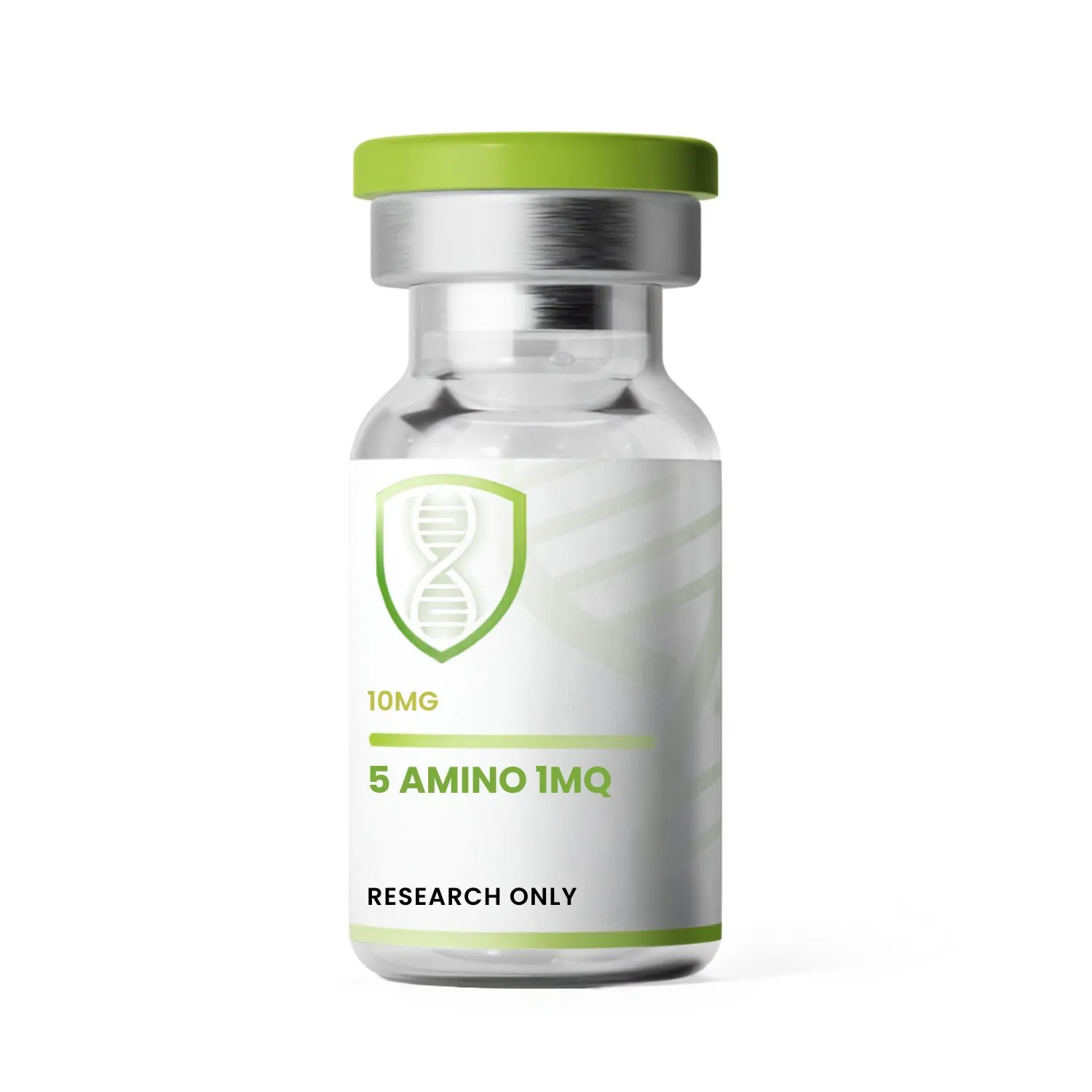
No, 5-Amino-1MQ is not a peptide. It is a small organic compound known as 5-amino-1-methylquinolinium, studied as an inhibitor of the enzyme nicotinamide N-methyltransferase, or NNMT. Its chemical structure does not contain the linked amino acid residues that define a peptide. CID 950107 – PubChem
The confusion is understandable. You may find 5-Amino-1MQ in a catalog that also contains research peptides. Its name also includes “amino,” which can sound like a reference to an amino acid chain.
However, a compound’s name, research purpose, and catalog placement describe different things. To understand its classification, we need to look at how its atoms are connected.
What Makes a Compound a Peptide?
A peptide contains two or more amino acid residues joined through peptide bonds. These bonds connect the carbonyl carbon of one residue to the nitrogen of another.
The IUPAC definition of peptides describes this chemical relationship. The defining feature is the connection between amino acid building blocks. peptides (P04479)
For example, a simple peptide could contain:
Alanine → Glycine → Serine
The order of these residues forms its amino acid sequence. Changing that order can change the resulting molecule.
This is why peptide research often involves questions such as:
- Which amino acids are present?
- In what order are they connected?
- Are the ends or individual residues modified?
- Does the tested material match the intended sequence?
For a beginner-friendly explanation, read Orion Peptides’ guide to how scientists identify peptide sequences.
What Is 5-Amino-1MQ Chemically?
5-Amino-1MQ belongs to the quinolinium family of compounds. Its structure contains a fused ring system, with an amino group and a methyl group attached at specific positions.
The PubChem record for 5-amino-1-methylquinolinium identifies the positively charged molecular ion as C₁₀H₁₁N₂⁺, with a molecular weight of 159.21 g/mol. CID 950107 – PubChem
Its name describes parts of this structure:
| Part of the name | What it means |
|---|---|
| 5-amino | An amino group is attached at position 5 |
| 1-methyl | A methyl group is attached to the ring nitrogen at position 1 |
| Quinolinium | The compound has a positively charged, nitrogen-containing fused ring system |
The “5” identifies a location. It does not mean the compound contains five amino acids.
This structure has no peptide backbone or amino acid sequence. That is the chemical reason 5-Amino-1MQ is classified as a non-peptide compound.
Does “Amino” Mean a Compound Is a Peptide?
No. An amino group, an amino acid, and a peptide are different chemical concepts.
An amino group is a group of atoms containing nitrogen. An amino acid contains both an amino group and a carboxylic acid group. A peptide contains amino acid residues connected through peptide bonds.
Having an amino group alone does not satisfy those other definitions.
A useful comparison is a building component and a finished structure: the presence of one component does not establish how the entire structure is assembled.
When classifying a research compound, the question is therefore: Does its structure contain amino acid residues joined by peptide bonds?
For 5-Amino-1MQ, the answer is no.
5-Amino-1MQ vs Peptides: The Main Differences
| Feature | 5-Amino-1MQ | Peptides |
|---|---|---|
| Chemical structure | Substituted quinolinium ring system | Linked amino acid residues |
| Peptide backbone | Absent | Present |
| Amino acid sequence | None | Describes the order of residues |
| Useful structural description | Chemical name, formula, and structure | Sequence, bonds, and modifications |
| Research classification | Studied as a small-molecule NNMT inhibitor | Research roles depend on the individual peptide |
Molecular size alone is not a reliable way to distinguish these categories. Very short peptides can also be small molecules.
The stronger distinction is chemical architecture: which building blocks are present and how they are connected.
What Does “NNMT Inhibitor” Mean?
NNMT stands for nicotinamide N-methyltransferase. It is an enzyme involved in methylation reactions, including the methylation of nicotinamide.
An inhibitor is a compound that reduces an enzyme’s activity under particular experimental conditions.
A 2017 study in the Journal of Medicinal Chemistry investigated small-molecule NNMT inhibitors and identified quinolinium structures as a promising chemical framework. Researchers examined how structural changes affected inhibition and interactions with the enzyme’s substrate-binding site. PubMed
This helps separate two questions:
- Chemical classification: What is the compound made of?
- Biological activity: What does it interact with in an experiment?
“Quinolinium compound” describes structure. “NNMT inhibitor” describes an experimentally studied activity.
An enzyme inhibitor does not have to be a peptide. Different types of molecules can interact with enzymes, and the target alone does not determine their chemical classification.
Likewise, identifying enzyme inhibition does not establish a clinical benefit or demonstrate that a compound is suitable for human use.
Why Does 5-Amino-1MQ Appear on Peptide Websites?
A research supplier may organize several types of compounds within the same catalog. Website navigation can therefore be broader than a strict chemical classification system.
For example, Orion’s 5-Amino-1MQ research compound page appears within its peptide-oriented catalog, while the compound description explicitly identifies the compound as a synthetic small molecule and states that it is not a peptide. orionpeptide.com
This distinction matters when reading compound listings.
A category label helps visitors browse a website. The compound’s structure and identity documentation establish what the material is.
If you encounter the phrase “5-Amino-1MQ peptide,” treat it as a reason to check the underlying description, rather than as a reliable chemical name.
Why Can Different Molecular Weights Appear for 5-Amino-1MQ?
One possible reason is that a source describes the positively charged molecular ion, while another describes a complete salt.
A counterion is an oppositely charged ion that balances the compound’s charge. Including it changes the formula and molecular weight of the material being described.
For example:
| Chemical entry | Formula | Molecular weight |
|---|---|---|
| 5-Amino-1-methylquinolinium ion | C₁₀H₁₁N₂⁺ | 159.21 g/mol |
| 5-Amino-1-methylquinolinium chloride | C₁₀H₁₁ClN₂ | 194.66 g/mol |
PubChem lists the parent ion and the chloride salt as separate chemical records. CID 950107 – PubChem
These values are not interchangeable. For laboratory documentation, the relevant formula must match the actual material supplied, including any counterion or other specified components.
A salt form also does not turn the compound into a peptide. Adding a counterion does not create an amino acid sequence.
What Should Researchers Check in a Compound Listing?
An accurate classification is a useful starting point. Researchers should also look for enough information to identify the specific material being supplied.
Useful questions include:
- What is the full chemical name?
An abbreviated compound name may leave out the salt form. - Does the formula match that name?
A parent-ion formula and a salt formula describe different entries. - Which material does the molecular weight represent?
The listed value should agree with the stated form. - Is batch-specific documentation available?
Check that the certificate of analysis refers to the relevant lot. - What does each reported test establish?
Identity and purity are separate questions. A purity percentage alone does not describe the complete chemical identity.
For Orion’s listing, consult the 5-Amino-1MQ compound information and analysis section and verify the supplied form against the corresponding batch documentation.
Frequently Asked Questions
Is 5-Amino-1MQ an amino acid?
No. The word “amino” refers to a functional group on its ring structure. It does not mean the compound is an amino acid.
Does 5-Amino-1MQ contain five amino acids?
No. The number 5 identifies the position of the amino group in the chemical name. It does not describe a chain length.
Does 5-Amino-1MQ have a peptide sequence?
No. There is no amino acid sequence to write out because it is not assembled from peptide-linked amino acid residues.
Are all small molecules non-peptides?
No. Some short peptides are small molecules too. Size is less informative than the actual bonding pattern when determining whether a compound is a peptide.
Does NNMT inhibition make a compound a peptide?
No. NNMT inhibition describes an experimental activity. Peptide classification depends on chemical structure.
Does a chloride or another salt form change its classification?
It changes the complete chemical formula and molecular weight, but it does not create a peptide backbone.
This article explains chemical classification and laboratory research terminology. It does not provide instructions for human use.
