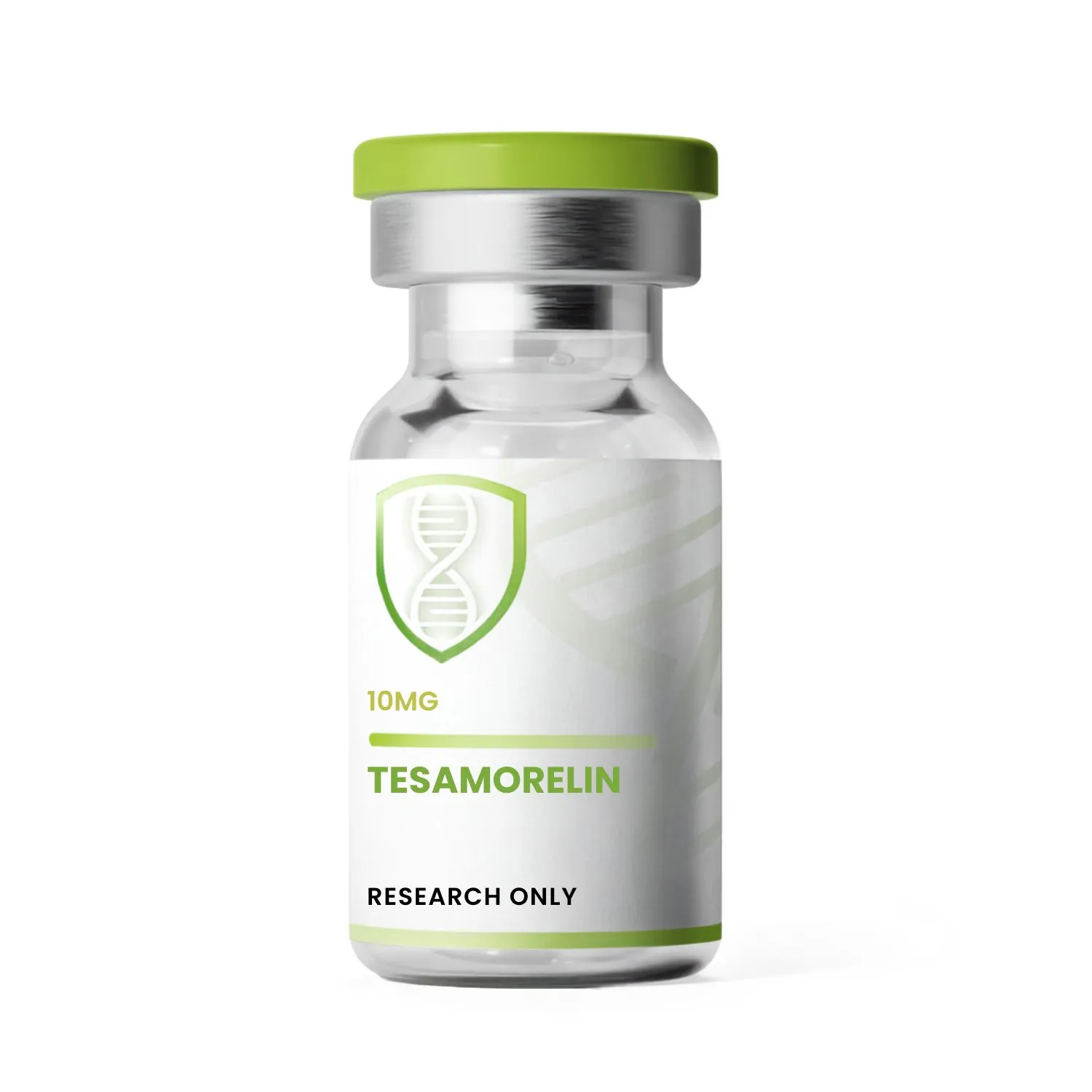
Tesamorelin 10 mg For Sale
Tesamorelin 10 mg is a synthetic GHRH analog used in laboratory research involving growth hormone signaling, the somatotropic axis, and related metabolic pathways. Our Tesamorelin 10 mg is available for $90 and is supplied as a lyophilized research peptide.
Research background: Tesamorelin research profile · AOD-9604 vs Tesamorelin
This compound is intended strictly for in vitro and in vivo research use. It is not intended for human consumption, self-administration, or therapeutic use.
Detailed Overview of Tesamorelin
Tesamorelin 10 mg is a stabilized synthetic peptide and an analog of growth hormone–releasing hormone (GHRH 1–44). It incorporates an N-terminal trans-3-hexenoic acid modification, a structural modification associated with improved peptide stability and reduced susceptibility to enzymatic degradation.
Tesamorelin consists of 44 amino acids and interacts with GHRH receptors expressed on pituitary somatotroph cells. Receptor binding stimulates endogenous growth hormone synthesis and supports the study of pulsatile GH secretion in experimental research models.
Within laboratory research, tesamorelin is investigated in studies of the somatotropic axis, including endocrine signaling, metabolic regulation, adipose tissue distribution, and interactions within the GH–IGF-1 pathway.
Tesamorelin 10mg is intended strictly for in vitro and in vivo research and is not approved for human consumption or therapeutic use.
Tesamorelin Mechanism of Action in Research Models
In preclinical studies, tesamorelin acts as a selective GHRH receptor agonist. It binds to growth hormone–releasing hormone receptors on pituitary cells, activating Gs-protein signaling pathways.
Activation increases intracellular cyclic AMP levels and protein kinase A activity, promoting transcription of growth hormone genes. The result is enhanced pulsatile GH release.
Growth hormone stimulates hepatic IGF-1 production. IGF-1 promotes lipolysis, limits adipocyte differentiation, and favors fat mobilization, especially in visceral tissue.
The trans-3-hexenoic acid modification improves resistance to DPP-IV cleavage, extending peptide stability and supporting a more favorable pharmacokinetic profile than native GHRH.
Tesamorelin Peptide Sequence
Tesamorelin is a linear peptide with 44 amino acids and includes an N-terminal trans-3-hexenoyl modification.
Peptide sequence:
trans-3-hexenoyl-Tyr-Ala-Asp-Ala-Ile-Phe-Thr-Asn-Ser-Tyr-Arg-Lys-Val-Leu-Gly-Gln-Leu-Ser-Ala-Arg-Lys-Leu-Leu-Gln-Asp-Ile-Met-Ser-Arg-Gln-Gln-Gly-Glu-Ser-Asn-Gln-Glu-Arg-Gly-Ala-Arg-Ala-Arg-Leu-NH₂
Chemical details include:
- Molecular formula: C₂₂₁H₃₆₆N₇₂O₆₇S
- Molecular weight: ~5135.78–5136 Da
- Key modification: N-terminal trans-3-hexenoyl group
- CAS number: 218949-78-1
This structure preserves full GHRH bioactivity and extends the half-life in experimental systems.
Tesamorelin Research
Tesamorelin 10mg has been widely studied in metabolic research. Early work focused on HIV-associated lipodystrophy, visceral adiposity, and endocrine dysfunction.
Randomized, placebo-controlled clinical trials have reported significant reductions in visceral adipose tissue (VAT) following 26 weeks of tesamorelin treatment. Across major Phase 3 studies, VAT reductions were approximately 14–18%, while placebo groups generally showed small increases in visceral fat. In one large randomized trial, VAT decreased by 15.2% with tesamorelin compared with a 5.0% increase with placebo.
A 2014 randomized clinical trial of 50 people with HIV-associated abdominal fat accumulation found that tesamorelin reduced hepatic fat over 6 months. Median liver fat decreased by 2.0 percentage points with tesamorelin versus a 0.9 percentage-point increase with placebo, giving a between-group treatment effect of −2.9 percentage points.
A larger 12-month randomized, double-blind trial specifically studying HIV-associated NAFLD found a 37% relative reduction in hepatic fat fraction with tesamorelin compared with baseline. Tesamorelin also increased the proportion of participants whose hepatic fat fraction fell below 5%.
Additional studies explore NAFLD and obesity-related insulin resistance. Tesamorelin increases IGF-1 levels dose-dependently, while pulsatile GH patterns remain intact, differing from continuous GH infusion models.
Safety data indicate mostly mild injection-site reactions. Transient IGF-1 elevations require monitoring. No clear liver injury appeared in trials. Ongoing research examines long-term endocrine effects and receptor kinetics.
Different Variations of Tesamorelin You Can Buy at Orion Peptides
- Tesamorelin 5mg
- Tesamorelin 10mg
How to Store and Handle Tesamorelin
Tesamorelin 10 is supplied as a lyophilized powder. Store unopened vials at 2–8°C, protected from light and moisture. Do not freeze the powder.
Reconstitute using bacteriostatic water or sterile diluent under aseptic conditions, and refrigerate reconstituted solutions. Use solutions within established stability periods and follow protocol-specific guidelines. Always use sterile tools and proper protective equipment.
Disclaimer
Tesamorelin is an investigational research peptide intended only for laboratory and animal research. It is not approved for general human use.
Regulatory approval exists only for specific prescription compounds. Research-grade tesamorelin is not approved for therapy or supplementation and falls under research chemical classifications, including WADA S0.
Preclinical findings do not predict outcomes outside studied settings. No claims are made regarding safety or effectiveness in humans. Handle only in qualified research facilities with institutional oversight. Compounds are sold strictly for laboratory use only.
Referenced Citations