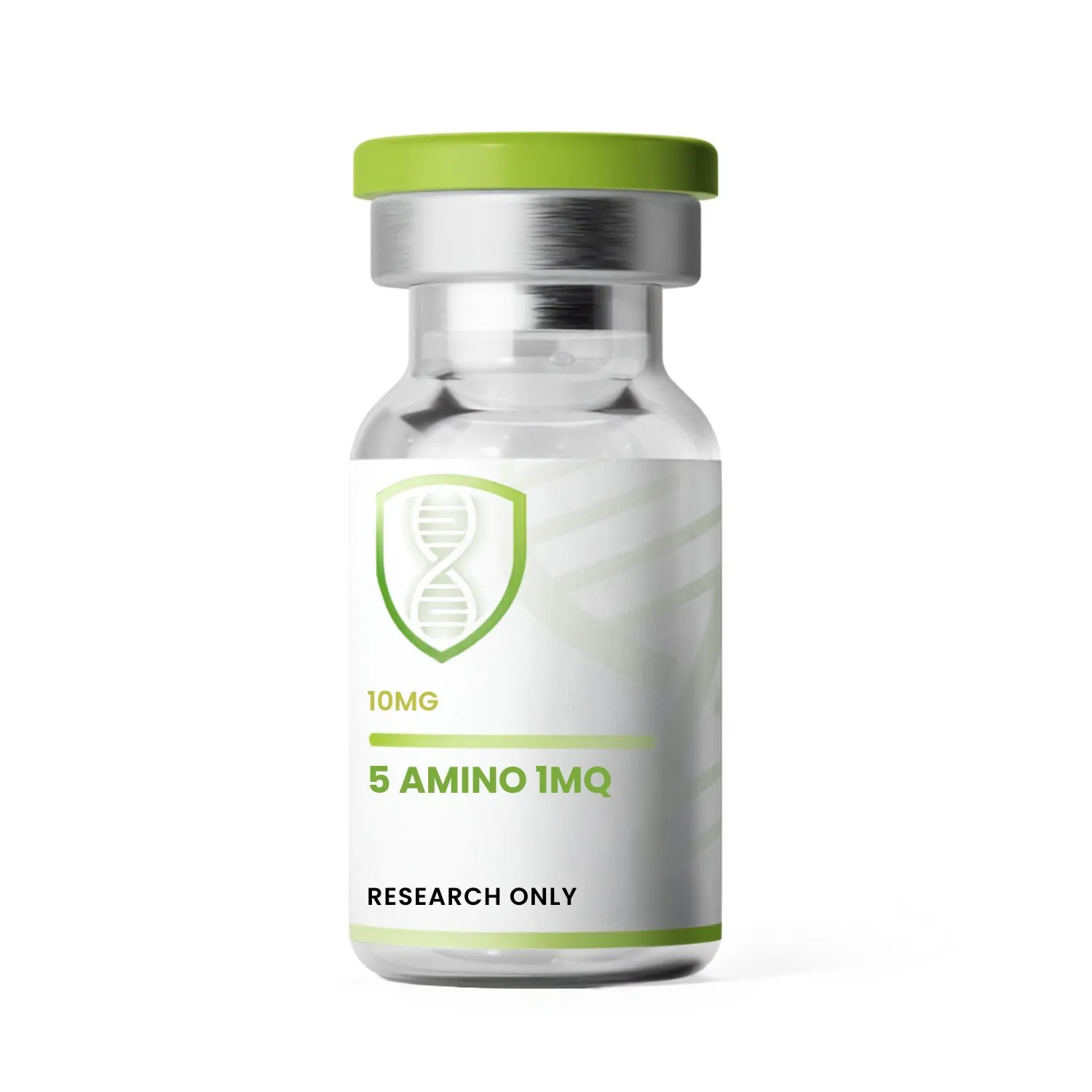
Buy 5-Amino-1MQ 10mg | NNMT Inhibitor Research Compound
5-Amino-1MQ 10mg is a synthetic small-molecule research compound studied for its ability to inhibit
nicotinamide N-methyltransferase (NNMT), an enzyme involved in nicotinamide metabolism and cellular methylation reactions.
Unlike conventional research peptides, 5-Amino-1MQ is a quinolinium-based organic compound. It does not contain an amino acid sequence or peptide bonds.
At
Orion Peptides, 5-Amino-1MQ 10mg is supplied as a research material for laboratory investigation, with batch-specific analytical documentation available for verification.
The reported results for batch
2026095A1MQ10 include:
- HPLC purity: 99.21%
- Measured quantity: 10.10mg
- Identity: Reported as passing the specified HPLC-DAD test
- Analysis date: September 1, 2026
- COA: Available for batch verification
These results apply to the identified batch and should not be assumed to represent every production lot.
Research Use Only (RUO). Not intended for human or veterinary consumption.
What Is 5-Amino-1MQ?
5-Amino-1MQ is the abbreviated name for
5-amino-1-methylquinolinium, a positively charged organic molecule studied as an inhibitor of NNMT.
NNMT is an enzyme that transfers a methyl group from S-adenosyl-L-methionine (SAM) to nicotinamide.
This reaction produces 1-methylnicotinamide (1-MNA) and S-adenosyl-L-homocysteine (SAH).
Researchers investigate NNMT because it participates in biochemical pathways involving nicotinamide processing and methyl-group metabolism.
5-Amino-1MQ has been studied in enzyme assays, cultured cells, and animal models as a tool for investigating NNMT-dependent reactions.
The compound is investigational and is not an approved medication or dietary supplement.
Is 5-Amino-1MQ a Peptide?
No. Although the term
5 amino 1mq peptide appears in online searches and commercial catalogs, 5-Amino-1MQ is chemically classified as a small-molecule quinolinium compound.
A peptide contains amino acid residues linked through peptide bonds.
5-Amino-1MQ instead contains a nitrogen-containing fused ring structure with an amino group and a methyl substituent.
Its name does not describe an amino acid sequence.
For a detailed explanation, read
Is 5-Amino-1MQ a Peptide? Chemical Classification Explained.
5-Amino-1MQ Chemical Properties and Molecular Structure
5-Amino-1MQ contains a quinolinium ring system. Its chemical structure includes an amino substituent at position 5 and a methyl group attached to the ring nitrogen at position 1.
The compound exists as a positively charged molecular ion, meaning isolated preparations require charge-balancing counterions.
This is why chemical references may list different molecular formulas and molecular weights for the same parent cation and its corresponding salts.
Chemical Specifications
| Property |
Details |
| Compound name |
5-Amino-1MQ 10mg |
| Chemical name |
5-Amino-1-methylquinolinium |
| Alternative designation |
5A1MQ |
| Compound class |
Quinolinium small molecule |
| Research target |
Nicotinamide N-methyltransferase |
| Parent cation formula |
C₁₀H₁₁N₂⁺ |
| Parent cation molecular weight |
159.21 g/mol |
| Parent cation PubChem CID |
950107 |
| Iodide salt formula |
C₁₀H₁₁IN₂ |
| Iodide salt molecular weight |
286.11 g/mol |
| Iodide salt CAS number |
42464-96-0 |
| Iodide salt PubChem CID |
66522933 |
| Chloride salt formula |
C₁₀H₁₁ClN₂ |
| Chloride salt molecular weight |
194.66 g/mol |
| Declared compound quantity |
10mg |
| Supplied chemical form |
Confirm using the applicable batch documentation |
| Intended use |
Laboratory research only |
Important: The cation, iodide salt, and chloride salt are chemically distinct descriptions and should not be assigned the same molecular formula or molecular weight.
The salt form of Orion’s supplied material must be confirmed using the manufacturer’s specifications and appropriate analytical documentation.
Scientific references:
How Does 5-Amino-1MQ Inhibit NNMT?
Nicotinamide N-methyltransferase is an enzyme involved in the methylation of nicotinamide.
Under normal reaction conditions, NNMT uses SAM as a methyl donor to convert nicotinamide into 1-MNA.
The reaction also produces SAH.
Nicotinamide + SAM → 1-MNA + SAH
5-Amino-1MQ has been investigated as an inhibitor of this reaction.
Published biochemical research indicates that the compound can inhibit NNMT under defined experimental conditions.
A study by Kraus and colleagues reported an NNMT inhibitory concentration (IC₅₀) of approximately
1.2 µM in the specified biochemical assay.
The researchers also examined the compound in cultured adipocytes, observing changes in intracellular 1-MNA levels.
These findings support the use of 5-Amino-1MQ as an experimental tool for examining NNMT activity.
However, an IC₅₀ value obtained in an enzyme assay cannot be directly translated into a human administration amount or clinical outcome.
Reference:
Kraus et al. — Selective and Membrane-Permeable Small-Molecule Inhibitors of NNMT.
Why Is NNMT Important in Laboratory Research?
NNMT participates in several interconnected biochemical pathways.
Researchers study this enzyme to better understand nicotinamide metabolism, methyl-group utilization, and metabolic signaling.
Nicotinamide Metabolism
Nicotinamide is a form of vitamin B3 involved in pathways associated with nicotinamide adenine dinucleotide (NAD⁺).
NNMT methylates nicotinamide to form 1-MNA.
Other cellular pathways can recycle nicotinamide into NAD⁺ biosynthesis.
Researchers examine how changes in NNMT activity may influence the distribution of nicotinamide among these biochemical pathways.
However, NNMT inhibition does not automatically increase NAD⁺ concentrations in every experimental system.
Methyl Donor Metabolism
SAM serves as a methyl donor in numerous biochemical reactions.
NNMT uses SAM during the conversion of nicotinamide to 1-MNA.
This makes the enzyme relevant to investigations of methyl donor utilization and related metabolic compounds.
Researchers use NNMT inhibitors to examine how enzyme activity affects these reactions under controlled laboratory conditions.
Cellular Metabolic Research
NNMT expression varies among tissues and experimental models.
Researchers have investigated the enzyme in adipose tissue, liver-related metabolic systems, and cultured cell models.
5-Amino-1MQ can be used as an experimental inhibitor in such investigations.
Observed results depend on the biological model, experimental design, and analytical methods.
What Have Scientific Studies Found About 5-Amino-1MQ?
Published evidence on 5-Amino-1MQ comes mainly from biochemical assays, cell-based investigations, and preclinical animal research.
1. NNMT Inhibition in Biochemical and Cellular Models
Kraus and colleagues investigated selective, membrane-permeable small-molecule inhibitors of NNMT.
Their research reported inhibition of NNMT by 5-Amino-1MQ and examined its activity in cellular models.
The researchers measured changes in NNMT-associated metabolites, including 1-MNA.
These experiments established useful findings about the compound’s inhibitory activity under controlled conditions.
2. Metabolic Research in Mouse Models
A 2024 study by Babula and colleagues examined NNMT inhibition in diet-induced obese mice.
The investigators evaluated experimental measurements involving body composition, glucose-related responses, and liver tissue characteristics.
Reported changes in these animal models contributed to research on NNMT-associated metabolic pathways.
However, animal findings should not be interpreted as evidence that 5-Amino-1MQ is safe or effective for weight management in people.
3. Research Involving Cancer Cell Models
Other investigations have examined NNMT inhibition in cultured cancer cell lines.
These studies investigate relationships between NNMT activity, methylation-related processes, and cellular proliferation.
Results from cell-line experiments provide information about molecular pathways but do not establish clinical anticancer effectiveness.
Overall, the available literature supports further biochemical investigation while leaving important questions about clinical safety and effectiveness unanswered.
5-Amino-1MQ vs. NAD⁺: Understanding the Chemical Difference
5-Amino-1MQ and
NAD⁺ are often discussed in related metabolic research contexts, but they are different molecules.
| Feature |
5-Amino-1MQ |
NAD⁺ |
| Compound class |
Quinolinium small molecule |
Dinucleotide coenzyme |
| Primary research context |
NNMT enzyme inhibition |
Cellular redox and enzyme-associated reactions |
| Chemical relationship |
Studied as an inhibitor of a nicotinamide-methylating enzyme |
Participates in nicotinamide-related metabolic pathways |
| Chemical identity |
Synthetic research compound |
Naturally occurring coenzyme |
The relationship between NNMT activity and NAD⁺ metabolism is complex.
Changes in one pathway do not guarantee corresponding changes in another.
Researchers must evaluate these processes using measurements appropriate to their experimental models.
Orion Peptides 5-Amino-1MQ 10mg: Quality and Batch Testing
When evaluating
5-Amino-1MQ for sale as a laboratory research compound, chemical identity and analytical documentation are important considerations.
Orion Peptides provides access to available testing information for its 5-Amino-1MQ 10mg compound.
Current Listed Batch Results
The following results are reported for batch
2026095A1MQ10.
| Analytical Property |
Reported Result |
| Batch number |
2026095A1MQ10 |
| Analysis date |
September 1, 2026 |
| Report date |
September 2, 2026 |
| Identity |
Pass, using the reported HPLC-DAD method |
| HPLC purity |
99.21% |
| Measured quantity |
10.10mg |
| Endotoxin result |
0.072 EU/mL |
| Sterility screening |
No growth under the reported method |
These are the results displayed for the identified batch.
They should not be represented as universal measurements for every batch or as confirmation that every possible impurity was evaluated.
The reported identity test should also not be treated as proof of the exact counterion unless the laboratory documentation establishes that characteristic.
High-Performance Liquid Chromatography (HPLC)
HPLC is used to separate chemical components and assess chromatographic characteristics.
For 5-Amino-1MQ, an appropriately selected HPLC method may provide information about purity and relevant impurities.
The listed 99.21% HPLC purity result describes the reported chromatographic measurement for the identified batch.
HPLC purity is not necessarily equivalent to the percentage of total vial mass contributed by the active molecular cation.
Chemical Identity Verification
Suitable analytical techniques can help establish whether a sample is consistent with the expected chemical structure.
For 5-Amino-1MQ, identity assessment should distinguish between the parent quinolinium ion and any associated salt form.
The parent cation has an average molecular weight of approximately
159.21 g/mol.
The iodide salt has a molecular weight of approximately
286.11 g/mol, while the chloride salt has a molecular weight of approximately
194.66 g/mol.
These values describe different chemical forms.
Researchers should confirm which form the supplied material contains rather than assume the identity from the abbreviated compound name alone.
Certificate of Analysis
Batch-specific Certificates of Analysis help researchers assess the documented characteristics of the supplied material.
Researchers should examine the relevant report for:
- Lot identification
- Test methods
- Chemical identity
- HPLC purity
- Reported compound quantity
- Testing date
- Any additional documented quality measurements
An analytical report must correspond to the actual batch being evaluated.
Orion Peptides provides access to available
Certificate of Analysis verification resources for research-material documentation.
Reported endotoxin or microbial-screening results do not establish suitability for human or veterinary administration.
Storage and Laboratory Handling
5-Amino-1MQ is a small-molecule research compound.
Storage and handling requirements should be based on the exact chemical form and documented stability characteristics of the supplied material.
General laboratory precautions include:
- Keep the material in a clearly labeled, properly sealed container.
- Protect it from unnecessary exposure to light and moisture.
- Follow the manufacturer’s validated storage-temperature recommendations.
- Use appropriate laboratory protective equipment.
- Follow institutional chemical handling and disposal procedures.
The stability of prepared solutions depends on the solvent, concentration, chemical form, temperature, and other experimental conditions.
A universal post-dissolution shelf life should not be assumed without appropriate stability data.
Frequently Asked Questions About 5-Amino-1MQ
What is 5-Amino-1MQ?
5-Amino-1MQ is a synthetic quinolinium-based small molecule studied as an inhibitor of nicotinamide N-methyltransferase, an enzyme involved in nicotinamide methylation.
Is 5-Amino-1MQ a peptide?
No. 5-Amino-1MQ does not contain an amino acid chain or peptide bonds. It is chemically classified as a small-molecule compound.
Read our detailed guide:
Is 5-Amino-1MQ a Peptide?.
What does NNMT stand for?
NNMT stands for nicotinamide N-methyltransferase, an enzyme involved in the conversion of nicotinamide into 1-methylnicotinamide.
What is the molecular weight of 5-Amino-1MQ?
The parent 5-amino-1-methylquinolinium cation has a molecular weight of approximately 159.21 g/mol.
The iodide salt has a molecular weight of approximately 286.11 g/mol, while the chloride salt has a molecular weight of approximately 194.66 g/mol.
The correct value depends on the chemical form.
What is the molecular formula of 5-Amino-1MQ?
The molecular formula of the parent cation is C₁₀H₁₁N₂⁺.
The iodide salt is represented by C₁₀H₁₁IN₂, while the chloride salt is represented by C₁₀H₁₁ClN₂.
Does 5-Amino-1MQ inhibit NNMT?
Published biochemical research has demonstrated NNMT inhibition by 5-Amino-1MQ under defined experimental conditions.
The degree of inhibition depends on the experimental system and assay conditions.
Is 5-Amino-1MQ the same as NAD⁺?
No. 5-Amino-1MQ is a synthetic quinolinium compound, while NAD⁺ is a naturally occurring dinucleotide coenzyme.
They have different chemical structures and roles in biochemical research.
What does 5-Amino-1MQ 10mg mean?
The 10mg designation describes the nominal quantity of research material associated with the compound.
It does not independently establish the net mass of the active cation or the exact salt composition.
Those details should be verified using the relevant specifications and analytical documentation.
How can researchers verify 5-Amino-1MQ purity?
Researchers should review the batch-specific Certificate of Analysis, including chromatographic purity, identity testing, quantity measurements, and the methods used.
Is 5-Amino-1MQ approved for human use?
5-Amino-1MQ is an investigational compound and is not an FDA-approved medication.
Orion Peptides supplies the material for laboratory research only.
Can 5-Amino-1MQ be used for weight loss?
No approved weight-loss indication has been established for 5-Amino-1MQ.
Findings from cellular and animal studies do not demonstrate that the compound is safe or effective for weight management in humans.
Where can researchers find 5-Amino-1MQ 10mg?
Researchers can review the current 5-Amino-1MQ 10mg listing at Orion Peptides for compound specifications and available analytical documentation.
The actual batch and supplied chemical form should be confirmed before laboratory investigation.
Scientific References
- Kraus D, et al. (2018). Selective and Membrane-Permeable Small Molecule Inhibitors of Nicotinamide N-Methyltransferase Reverse High-Fat Diet-Induced Obesity in Mice. Biochemical Pharmacology, 147, 141–152. DOI: 10.1016/j.bcp.2017.11.007.
- Babula JJ, et al. (2024). Nicotinamide N-Methyltransferase Inhibition Mitigates Obesity-Related Metabolic Dysfunction. Preclinical research involving NNMT inhibition.
- National Center for Biotechnology Information. PubChem: 5-Amino-1-methylquinolinium. Parent ion molecular formula and chemical identifiers.
- National Center for Biotechnology Information. PubChem: 5-Amino-1-methylquinolinium Iodide. Salt molecular formula, molecular weight, and CAS information.
- National Center for Biotechnology Information. PubChem: 5-Amino-1-methylquinolinium Chloride. Chloride salt chemical structure and molecular properties.
Research Use Only (RUO) Disclaimer
5-Amino-1MQ 10mg supplied by Orion Peptides is intended strictly for laboratory research, chemical analysis, and scientific investigation.
This material is not intended for human or veterinary consumption, clinical administration, diagnosis, treatment, cure, or prevention of any disease.
The information provided on this page is for scientific and educational purposes only. Findings from biochemical assays, cultured cells, or animal studies do not establish safety or effectiveness in humans.
Researchers must verify the identity, chemical form, and batch-specific specifications of the supplied material and comply with applicable laboratory safety procedures and regulations.